
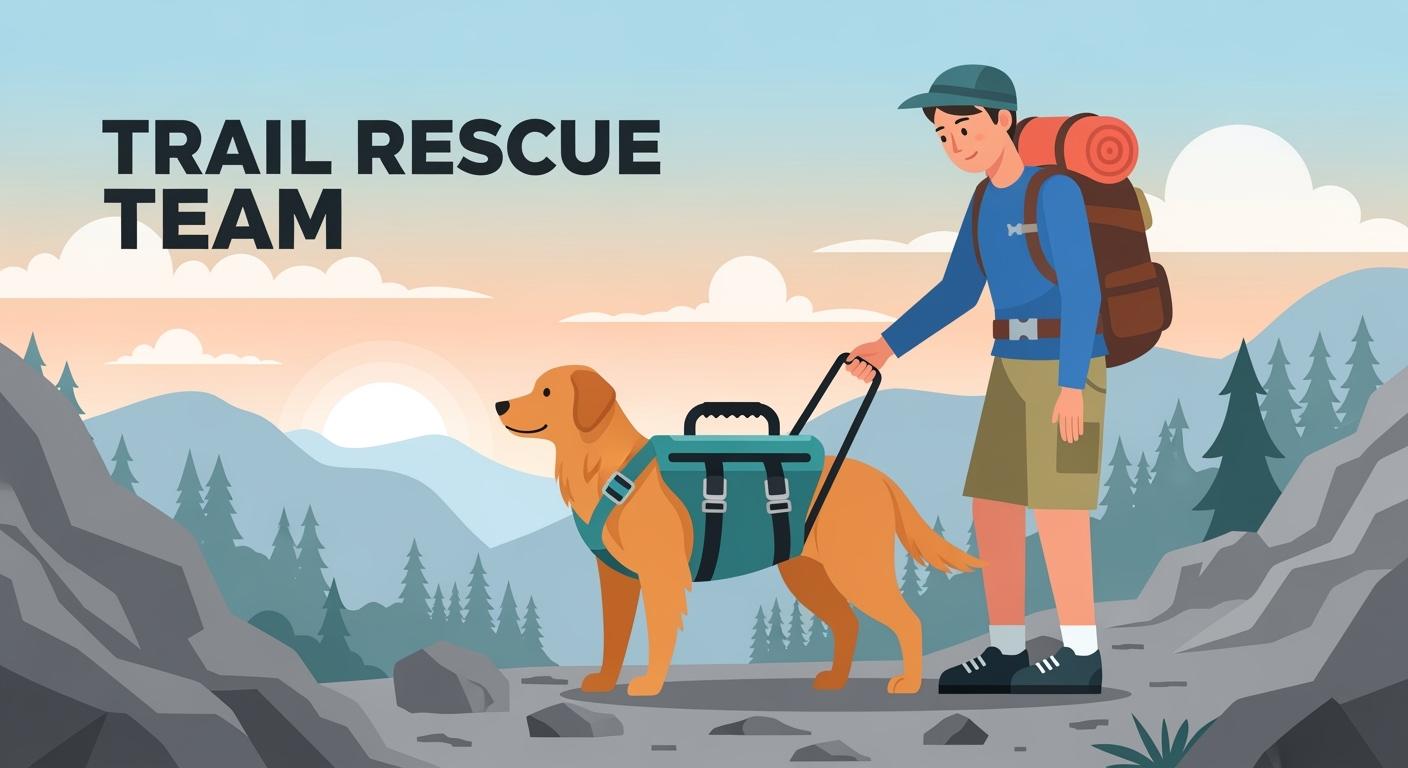
A dog collapses at mile four. Heat exhaustion, a torn pad, a joint that finally gave out — the cause does not change what happens next. You are three miles from the trailhead. Your dog cannot walk. The harness you packed, or did not pack, determines whether the carry-out works or makes things worse.
Most hikers picture a controlled carry: one arm under the chest, one under the belly, moving steadily toward the trailhead. Dogs do not hold still on uneven terrain. Their weight shifts. Your grip fails. You grab a top handle and the body twists. A walking harness was never built for this. Narrow straps press into the chest. A single handle pulls at an angle that makes breathing harder. The dog’s weight hangs from one point instead of spreading across the body.
A carrying harness built for the purpose does something different. It cradles instead of hangs.
Why Regular Harnesses Make Emergency Carrying Worse
The Single-Point Problem
A walking harness routes force through the chest and shoulders to steer, not to support dead weight during a carry. Grab the top handle on a standard harness and the dog’s body rotates. The chest strap rides up toward the throat. The belly section sags. What was snug on level ground becomes a suspension point pulling against the wrong anatomy.
The handle itself is part of the failure. Most walking harness handles are narrow webbing loops sewn flat into the back panel, built for a quick two-second grab, not for bearing 40, 60, or 80 pounds across a mile of trail. Under sustained load, that narrow strap concentrates pressure into a strip maybe half an inch wide. On the dog’s side, the corresponding chest or belly strap does the same thing, pushing into soft tissue with the full weight behind it.
Dogs that slip out of a harness on a hiking trail often do so because the fit was checked standing still, not under the forces of a carry.
Handler Mechanics Break Down Too
The person carrying matters as much as the harness. A dog suspended from one hand pulls the carrier off center. Shoulders hunch. The spine tilts. On rocky or sloped trail, the imbalance compounds with every step. The carrier compensates by hugging the dog tighter, which pushes the dog’s legs against the carrier’s body, restricting what little ability the dog still has to shift its own position.
A harness that positions the dog closer to the carrier’s center of mass, spreading the load across both the dog’s torso and the carrier’s grip points, changes the mechanics of every step. The dog stays level. The carrier stays upright. Both move more predictably.
| Walking Harness Weak Point | Performance Difference Under Load | Why It Matters for Carry-Out |
|---|---|---|
| Chest strap | Rides up toward throat when lifted | Restricts breathing during a carry that may last 20 minutes or more |
| Belly band | Sags, letting the dog’s rear drop | Spine flexes into an unsupported curve under body weight |
| Back handle | Pulls at a single seam point | Concentrates the dog’s full weight on a stitch line not rated for lifting |
| Narrow webbing | Cuts into soft tissue under sustained load | Bruising and pressure injury can develop within minutes |
| Off-center carry position | Handler tilts to compensate | Increases fall risk on uneven trail surfaces |
What a Full-Body Carry Design Actually Needs to Get Right

Cradle, Do Not Hang
The core distinction is straightforward. A harness that hangs the dog from a single row of webbing is doing the same thing as lifting by the collar — just over a slightly wider surface. A harness that cradles supports the dog from below, wrapping the torso in a way that keeps the spine aligned and the chest open.
Cradling requires structure. Wide panels under the chest and belly distribute pressure across square inches instead of linear inches. A strap path that loops around the ribcage rather than crossing it at a single point prevents the harness from shifting upward when weight is applied. The difference in contact area between a one-inch strap and a three-inch padded panel is not just comfort. It is the difference between pressure injury and a carry the dog can tolerate for the time it takes to reach the trailhead.
Body coverage matters here in a way it does not for daily walking. A full-coverage harness spreads force across more surface area, which matters when that force is the dog’s entire body weight rather than a brief leash tug.
Strap Path and Load Routing
Where the straps sit determines which anatomy bears the weight. A strap path that runs behind the front legs and under the sternum transfers load to the ribcage — a structure built to handle compressive force. A path that crosses the soft belly or rides up into the armpit directs force into areas with less skeletal protection.
The Y-shaped front design used in some full-body harnesses channels pressure onto the manubrium, the upper section of the sternum. That bone is thick and well-anchored by the clavicles and first ribs. A horizontal chest strap that sits lower, common on walking harnesses, presses into cartilage and soft tissue when lifted because the lower sternum is less reinforced.
These positions are not interchangeable. A harness that fits well for leash walking can become a pressure hazard the moment the load direction changes from horizontal pull to vertical lift. The same strap that sits comfortably during a walk compresses the throat when the dog is hoisted from above.
For a harness to work as both a walking tool and an emergency carry device — the scenario many hikers want — the strap path must account for both force directions. That is a harder design problem than solving for either one alone. A full-body design with multiple load paths approaches the problem by separating the walking attachment points from the lifting support structure, rather than asking one set of straps to do both jobs.
Material Demands That Walking Harnesses Do Not Face
Sustained lifting introduces stress modes that short-duration leash pulls never create. Stitching sits under constant tension for minutes rather than split seconds. Webbing bears static load against the same few inches of contact surface the entire time. Buckles and D-rings that hold fine during a brief correction can creep or fail under continuous load, especially if the hardware is die-cast zinc rather than forged steel.
Padding matters beyond comfort. Under static load, foam compresses. Low-density padding bottoms out quickly, leaving the dog supported by nothing but the outer shell fabric over a taut strap — essentially the same pressure concentration as no padding at all. Higher-density closed-cell foam resists compression longer, maintaining some distribution of force even after several minutes under load.
Note: A harness rated for walking is not necessarily rated for lifting. The load direction and duration are different enough that neither the stitching nor the hardware can be assumed to perform the same way.
When a Carrying Harness Helps — and When It Does Not
Scenarios Where Full-Body Carry Support Makes Sense
A carrying harness solves a specific problem: the dog cannot walk out under its own power and needs to be transported across terrain where dragging or fireman-carrying is not practical. The causes vary. Heat exhaustion on an exposed ridgeline. A pad tear on sharp rock. A joint injury from a misstep. Sudden lameness with no visible cause. In each case, the distance to the trailhead makes the difference between a manageable exit and a dangerous one.
Remote trails amplify the need. When help is hours away and cell service is absent, the harness you brought is the only extraction tool available. Outdoor gear that holds up under real conditions is not just about performance — it is about what happens when the outing goes wrong.
Older dogs, dogs with known joint issues, and dogs hiking at the edge of their conditioning are the most likely to need a carry. But any dog can step wrong, overheat, or encounter something on the trail that stops them. The harness earns its place in the pack by covering the scenario you hope never arrives.
Where a Carrying Harness Is the Wrong Tool
A carrying harness is emergency extraction gear. It is not a substitute for rest breaks, water management, knowing your dog’s conditioning limits, or basic trail first aid. It does not cool an overheated dog, stabilize a fracture, or treat a torn pad. It gets the dog off the trail after those things have happened.
Very small dogs present a different problem. A dog under 10 pounds can often be carried in a daypack or held against the chest with one arm, making a dedicated carry harness less necessary. The weight is low enough that pressure concentration matters less, and the carry distance is limited more by the handler’s fatigue than by the dog’s tolerance for the harness.
At the other end, some giant breeds push the limits of what a fabric harness can support. A 140-pound dog generates forces that test every stitch, buckle, and strap beyond what most consumer harness hardware is designed to hold in a sustained carry. The harness may still help as a stabilization aid and lift assist, but expecting it to function as a full suspension system for a long carry is unrealistic.
Disclaimer: A carrying harness does not replace veterinary care. If a dog shows signs of serious injury, heat stroke, or collapse, the goal is to exit the trail safely and seek professional treatment as soon as possible.
Design Details That Change Real-World Carry Performance
Handle Placement and the Balance Point
A handle centered on the back works for a quick grab. For a sustained carry, the balance point shifts. Most dogs are heavier in the front — the head, chest, and shoulders account for roughly 60 percent of body weight in many breeds. A single back-mounted handle leaves the front half unsupported, forcing the head to droop and the spine to curve.
Dual handles — one near the shoulders, one near the hips — let the carrier distribute lift between two points. The dog stays closer to level. The carrier can adjust grip as terrain changes. A harness with multiple handle positions changes the carry from a single-point suspension into something closer to a two-person lift, even with one handler.
Handle material matters too. A flat webbing handle concentrates the carrier’s own hand pressure. A rolled or padded handle spreads it. Over a half-mile carry, the difference is the carrier’s ability to maintain grip without stopping to shake out cramped fingers.
Adjustment Speed Under Stress
A harness with nine adjustment points fits precisely. It also takes five minutes to dial in — time you do not have when a dog is panting on the ground and the light is fading. The design tradeoff is real: more adjustability means better fit but slower deployment. Fewer adjustment points mean faster setup but a fit that can only approximate the dog’s actual shape.
The harnesses that work best for emergency use tend toward a middle ground: three to four well-placed adjustment points that control the critical dimensions — girth, chest depth, and torso length — without requiring micro-adjustments at every junction. Quick-release buckles on the main entry points speed up the process by letting the harness open flat and wrap around the dog rather than requiring legs to be lifted through loops.
How a harness fits across different body types determines whether a single size actually works for the dog it claims to fit. The sizing principles covered in harness sizing and material selection apply here too, though the margin for error shrinks when the load is dead weight rather than leash tension.
What Fails First
Stitching fails before webbing. Specifically, the bar-tack reinforcement at attachment points — where the handle meets the body panel, where the D-ring is sewn into the strap path — takes the highest stress and is the most common point of failure under sustained load. A harness with box-stitched or reinforced attachment points distributes force across more thread contacts than a single bar tack.
Buckles fail in ways that are harder to spot before they go. Side-release buckles under constant tension can creep apart if the latch mechanism is shallow. Metal hardware avoids this but adds weight. The failure mode matters: a buckle that gradually separates gives warning. A stitch line that pops does not.
| Design Feature | Performance Difference | Main Limitation |
|---|---|---|
| Wide chest and belly panels | Distributes weight across square inches, reducing tissue pressure | Adds bulk; harder to pack into a daypack for trail use |
| Dual lift handles | Keeps the dog closer to level during carry; allows grip adjustment | Requires the carrier to manage two grip points simultaneously |
| Quick-release buckles | Cuts deployment time; harness wraps around the dog instead of lifting legs through | Shallow latch mechanisms can creep under sustained tension |
| Reinforced attachment stitching | Resists the point loads that cause seam failure during lifting | Adds cost and manufacturing complexity; not visible to the user |
| High-density foam padding | Resists bottoming out under static load, maintaining pressure distribution | Stiffer initial feel; less conforming for everyday walking use |
| Packable, lightweight construction | Realistic for hikers to actually bring; fits in a daypack side pocket | Thinner materials trade durability for portability |
FAQ
Can a regular walking harness work as a carry harness in an emergency?
It can work for a very short drag — a few yards to clear an immediate hazard. Beyond that, the straps concentrate pressure on soft tissue, the single handle twists the body, and the stitching was never tested for sustained lifting loads. If it is the only option, use it to move the dog the minimum distance needed to reach a safer position, then reassess.
What is the hardest part of carrying a dog on a trail?
It is not the weight. It is the shifting. A conscious dog moves, adjusts, tenses, and relaxes unpredictably. The handler compensates on uneven trail surfaces. After a few hundred yards, the combined effect of shifting load and unstable footing drains energy faster than carrying a static weight of the same mass. A harness that keeps the dog closer to the carrier’s center of mass and limits lateral movement reduces that energy cost measurably.
Does a carrying harness need to fit differently than a walking harness?
Yes — the force direction changes. A walking harness manages horizontal pull. A carrying harness manages vertical lift. The same strap that sits correctly during a walk can compress the throat when the dog is lifted, because the entire harness shifts upward under load. Chest and belly panels need more surface area to handle the higher pressure, and the strap path must account for where the dog’s weight settles when feet leave the ground, not just where it sits during a standing fit check.
Why do harness handles fail during a carry?
The handle-to-body attachment point is the weakest link. A handle sewn with a single bar tack concentrates the full lifting force on roughly a dozen thread contacts. Under static load, those threads stretch. If one breaks, the load redistributes to the remaining threads, which then fail in sequence. A box-stitched pattern or reinforced attachment point distributes the same force across more thread contacts, making cascading failure less likely. Hardware can fail too — die-cast D-rings can deform under sustained loads that forged steel rings handle without issue.






