
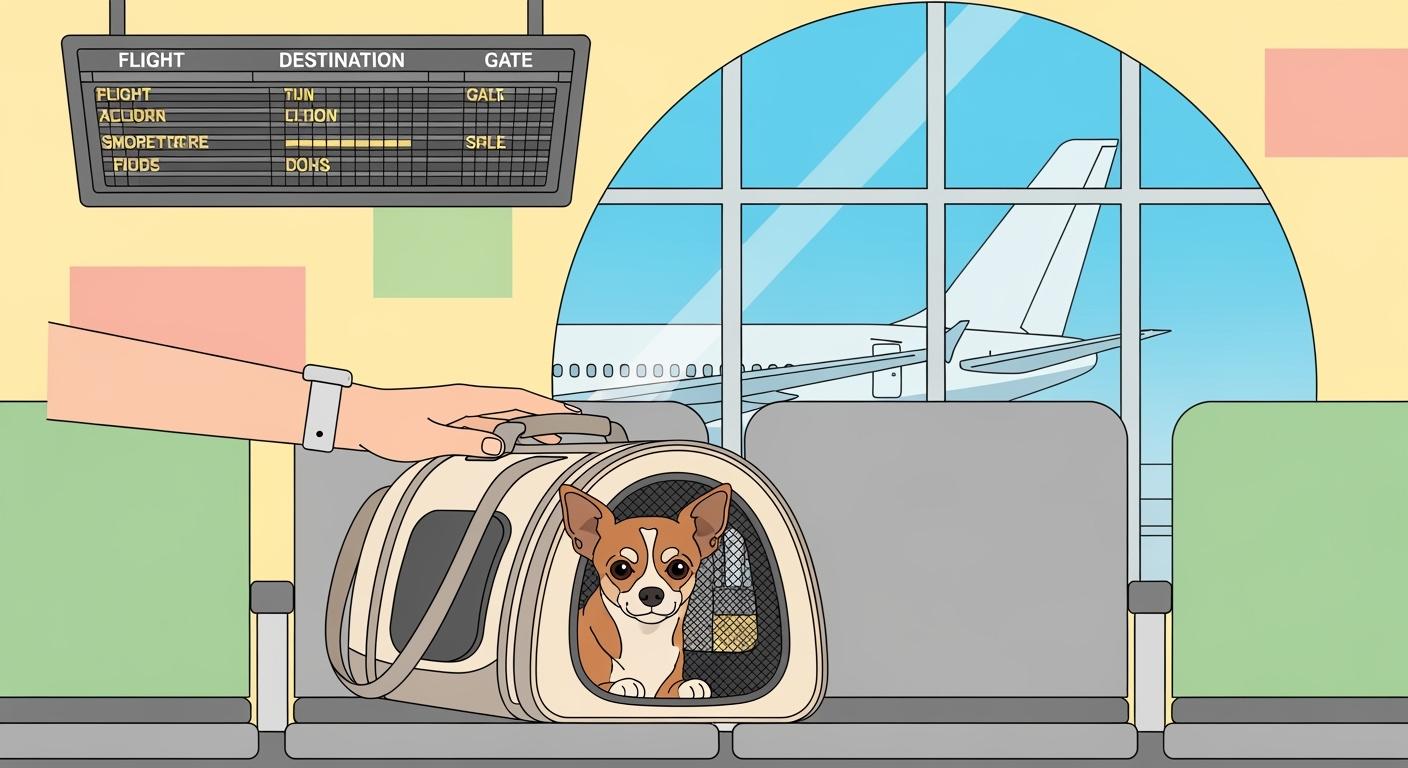
Half an inch. That is the difference between your dog flying in the cabin with you and getting told no at the gate.
Most carriers are photographed and measured empty. An empty carrier slides under a chair without resistance. An empty carrier matches the listed dimensions on the product page. The problem starts the moment you unzip it and load it for a real trip. Liners, a leash, travel documents, a collapsible bowl, maybe a small bag of treats. Each item pushes against the sidewalls, raises the floor, or bulges a pocket outward. The carrier that looked slim online is now half an inch too wide, and the gate agent has already reached for the sizer.
This is not about the printed size label. It is about what happens after packing. The empty-carrier illusion is the single biggest reason in-cabin pet carriers get refused at boarding, and most travelers do not see it coming until they are standing at the jet bridge with nowhere to put their dog.
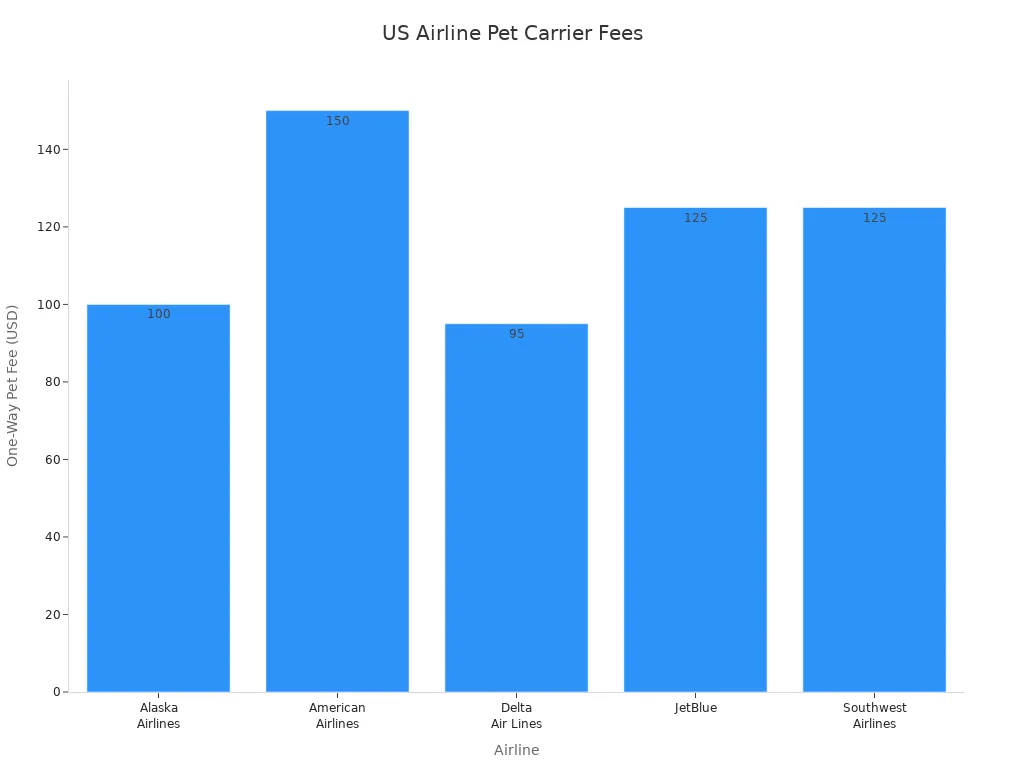
| Airline | One-Way Pet Fee | Max Weight | Max Soft Carrier Size (L x W x H) |
|---|---|---|---|
| Alaska Airlines | $100 | Under seat | 17 x 11 x 9.5 |
| American Airlines | $150 | Varies | 18 x 11 x 11 |
| Delta Air Lines | $95 | Must fit comfortably | 18 x 11 x 11 |
| JetBlue | $125 | Must fit comfortably | 17 x 12.5 x 8.5 |
| Southwest Airlines | $125 | Not stated | 18.5 x 13.5 x 9.5 |
Why an Airline Carrier Fits Empty but Fails After Packing
The Empty-Carrier Illusion
A carrier labeled “airline approved” tells you almost nothing. The label means the empty dimensions fall within a range that could fit under a seat. It does not mean the carrier will pass a gate check after you have packed it. Gate staff see packed carriers, not empty ones. If the sidewalls bow outward or the roof sits higher than expected, the printed approval means nothing.
Even an IATA-approved badge does not override a visual judgment at the gate. Staff are trained to check whether the carrier looks like it will slide under the seat without forcing it. A bulge of half an inch at the pocket, a roofline that refuses to compress—either one can trigger a refusal. The same carrier, packed differently, can pass on one flight and fail on the next. That inconsistency alone should tell you the label is not the safety net people assume it is.
This is where home-fit testing falls short of the real under-seat environment. A chair at home has no seat frame pressing down from above, no metal seat legs narrowing the usable width, and no gate agent watching.
What Packing Does to the Shape
Load a carrier with a liner, a small leash, documents, and a collapsible water bowl. Three things happen fast.
First, side pockets that looked flat in the product photos stretch outward. A pocket filled with treats or paperwork can add three-quarters of an inch to each side. Two bulging pockets and the carrier is suddenly an inch and a half wider than its listed width.
Second, a thick pad or folded blanket raises your dog closer to the roofline. The interior height you measured empty just shrank by the thickness of whatever you put on the floor. A dog that had two inches of head clearance now has one. If the seat frame presses down on the roof, that last inch disappears.
Third, the base panel takes all the weight. A weak floor bows downward when you lift the carrier by its handles. The carrier slumps. The dog slides to the low point. The usable floor area shrinks because the dog is now huddled against one wall, trying not to roll.
Gate-Refusal Signals Before You Leave Home
You do not need a sizer tool to catch most failures. Watch for these signals during a packed test at home:
- The carrier slumps or tilts when lifted by the handles. That is a weak base panel.
- The side pockets pull outward and stay there after packing. The carrier is now wider than its listed spec.
- Your dog keeps shifting position and cannot settle. The floor is uneven or the interior height is too low.
- The mesh panels sit flush against the sidewalls instead of staying open. Airflow is already compromised.
Any one of these can trigger a refusal. Two or more and the carrier is unlikely to clear a gate check on a strict airline. The checklist of refund triggers at boarding is short, but each item traces back to one of these packed-fit problems.
What Changes the Real Shape Under the Seat
Side Pocket Bulk and Why Placement Matters
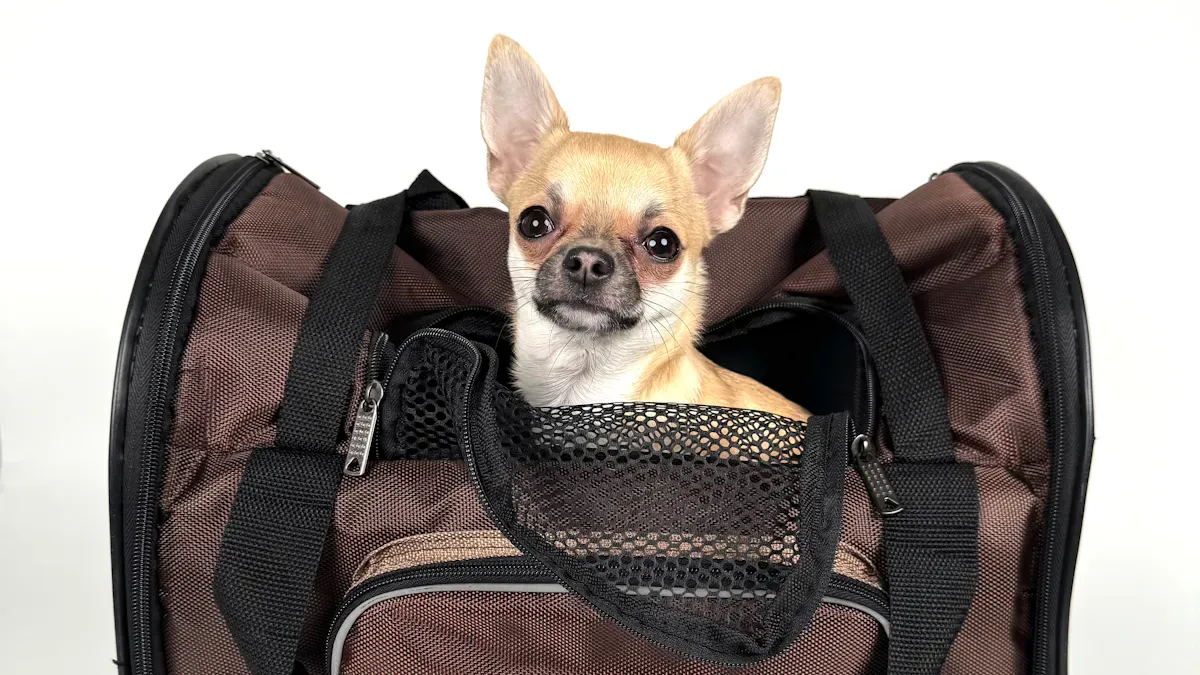
Pockets look harmless in product photography because they are empty. Fill one with a folded leash, a few treat bags, and a copy of the health certificate. It balloons outward. If that pocket sits directly over a mesh panel, the same bulge that widens the carrier also chokes the ventilation.
A pocket placed low and kept shallow avoids both problems. It stays closer to the carrier body and does not press against mesh when filled. The difference between a deep, stretchy pocket sewn over a vent and a flat pocket stitched onto a solid side panel is the difference between passing and failing a visual gate check.
Tip: Pack the carrier completely, then run your hand along each side. If any surface pushes outward more than a finger’s width beyond the listed dimensions, assume it will be flagged at the gate.
| Packed Fit Problem | Why It Matters | Design That Avoids It |
|---|---|---|
| Bulging side pockets | Increases width past airline limits, blocks mesh airflow | Flat, shallow pockets sewn away from mesh panels |
| Thick pad or liner | Raises the dog, shrinks headroom, roof presses on the dog | Thin removable liner with non-slip backing |
| Weak floor panel | Base sags when lifted, dog slides to low point, anxiety spikes | Reinforced base board or rigid insert panel |
| High rigid roofline | Won’t compress under seat frame, zippers strain and gap | Controlled soft structure that flexes without collapsing |
| Mesh pressed against seat frame | Ventilation drops to near zero, dog overheats on longer flights | Mesh on three or more sides, positioned away from contact points |
Thick Pads, Bowed Sidewalls, and Weak Floor Panels
A thick pad seems like a kindness. It is often the opposite. Every extra half-inch of padding under the dog reduces the interior height by the same amount. In a carrier with a 9.5-inch height limit, a 2-inch pad leaves 7.5 inches for the dog. A small dog that stands 9 inches tall is now pressed against the roof.
Bowed sidewalls are harder to spot. They happen when a carrier with no internal frame gets packed tight and the walls curve inward. The listed width might be 11 inches, but the usable width at the center shrinks by an inch or more. The dog loses turn-around space.
A weak floor panel compounds both problems. When the base sags, the dog slides to one end and braces against the low wall. What looked like enough space on paper becomes cramped and unstable in the air.
High Rooflines, Zipper Strain, and Mesh Getting Crushed
Some carriers advertise extra headroom as a feature. Under a tight seat frame, extra headroom becomes extra resistance. The roof presses up against the seat bottom and refuses to give. The zippers, now under constant tension, start to gap. A zipper that separates mid-flight turns a contained dog into a loose dog in the cabin.
Mesh at the top of the carrier takes the worst of it. Pressed flat against the seat frame, it blocks nearly all airflow. The dog breathes warmer air. On a short flight, uncomfortable. On a cross-country route, dangerous.
A carrier with controlled soft structure handles this better. The roof flexes just enough to clear the seat frame but rebounds when pressure eases. The zippers run along reinforced seams rather than taking structural load. Mesh sits on the sides and front, not the top, so the seat frame cannot flatten it.
Note: Test the packed carrier under a chair with a low seat pan — the kind found in economy rows. If the roof resists compression or the zippers pull apart, do not assume the actual aircraft seat will be more forgiving.
Carrier Designs That Hold Their Shape
Low-Profile Storage and Flatter Side Panels
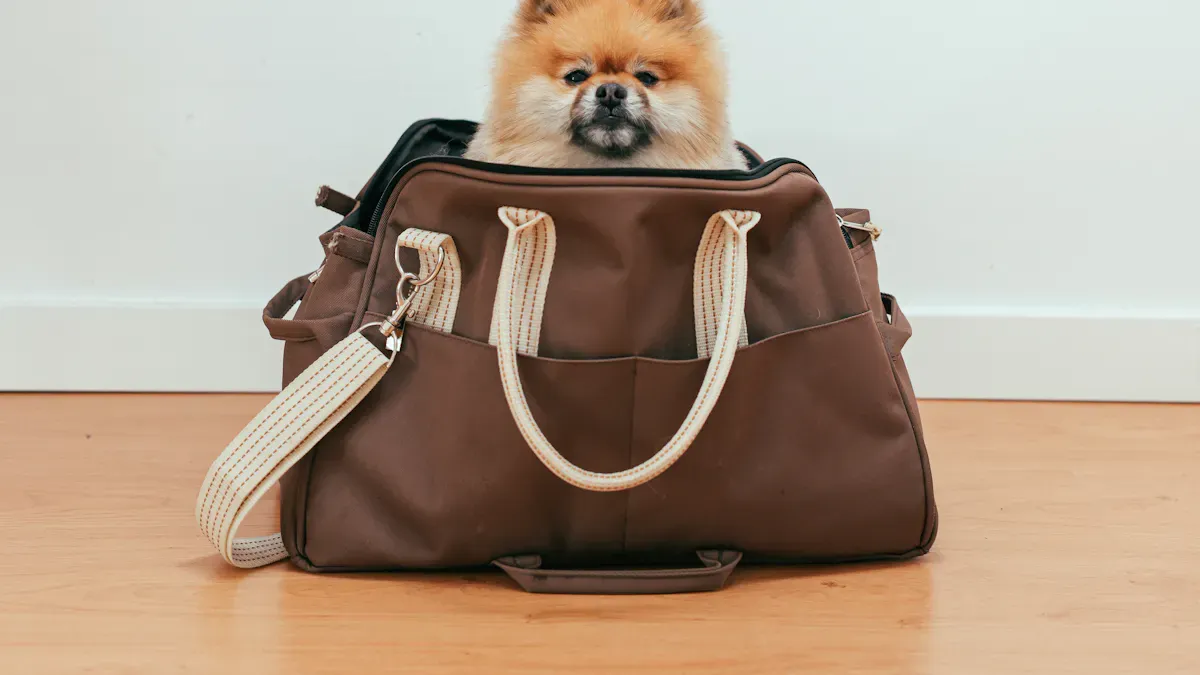
Shallow pockets solve the bulge problem at its source. A pocket that stays tight to the carrier body when empty does not suddenly balloon outward when filled, because there is no excess fabric to stretch. Flatter side panels do the same for overall width: the carrier slides between seat legs without catching or jamming.
Pocket placement relative to mesh is the design detail most buyers overlook. A pocket sewn onto a solid panel cannot block ventilation no matter how full it gets. A pocket layered over mesh inevitably restricts airflow when packed. That is a material choice that shows up in use, not in the product photos.
An expandable carrier with flat sidewalls and smart pocket placement avoids the width creep that catches travelers off guard at the gate. The expansion feature is secondary to the base geometry — if the packed carrier is already too wide, expanding it later does not fix the gate-check problem.
Controlled Soft Structure and a Stable Base
Not all “soft-sided” carriers are equally soft. Some collapse under light pressure. Others use internal rods, reinforced seams, or semi-rigid edge frames to hold their shape while still flexing enough to fit under a seat. That middle ground — controlled soft structure — is the target.
A stable base matters more than most people think. When you lift a loaded carrier by the top handle, the entire weight pulls through the base panel. If the base flexes, the carrier distorts. The dog feels the floor shift. A rigid or semi-rigid insert inside the base panel keeps the floor flat regardless of how the carrier is carried.
Carriers that pass packed-fit checks consistently share a few structural markers: triple-stitched load-bearing seams, zippers that run along reinforced tape rather than raw fabric edges, and handles that distribute weight across the frame instead of pulling from a single point.
Thin Removable Liners and Open Mesh Placement
A thin liner with a non-slip underside gives the dog a stable surface without eating headroom. If it is removable, you can pull it out and wash it between flights — a bigger deal than it sounds when a nervous dog has been in the carrier for four hours.
Mesh on three or more sides keeps air moving even when one panel gets partially blocked. The front panel catches the most airflow under the seat. Side panels provide cross-ventilation. If the carrier has mesh only on the front and top, losing the top to seat-frame pressure cuts ventilation in half instantly.
The same under-seat sizing and ventilation considerations apply across pet carriers, since the seat geometry does not change whether the animal inside is a cat or a small dog. Mesh placement and base stability are universal constraints.
In practice: A carrier that passes the packed fit test at home with room to spare handles gate checks more predictably than one that barely squeezes into the airline’s posted maximum. The margin is not about the number — it is about what happens when a seat frame, a bag of treats, and a gate agent’s judgment all converge on the same half-inch.
When an In-Cabin Carrier Works — and When It Does Not
Where It Works
In-cabin soft-sided carriers are built for small dogs on commercial flights. The dog needs to fit comfortably inside without pressing against the walls: standing, turning around, and lying down without curling into a tight ball. Carriers with mesh on three or more sides and a stable base perform best on flights under four hours. Longer routes push the limits of ventilation and comfort, but the carrier itself is not the limiting factor — seat geometry, cabin temperature, and how the dog handles confinement all matter more than the bag.
A step-by-step pre-flight packing routine for small-dog carriers catches most of the fit problems that surface at the airport rather than at home. The same checklist logic applies whether the carrier is a basic soft-sided bag or an expandable model.
Where It Fails
These carriers fail in predictable ways.
Dogs that nearly fill the interior dimensions are the hardest to fit. If the dog’s standing height is within an inch of the carrier’s listed interior height, any pad or liner puts the dog in contact with the roof. If the dog’s length leaves less than two inches of clearance at each end, turn-around space vanishes.
Overpacking breaks the ventilation math. A carrier stuffed with bedding, toys, a water bottle, and a week’s worth of treats has no open air volume left. The mesh works only if air can move through the interior. Pack it full and the mesh becomes decorative.
Soft-sided carriers with no internal frame fail under seat-frame pressure. The roof collapses onto the dog. The sidewalls bow inward. The usable space inside shrinks to a fraction of the listed dimensions. These carriers are lighter and cheaper, but they trade away the structural properties that make an in-cabin carrier actually work.
FAQ
Will an “airline approved” label guarantee boarding?
No. The label usually means the empty dimensions fall within a common range. It does not account for how the carrier behaves when packed. Gate staff judge the carrier as it appears in your hands — not as it was photographed for the product page. A visible bulge or a roofline that looks too tall can override the label.
How much clearance should a dog have inside the carrier?
The dog should be able to stand without the ears or head pressing against the roof, turn around without scraping the sidewalls, and lie down with legs extended. If the dog’s standing height is within one inch of the carrier’s listed interior height, the pad or liner will eat that margin. Measure the dog, add the pad thickness, then compare to the carrier’s interior — not exterior — height.
Do expandable carriers cause more gate-check problems?
Not inherently, but the expansion zipper adds another failure point. If the zipper that controls the expandable section is the same one that takes structural load when the carrier is compressed, strain on that zipper can cause it to separate. An expandable carrier with a separate expansion panel and dedicated load-bearing zippers avoids this.
Are hard-sided carriers better for under-seat fit?
Hard-sided carriers are more predictable dimensionally — they do not bulge or sag. But they cannot compress at all. If the listed height is 10 inches and the seat clearance is 9.5, a hard carrier will not fit, period. A soft-sided carrier with controlled structure might flex that half-inch and still work. The tradeoff is dimensional certainty versus fit flexibility. For most economy seats, a soft-sided carrier with a rigid base insert splits the difference best.






