
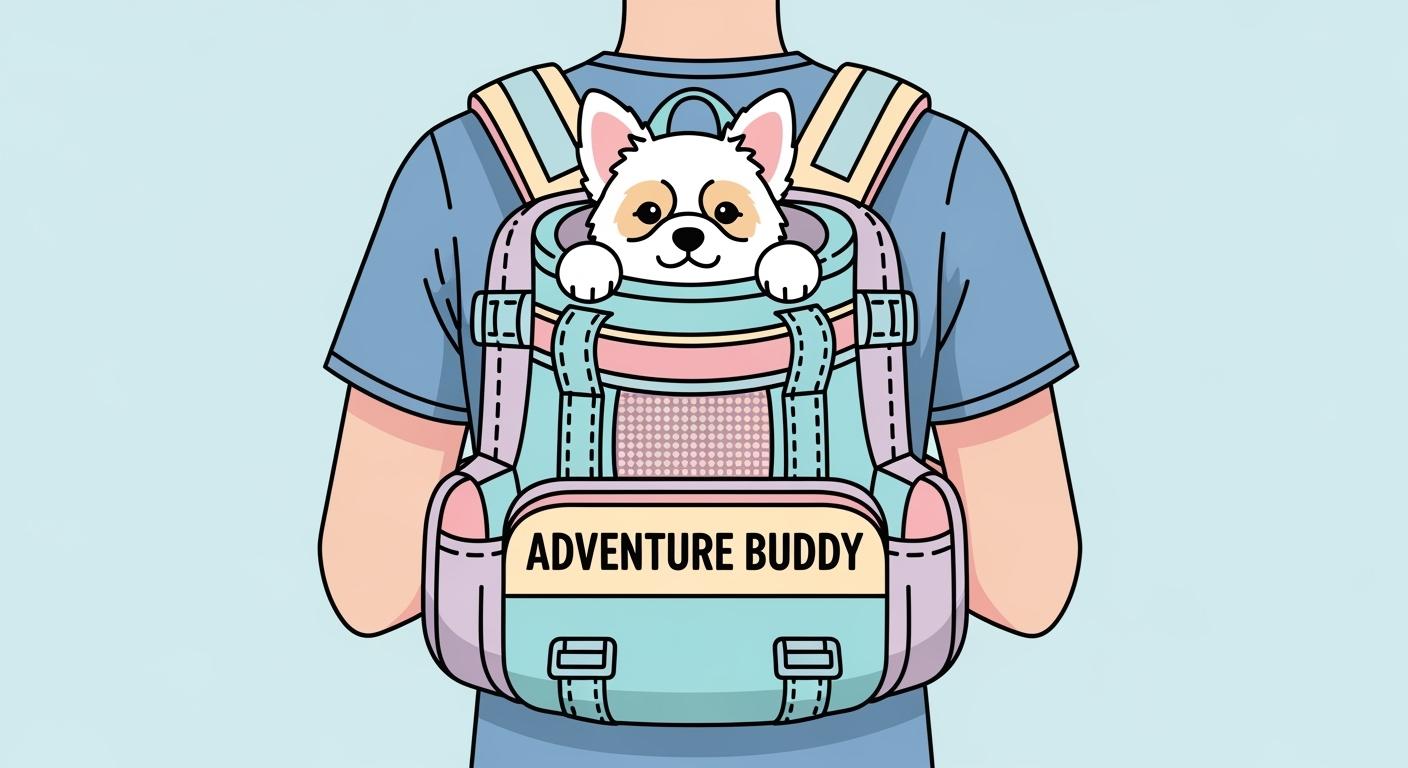
A small dog steps into a backpack carrier, sinks below the opening, and immediately braces with its front legs. Within minutes it is panting, shifting, trying to climb out. The carrier is rated for its weight. The zipper is closed. And yet the dog will not settle.
This happens more often than most people realize. The weight limit on the tag has almost nothing to do with whether a dog rides calmly. What matters is how the carrier holds the dog’s body — and most little dog backpack carriers get this wrong in predictable ways.
Hikers who need a dependable carry for uneven trails often discover the same pattern: a carrier that works on the first outing fails by the third, not because the dog outgrew it but because the structure gave out under repeated use. The checklist for trail readiness tracks the same failure points covered here — base compression, side panel collapse, and depth mismatch — which is why fit checks before a hike catch problems early.
Why Small Dogs Sink, Brace, or Refuse the Carrier
Sinking Below the Opening
Sinking is the most common failure. A dog enters the carrier, the base compresses, and within seconds the dog disappears below the rim. It cannot see out. It cannot rest its head. It ends up curled in a pocket it cannot escape.
The cause is almost always a soft bottom panel. Some carriers use a thin foam pad that compresses to nothing under even six or eight pounds. Others skip the base reinforcement entirely, leaving only fabric between the dog and the wearer’s back. Either way, the dog rides low, fighting gravity with every step the owner takes.
A firmer base changes everything. Solid bottom panels with internal webbing or a removable support insert keep the carrier floor from bowing downward. The dog stays at the designed riding height instead of sinking into a collapsed pocket. Fit stability starts with the base — when it holds, the dog does not have to brace just to stay visible.
Bracing with Front Legs
Bracing looks like a dog doing a half push-up for the entire ride. Front legs stiff, shoulders locked, weight shifted forward. It is exhausting for the dog and impossible to ignore for the owner who feels every tremor through the straps.
Two design details cause this. The first is a compartment that is too deep for the dog’s body height — the dog has to lift itself just to see over the edge. The second is a viewing window or mesh panel placed too high. The dog pushes upward searching for visual access and fresh air, and never finds a resting position.
When the inner depth matches the dog’s sitting height, the dog’s head naturally clears the opening. No pushing. No straining. The mesh sits at eye level instead of somewhere above the ears. That single measurement — inner floor to opening height versus the dog’s floor-to-eye height — predicts whether bracing will happen more reliably than any weight chart.
Note: A carrier can fit by weight and still fail by depth. A 10-pound dachshund and a 10-pound chihuahua need different compartment heights even though they weigh the same.
Leaning, Sliding, and Searching for Support
Weak side panels create a different problem. The dog sits upright but the walls give way, leaving nothing to lean against. Every turn, every step, the dog slides sideways and has to correct. Some dogs press against the mesh hoping it will hold. Others twist into unnatural positions, muscles tensed, waiting for the next lurch.
Side panels that hold their shape give the dog a boundary it can trust. The dog can rest against the wall without it bowing outward. This matters especially on uneven ground — trails, stairs, crowded sidewalks — where lateral movement is constant. Carriers with structured side support reduce the micro-adjustments that wear a dog out over a long outing.
Too much empty space makes this worse. A carrier that is too wide lets the dog shift several inches in either direction before hitting a wall. That slack feels unstable. The dog never settles because the carrier never gives it a fixed position.
| Visible Failure | Design Cause | Why It Matters |
|---|---|---|
| Sinking below opening | Soft or unreinforced base panel | Dog cannot see out or rest naturally; rides in a collapsed pocket |
| Bracing with front legs | Compartment too deep or window too high | Dog exhausts itself holding a half push-up position |
| Leaning or sliding sideways | Weak side panels or excess interior width | Dog cannot find a stable resting position; constant muscle tension |
| Panting, shifting, refusal to re-enter | Combination of the above — structural failure cascade | Stress builds across outings; dog associates carrier with discomfort |
Design Details That Cause the Problem
The inner depth of a carrier is the measurement nobody checks. Most buyers look at weight limits. Then they look at external dimensions. Neither tells you whether a dog’s head will clear the opening when it sits inside.
A compartment that is too deep forces the dog into a choice it cannot win: sink and see nothing, or brace and exhaust itself. Short-bodied breeds suffer the worst. A dachshund in a carrier designed for an average small-dog silhouette will drop below the rim by two or three inches — enough to eliminate all visibility and airflow at head level.
The fix is not a shallower carrier across the board. It is a carrier with an inner depth that matches the specific dog’s sitting height. Some dogs need six inches. Others need nine. What matters is that the number on the carrier and the number on the dog align before the zipper closes.
Soft Bases That Compress Under Load
Every soft base fails the same way: it starts flat, then bows. A thin EVA foam pad compresses. A fabric-only floor sags immediately. Even multi-layer bases delaminate over time if the bonding between layers is weak.
The failure is progressive. The first few outings feel fine. By the tenth, the base no longer recovers its shape between uses. The dog rides lower. It braces more. The owner tightens the straps to compensate, which changes the carrier geometry and creates new pressure points. Fit and sizing checks catch this degradation pattern before it becomes the dog’s problem — a compressed base that does not spring back is already a failed base, even if it looks intact.
Mesh Placement and the Upward Push
Mesh panels that sit above the dog’s natural head height are the most overlooked design flaw in small-dog carriers. The dog can breathe. The dog can see a sliver of sky. But the dog cannot see out without stretching upward — and so it stretches, constantly.
This upward push mimics bracing but has a different root cause. The dog is not trying to escape a deep compartment. It is trying to reach a window placed for a taller animal. After twenty minutes the neck and shoulder muscles fatigue. The dog pants more. It may paw at the mesh or whine.
Multi-layer breathable mesh positioned at resting head height solves this entirely. The dog breathes easily without craning. It sees the world without climbing. Air moves through the panel instead of pooling inside. This is not a luxury feature — it is the difference between a dog that settles in thirty seconds and a dog that never settles at all.
Excess Interior Space and Instability
A carrier that is too spacious sounds like a good thing. It is not. Extra width and depth create a shifting environment where the dog slides on every turn. The walls are too far away to brace against. The floor offers no fixed position.
Dogs do not sprawl in carriers. They sit or lie in a compact posture. A carrier shaped close to the dog’s body dimensions keeps it centered and stable. Sizing that accounts for body length and chest width, not just weight, prevents the loose, unstable fit that turns a calm dog into a restless one within half a mile.
Wide carriers also shift the owner’s center of gravity. A dog sliding to one side pulls the straps off-balance, which the owner corrects by leaning, which creates more movement for the dog. The instability feeds itself.
| Design Flaw | Failure Mode | Performance Difference When Fixed |
|---|---|---|
| Too-deep compartment | Dog sinks out of view, cannot see or rest | Dog sits upright with head naturally above opening |
| Soft compressible base | Riding height drops as base bows under weight | Stable platform keeps dog at designed position all outing |
| High mesh window | Dog pushes upward constantly to see or breathe | Dog relaxes with clear view and airflow at resting head height |
| Weak side panels | Walls collapse; dog leans and slides with every movement | Structured sides give a reliable boundary the dog can rest against |
| Excess interior space | Dog shifts laterally, never finds fixed position | Snug fit centers the dog and reduces corrective movement |
What Design Fits Better for Calm, Supported Carrying
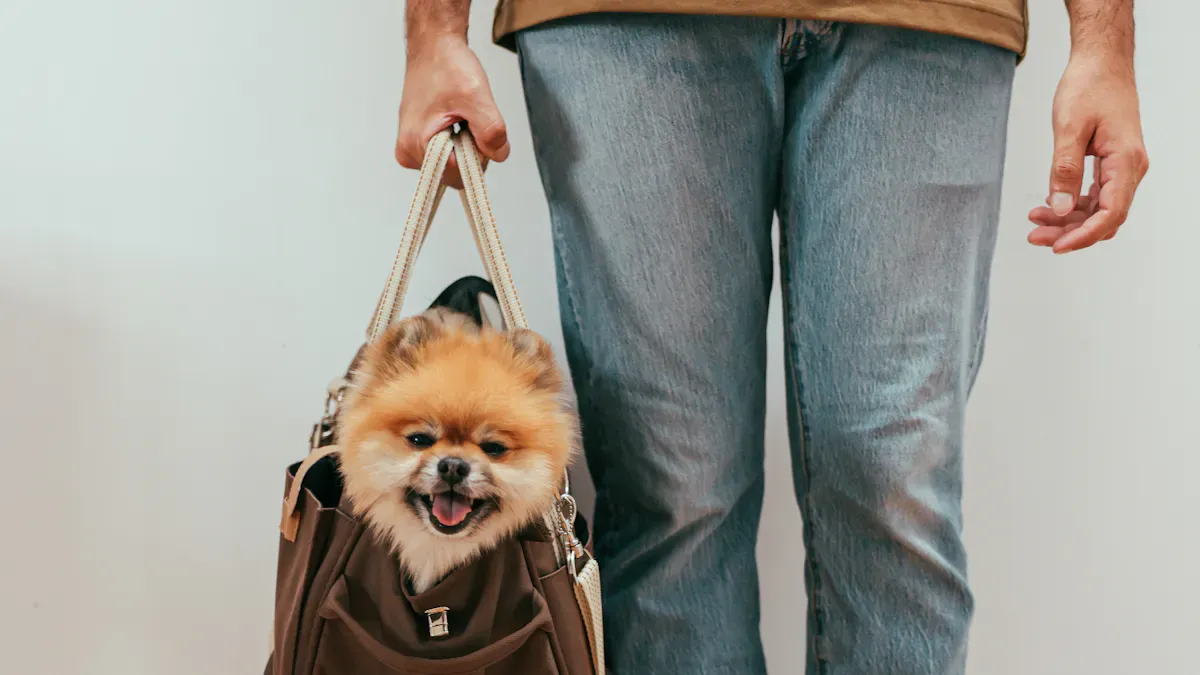
Firmer Base Support and Stable Posture
A base that does not compress keeps the dog at the height the carrier was designed for. That sounds obvious. It is also the single most common point of failure across budget and mid-range carriers.
Solid bottom panels — typically a rigid insert wrapped in fabric or a multi-layer bonded base with internal webbing — distribute the dog’s weight across the entire floor instead of letting it concentrate in the center. The dog does not sink into a bowl shape. It stays flat. It stays visible. It stays calm.
Removable support inserts add durability without making the carrier bulky. When the insert eventually fatigues — and all foam fatigues eventually — it can be replaced without replacing the entire carrier. That detail alone extends usable life by months or years depending on frequency of use.
Tip: Press the center of the base with your hand before loading a dog. If it deflects more than a quarter inch under hand pressure, it will deflect far more under a live animal shifting its weight with every step.
Inner Depth Matched to Body Height
A carrier with an inner depth of around ten inches supports a range of small breeds without forcing the shortest ones to sink or the tallest ones to crouch. The key word is inner — external dimensions include padding, frame thickness, and fabric layers that eat into usable space.
The dog should be able to sit on all fours with its head clearing the opening and its eyes level with or slightly above the rim. If the dog has to look up to see out, the compartment is too deep. If the dog’s shoulders press against the top opening, the carrier is too shallow. A design built for small-dog proportions balances these constraints — deep enough for stability, shallow enough for visibility — without the compromises that come from scaling down a medium-dog carrier.
| Fit Check | Pass Signal | Fail Signal |
|---|---|---|
| Inner depth vs. sitting height | Head clears opening; eyes level with or above rim | Dog must look up to see out; chin rests on rim |
| Base compression under weight | Floor stays flat after dog settles | Base bows downward; dog rides visibly lower after first minute |
| Side panel rigidity | Walls hold shape when dog leans into them | Panels flex outward; dog slides on turns |
| Mesh height vs. resting head height | Mesh aligns with eyes and nose in natural sitting posture | Dog stretches upward to reach airflow or view |
Mesh at Resting Head Height
Multi-layer breathable mesh does two things at once: it moves air and it gives the dog a window. When placed correctly — at the height of the dog’s eyes and nose in a relaxed sitting position — the dog gets both without effort.
Single-layer mesh tears. It also collapses against the dog’s face if the dog leans into it, blocking airflow instead of enabling it. Multi-layer panels hold their structure even under contact. That matters on warm days when the dog is already working to regulate temperature inside an enclosed space.
Mesh that runs wider rather than just taller gives the dog peripheral vision. A narrow vertical slit forces the dog to face perfectly forward to see anything. A wider panel lets the dog turn its head naturally and still see the world moving past.
Supportive Side Panels and Fit Boundaries
Side panels with internal structure — plastic framing, dense foam, or reinforced fabric — give the dog something to rest against without the wall giving way. Press on the side of a carrier in a store. If it crumples under hand pressure, it will crumple under a dog.
But there is a limit. A carrier with rigid walls on all sides becomes a box. The dog cannot shift its weight, cannot adjust posture, cannot even turn its head without hitting a hard edge. Structured sides need to hold their shape while still allowing the dog to reposition. That balance — firm but not hard, supportive but not confining — separates carriers dogs accept from carriers they fight.
Fit boundaries are worth stating plainly. A dog that continues to sink, brace, or refuse entry after the base, depth, and mesh placement have been checked likely needs a different carrier entirely — not a different size of the same model. Some dogs will not tolerate an enclosed backpack style regardless of design quality. A sling or front-facing carrier may work better. The goal is a calm ride, not loyalty to a specific form factor.
Note: A dog that avoids the carrier after multiple negative experiences may need more than a design fix. Reintroduction in a well-fitted carrier — short sessions, no motion at first, positive reinforcement — gives the dog a chance to relearn that the carrier is not a threat. But the carrier itself has to be right first.
FAQ
How can I tell if a base is firm enough before using it?
Press the center of the floor panel with your full hand. A base that deflects more than a quarter inch under hand pressure will compress significantly under a live dog. Also check whether the base rebounds immediately — slow recovery signals a material already losing its structure.
Does a higher weight limit mean a more supportive carrier?
No. Weight limits describe what the straps and seams can bear, not how the interior holds a dog’s body. A carrier rated for 20 pounds can still have a soft base that sinks under a 7-pound dog. Support comes from structure, not capacity ratings.
Why does my dog keep pushing upward even after I lowered the mesh?
The mesh height is one variable. Also check the compartment depth — if the dog is sitting too low, lowering the mesh does not help because the dog’s head is still below it. The inner floor-to-mesh distance must match the dog’s floor-to-eye height in a natural sitting position.
Are collapsible carriers more likely to have weak side support?
Many are. The folding mechanism that makes storage convenient often removes the structural elements that keep walls upright. A carrier that folds flat for storage needs to lock its panels rigidly when deployed. If the locking mechanism is flimsy — a thin plastic clip or a friction fit — side support will degrade quickly with use.
What if none of these design fixes stop my dog from refusing the carrier?
Some dogs genuinely cannot tolerate the enclosed-backpack form factor, regardless of how well the dimensions and structure match. Movement sensitivity, prior negative experiences, or simple preference may mean a front-facing carrier, sling, or tote works better. The correct product decision is the one the dog accepts, not the one that looks right on paper.






