
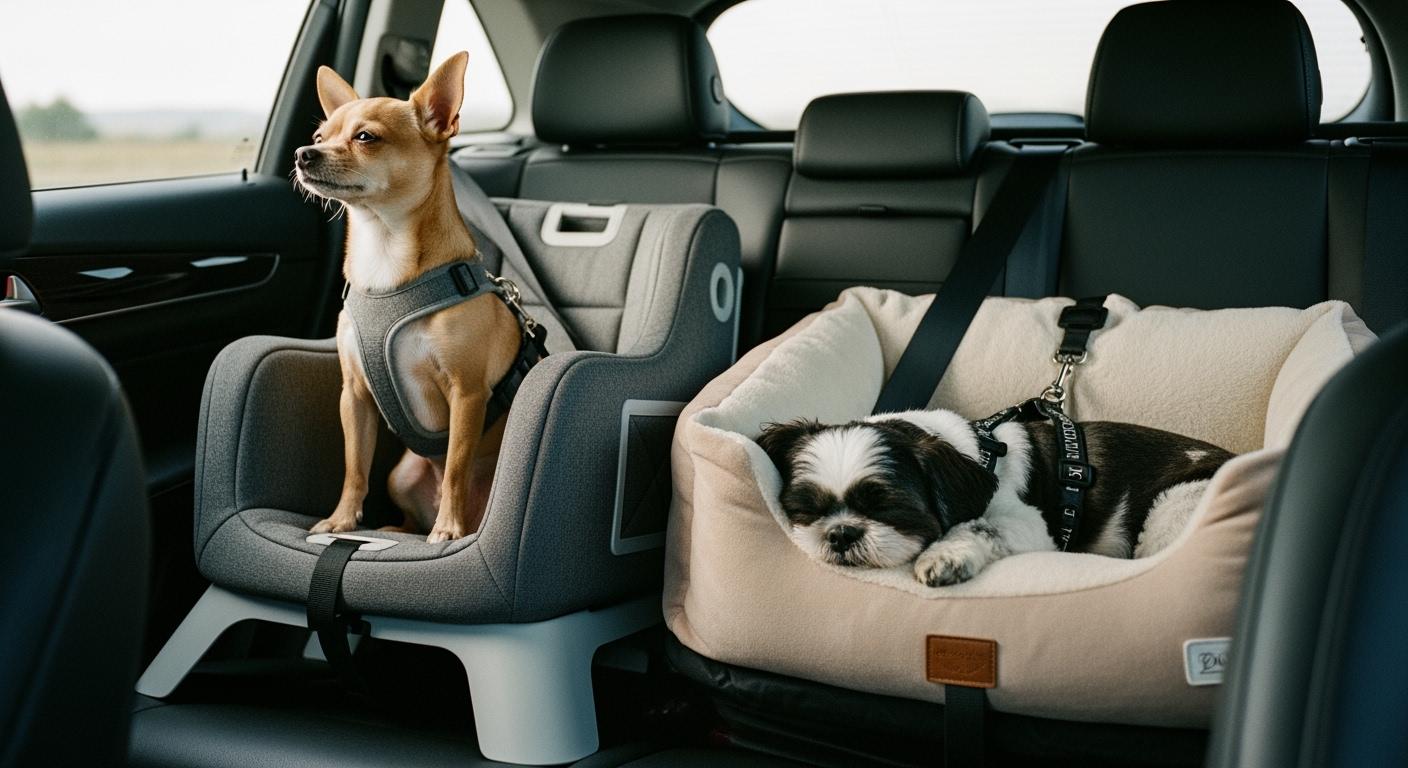
A small dog weighs twelve pounds. A car taking a residential turn at 15 mph generates lateral force equal to roughly a third of that dog’s body weight pulling sideways. Place that dog on a flat, unstructured cushion and the physics is simple: the dog slides. The cushion bunches. The dog braces, stiffens, and the ride stops being restful. A raised booster seat with a stable base and defined side walls changes the equation entirely — not by adding more padding, but by giving the dog a boundary the lateral force cannot overcome.
The comparison of a dog car seat versus a dog car bed for small breeds is not really about soft versus firm. It is about whether the surface resists displacement or follows it. For a twelve-pound animal in a moving vehicle, that distinction determines whether the trip ends with a settled dog or a stressed one.
Why Small Breeds Slide in a Soft Car Bed
When Comfort Becomes Instability
A soft dog car bed does exactly what it is designed to do on a living room floor: it conforms. The fill compresses under weight, the fabric yields, and the dog sinks into a nest. On a stationary surface, that is comfort. On a car seat, that same conformance becomes a liability. As the vehicle turns, the fill shifts laterally. The fabric cover, with nothing rigid beneath it, follows. The dog’s center of mass, already low, drifts with the fill rather than staying anchored above the seat base.
This is the core mechanical difference. A structured booster seat resists lateral deformation at the base layer. A soft bed amplifies it. The same fill compression that feels plush at home translates, in a moving vehicle, into a surface that migrates under load.
| Design Difference | Why It Matters | Main Limitation |
|---|---|---|
| Structured base panel vs. unsupported fill | A rigid or semi-rigid base resists lateral shear; loose fill shifts with every turn and redistributes unevenly under the dog | Structured bases add weight and reduce packability for owners who remove the seat between trips |
| Defined side bolsters vs. flat or softly rolled edges | Raised sides create a containment zone that converts lateral vehicle force into gentle pressure against the bolster rather than sliding momentum | Bolsters that are too tall for very short-legged breeds can block the downward view, which some dogs find disorienting |
| Elevated seating platform vs. seat-level cushion | Lifting the dog 4–6 inches off the seat surface aligns their eye line with the window and shortens the lever arm between the dog’s center of mass and the seat belt anchor point | Dogs that prefer to curl into a tight ball may find the raised platform too shallow for deep nesting |
What Happens to a Small Dog During a Turn
Here is the causal chain. A car enters a right turn. Lateral force pushes everything in the cabin to the left. A twelve-pound dog on a soft bed experiences that force as a sideways tug at every point of contact. The fill beneath the dog’s ribs compresses left. The fabric cover, lacking a rigid anchor, slides left. The dog’s paws, which rely on surface friction for stability, lose grip as the fill surface deforms. The dog’s inner ear signals imbalance. The dog stiffens, extends its legs, and tries to self-correct — which shifts more weight into the already-compressed fill. The bed bunches further. By the time the turn completes, the dog is no longer centered, the bed is crumpled against the door, and the dog’s heart rate is elevated.
Now replay the same turn with a booster seat that has a rigid base and raised side bolsters. Lateral force still pushes left. But the base does not deform, so the dog’s paws keep their purchase. The left bolster absorbs the dog’s weight without collapsing. The dog feels pressure against its side — a known boundary — rather than an open slide into empty space. The dog’s inner ear registers the turn, but the proprioceptive feedback from the bolster says stable. The dog may shift slightly, but it does not relocate. When the turn ends, the dog is where it started. That difference in outcome comes entirely from whether the support surface resists lateral shear or transmits it.
Tip: After a drive with turns, check whether the bed or seat base has migrated more than an inch from its original position. Movement at the base is the first signal that the dog experienced the same displacement internally.
Where Each Option Solves a Different Problem
Dog Car Bed: Familiar Scent, Resting Comfort
A soft car bed solves one problem well: it brings home into the vehicle. For a dog that associates a specific blanket or bed with rest, that familiar scent lowers cortisol and signals safety. This matters most for dogs with generalized travel anxiety that is triggered by the car itself — the engine noise, the vibration, the enclosed space — rather than by movement forces. If the dog’s stress peaks before the car moves, a familiar soft bed is a legitimate intervention. It does not address positional stability, but positional stability was never the problem it was solving.
The limitation is structural. Once the vehicle is in motion, scent familiarity cannot resist lateral force. A soft bed works for the dog that needs calming through familiarity rather than physical containment. It fails for the dog whose anxiety is motion-driven.
Dog Car Seat: Raised Position and Side Containment
A structured booster seat solves the opposite problem. It does not carry the scent of home, but it carries the dog through turns, stops, and lane changes without losing position. The raised platform addresses the visibility deficit that small breeds face in most vehicles — sitting at seat level, a Chihuahua or Pomeranian sees nothing but seat-back fabric. That sensory deprivation is its own anxiety trigger. Lifting the dog 4–6 inches changes the visual field from upholstery to horizon, which tends to reduce restlessness independently of any cushioning.
The side bolsters serve a dual function. During straight driving, they define the dog’s space clearly enough that the dog settles without testing boundaries. During maneuvers, they act as passive restraint surfaces — not straps or tethers, but physical stops that catch the dog before momentum builds. This is a fundamentally different mechanism from a soft bed’s approach of absorbing weight, and it is why booster seat sizing and bolster height directly determine how much lateral support the dog actually receives.
The Bed-Style Booster: Both Functions, Neither at Full Strength
Some seats combine a soft cushioned surface with raised sides and a stable base. The appeal is clear: nest-like comfort plus structural containment in one product. In practice, these hybrid designs trade some of each function. A cushioned surface that is soft enough to feel bed-like will compress more under lateral load than a firm booster platform. Bolsters on a bed-style seat are typically shorter than those on a dedicated booster, because tall rigid walls read as less bed-like to buyers. The result is a seat that contains the dog better than a flat bed but with less positional precision than a dedicated booster — a compromise that works well for dogs with moderate motion sensitivity on shorter trips, and less well for dogs that slide aggressively or travel on winding roads.
| Travel Problem | Dog Car Bed Limitation | Booster Seat Direction | Where It Falls Short |
|---|---|---|---|
| Sliding during turns | Fill shifts laterally, bed migrates toward door | Rigid base and bolsters arrest lateral movement at point of contact | Very tight turns at speed can still shift a dog that actively leans into the turn |
| Low sitting height | Dog sees only seat backs; sensory deprivation drives restlessness | Elevated platform aligns eye line with window glass | Some dogs find the height unsettling initially and need gradual exposure |
| Undefined boundaries | Open surface gives no proprioceptive feedback about space limits | Bolstered sides create tactile boundaries the dog can lean against | Dogs that prefer to sprawl may find bolsters confining on long trips |
| Motion-induced anxiety | Familiar scent helps pre-drive anxiety but offers nothing against in-motion forces | Predictable surface response under motion reduces the startle-reflex cycle | Does not address scent-triggered calm; combining with a familiar blanket helps |
The decision between these options hinges on whether the primary travel problem is positional or sensory. A dog that slides and stiffens during turns needs structural containment. A dog that trembles before the engine starts may benefit more from a familiar soft surface — placed inside a structured seat for the drive itself.
Why Raised Booster Support Keeps Small Dogs in Position

Window Height Changes Behavior
A dog that can see out tends to settle faster than a dog staring at fabric. This is not speculation — it follows from how canine spatial attention works. When a dog cannot see the horizon, its vestibular system registers motion without the confirming visual reference of a stable outside world. The mismatch between what the inner ear reports and what the eyes confirm is the same sensory conflict that causes motion sickness in humans. Restoring the visual horizon does not eliminate car sickness, but it removes one contributing factor that a low, flat bed cannot address.
Booster seat height also shortens the effective lever arm between the dog’s body and the seat belt path. When a dog sits directly on the vehicle seat, the belt anchor point is above and behind the dog’s center of mass. Under braking, the dog’s body rotates forward around that high anchor, and the harness straps ride up. Raising the dog brings the center of mass closer to the belt path, reducing forward rotation. It is the same reason child booster seats exist.
Side Bolsters Do More Than Contain
The most underappreciated function of a side bolster is not containment — it is proprioceptive feedback. When a dog leans against a bolster during a turn, the pressure against its ribs and shoulder tells the nervous system exactly where the body is in space. That feedback suppresses the righting reflex that causes the dog to stiffen, scramble, and overcorrect. Without bolsters, the dog’s body moves through open space with no tactile reference, and the nervous system defaults to full-alert bracing. With bolsters, the same turn produces a predictable pressure signal that the dog’s brain processes as information rather than threat. This is why dogs often fall asleep against a side wall in a booster seat but remain rigid and vigilant on a flat bed — the brain is not fighting unknown forces.
The design logic behind car safety seating for dogs follows this principle: restraint is not only about tethers and clips. Surface geometry that communicates body position to the dog’s nervous system is a form of passive restraint that works continuously, without adjustment, at every speed.
Base Stability: What to Check After the Drive
After a 20-minute drive with turns and stops, run your hand under the seat base and check how far it has shifted from the position where you placed it. Less than half an inch is what a non-slip base with proper strapping delivers. More than an inch, and the seat’s anti-slip design is either insufficient or the straps need re-tensioning. Do the same check with a soft bed: the bed will typically have slid several inches, and the fill will be bunched toward one side. The dog experienced every inch of that migration internally before you saw it externally.
This is the observable test that separates surface-level comfort from travel stability. A bed that feels plush to your hand tells you nothing about what happens to it under lateral load. The shift distance after a real drive tells you everything.
| Feature | What to Check After a Drive | Why It Matters |
|---|---|---|
| Base panel rigidity | Base should show no flex creases or permanent deformation | Repeated flexing weakens the anti-slip surface bond and reduces grip over time |
| Non-slip bottom material | Run fingers across the bottom: it should feel tacky, not smooth or dusty | Smooth or dust-coated surfaces lose grip on leather and vinyl seats within weeks |
| Strap tension retention | Straps should be as tight after the drive as before; re-tension if slack appears | Strap creep during a drive lets the seat gain momentum before the next maneuver |
| Bolster foam rebound | Press into a bolster and release: it should regain shape in under 2 seconds | Slow-rebound foam has already compressed permanently and will not arrest the next lateral shift |
When a Soft Bed Still Makes Sense
A soft car bed is not the wrong product. It is the wrong product for a specific problem — positional instability during vehicle motion. For a dog whose car stress is exclusively pre-drive and scent-driven, a familiar bed placed in the footwell (not on the seat) can lower the stress baseline enough to make the drive tolerable. For a dog recovering from surgery that must lie flat and cannot tolerate bolsters against an incision site, a soft bed is the only viable option. For a dog traveling in an RV or camper where the vehicle’s motion profile is gentler and the dog has floor-level space to brace naturally, a soft bed may be sufficient.
Disclaimer: The bolster-containment mechanism described here assumes the dog’s chest and shoulder width falls within the seat’s design dimensions. Small breeds with unusually deep or narrow chest profiles — Italian Greyhounds, for example — may contact bolsters at a shallower angle, reducing lateral feedback. For these dogs, check after a 10-minute drive with turns whether the dog has repositioned more than 2 inches from center. More than that, and the bolster geometry is not matching the dog’s body profile closely enough to provide reliable proprioceptive feedback.
The place where a soft bed consistently fails is the scenario the comparison keyword implies: a small dog, on a passenger seat, during normal driving with turns and stops. In that scenario, the absence of a rigid base, the absence of side bolsters, and the absence of elevation combine into a single outcome — the dog braces continuously, fatigues, and arrives more stressed than when it left. A small dog folding car seat with a structured base addresses all three absences in one product. A soft bed addresses none of them. The question is not which product is better in absolute terms. It is which product matches the physics of the scenario. For a small dog on a moving passenger seat, the physics points one way.
Frequently Asked Questions
Can a soft dog bed be made safer for car travel?
Partially. Anchoring the bed with a non-slip mat underneath reduces base migration, and placing the bed in a footwell rather than on a seat lowers the fall distance if the dog slides. But neither fix adds side bolsters or a rigid base. The bed will still deform under lateral load, and the dog will still lack proprioceptive boundaries during turns. These mitigations reduce the worst outcomes — the bed sliding off the seat entirely — without solving the core stability problem.
At what size does a dog outgrow the need for a booster seat?
It depends less on weight than on shoulder height relative to the vehicle’s window line. A dog whose shoulders sit at or above the bottom edge of the window glass when seated naturally does not need the elevation a booster provides for visibility. That threshold is typically around 14–16 inches at the shoulder — roughly the size of a Cocker Spaniel or larger. However, side containment remains relevant at any size for dogs that shift during turns, and what matters most in a small dog car seat applies similarly to medium breeds: base stability and bolster geometry drive the outcome more than the size label on the box.
Does a travel bed-style seat work for dogs that get carsick?
It can help, but with a specific mechanism. Carsickness is triggered by sensory conflict between the vestibular system and visual input. Raising the dog to window height removes the visual deprivation component of that conflict — the dog can see a stable horizon, which aligns with what the inner ear reports. The bed-style surface does not contribute directly to nausea reduction, but it may lower the dog’s overall stress, and lower stress reduces the likelihood of vomiting independently of motion. The elevation matters more than the cushioning for carsickness specifically.
How do I know if my small dog needs more side support?
Film your dog during a drive that includes at least three turns and one moderate stop. Watch the footage for three signals: the dog’s body sliding more than an inch in any direction, the dog’s legs extending and bracing against empty air, and the dog repeatedly repositioning between turns. Any two of these three signals indicate that the current setup is not providing enough lateral containment, regardless of how comfortable the surface feels to the hand.
What is the single biggest design difference that affects real-world performance?
Base rigidity. A soft bed and a structured booster seat differ in padding, elevation, and side walls — but the base panel is the load path through which every other force must travel. A rigid base transfers lateral force from the dog into the seat belt anchor and the vehicle seat surface without deforming. A soft base absorbs that force internally, stores it as displaced fill, and releases it unpredictably. Everything else — bolster height, strap placement, fabric grip — modifies how well the system works once the base is rigid. Without base rigidity, the rest is detail on an unstable foundation.






