
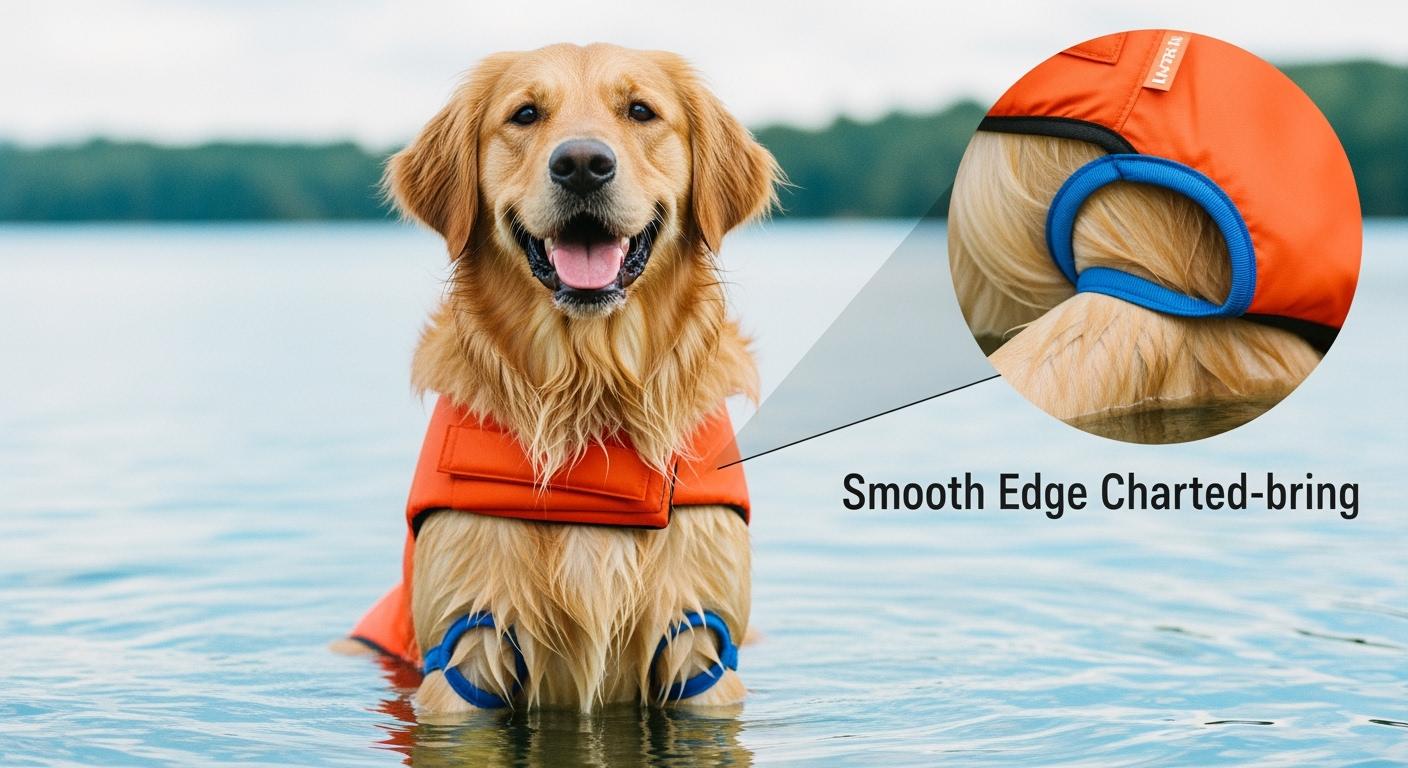
A dog standing still in a life jacket tells you almost nothing. The problem starts the moment the front legs extend into a paddling stroke. Each stroke cycle pulls the leg forward, then drives it back. The armhole edge sits right at the crease where the leg meets the chest — an area with thin skin, minimal fur coverage on many breeds, and constant flexion. Every stroke brings that edge into contact with the same soft tissue.
Here is the causal chain: as the front leg reaches forward, the armhole opening rotates slightly. A stiff binding resists this rotation. Instead of deforming, it presents a narrow ridge of fabric that scrapes across the skin. Multiply by hundreds of strokes per swim session, and micro-abrasion accumulates into visible redness, then hair loss, then a dog that hesitates at the water’s edge.
Soft, flexible binding changes the equation. A pliable edge deforms under contact pressure rather than resisting it. The binding rolls with the leg motion instead of scraping against it. Sizing mistakes in dog life jackets often show up as chafing and ride-up once the dog is in the water, not during the dry-land try-on.
Why Rubbing Happens Under the Front Legs During Swimming
Paddling Motion and Armhole Edge Contact
On land, the vest sits quietly. In water, every paddling stroke cycles the armhole edge against the armpit crease. The front leg does not move in a simple pendulum — it arcs outward, extends forward, then sweeps back with downward pressure. Each phase of this three-dimensional motion changes the angle at which the armhole edge contacts the skin.
The armpit crease opens and closes with every stroke. If the edge binding is stiff, that closing motion traps a fold of skin between two fabric surfaces. After ten minutes of swimming, the dog has cycled through this pinch-and-release sequence hundreds of times. The result is not a single rub mark but cumulative surface abrasion.
An observable check: after a swim, run a finger along the inner armhole edge of the jacket. If you feel a sharp, well-defined crease line in the fabric near the armpit side, that edge spent the session pressed hard against the leg. A jacket with softer, more compliant binding leaves a diffuse contact pattern instead of a sharp crease.
Water Weight and How It Shifts the Fit
Water does two things to a life jacket: it adds mass and it changes surface friction. A vest that sits perfectly on dry land can pull forward, ride up, or rotate once submerged. When the jacket absorbs water, the added weight pulls downward. If the straps are too tight on land, that downward pull translates into upward pressure at the armholes — the jacket rides up and the edges dig in. If the straps are too loose, the jacket migrates with each stroke, creating rub points that did not exist during the living-room fit check.
The observable test: put the jacket on the dog, walk into shallow water, and after two minutes of paddling, run your fingers along the inside of each armhole edge. If the jacket has shifted more than a finger’s width from its dry-land position, the strap tension needs adjustment before the dog swims any longer.
Armhole Shape and the Armpit Crease
Shape matters as much as what the edge is made of. A circular armhole with a small diameter concentrates contact pressure into a single ring around the leg. An oval or teardrop-shaped opening distributes the same contact area across a longer perimeter, reducing pressure at any one point. The armpit crease is the highest-risk zone because it flexes with every stroke. A chest panel that extends too far forward will bunch and press into this fold with each closure.
| Rubbing Signal | Design Cause | Better Design Direction |
|---|---|---|
| Redness under front legs | Stiff armhole edge binding | Soft, smooth edge binding that deforms under contact |
| Hair loss at armpit crease | Tight or shifting strap placement | Stable, adjustable strap routing with wet-grip webbing |
| Reluctance to swim or shortened stroke | Bulky chest panel, poor armhole shape | Flexible chest panel with forward clearance from the armpit crease |
Where Edge Design and Fit Commonly Fail
Narrow Armhole Openings
A narrow armhole limits the paddling stroke before the edge touches skin. The dog shortens its stroke to avoid contact — less propulsion, more effort for the same distance. After a swim, look at the inner armhole fabric for crease marks. A sharp crease on the armpit side means the opening was too tight for the dog’s range of motion. A wider, more flexible cutout leaves a softer, more diffuse contact impression.
Stiff or Rough Edge Binding
Edge binding is the narrow folded strip that finishes the raw cut edge of the armhole. On cheaper construction, this binding uses the same face fabric as the jacket body — typically a polyester weave chosen for durability, not skin contact. When wet, polyester binding can stiffen and its weave texture becomes more pronounced against the skin.
Neoprene binding behaves differently. It stays pliable when wet because its closed-cell structure does not absorb water into the fiber matrix. The production trade-off is real: neoprene binding costs more to cut and sew cleanly because it grips the presser foot differently than woven polyester. But in the water, that same surface characteristic means the binding moves with the leg rather than resisting it. Material choice in life jackets affects not just durability but how the jacket behaves against skin when wet.
Chest Panel Pressure Points
A chest panel should sit flat and end before the armpit crease begins. When the panel is too long or too wide, it folds into the crease during the forward phase of the stroke. When the panel is too stiff — often from thick foam laminated to a rigid backing — it does not conform to the chest contour. It bridges across, creating two concentrated pressure points at the panel edges instead of distributing load across the full surface.
| Common Fit Failure | Root Design Cause | Observable Sign |
|---|---|---|
| Sliding | Straps lose tension when webbing gets wet | Jacket shifts more than a finger-width from its dry-land position after 2 min in water |
| Twisting | Single midline strap allows rotation around the torso | One armhole sits visibly higher than the other after swimming |
| Ride-Up | Neck strap positioned too high, no belly anchor | Armhole edge presses upward into the armpit, leaving a red arc-shaped mark |
Strap Tension Imbalance
Too tight, and the jacket rides up when weighted with water, pressing armhole edges into the armpit. Too loose, and the jacket migrates with each stroke — rotating around the torso, sliding toward the tail, or twisting so one armhole sits higher than the other. Standard webbing can become slick in water and lose grip in the buckle, so tension set on land drifts within minutes of swimming. Wet-grip webbing holds its position, meaning the fit you set at the shore stays set through the swim.
Bulky Flotation Panels
Flotation comes from foam. More foam means more lift. It also means more bulk. A thick foam panel that extends past the last rib interferes with the rearward phase of the paddling stroke. The dog compensates by shortening the stroke or paddling with the legs splayed wider. Neither is efficient. Better designs place flotation where it is hydrodynamically useful — across the back and upper sides — and keep it thin or absent under the belly and near the leg openings. This preserves buoyancy without trading away stroke freedom.
What a Better-Designed Life Jacket Does Differently
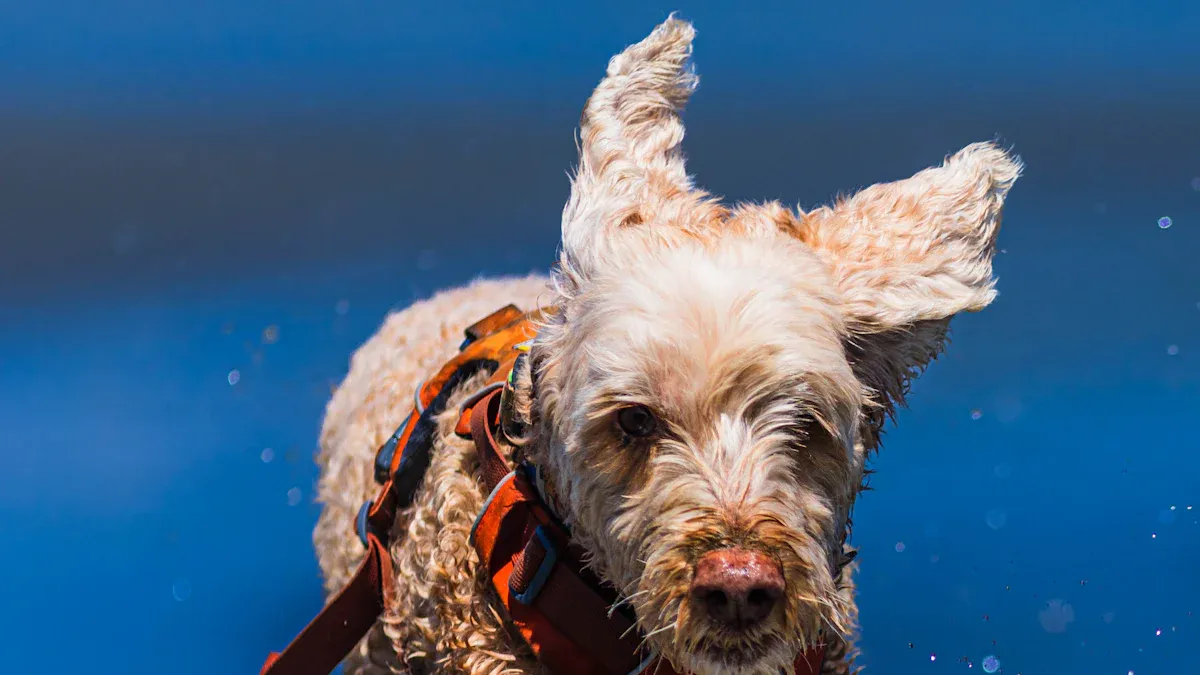
Soft Edge Binding and a Low-Friction Finish
A life jacket that prevents rubbing starts with the edge that contacts the dog most. Soft binding — neoprene or a neoprene-faced polyester — deforms under the light pressure of a paddling stroke. Instead of presenting as a fixed ridge, the edge gives way at the contact point.
The finish matters equally. A smooth-faced binding with a low coefficient of friction when wet reduces the shear force transmitted to the skin. A quick comparison: rub the armhole binding between your fingers under running water. The surface that feels slippery rather than grabby will generate less friction against the dog’s skin during repetitive motion. The way a life jacket integrates fit, strap placement, and edge finishing determines whether a dog builds swimming confidence or develops water reluctance.
Front-Leg Clearance and a Flexible Chest Panel
Clearance is not about making the armhole bigger — it is about where the armhole sits relative to the shoulder joint. A well-placed armhole centers the opening slightly forward of the joint, so the dog’s natural range of motion never forces the edge into the armpit crease.
Lift your dog’s front leg forward to roughly the angle it reaches during a swim stroke. If the jacket edge contacts the armpit crease before the leg reaches full extension, the clearance is insufficient for swimming — even if it looks fine standing still. A fit checklist that works for swimming includes wet-state checks that a dry-land fitting cannot replicate.
A flexible chest panel uses segmented or articulated foam that bends at the midline rather than bridging across it. This lets the panel follow the chest contour when the ribcage expands during exertion, instead of pressing back as a rigid plate.
Strap Placement That Secures Without Restricting
Strap routing determines where tension forces land on the dog’s body. A neck strap set too high pulls the jacket upward when the dog’s head is low in the water — which is exactly where it sits during active swimming. A belly strap set too far back allows the rear of the jacket to float up, tilting the dog forward and shifting armhole contact pressure toward the front of the armpit.
The right strap layout anchors the jacket at three points: behind the shoulder blades, at the narrowest point of the belly behind the ribs, and under the chest. Tension from water drag distributes across the torso rather than concentrating at the armholes. A life jacket with segmented flotation panels and soft-bound armholes addresses the main friction points without adding bulk.
| Design Feature | Where It Fails | Better Design Approach |
|---|---|---|
| Low-cut armholes, rough edge binding | Front legs rub raw within minutes of paddling | High leg clearance, smooth neoprene-bound edges |
| Belly panel extends past the last rib | Short, choppy paddling stroke | Shorter belly panel, side foam anchored above the leg line |
| Side foam dips into leg movement zone | Uneven paddling, dog tilts to one side | Side foam anchored above the shoulder joint |
| Straps loosen when wet, poor torso contour | Vest rotates or shifts during swimming | Adjustable straps with wet-grip webbing, contoured chest panel |
| Panel covers hips, blocks knee lift | Dog cannot climb out of water | Panel stops before hind legs, belly area stays free |
Materials That Stay Flexible When Wet
Not all jacket materials behave the same way when submerged. Neoprene maintains its flexibility regardless of water temperature. Polyester webbing can stiffen in cold water — not from water absorption in the fiber itself but from surface tension between wet fibers. Ripstop nylon stays light but can become slippery against itself, which affects how well straps hold in buckles.
The key material property for rubbing prevention is wet-state flexibility combined with adequate wet-state surface friction. A material that stiffens when wet will present sharper edge contact. A material that becomes too slick when wet will let the jacket migrate, creating new rub points with each position shift. The features that matter most — soft edge binding, front-leg clearance, wet-stable strap tension — are invisible in product photos but immediately apparent in the water.
| Material | Wet-State Behavior | Main Trade-Off |
|---|---|---|
| Neoprene | Stays flexible, closed-cell surface resists water absorption | Higher production cost for clean edge finishing |
| Polyester webbing | Can stiffen in cold water, weave texture becomes more pronounced | Durable and inexpensive; less skin-friendly when wet |
| Ripstop nylon | Lightweight, tear-resistant; can lose surface friction when wet | Strong but may slip in buckles without texture backing |
| Polyurethane foam | Provides buoyancy; rigid foams stiffen further in cold water | Thicker foam = more flotation but less stroke freedom |
Shape That Follows Natural Paddling Mechanics
A dog’s paddling stroke traces a three-dimensional arc — abduction away from the body, forward extension, adduction back toward the body with downward pressure. A life jacket cut for standing posture — straight armholes, flat chest panel, symmetrical side panels — fights this motion at every phase.
A jacket patterned for swimming uses curved armhole cutouts that follow the leg’s arc. The belly panel stops short of the hind-leg movement zone. The side panels taper above the shoulder rather than extending into it. These shape decisions are visible even on the hanger: hold the jacket up and look at the armhole cut from the side. A straight vertical cut is a standing-silhouette pattern. A forward-angled or curved cut is a swimming-conscious pattern.
Measure neck circumference at the base, chest girth just behind the front legs, and body length from neck base to tail base. Use the adjustable straps to fine-tune tension at each anchor point. A stable fit that does not shift side-to-side or ride up during paddling supports the dog’s natural stroke rather than fighting it.
When Even Good Design Reaches Its Limits
A well-designed life jacket reduces rubbing substantially. It does not eliminate every scenario. Some body shapes present challenges that no off-the-rack pattern fully solves.
Dogs with very deep chests and narrow waists — Greyhounds, Whippets, some Dobermans — have a chest-to-waist taper that creates a natural slide path for any vest. The jacket migrates toward the narrowest point, pulling the armholes forward into the armpit as it moves. Short-legged, long-bodied breeds like Dachshunds and Corgis have less vertical clearance between the armpit and the ground. A belly panel that extends below the chest will contact the surface during the dog’s natural low posture, pushing the jacket upward.
Dogs with very short coats — Boxers, Pit Bulls, Vizslas — show rub marks faster not because the jacket is worse but because there is less fur to buffer the contact. The same edge pressure invisible under a double coat shows as pink skin within minutes on a single-coated breed.
Disclaimer: The fit checks and rub-pattern observations described here assume a smooth-coated or short-coated dog where skin visibility allows visual inspection. For double-coated breeds — Huskies, Golden Retrievers, German Shepherds — rub marks may be hidden under dense fur and require hand-checking: run your fingers along the armhole contact line after swimming and feel for warmth, dampness concentrated at one edge, or the dog flinching at a specific point. These are the tactile equivalents of visible redness. Additionally, dogs with a barrel chest or very deep keel may fall outside the body-shape norms that standard life jacket patterns are graded for. In these cases, even a well-designed jacket may not achieve full armhole clearance, and a custom-fit or breed-specific pattern may be necessary.
FAQ
What causes rubbing under my dog’s front legs when wearing a swim vest?
Three design factors typically contribute: stiff armhole edge binding that scrapes instead of deforming during the paddling stroke, narrow leg openings that limit the dog’s range of motion, and chest panels that extend too far forward and bunch into the armpit crease. All three become more pronounced once the jacket is wet and weighted with water.
How do I know if my dog’s life jacket fits correctly for swimming?
A dry-land fit check is not enough. After two minutes of paddling in shallow water, check whether the jacket has shifted more than a finger’s width from its original position. Look at the inner armhole edge for sharp crease marks — these indicate the opening was too tight for the dog’s stroke range. The straps should stay at the tension you set, and the jacket should not ride up toward the neck or rotate around the torso.
Can adjusting the straps fix rubbing, or do I need a different jacket?
Strap adjustment helps when the underlying design is sound but the tension is off. If the armhole binding itself is stiff and rough, or the armhole openings are fundamentally too narrow for the dog’s shoulder range, no amount of strap adjustment will compensate. In those cases the edge material and cutout shape, not the strap tension, are the root cause.






