
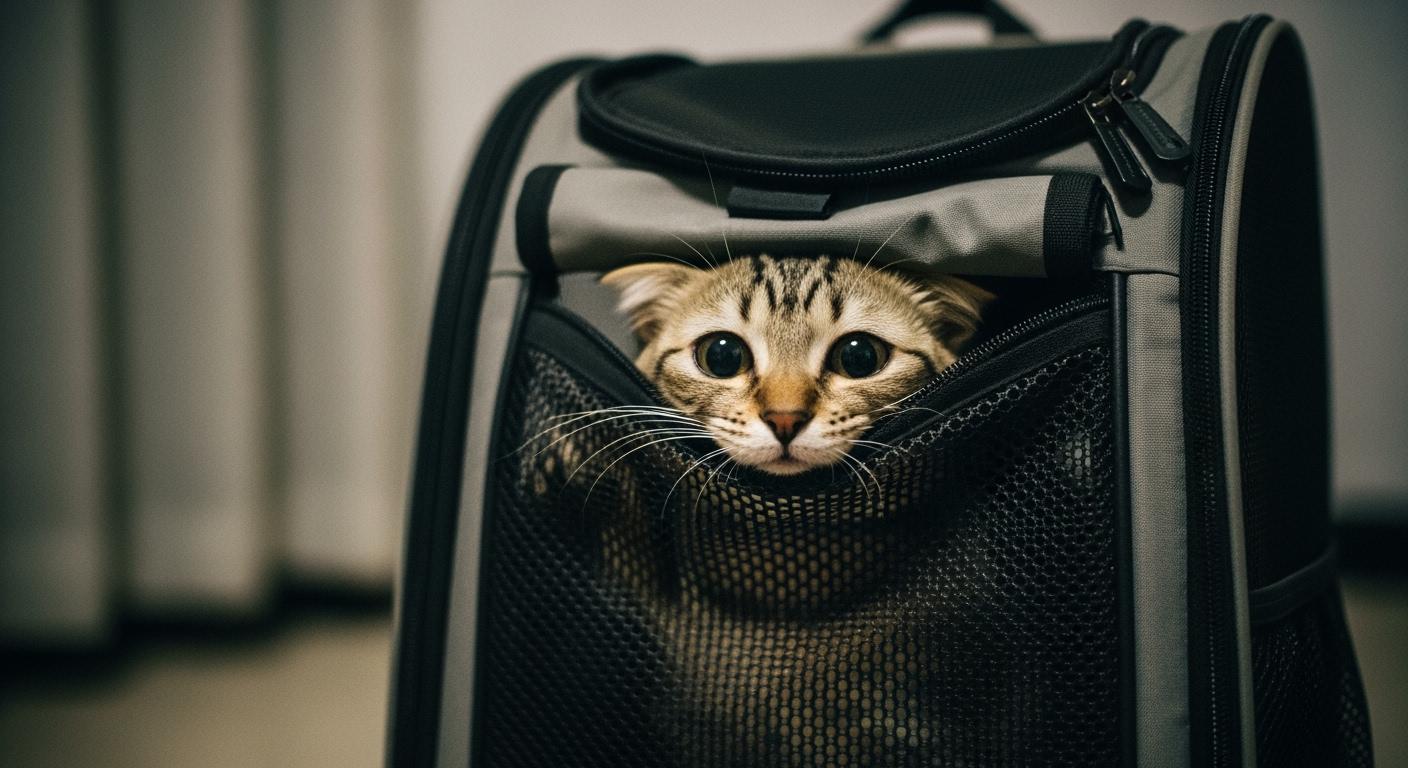
A backpack pet carrier can list breathable side mesh on the spec sheet and still leave a cat or small dog panting inside a stagnant pocket of warm air. The label is not the problem. The placement is.
Mesh that sits low on the carrier walls — below the pet’s resting face and chest — does almost nothing for the animal inside. Air moves at the breathing zone or it does not matter. The gap between “has mesh” and “breathes well” is a design gap, and it opens up in three specific ways: where the mesh sits, how large the openings are, and whether the carrier structure keeps those openings clear when the pet shifts position.
| Mesh placement issue | Real-use problem inside carrier | Better design direction |
|---|---|---|
| Mesh below pet’s face/chest | Airflow misses the breathing zone entirely | Pet-height mesh, cross-ventilation path |
| Small or blocked mesh panels | Heat trapped, no air exchange | Large, unobstructed, bilateral mesh openings |
Why Mesh Placement — Not Mesh Presence — Determines Whether a Backpack Carrier Breathes
The Breathing Zone: Face, Chest, and Upper Body
A cat curled inside a backpack carrier for cats and small dogs does not breathe through its lower back. The nose, mouth, and upper chest are where heat and moisture leave the body. Mesh that sits below this zone — near the carrier floor or mid-body — leaves exhaled warm air with no exit path. It rises, hits the solid fabric ceiling, and pools.
This is the simplest airflow dynamic inside any enclosed carrier: warm air climbs. If the only mesh openings are at or below mid-height, there is no cross-ventilation. Air enters low, warms, rises to the top, and stays there. The pet breathes the same increasingly humid air until the carrier is unzipped.
Tip: After a 15-minute walk with the carrier, unzip the top and place your hand near where the pet’s face was resting. Warm, still air at face level means the mesh is not aligned with the breathing zone — regardless of how much mesh the carrier has.
Mesh at pet-height — lining up with where the animal’s nose and chest actually sit — lets exhaled air exit sideways while cooler air enters from the opposite panel. This is the minimum anatomy of cross-ventilation. Without it, every other breathability feature is cosmetic.
How Cross-Ventilation Works Inside a Backpack Carrier
Two large mesh panels on opposite sides create a pressure differential when the carrier is in motion. Walking forward pushes outside air against the front or side panel. That air enters the carrier, travels across the pet’s body, and exits through the far-side mesh — carrying heat and moisture with it.
| Mesh Coverage | Temperature Impact |
|---|---|
| Under 30% of surface area | Temperature inside climbs steadily over 30 minutes |
| 50% or more of surface area, bilateral | Temperature stabilizes closer to ambient, especially in motion |
Surface coverage matters, but it is the pairing of panels that creates the airflow tunnel. One large mesh panel with a solid opposite wall produces far less air exchange than two moderate panels facing each other. The airflow path — not just the total mesh area — determines whether the carrier ventilates or merely has windows.
This is also where backpack carrier fit and sizing intersect with ventilation. If the carrier is too small, the pet’s body presses against both side walls simultaneously, blocking airflow on both sides. The mesh itself is open, but the pet occludes it. Enough internal width to keep a small air gap between the animal and each mesh panel is as important as the panel size.
Everyday Conditions: Walking, Waiting, Car Rides
Cross-ventilation works best when the carrier is moving — walking generates the pressure differential that drives air through. When the carrier sits stationary (waiting at a vet, stopped in a car), airflow drops to passive convection only. This is when mesh placement matters most sharply.
| Condition | What happens to ventilation |
|---|---|
| Walking with carrier | Motion-driven cross-flow is at its highest; mesh at pet-height performs best |
| Stationary, indoors or in shade | Passive convection only; mesh placement is the sole driver of air exchange |
| Direct sun, high heat or humidity | No passive-ventilation carrier can maintain comfort; external cooling is required |
The stationary condition exposes design shortcuts. A carrier that only ventilates while moving is under-designed for half of real-world use.
Where Low Mesh, Small Panels, and Blocked Openings Fail
Mesh Panels Below the Breathing Zone
When mesh sits low on the side walls, a pet lying down covers it with its own body. The panel is technically open but functionally blocked. The air above — at face and chest level — sits behind solid fabric.
This is the most common failure mode in carriers marketed as breathable. The mesh exists, so the claim is defensible. But in the position the pet actually occupies — curled, resting, head lowered — the mesh is irrelevant.
Tip: Place a stuffed toy or folded towel roughly the size of your pet inside the carrier, lay it in a resting curl, and look through the side. If you cannot see the toy’s “face” area through mesh, neither can outside air reach it.
Small or Isolated Mesh Panels
A single small mesh window on one side does not ventilate — it creates a single-point air leak. Heat still pools at the top. Moisture from panting still saturates the interior air. The panel may look intentional on a product page, but in use it provides roughly the same air exchange as leaving the zipper cracked open half an inch.
Large bilateral panels are not a cosmetic preference. They are the mechanical minimum for backpacking and hiking with a pet carrier, where the carrier stays closed for extended periods and passive airflow must do all the work.
Mesh Blocked by Pockets, Straps, and Collapsing Fabric
Some carriers place storage pockets directly over side mesh panels. Others route straps across them. When the carrier is worn, the wearer’s back presses against one panel, cutting airflow on that side. If the carrier lacks internal structure, the side walls buckle inward when the shoulder straps are tightened, and the mesh panels fold or collapse.
| Mesh placement issue | Real-use problem inside carrier | Better design direction |
|---|---|---|
| Mesh below pet’s breathing zone | Airflow blocked by pet’s own body | Mesh at pet-height, stable carrier shape |
| Small or isolated side mesh | No cross-ventilation path forms | Large bilateral panels, unobstructed |
| Mesh blocked by pockets or straps | Airflow cut on wearer-facing side | Mesh panels placed clear of strap paths and external pockets |
Openings That Only Work When the Pet Stands Upright
Top-only mesh openings create a ventilation path that disappears the moment the pet sits or lies down. A cat in a vertical backpack carrier may spend most of the trip resting at the bottom, head lowered, with no airflow reaching its face. The top mesh vents heat from the ceiling — which helps — but does nothing for the breathing zone below.
Vertical carriers amplify this effect. The narrow internal shape restricts air circulation around the body, and if the only mesh is at the top, warm air rises and stalls at the ceiling while the pet breathes the same re-circulated air near the floor.
Structure Is What Keeps Ventilation Working
Why a Rigid Frame Determines Whether Mesh Stays Open
A mesh panel’s ventilation value is zero if it collapses against the pet. Carrier structure — not mesh material — is what prevents that collapse.
Here is the causal chain: when shoulder straps are tightened for carrying, they pull the carrier body against the wearer’s back. This compresses the rear wall inward. If the carrier walls are soft fabric with no internal frame, the compression travels through the structure and bows the side walls inward as well. The mesh panels — even large ones — buckle, fold, or press against the pet inside. Airflow stops.
A semi-rigid frame — typically a stiffened bottom board with reinforced edge piping or lightweight internal stays — isolates the strap tension from the mesh panels. The straps pull on the frame, not the fabric walls. The side mesh stays flat and vertical. Air moves through it whether the carrier is on the wearer’s back or set on the ground.
| Structural feature | How it affects airflow |
|---|---|
| Rigid bottom board | Keeps base flat; prevents floor sag that pulls side mesh inward |
| Semi-rigid side panels or edge stays | Isolate strap tension from mesh panels; mesh stays open when carried |
| Reinforced mesh edges | Prevents panel from folding or tearing under repeated compression |
| Mesh at pet-height | Aligns airflow path with the breathing zone regardless of pet position |
Tip: Load the carrier with a 5-8 lb weight — a bag of rice or a weighted blanket — and tighten the shoulder straps. Look at the side mesh panels. If they bow inward or wrinkle, the carrier structure is transferring strap tension to the mesh, and ventilation will be reduced when worn. A carrier with proper internal framing shows flat, unchanged mesh panels under the same load.
Ventilation Combined with Visibility, Security, and Fit
Mesh panels serve more than airflow. They give the pet a view of the outside, which tends to reduce stress-related panting and restlessness — two behaviors that raise internal temperature and humidity independently of ambient conditions. A stressed pet pants more, producing more moisture, which saturates the interior air faster. Mesh that provides both airflow and visibility attacks the ventilation problem from two directions: moving stale air out and reducing how much moisture the pet generates in the first place.
Security features — a properly sized and adjusted carrier with an internal safety tether — keep the pet from shifting against the mesh and blocking it. A pet that slides or scrambles inside the carrier presses against one panel, cutting cross-flow on that side. A snug but not tight internal dimension combined with a tether keeps the pet centered, preserving the air gap on both sides.
When Breathable Side Mesh Alone Reaches Its Limit
Mesh panels — even ideally placed, large, and kept open by a rigid frame — cannot overcome every thermal condition. High heat, direct sunlight, and high humidity each attack the ventilation system differently.
In direct sun, the carrier’s solid fabric panels absorb radiant heat and re-radiate it inward. The mesh panels let light in but also let heat in. On a 90°F day with direct exposure, the interior of any soft-sided carrier climbs toward ambient-plus-radiant, and passive airflow cannot keep up.
Materials and construction choices also influence thermal behavior. Dark-colored fabrics absorb more radiant heat than light colors. Thick padding on the back panel — the side against the wearer — traps body heat from the person carrying the pack, transferring it into the carrier interior. A breathable carrier worn against a hiker’s warm back on a summer trail faces heat input from two sources: the sun and the wearer.
Disclaimer: This analysis assumes a short-coated cat or small dog in moderate conditions below 80°F. Brachycephalic breeds — Persians, Bulldogs, Boston Terriers — may show heat stress at lower temperatures even with optimal mesh placement. If a pet pants with its mouth fully open inside the carrier, regardless of mesh design, that is a stop-and-cool-down signal, not a sign to buy a different carrier. No passive-ventilation backpack carrier replaces active cooling, shade, and limiting carry time in hot weather.
Microclimates form quickly inside carriers. A pet panting for five minutes can raise the interior humidity enough that evaporative cooling — the pet’s primary heat-shedding mechanism — becomes ineffective. Mesh panels vent moisture, but in humid outdoor air the moisture gradient is shallow and drying is slow. The carrier interior reaches equilibrium with outdoor humidity, and the pet’s panting adds moisture faster than passive airflow can remove it.
This is not a design failure of mesh. It is the physical ceiling of passive ventilation. When conditions exceed what any mesh panel arrangement can handle — high heat plus high humidity plus direct sun — the correct response is not a different carrier. It is shade, water, and shorter carry intervals.
Airline travel with a backpack carrier introduces its own ventilation constraints. Under-seat stowage limits airflow around the carrier exterior, reducing the pressure differential that drives cross-ventilation. Cabin air is typically dry, which helps with moisture removal, but the restricted space around the carrier means mesh panels depend almost entirely on passive convection — not motion-driven airflow — for the duration of the flight.
FAQ
How can I tell if my carrier’s mesh is at the right height for my pet?
Place your pet — or a similarly sized stuffed object — inside in its typical resting position. Look through the side mesh from the outside. If you can see the area around the animal’s face and upper chest through the mesh, the panels are at breathing-zone height. If you see only the animal’s lower back or the carrier floor through the mesh, the panels are too low.
Is more mesh always better for ventilation?
Not necessarily. Two moderately sized mesh panels on opposite sides create cross-flow. One very large panel with no opposite opening creates a pressure dead-end — air enters but has no exit path. The pairing of panels determines whether air moves through the carrier or merely enters and stalls.
Does a rigid carrier frame really affect airflow, or is it just about durability?
A rigid frame prevents the side walls from buckling inward when shoulder straps are tightened. If the walls buckle, mesh panels fold or press against the pet, cutting airflow. The frame’s ventilation role is as important as its structural role — it protects the airflow path, not just the carrier shape.
What should I watch for during travel that signals the ventilation is not keeping up?
Panting with an open mouth, restlessness combined with scratching at the mesh, and a shift from settled resting to frequent repositioning are all early signals. If the pet’s fur near the chest or neck feels damp to the touch after 20 minutes inside, moisture is not being cleared — the ventilation rate is too low for the conditions.






