
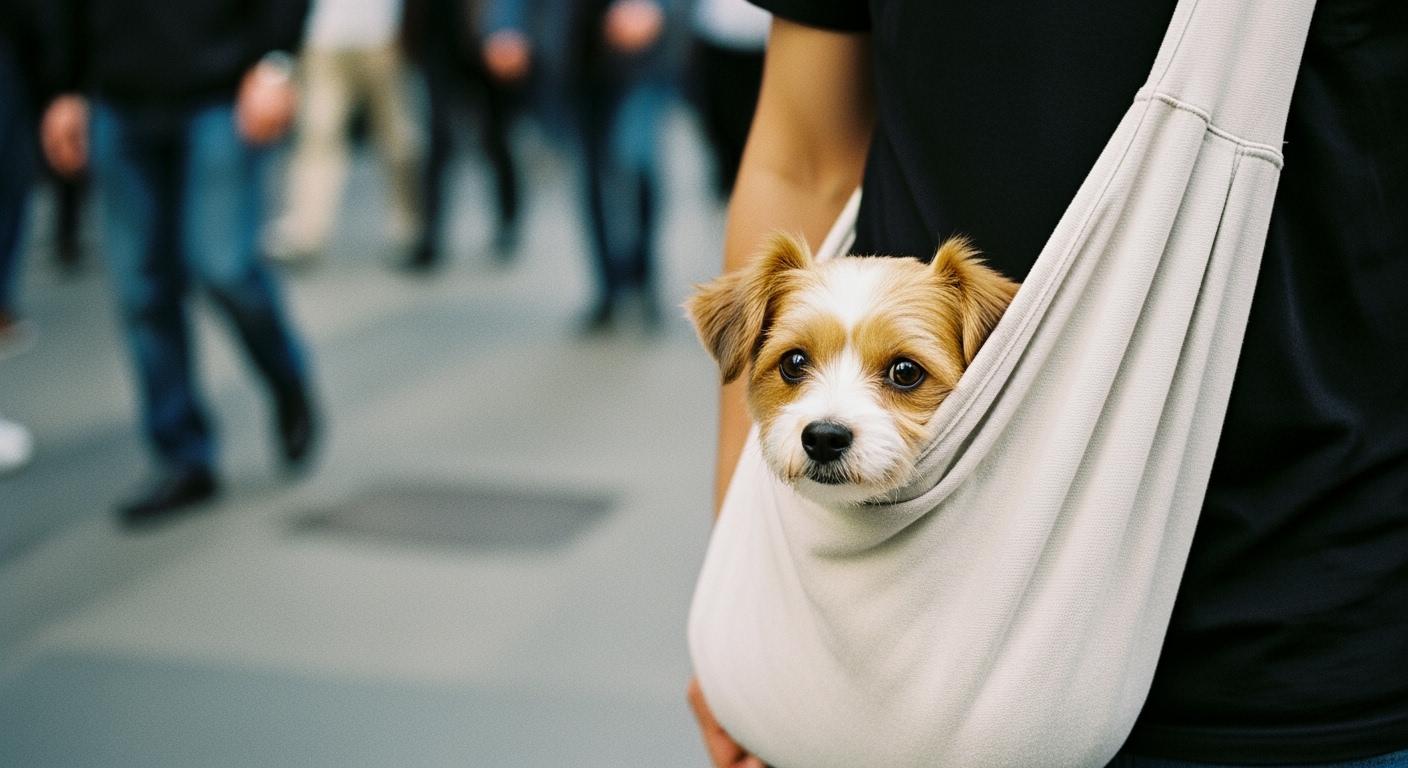
A sling carrier opening that is too loose for a small dog is not just a comfort complaint. It is a structural failure. When the opening edge sags below the dog’s center of mass, the rim becomes a pivot point — the dog’s own weight, multiplied by even gentle movement, pushes the edge lower and the dog closer to tipping out. The opening widens. The carrier stops working as a container and starts working as a ramp.
The fix is not a smaller bag. It is a set of design decisions that control the opening geometry under load: a stable rim that resists deformation, an adjustable top closure that sets the opening height to match the dog’s torso, and structured side panels that prevent the carrier mouth from collapsing when the dog shifts. These three features, working together, determine whether a sling holds its shape during a walk or slowly opens into a hazard.
Why a Loose Opening Is a Structural Problem, Not a Sizing One
How Small Dog Body Mechanics Interact with the Opening
Small dogs sit differently in a sling than medium or large breeds. Their center of mass sits proportionally higher in the carrier. Their back length and chest girth are compact, so less of their body sits below the rim line. If the opening is wide or soft, the dog’s shoulder pressure against the front edge creates a forward moment — a rotational force that tilts the dog toward the opening. The shorter the dog’s torso relative to the pocket depth, the less counter-leverage the carrier provides against this tilt.
| Measurement Type | Description |
|---|---|
| Back Length | Base of Head to Top of Tail |
| Chest Girth | Widest Part of Ribcage – Behind the Legs |
| Neck | Measure the Base of the Neck |
An adjustable top closure changes this equation. By setting the opening height to just above the dog’s shoulder line, the closure moves the pivot point higher than the dog’s center of mass. Forward lean no longer translates into forward tipping because the edge sits above the point where the dog can apply leverage. The carrier’s structure — not the dog’s restraint — keeps the body inside.
Movement Amplifies Every Millimeter of Slack
Standing still, a slightly loose opening may seem harmless. But the carrier is rarely static. Walking produces a pendulum motion: the sling, suspended from a single crossbody anchor, swings laterally with each step. When the wearer turns, climbs stairs, or navigates a crowded sidewalk, the dog’s weight shifts off-center. A soft rim flexes under this lateral load. The opening widens. The pocket depth effectively decreases as the base panel shifts.
This is why a sling carrier built for short errands and busy sidewalks needs more than a deep pocket. It needs a rim that resists torsional flex — the twisting force that comes from the dog’s weight swinging side to side. A rim that holds its arc under lateral load keeps the opening geometry stable. The dog may shift, but the carrier does not follow.
In practice: Walk 10 minutes with the sling loaded and check whether the front edge has dropped. If the rim sits visibly lower than when you started, the carrier is losing structural integrity under sustained movement — not just during sudden turns.
Where Open-Top Sling Designs Break Down
Soft Rims and the Collapse Cascade
A soft, unreinforced rim starts a predictable chain of failures. Step one: the dog leans forward to look out. The fabric edge flexes downward. Step two: with the rim now lower, the dog’s shoulder sits above the edge rather than behind it. The dog feels the shift and leans further. Step three: the base panel sags under the redistributed weight, pushing the dog’s hindquarters down and the front half up and forward. The opening has now become an exit.
This cascade happens faster than most owners expect because each failure feeds the next. A structured rim interrupts the chain at step one — the edge does not flex, so the dog cannot initiate the lean-flex cycle. The opening stays where it was set.
Shallow Depth and Missing Side Structure
Depth without structure is nearly as bad as no depth at all. A shallow pocket places the dog close to the rim even when sitting correctly. But a deep pocket with weak side panels creates a different problem: the fabric bows outward under pressure, effectively shallowing the carrier as the dog moves. The dog ends up closer to the opening than the pocket dimensions suggest.
Structured side panels resist this bowing. They keep the carrier walls vertical under load, preserving the designed pocket depth regardless of how the dog shifts. Combined with a stable rim, they create a three-sided enclosure that the dog’s body cannot gradually reshape during a walk.
| Failure Signal | Likely Sling Design Cause | Better Design Direction |
|---|---|---|
| Dog leans out | Loose, wide opening | Adjustable top closure |
| Sling mouth collapses | Soft rim, weak side support | Stable rim and structured side panels |
| Dog slides toward edge | Shallow pocket depth | Deeper pocket and inner safety tether |
| Sling swings off body | Poor strap position | Close crossbody fit |
No Closure, No Containment
An open-top sling without any form of adjustable closure relies entirely on pocket depth and rim height to contain the dog. That works on a calm dog standing still. It falls apart when the dog is anxious, curious, or simply shifts to reposition. An adjustable top closure — whether a drawstring, zippered panel, or cinch strap — gives the carrier a variable geometry that open-top designs lack. The same sling can be set wider for a relaxed dog at home and drawn closer for a busy street.
An inner safety tether clipped to a harness adds a mechanical backup, but it should not be the primary containment strategy. A tether catches the dog after it has already climbed to the rim. A properly adjusted closure prevents the dog from reaching the rim in the first place — a design difference that separates active containment from passive catch.
What Carrier Structure Actually Keeps a Small Dog In
Rim Construction and Edge Stability
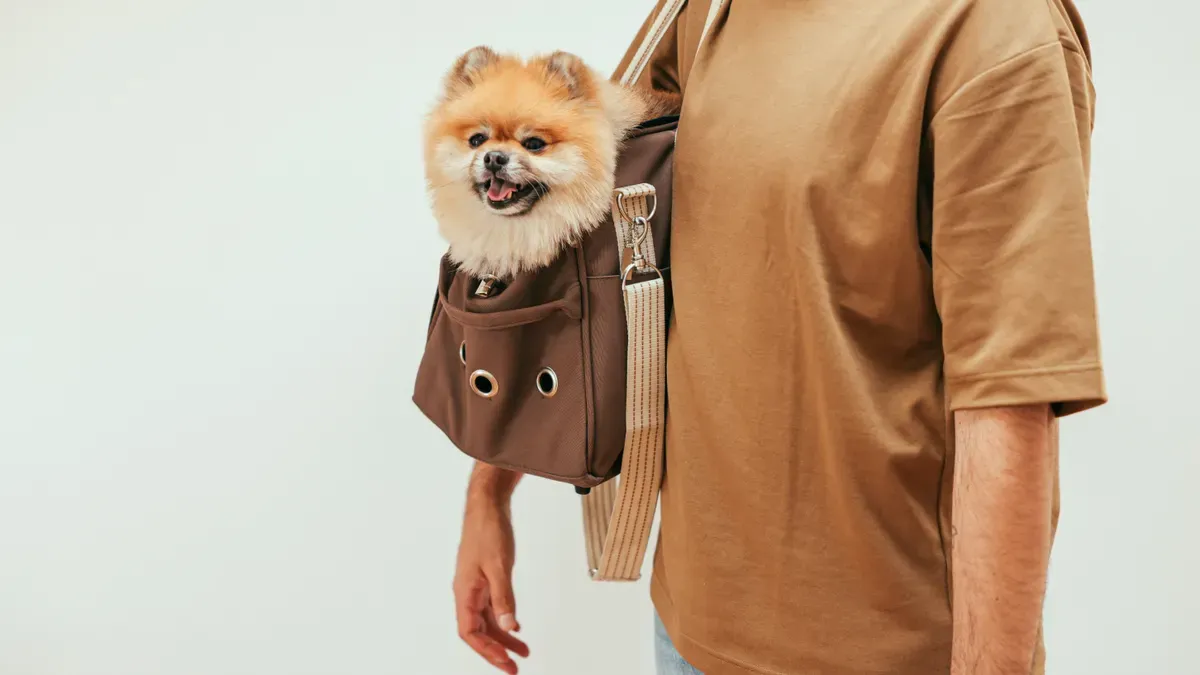
The rim is the single most influential design element for opening control. A rim that holds its arc under load does three things simultaneously: it sets a fixed upper boundary the dog cannot push past, it distributes lateral force around the carrier circumference instead of concentrating it at the front edge, and it preserves the relationship between pocket depth and opening height regardless of how the dog moves inside.
Reinforced rims — typically a dense foam cord or plastic stiffener sewn into a fabric channel — provide this stability without adding bulk. The stiffener works in compression when the dog pushes outward and in torsion when the carrier swings. A rim that is merely thick fabric, without a discrete stiffener, compresses under the same forces. The difference is visible: after a walk, a well-structured sling returns to its original shape. A soft-rimmed sling stays deformed.
Adjustable Top Closure as Geometry Control
The top closure does not just make the opening smaller. It sets the relationship between the opening height and the dog’s shoulder line — a geometric variable that determines whether the rim acts as a barrier or a fulcrum. When the closure sits above the dog’s shoulders, forward pressure meets a fixed surface above the center of mass. The dog stays in. When the closure sits at or below shoulder height, forward pressure meets a surface the dog can lever against. The dog tips out.
Drawstring closures offer continuous adjustability, letting the owner set the exact opening width for the dog’s build. A zippered panel provides a more rigid partial closure — less adjustable but more resistant to being pushed open by a determined dog. The right choice depends on the dog’s temperament, but either mechanism beats an open-top design that offers no geometry control at all.
Tip: After adjusting the closure, press gently downward on the front edge. If it deflects more than half an inch, the rim lacks the stiffness to hold the closure setting under the dog’s actual weight.
Pocket Depth, Base Support, and the Crossbody Anchor
A deeper pocket lowers the dog’s center of mass relative to the rim, increasing the mechanical advantage the carrier has against forward tipping. But depth alone creates a new problem: if the base panel is unsupported, the dog’s weight sinks it downward, stretching the carrier vertically and effectively moving the rim lower relative to the dog. A reinforced or padded base panel prevents this vertical stretch, preserving the designed depth under load.
The crossbody strap position matters here too. A strap that anchors the carrier close to the wearer’s torso reduces lateral swing. Less swing means less off-center loading on the rim and side panels. The carrier stays aligned with the wearer’s body, and the dog’s weight stays centered in the pocket rather than shifting toward one edge with each step.
| Feature | Description |
|---|---|
| Curved Base Structure | Maintains balance and keeps the dog’s weight centered during movement. |
| Arch-Shaped Trapezoidal Structure | Distributes weight evenly and reduces swaying, helping dogs relax. |
| Open Top Design (with mesh) | Keeps dogs connected to you while providing safety and airflow. |
When a Tighter Opening Is Not the Answer
A sling opening should be controlled, not sealed. Small dogs, especially brachycephalic breeds or those with thick coats, generate significant body heat inside a close-fitting carrier. A fully closed top traps heat and restricts airflow through the one surface that provides ventilation — the opening itself. Mesh panels in the carrier body help, but the opening remains the primary air-exchange surface.
This is the design tension at the core of sling carrier engineering: the opening must be small enough to contain but large enough to ventilate. The solution is adjustability — a closure that can be drawn closer on a crowded sidewalk and relaxed on a quiet bench. Fixed-size openings, whether tight or loose, force a one-setting compromise. An adjustable closure lets the same carrier serve both security and airflow, scenario by scenario.
Disclaimer: This check assumes a smooth-coated dog. Double-coated breeds or dogs with thick undercoats may overheat faster even with an open mesh top — hand-check under the carrier body for dampness rather than relying on visible panting, which can be a late signal. If the dog’s chest shape falls far outside typical small-breed proportions — particularly barrel-chested breeds like Pugs or Boston Terriers — the fit checks described here may not catch every pressure point.
FAQ
How do you set the sling opening height for your dog?
Adjust the top closure so the rim sits just above the dog’s shoulder line when the dog is sitting naturally in the carrier. The dog should be able to rest its chin on the edge but not push its shoulders over it. Walk 10 minutes with the sling loaded and recheck — if the rim has dropped, the closure or rim structure is not holding.
What is the difference between a drawstring closure and a zippered panel?
A drawstring provides continuous adjustability — you set the exact opening width by pulling the cord to the desired tension. It works well for dogs that shift positions frequently. A zippered panel creates a more rigid partial closure that a dog cannot easily push open from inside, but it offers fewer intermediate settings. For dogs that actively try to climb out, the zippered panel provides more resistance to outward pressure.
Does a deeper pocket fix a loose opening?
Only partially. A deeper pocket lowers the dog’s center of mass relative to the rim, which helps. But if the rim itself is soft or the side panels bow outward under pressure, the effective opening still widens. Depth works with rim stability — not as a replacement for it.
How do you test whether the rim is stiff enough?
Load the sling with a weight roughly matching your dog — a bag of rice or flour works — and walk for 10 minutes. Check whether the front edge has dropped from its starting position. Then press down on the edge with two fingers. If it deflects more than half an inch without springing back, the rim lacks adequate stiffness for urban carrying conditions where frequent stops and turns load the carrier from multiple directions.
Can a safety tether replace a good rim and closure?
No. A tether clips to the dog’s harness and prevents a full escape after the dog has already reached the rim — it is a last-line backup. A properly adjusted closure and stable rim prevent the dog from reaching the rim in the first place. A well-designed sling carrier uses the tether as a secondary measure, not the primary containment strategy.
How does the crossbody strap position affect opening stability?
A crossbody strap that holds the carrier snug against the wearer’s torso reduces lateral swing during walking. Less swing means less off-center loading on the rim — the carrier stays oriented upright, and the opening maintains its relationship to the dog’s body. A shoulder-only carry, without the crossbody anchor, allows more independent carrier movement, which can shift the opening angle relative to the dog with each step. Secure carrying starts with strap positioning before it depends on rim and closure design.






