
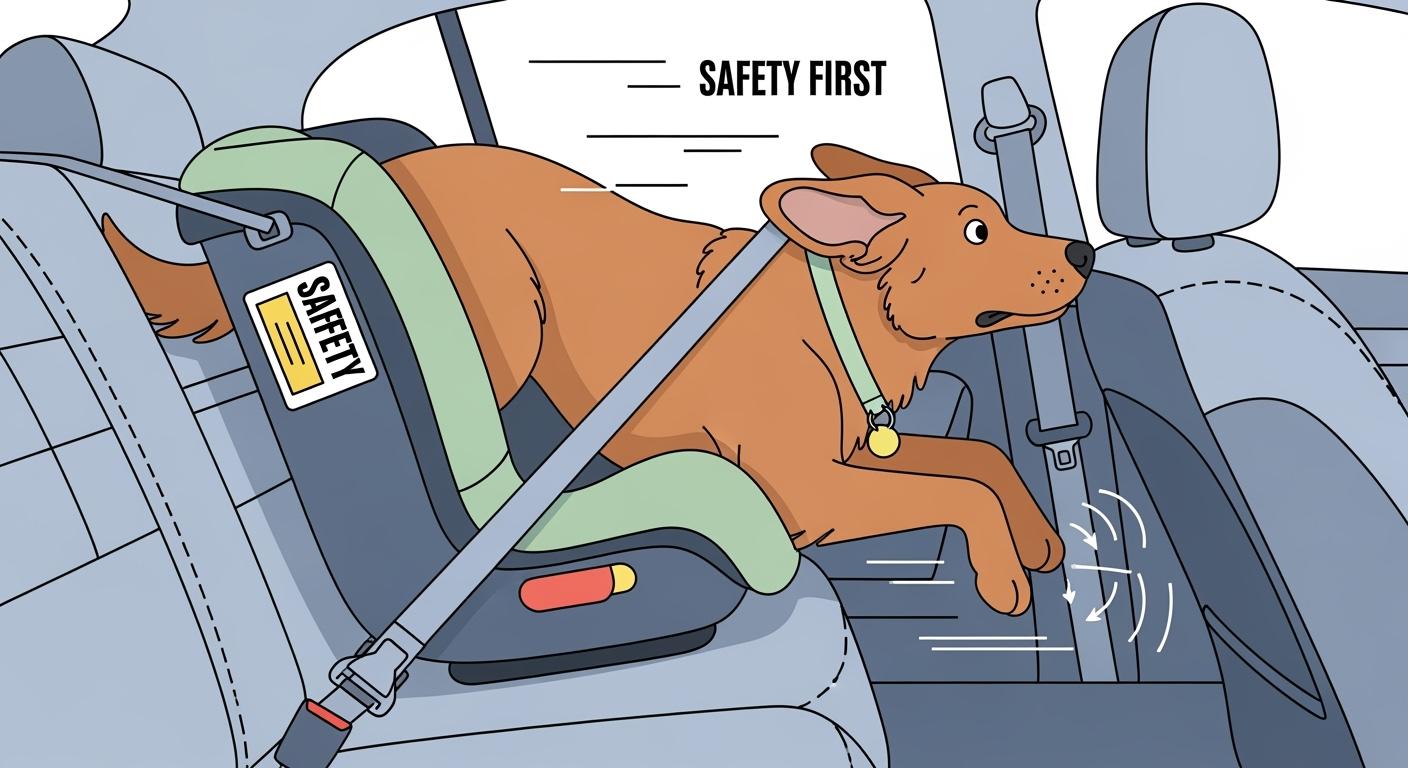
A medium dog in a raised booster seat does not sit the way a 10 lb dog sits. The extra weight sits higher off the vehicle seat, which means the center of gravity shifts upward. When the car brakes, that elevated mass converts forward deceleration into a rotational force around the base. If the base is too narrow or the anchor connection has slack, the seat tilts. That is the whole physics of it. The walls can be tall, the padding can be thick — neither stops a tipping moment if the base-anchor relationship is not right.
Most dog car seats are patterned for small dogs and then scaled up. But mass does not scale linearly with seat dimensions. A 35 lb dog in a seat designed around a 12 lb dog creates roughly three times the forward load during a 0.6g braking event — and that load acts through a taller center of mass. The lever arm lengthens. The rotational torque on the base multiplies. This is why getting the base width and anchor geometry right for medium dogs matters more than adding another inch of foam to the bolsters.
| What you see during braking | Design cause | What fixes it |
|---|---|---|
| Seat tilts forward, front edge lifts | Narrow base plus anchor slack lets the rotational moment rotate the seat around its rear edge | Wider base footprint and anchor straps that route force through the base pan, not just the backrest |
| Dog slides or braces against the front wall | Restraint tether attaches to the seat shell rather than the vehicle anchor, so the whole unit moves | Tether connected directly to a vehicle anchor point, with the seat shell serving as positioning — not restraint |
Why the Base Decides Whether a Seat Tips
A dog car seat is a cantilevered platform with a live load on top. The forward edge of the base is the pivot point. Braking pushes the dog’s mass forward. The seat resists rotation through two mechanisms: the width of the base footprint and the tension in whatever anchors the seat to the vehicle.
The base footprint matters because it sets the lever arm for the restoring force. A base that extends farther forward relative to the dog’s center of mass creates a longer moment arm that counteracts the tipping torque. A short, square base sitting directly under the dog puts the pivot point too close to the load — there is almost no mechanical advantage resisting rotation.
Anchor routing is the second half of the equation. When the vehicle seatbelt threads through a channel molded into the base pan — rather than looping around the backrest — the tension pulls down and rearward on the structure that is actually in contact with the vehicle seat. This converts braking force into compression between the booster base and the vehicle seat cushion. If the belt only wraps the backrest, the base can still lift at the front edge because nothing is pinning it down where the rotational force originates.
The two mechanisms compound: a wide base with poor anchor routing still tips, and a well-routed anchor with a narrow base still tips. Evaluating a booster seat means checking whether width and routing work together — not whether each feature exists in isolation.
In practice: After installing a booster seat, press down firmly on the front edge with your hand. If the rear of the base lifts off the vehicle seat by more than a quarter inch, the anchor is not pinning the base. Under braking load from a 30-40 lb dog, that quarter inch becomes a full tilt.
What Changes When a Medium Dog Sits in a Booster
This is where the distinction between a booster that fits the dog’s dimensions and a booster built for the dog’s mass becomes visible. A seat can have internal dimensions that accommodate a 20-inch-long dog — the dog fits inside the walls — but still fail the braking test because the base geometry and anchor routing were designed around a lighter payload.
One way to verify this without specialized equipment: note your dog’s posture after a drive with several normal-speed stops. If the dog is consistently leaning into the front wall or has shifted position forward from where they started, the seat is rotating under load even if you cannot see it happening. The dog is compensating with body English for what the seat is not doing structurally. After a longer trip on roads with predictable braking, check whether the base has crept forward on the vehicle seat. Forward creep under repeated moderate braking signals that the anchor is slipping in micro-increments — the seat is not locked to the car, and under a hard stop it will travel farther.
Checking booster seat fit for a medium dog means testing with the actual payload weight — not just comparing the listed dimensions to the dog’s measurements. A seat can match on paper and fail under load.
| Design difference | Why it matters for medium dogs | Main limitation |
|---|---|---|
| Base pan with integrated belt channel vs. backrest-only belt loop | Routes braking force into compression between base and vehicle seat, pinning the structure at the point where rotation starts | Requires a vehicle seatbelt that locks; some older retractors allow too much payout before engaging |
| Wide footprint base vs. compact square base | Extends the restoring moment arm forward of the dog’s center of mass, making it harder for braking torque to overcome the base’s mechanical advantage | Takes up more seat width; may not fit next to a child seat or in narrow rear benches |
| Tether to vehicle anchor vs. tether to seat shell | Restrains the dog independently of the booster structure, so the seat moving does not mean the dog moves | Adds an installation step; the tether must be short enough to prevent the dog from reaching forward momentum before it engages |
When a Booster Seat Is Not the Right Choice
A raised booster works well when the dog settles calmly, the trips involve predictable braking, and the vehicle has a standard rear bench with accessible seatbelt receivers and anchor points. These are the conditions the design assumes. They are not always the conditions you have.
For a dog that paces, circles, or stands for most of the drive, a booster seat puts the dog’s center of mass even higher than the seat alone does — the dog’s constant movement creates unpredictable lateral loads that no base width can fully counteract. In that scenario, a back-seat hammock-style restraint combined with a crash-tested harness often produces a more stable result, because the dog sits directly on the vehicle seat with a lower center of gravity and the harness tether anchors independently of any booster structure.
For a dog with a barrel chest or a very deep keel — common in bully breeds and some hounds — the contoured walls of a booster may press against the ribcage in ways that flat-surface seating does not. The fit checks described earlier assume the dog’s chest profile matches the seat’s internal contour reasonably well. If the dog’s chest shape falls well outside the breed norms most booster seats are patterned for, the pressure distribution at the side walls changes, and what feels like a snug fit at a stoplight can become a pressure point after 20 minutes of road vibration.
Disclaimer: The stability checks described here assume a smooth-coated dog sitting in a standard rear bench seat with functioning retractor-lock seatbelts. Double-coated breeds or dogs wearing coats may show subtler slip signals that need hand-checking rather than visual inspection. If the vehicle has bucket-style rear seats with deep bolsters, the booster base may not sit flat even before braking — check for base-to-seat contact across the full footprint before loading the dog.
If most drives are short urban trips with frequent stops and starts, the anchor system gets more cycles per trip than it would on a highway cruise. Each stop-start cycle is a micro-test of the anchor’s ability to hold tension. A seat built for this use pattern uses anchor hardware that resists ratcheting loose under repeated load-unload cycles — a detail that matters far more in city driving than on open roads.
Removable pads and washable covers help with daily use, but they do not compensate for a base-anchor mismatch. The cleaning convenience is real; the stability contribution is zero. Restraint systems that separate the tether function from the booster positioning function avoid conflating those two jobs — and that separation is what keeps the dog secure when the seat moves.
FAQ
Why does a dog car seat tip forward even when the straps feel tight?
Tight straps can still allow rotation if they anchor to the backrest rather than routing through the base. When braking pushes the dog forward, that force rotates the seat around the point where the backrest meets the base. If the anchor is only at the backrest, the front edge of the base is free to lift. The strap tension is pulling rearward while the dog’s mass is rotating forward — the two forces act on different parts of the structure, and the base pivots between them.
How do I know if my medium dog’s booster seat is stable enough before a trip?
Load the seat with weight approximating your dog — a bag of dog food works — and push sharply forward on the front edge. Watch the rear corners of the base. Any lift at the rear means the anchor is not creating enough compression between the base and the vehicle seat. Second check: after a drive with several normal stops, run your hand along the vehicle seat where the booster base meets it. If the base has crept forward by more than a finger’s width, the anchor is slipping under repeated load.
Can a harness replace a stable car seat base for medium dog safety?
A harness tethered to a vehicle anchor restrains the dog. A stable base positions the dog. The two solve different problems. A harness clipped to a loose seat still lets the seat tip and the dog go with it. A stable seat without a harness keeps the platform flat but does not restrain the dog in a collision. The two systems working together — harness to vehicle anchor, seat to vehicle anchor, independent of each other — is what creates redundancy in the restraint chain.
Does a taller booster seat wall improve stability for a medium dog?
No. Wall height provides lateral containment — it keeps the dog from leaning out the side. It does nothing to resist forward rotation during braking. The rotational axis runs side-to-side through the base, not vertically through the walls. Tall walls on a narrow base can actually mask instability: the dog looks contained at a stoplight, but under braking the entire structure rotates forward and the walls just rotate with it.






