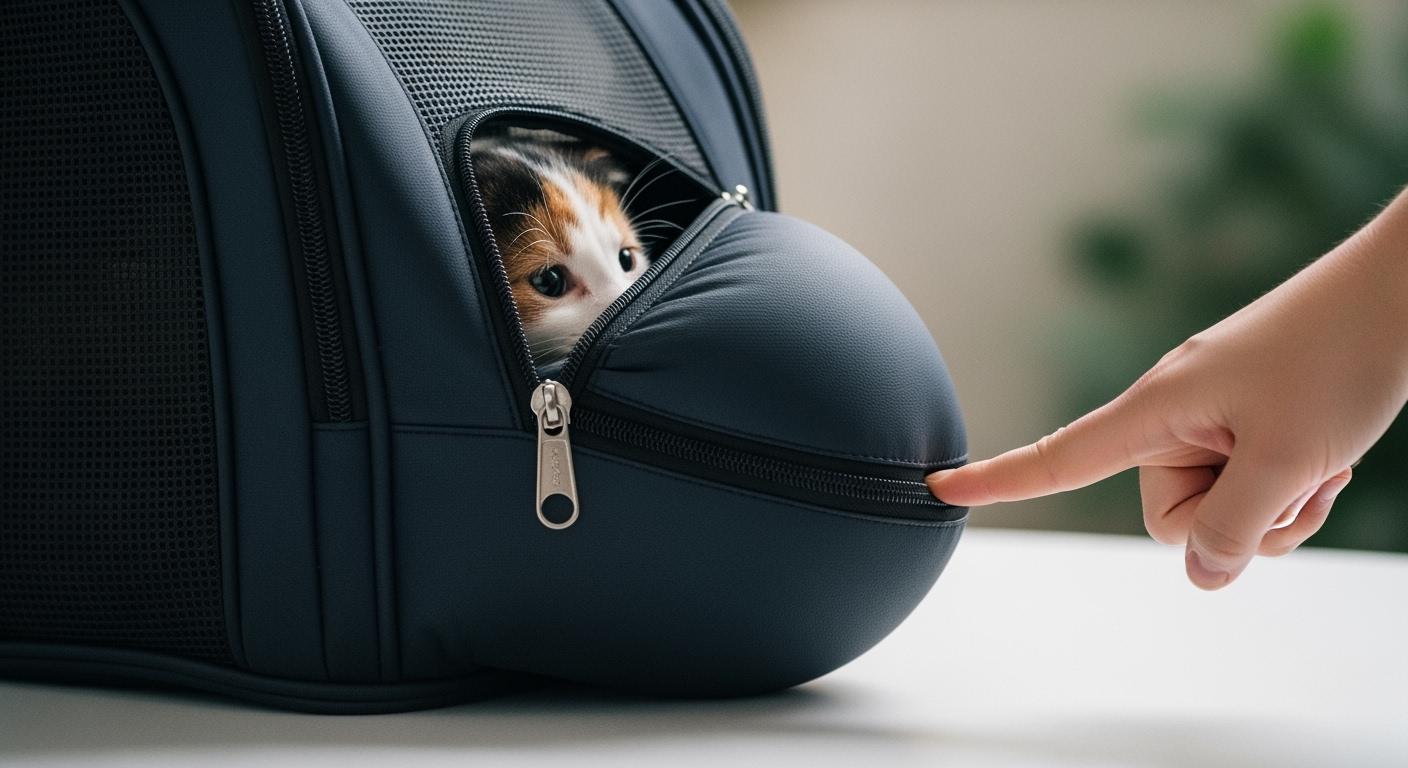
You zip your pet into a backpack carrier, take a few steps, and the side entry is open again. The pet did not chew through mesh or tear a seam. The zipper simply moved. That is not a defect. It is a design equation: where the puller parks after closing, how stiff the door panel stays under load, and whether the zipper track stays straight when internal pressure hits.
When the pet backpack carrier side entry zipper pushed open, the puller was almost certainly sitting in a pressure zone. The pet leaned, shifted, or pawed against the door, and body force traveled along the line of least resistance — straight into the zipper puller, sliding it along the track. This is not random. It follows the same force path every time.
Tip: Before every trip, close the side entry and note where the puller parks. If that spot lines up with where your pet’s shoulder or hip rests against the panel, the zipper is in a pressure zone and at risk of sliding open.
Why Side Pressure Can Push Open a Poorly Parked Zipper
How Pet Body Force Reaches the Puller
The mechanical chain is straightforward. A pet inside a carrier braces against the side panel. That contact force bows the panel outward — even a quarter inch of flex is enough. The bowing changes the local geometry of the zipper track, and if the track curves, the tension on the zipper teeth shifts. The puller, which relies on uniform track tension to stay put, now faces a differential: tension ahead of it versus behind it. Internal pressure effectively pushes the puller toward the lower-tension side.
A rigid entry frame changes the equation completely. The downward force meets a static structure that does not deform, so the opening profile stays constant through each paw placement. When the panel does not bow, the track stays straight, and the puller stays where it was parked.
This is why choosing a carrier by size and activity level matters beyond comfort — a carrier proportioned to the pet leaves less slack in the panel, reducing the deformable surface area that can transfer force to the zipper.
Zipper Movement vs. Structural Failure
Zipper movement is a specific failure mode. It is not mesh tearing, seam splitting, or buckle breakage. It happens when the puller slides along an intact track solely because internal pressure overcomes the puller’s static grip on the teeth. The zipper itself is not broken. It worked exactly as designed — it opened when force was applied in the opening direction. The question is whether the design positioned the puller to receive that force in the first place.
| Condition | What It Looks Like | Risk |
|---|---|---|
| Puller parked at reinforced terminal, panel stays flat under load | Zipper track straight, puller does not drift during movement | Low |
| Puller parked at bottom or side, panel bows outward when pet leans | Puller slides 1–2 inches within 5 minutes of walking | High |
| Paired pullers meeting mid-track, gap widens under load | Visible gap between pullers, track curves at meeting point | High |
You can verify this at home. Load the carrier with a weighted object roughly matching your pet’s weight — a bag of rice or a dumbbell wrapped in a towel works. Walk with the carrier for 5 minutes, then check the puller. If it moved from its original parked position, the entry design is transferring internal pressure to the closure. That is the signal.
Door Panel Stiffness, Track Alignment, and How Force Transfers
What Happens When the Panel Flexes
Door panel stiffness is not about material thickness alone. It is about whether the panel has internal structure that resists bowing under off-axis load. A panel supported by nylon or polyester webbing strips sewn into the perimeter — essentially a hidden skeleton — distributes force to the frame rather than to the zipper track. Without that internal structure, the entire panel acts as a lever arm. A pet pressing near the center of an unsupported panel can multiply the force that reaches the zipper by a factor of two or three compared to pressure applied near a reinforced edge.
Neoprene padding adds comfort but contributes almost nothing to structural stiffness. It compresses under load. The stiffness has to come from the webbing frame, the seam reinforcement at the corners, and the hardware anchoring the panel to the carrier body.
Single Puller vs. Paired Pullers
| Zipper Design | Puller Parking | Force Path Under Pressure | Risk |
|---|---|---|---|
| Single puller | Reinforced terminal at top corner | Force hits panel, frame absorbs it, puller isolated from pressure zone | Low |
| Single puller | Bottom or side, unreinforced | Pressure aligns with opening direction, pushes puller along track | High |
| Paired pullers | Meet mid-track | Gap at meeting point receives concentrated force, pullers spread apart | High |
Single-puller designs that park at a reinforced top terminal keep the puller farthest from where a standing or sitting pet applies the most force: the lower half of the panel. Paired pullers meeting in the middle create a concentrated opening point precisely where force is likely to be highest. If the carrier frame twists — common on uneven trails or when the wearer shifts posture — that gap widens further.
A second at-home check: unzip the side entry halfway, then press outward from inside the carrier with one hand against the center of the door panel. If the zipper track visibly curves or the puller begins to slide without you touching it, the panel is too flexible relative to the zipper’s retention strength. A carrier with a stiffer door frame and reinforced zipper terminals would not let that happen.
Note: A tabletop inspection of an empty carrier will not reveal this. The panel needs internal pressure to show whether it flexes enough to transfer force to the zipper. Always test it loaded.
When the Design Holds — and When Conditions Overwhelm It
Conditions Where a Good Design Stays Closed
A well-designed side entry — puller parked at a reinforced top terminal, panel stiffened by internal webbing, track straight under load — holds reliably during short walks, calm pets, and carriers sized correctly for the animal inside. The force a resting or calmly sitting pet applies is usually diffuse and low. It spreads across the panel rather than concentrating at one point. A rigid panel handles this without transferring meaningful load to the zipper.
The design also holds when the carrier is worn on level ground. On flat pavement or indoor floors, the carrier body stays upright and the frame does not twist. Track alignment remains consistent, and the puller stays in its reinforced parking spot. This is the operating condition the entry was designed for, and within it, the design performs as expected.
When Even a Good Entry Can Fail
An anxious pet that paws repeatedly at the side entry applies concentrated, repetitive force at unpredictable angles. No panel stiffness fully cancels a direct paw strike to the zipper track itself. If the pet’s nails catch the puller or the zipper tape, the closure can open regardless of parking position.
Extended trail use introduces a different problem: frame distortion. Over an hour or more of hiking, the carrier base can sag from body heat and moisture. This sag tilts the carrier geometry, pulling the zipper track out of alignment. A puller parked at a reinforced terminal may still hold, but a mid-track meeting point will start to drift. The carrier that passed a 5-minute living-room test may not pass a 45-minute trail test.
Carrier sizing also sets the ceiling. A pet that fills the carrier tightly has less room to shift, which keeps pressure more predictable. A smaller pet in an oversized carrier can reposition against any panel at any angle — including a paw placed directly against the zipper track. Measuring and testing fit under load is what determines whether the entry design’s protections actually reach the pet inside.
Disclaimer: These checks assume a smooth-coated dog or cat whose body shape falls within the breed norms the carrier was patterned for. Double-coated breeds or dogs with a barrel chest or very deep keel may distribute pressure differently across the side panel, producing subtler signs of entry stress that need hand-checking — run your fingers along the zipper track after a walk to feel for any widening between teeth — rather than visual inspection alone.
FAQ
Why does the zipper open even when it feels tight after closing?
Tightness at rest tells you the zipper teeth are engaged. It does not tell you what happens when internal pressure bows the panel. A zipper can feel snug at the puller and still slide open once the track geometry changes under load. The relevant test is not “does it feel closed” but “does it stay closed after 5 minutes of walking with weight inside.”
Does a locking zipper solve the problem entirely?
A locking zipper — one where the puller snaps into a fixed detent at the terminal — helps when the puller parks in a reinforced position. But if the puller parks in a pressure zone, the lock only adds a threshold the pet has to overcome. It raises the force needed, which buys time on short trips. It does not change the fundamental force path. The lock is a mitigation, not a redesign.
Are paired zipper pullers always worse than a single puller?
Paired pullers are not inherently worse. They become worse when the design parks them mid-track without reinforcement at the meeting point. A paired-puller entry with a stiffened panel, a reinforced center terminal, and a frame that resists twist can perform as well as a single-puller design. The difference is in how the meeting point is engineered — not in the number of pullers.
What should I check if the carrier passed a tabletop test but failed on a real walk?
Check three things in order. First, whether the carrier base sagged during the walk — a sagging base tilts the frame and misaligns the zipper track. Second, whether the pet’s body position shifted over time — a pet that slides lower inside the carrier applies force to a different part of the panel than where the puller was parked. Third, whether the backpack carrier’s internal support structure is maintaining tension — a panel that softens as the carrier warms up from body heat behaves differently at minute 20 than at minute zero.
A side entry that stays closed is not about a stronger zipper. It is about a design that keeps the puller out of the force path. That means a stiff door panel that does not bow, a track that stays straight under load, a puller parked at a reinforced terminal, and a carrier sized so the pet’s body cannot apply concentrated force directly to the closure. These four things — not zipper brand, not teeth size — are what decide whether the entry holds when the carrier goes from the living room to the trail.