
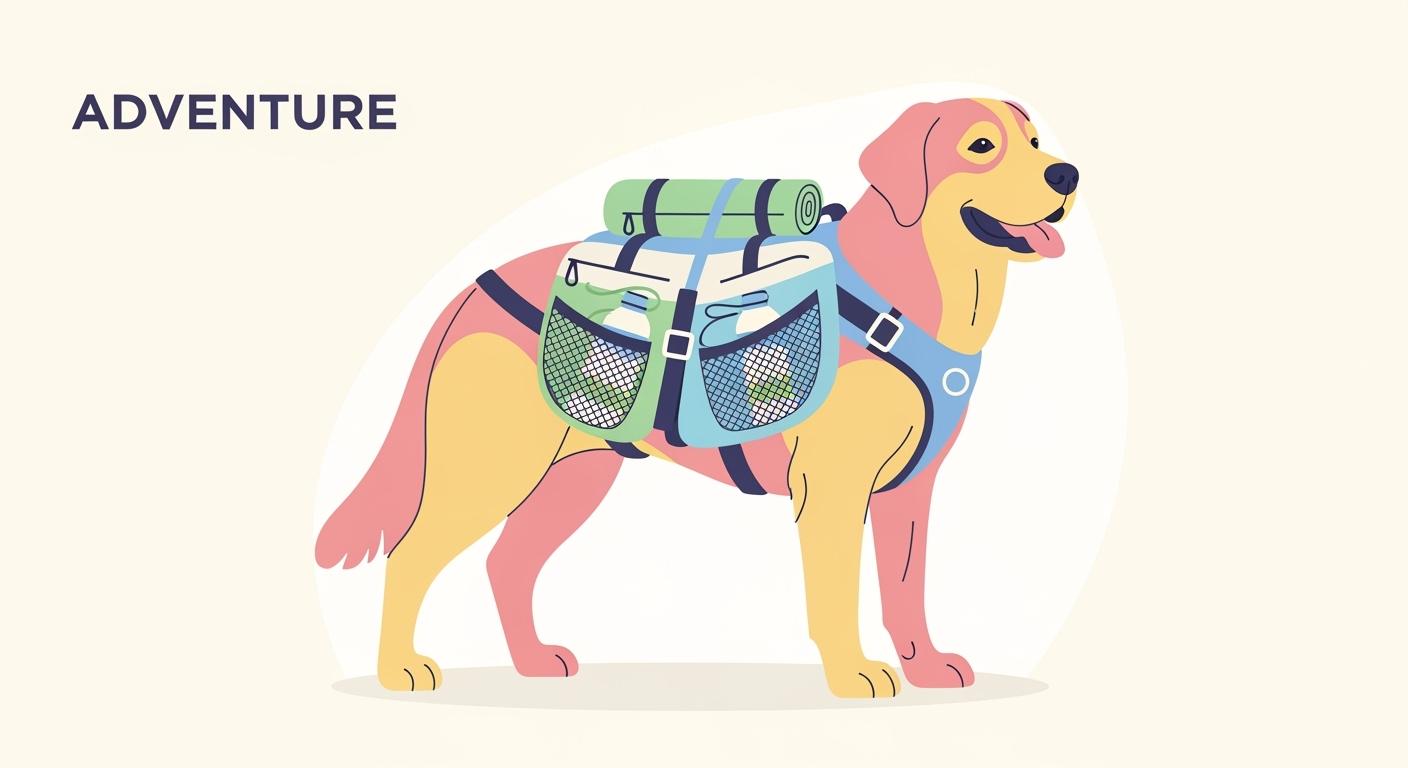
A loaded backpack harness looks straight at a standstill. Ten steps later it has drifted sideways, one pouch riding lower, the chest strap angling off center. The problem is not the dog. It is what happens when a weight distribution system has no rigid chassis to resist rotational force — and the dog underneath it has a deep chest and a long, powerful stride.
Tip: Strap tension and pouch height do more to keep a backpack centered than equal packing alone. Check both before blaming the load.
Why Side Loads Pull a Backpack Harness Off Center on Large Dogs
The Rotational Mechanics That Twist a Loaded Harness
When a side pouch carries more weight than its counterpart, gravity pulls the heavier side downward. That downward force does not travel straight through the harness — it enters at the pouch attachment point, which sits offset from the dog’s spine. The distance between the load and the spinal midline creates a torque arm. The harness back panel becomes the pivot surface, and the result is a rotational moment that twists the entire assembly around the dog’s torso axis.
Large dogs amplify this effect for two reasons. First, a deeper chest creates a longer lever arm — the distance from the spine to the lowest point of the chest gives the twisting force more mechanical advantage. Second, a longer stride means more lateral displacement per step. Each time the dog’s shoulder moves forward, the harness strap on that side goes momentarily slack. When it re-tensions, it often grabs at a slightly different angle. Over hundreds of steps, these micro-shifts accumulate into a visible drift.
When a load pulls from one side, the downward force at the pouch and the upward reaction at the back strap form a couple — two equal and opposite forces separated by distance — that rotates the harness around the dog’s ribcage. The deeper the chest, the longer the moment arm and the stronger the twist.
Loose neck-to-chest straps make the problem worse by failing to lock the shoulder straps into a closed loop. Without that loop, there is no structural path to transfer stabilizing force into the ribcage. The harness behaves like an open band — free to rotate around a single anchor point — rather than a cinched system that resists twist through tension on both sides.
How Movement Magnifies Small Imbalances
Dogs do not walk in straight lines at constant speed. Turning shifts load laterally. Stopping transfers momentum forward, then backward. Speeding up changes the tension vector on every strap simultaneously. If the side pouches sit away from the body — mounted on loose webbing or placed too low — they swing outward during turns and pull the harness with them.
An observable check: after a 10-minute walk on mixed terrain, look at the back strap’s position relative to the spine. If it has drifted more than an inch off the spinal midline, either the side loads were unbalanced or the strap tension was too low to resist the rotational forces at work. This check catches problems that a static living-room fit test misses entirely.
| Failure Signal | Likely Design Cause | Better Design Direction |
|---|---|---|
| Rubbing under belly | Rough or narrow binding edge, strap too close to front legs | Smooth wide binding, strap placed behind forelimb movement zone |
| Sagging or swinging pockets | Unstable pocket attachment, unbalanced load | Close-mounted pockets, balanced side-to-side, rigid pack chassis |
| Strap drifts rearward | Single belly strap, steep strap angle, loose pack body | Dual belly straps, shallow angle, stable harness base |
Where Strap Geometry and Chest Anatomy Create Fit Failure Points
Chest Depth, Shoulder Clearance, and Why Small Errors Show Big on Large Dogs
A deep-chested dog — think shepherd, hound, or retriever — has a chest profile that narrows significantly from shoulder to sternum. A harness strap that sits correctly at the broadest point of the ribcage may slide forward as the chest tapers, especially when the dog lowers its head or climbs. If the harness lacks a second belly strap to arrest that forward creep, the entire pack drifts.
Shoulder clearance matters separately from chest girth. A strap that crosses the shoulder joint restricts scapular rotation — the shoulder blade cannot glide freely through its range. Over multiple walks, restricted rotation can translate into altered gait and muscle tension. The difference between a harness that clears the shoulder and one that crosses it is often a matter of strap angle — a shallower angle from the chest ring to the back panel tends to route the strap behind the shoulder rather than across it.
Neck-to-Chest Strap Tension and Why It Determines Stability
The neck-to-chest strap is the component that turns a collection of separate straps into a single closed tension loop. When adjusted to the correct tension at mid-chest height, it ties the left and right shoulder straps together so that force applied to one side is distributed across both. This is the mechanism that resists rotation: a sideways pull on the left pouch tightens the left shoulder strap, which transfers tension through the chest strap into the right shoulder strap, creating an opposing force that limits rotation.
If this strap sits too loose — or too low, near the sternum rather than mid-chest — the loop does not close. Each side behaves independently. A one-sided load pulls only on its own strap, and nothing counters it. Sliding buckles let the user tune this tension for dogs whose chest profile changes between standing and walking postures. But the buckle position itself matters: placed too far forward, it rides into the armpit. Placed too far back, it loses leverage over the shoulder straps.
Strap Slack and Why Large Dogs Show Imbalance Faster
A harness with half an inch of slack may stay centered on a 20-pound dog during a flat sidewalk walk. The same half-inch on an 80-pound dog on uneven ground becomes a different problem. More body mass means more inertia during direction changes. A longer stride length means each step cycle applies force over a larger displacement. Slack that would be harmless on a small dog becomes a gap large enough for the harness to rotate several degrees per step.
Tightening straps to eliminate visible slack is the baseline. But over-tightening — especially around the chest — restricts ribcage expansion during breathing. The sweet spot is tension that removes slack without compressing the coat. A quick field test: slide two fingers under the chest strap while the dog stands. You should feel contact without resistance. Then watch the dog take ten strides. If the strap gap opens and closes with each step, it is too loose.
Design Features That Keep Side Loads Centered During Movement
Where the pouch sits relative to the dog’s torso determines how much leverage the load has over the harness. Pouches mounted low — near elbow height — place the load’s center of mass far from the spine. The result is a longer moment arm and more rotational torque per ounce of weight difference. Pouches mounted high, at mid-torso or above, bring the load closer to the spinal axis, shortening the moment arm and reducing twist force.
Attachment stability matters as much as height. A pouch sewn directly to the harness body panel moves as a unit with the dog. A pouch attached with loose webbing or bungee cord swings independently — and every swing applies a lateral tug that the harness structure must absorb. Harness designs that integrate pouches into the main body panel rather than hanging them as separate accessories tend to transmit less swing force into the strap system.
| Side Panel Height | Effect on Weight Distribution |
|---|---|
| Low (elbow height or lower) | Provides zero containment above the dog’s mid-torso; load swings outward during movement and pulls the harness off center. |
| High (mid-torso or higher) | Keeps the center of mass closer to the spine, reducing the moment arm that twists the harness under uneven loads. |
Sliding Buckle Mechanics and Close-to-Body Strap Routing
Sliding buckles serve a specific mechanical purpose beyond adjustability: they let the user set strap tension independently at the chest, belly, and shoulder positions. A fixed-length strap system forces a single tension across all three zones, which means the loosest zone dictates overall stability. Independent sliding adjusters mean the chest strap can be set tighter than the belly strap on a dog with a tapered chest — maintaining the closed tension loop where it matters most.
Strap routing that keeps webbing close to the body reduces the gap between the harness and the dog. Every millimeter of gap is a millimeter of potential displacement before the strap engages to resist movement. Close-routed straps shorten that reaction distance. After a walk in warm conditions, flip open the chest panel and feel the inner lining against your hand. If it is damp, the material is trapping heat and moisture — a sign that breathability is not keeping up with the close-body fit. If it is dry and cool, the fabric is venting adequately while maintaining tension.
| Material Feature | Effect on Weight Distribution and Stability |
|---|---|
| Weather resistance | Keeps contents dry; water absorption adds weight unevenly and can shift balance mid-walk. |
| Breathability | Reduces heat buildup under close-contact panels, preventing the dog from altering gait to escape hot spots. |
| Reinforced stitching | Maintains structural integrity at weight-bearing seams; stitch failure at one pouch shifts load to the opposite side. |
| Low-profile construction | Reduces snag risk on narrow trails; a snagged pouch yanks the harness sideways with sudden high force. |
Regular Fit Checks and What They Reveal About Design
Fit checks are not just maintenance — they are diagnostic. What the harness does after 15 minutes of movement tells you more about its design quality than any spec sheet. The table below maps what you see to what it means about the harness structure and how different walking setups affect control and stability.
| Problem | What You See | What It Reveals About the Design |
|---|---|---|
| Harness slides sideways | Back panel drifts off spinal midline | Strap loop is not closing; chest or belly tension is too low to resist rotation |
| Side bag sags | One pouch hangs lower than the other | Pouch attachment lacks rigidity or load is unbalanced between sides |
| Straps loosen during walk | Gap opens between strap and coat with each step | Buckle creep or webbing stretch; sliding adjusters may need a lock mechanism |
| Rubbing or chafing | Red skin under straps or pouch edges | Strap edge is too narrow or binding material is too stiff for the movement zone |
When a Weight-Distribution Harness Reaches Its Limits
A backpack harness distributes load across the torso, but it is not a cargo system. The design works best with moderate, evenly split loads on dogs whose chest shape matches the strap geometry. Push beyond those conditions and the same design features that work well become sources of failure.
Dogs with barrel chests — bulldogs, some mastiffs — have a chest profile that is round rather than deep. Harnesses cut for a deep-chested dog sit differently on a barrel chest: the chest strap tends to ride up toward the throat, and the belly strap loses its anchor point against the narrower waist. A backpack harness designed around a deep-chest pattern may simply not have the geometry to stabilize on these builds.
Heavy single-sided loads — a full water bottle on one side with nothing counterbalancing — defeat even the best strap system. The torque arm is too long and the force too concentrated for tension alone to resist. Checking pouch attachment rigidity and balanced packing matters more than strap adjustment when the weight difference between sides exceeds a few ounces.
Disclaimer: The fit checks described here assume a smooth-coated dog where strap position and skin contact are visually clear. Double-coated breeds — huskies, malamutes, shepherds with thick undercoat — may show subtler rub marks that require hand-checking under the coat rather than visual inspection. If the dog’s chest shape falls outside the breed norms this harness pattern was built for — particularly barrel-chested or very deep-keeled dogs — the midline drift check may not catch every pressure point. In those cases, check for hot spots by running fingers under each strap edge after removing the harness, not by watching for visible shift alone.
FAQ
How do you know if a backpack harness fits correctly before loading it?
Start with an empty harness on a standing dog. The back panel should sit centered on the spine. The chest strap should rest at mid-chest height, not near the throat or low on the sternum. Slide two fingers under each strap — you should feel contact without resistance. Have the dog walk ten strides. If any strap gap opens and closes with movement, tighten until the gap disappears, then recheck.
What causes the harness to slide sideways even when both pouches feel equally packed?
Equal weight does not guarantee equal leverage. If one pouch is mounted lower or farther from the body than the other, the same weight produces different torque on each side. Check that both pouches sit at the same height and are attached with the same strap tension. A twisted chest strap — even slightly rotated — can also create asymmetric tension that pulls the harness off center.
How often should strap tension be checked during a walk?
Check at the start and after the first 10 to 15 minutes. That initial window is when most strap settling happens — webbing relaxes, buckles micro-slip, and the harness finds its working position. After that, check whenever the terrain changes significantly or the dog has been running. A quick visual on the back panel’s position relative to the spine takes seconds.
What is the difference between a backpack harness shifting and a poorly fitted harness shifting?
A poorly fitted harness shifts on its own, loaded or not — the straps are simply too loose for the dog’s dimensions. A backpack harness that only shifts when side pouches are loaded points to a weight distribution problem, not a sizing problem. The distinction matters because the fix is different: sizing for the former, load balancing and pouch positioning for the latter.






