
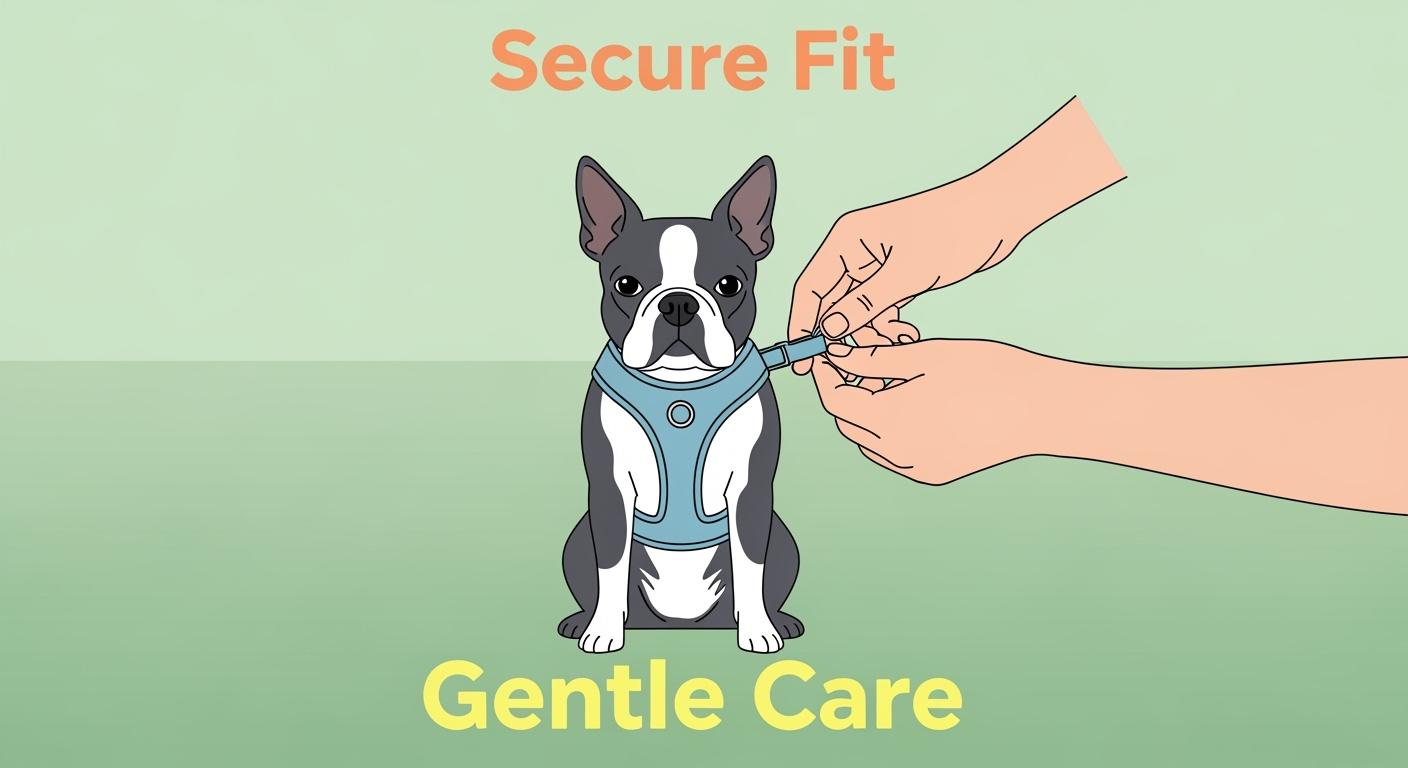
For most Boston Terriers, the best dog harness is a lightweight, adjustable chest harness that stays low on the sternum, leaves the shoulders free, and does not pile bulk across the front of the body. That matters because Boston Terriers are compact, broad-chested, and often less tolerant of throat pressure than longer-muzzled breeds.
If a harness rides up, crowds the armpits, or feels heavy in front, even a normally eager dog can start coughing, shortening stride, or resisting walks. Brand names matter less than three basics: low neck load, enough chest room, and a fit that stays centered once the leash is attached.
What usually works best on a Boston Terrier
A Boston Terrier usually does best in a harness that spreads pressure across the chest without adding a wide, stiff front panel. In real use, that often means choosing a lighter design over a more technical-looking one.
| Harness style | What it does well | Common risk on a Boston Terrier | Best use |
|---|---|---|---|
| Low-bulk Y-front | Keeps pressure on the chest and usually leaves the shoulders freer | Poor adjustment can still let the front rise toward the throat | Most daily walks |
| Low-profile step-in | Easy to put on and can feel light on a short-coated dog | Some shapes crowd the front legs or rotate off center | Calm walkers that dislike overhead gear |
| Heavy control vest | Can feel secure and offer extra attachment points | Often adds front bulk, heat, and shorter stride | Only when a lighter style clearly fails |
For a wider look at dog harness size and material choices for daily walks, the same tradeoff shows up again and again: on small, muscular dogs, lighter hardware and better adjustability usually matter more than extra padding.
Comparing adjustable dog harness styles also helps you spot whether the chest section is actually narrow enough for a Boston Terrier’s frame. If the front looks wide, stiff, or tall before you even put it on, it is unlikely to improve once your dog starts moving.
Why this breed is easy to fit badly
Boston Terriers combine a compact torso with a deep chest for their size, short coat, and a face shape that can make any throat pressure more noticeable. A harness that seems acceptable on a longer, leggier dog can feel wrong very quickly on a Boston Terrier.
- The front of the harness has to stay below the throat, not climb upward when leash tension starts.
- The shoulder area needs enough clearance for a full stride, especially on brisk neighborhood walks.
- Short coat means strap edges and seams show their problems fast.
- Heavy front coverage can feel like too much gear on a small frame.
Note: If your Boston Terrier coughs, wheezes, overheats quickly, or suddenly resists moving in a harness, stop the walk and ask your veterinarian whether the fit or the gear style is adding stress.
How to measure before you buy
Use a soft tape measure while your dog is standing naturally. Ignore size labels like small or medium until the chart matches your dog’s actual numbers.
| Measurement | How to take it | Why it matters |
|---|---|---|
| Girth | Measure around the widest part of the ribcage, just behind the front legs | This is usually the main number that decides size |
| Lower neck | Measure around the base of the neck where the harness sits, not high on the throat | Helps you avoid a front opening that rides up |
| Chest length | If the brand lists a fixed front panel, compare the distance from lower neck to the point between the front legs | Useful when a harness body looks long or bulky for a short frame |
If the chart looks close at rest but confusing once your dog moves, dog harness sizing and fit checks are usually more useful than simply choosing the larger label. A bigger harness can create just as many problems as a tight one if it starts drifting sideways.
Step-in styles are not automatically wrong for Boston Terriers, but many of the complaints about them are really step-in harness placement mistakes that show up on the first walk. If one shoulder opening sits too far back or the chest piece rotates after a few minutes, the style may not match your dog’s shape even if the girth number looks right.
| Fit check | Pass | Fail |
|---|---|---|
| Front position | Chest piece stays low and clear of the throat | Front edge climbs upward as soon as the leash tightens |
| Shoulder movement | Stride stays smooth and even | Steps get shorter, choppy, or hesitant |
| Underarm clearance | No rubbing after a short walk | Redness, licking, or hair wear appears near the armpits |
| Stability | Harness stays centered on the chest | Body twists or slides to one side |
| Overall feel | Looks light and balanced on the dog | Sags, looks oversized, or feels heavy in front |
Failure signs that matter on real walks

Throat pressure
The first red flag is upward movement toward the neck. If the front panel rises when your dog leans into the leash, the harness is no longer doing the job you bought it for. On a Boston Terrier, even light throat contact can be enough to make the walk look tense instead of natural.
Chest crowding and underarm rub
A harness can look secure and still be wrong if it crowds the front legs. Persistent redness usually points to rubbing and shoulder restriction, not stubborn behavior. Short-coated dogs show these problems early, so check the skin after the first few walks instead of assuming your dog will adjust.
Too much front bulk
A Boston Terrier does not need a large chest plate to feel secure. If the harness looks like armor, sags to one side, or makes the dog trot short and stiff, the extra material is probably doing more harm than good. This is especially common with heavily padded control styles that solve pulling by adding structure rather than improving fit.
Common buying mistakes
- Choosing the thickest padding and assuming it will be the most comfortable.
- Buying by size label alone instead of measuring girth and lower-neck position.
- Tightening every strap to stop shifting, which can create throat rise and rubbing at the same time.
- Picking a harness because it says no-pull without checking how much hardware and front coverage it adds.
- Leaving the harness on for long periods at home, where rubbing can build without you noticing.
If leash control is the real problem, a heavier harness is not always the answer. Small dogs often do better when harness-and-leash fit with the right leash length is sorted out first, because oversized clips, too much slack, or a poorly balanced leash can make even a light harness feel unstable.
For most owners, the best dog harness for Boston Terrier use is the one that disappears once the walk starts. You should notice steady movement, easy breathing, and a harness body that stays put, not extra features competing for space on a small chest.
FAQ
Is a step-in harness good for a Boston Terrier?
It can be, as long as the design stays light, keeps the chest panel low, and does not crowd the shoulders or rotate off center.
How tight should a Boston Terrier harness be?
It should be snug enough to stay centered during a walk and loose enough that your dog can breathe, turn, and stride freely without rubbing.
Can a Boston Terrier wear a harness all day?
For most dogs, it is better to use the harness for walks and remove it afterward so moisture, friction, and pressure do not build up indoors.
When should you switch harness styles?
Switch if the harness keeps climbing toward the throat, leaves rub marks, twists during walks, or makes your dog move with a shortened stride even after careful refitting.






