
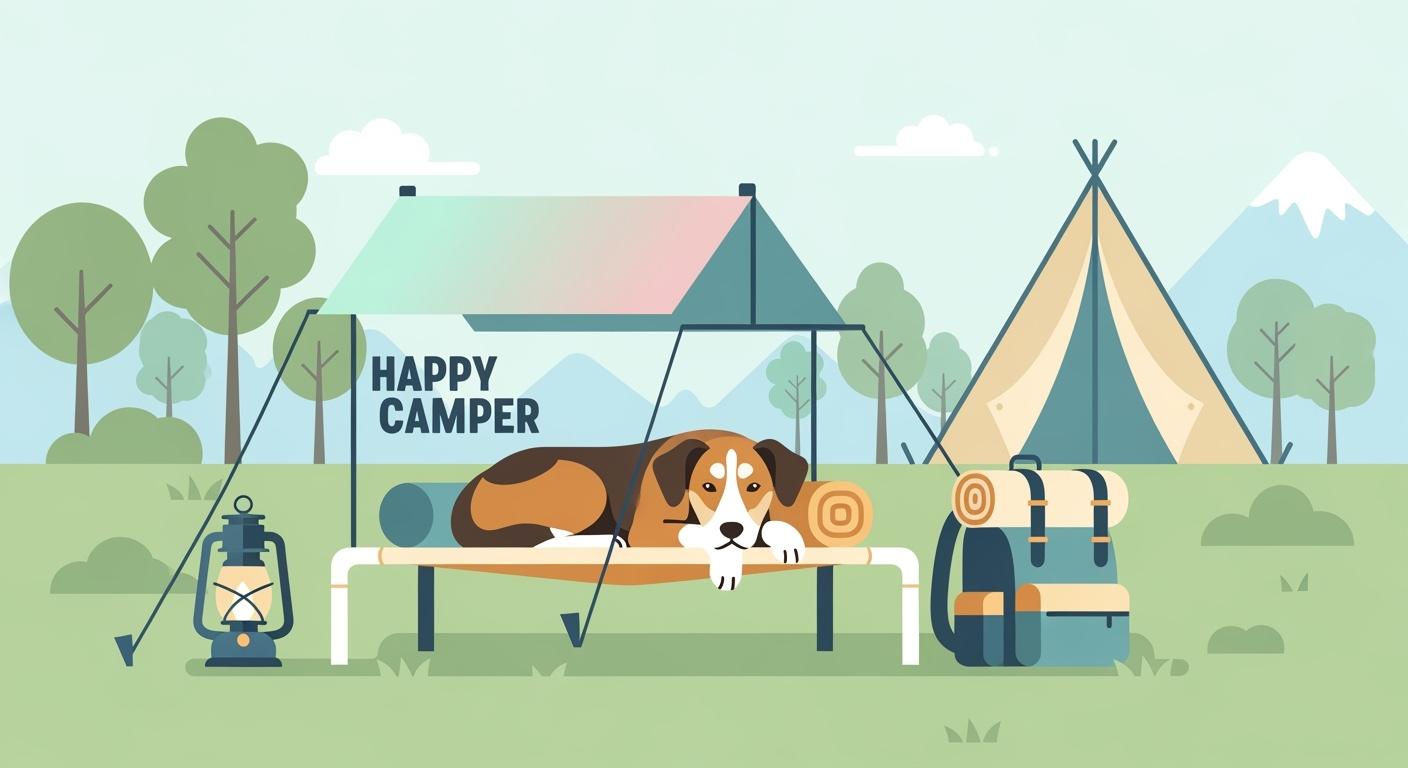
A campsite looks flat until you put weight on it. Grass that felt firm under your boot gives way when four narrow leg tips concentrate a dog’s body weight onto four small points. The bed tilts. The dog hesitates. That is the core problem an elevated dog bed with canopy for camping has to solve — and most do not solve it well.
The design difference that matters is not frame height or tubing thickness. It is how the leg ends meet the ground and how the corner joints resist twist when the surface underneath is uneven. A bed that stands dead level on a showroom floor can fail within minutes on loose soil. The question is which design details prevent that failure.
When Soft Campsite Ground Defeats a Narrow-Leg Elevated Bed
Grass, Sand, and Loose Soil Are Not the Same Surface
Indoors, the floor does not yield. Outdoors, the ground does. Thick grass hides loose topsoil underneath. Sand shifts under load with no warning. Loose soil compresses at different rates from one spot to the next — one leg finds a buried root, the neighboring leg finds a pocket of uncompacted fill. The bed does not sink uniformly. It tilts.
This matters because a dog reads instability instantly. A tilted sleep surface signals unreliability. Some dogs will refuse the bed entirely. Others will climb on but stay tense, shifting their weight in small adjustments that never quite find level. Neither outcome is rest.
Sinking Legs and Wobbling Frames: What Actually Happens
Narrow leg tips act like punches on soft ground. A 60-pound dog distributed across four contact points each the diameter of a quarter puts ground pressure high enough to exceed what loose sand or wet topsoil can support. The leg breaks through the surface. Once one leg sinks, the frame tilts. The dog’s weight shifts toward the low corner, increasing pressure on that leg further. The sink accelerates.
Weak corner joints make this worse. When the frame can twist independently of the leg positions, the bed racks into a parallelogram. The fabric no longer pulls evenly across the frame rails. One edge goes slack. The dog feels the surface deform under its weight and responds by tensing up — exactly the opposite of what a rest surface should produce.
Adding a canopy changes the math. A canopy adds weight above the frame’s center of gravity. On firm ground this is negligible. On soft ground, that top-weight biases the tilt toward whichever leg finds the softest spot first. The canopy does not cause the sink — the narrow legs do — but it amplifies the asymmetry once sinking starts.
Wide Feet and Rigid Corners: The Two Design Differences That Hold a Level Surface

Ground Pressure: Why Contact Area Decides Whether the Bed Sinks
The physics is straightforward. Ground pressure equals load divided by contact area. Halve the contact area and you double the pressure. On a surface with a bearing capacity — and all soils have one — exceeding that threshold means the leg penetrates the surface.
A narrow tubular leg end presents roughly the wall thickness of the tube as its contact ring. That is a tiny area. A wide, flared, or capped foot spreads the same load across a contact patch several times larger, dropping the ground pressure below the soil’s bearing capacity. The foot sits on top of the surface instead of pushing through it. That is the whole mechanism.
This is not a comfort feature. It is a binary pass/fail condition for soft-ground use. A bed with narrow legs will eventually sink on anything looser than packed dirt. How fast depends on soil moisture and the dog’s weight, but the outcome is the same.
In practice: After the dog has been resting on the bed for 10 minutes, walk around and check whether any leg has sunk more than half an inch deeper than the others. A tilted frame means at least one leg lost the ground pressure battle — even if the fabric still looks flat from above.
Corner Rigidity: Why the Frame Must Not Twist Independently of the Legs
Even with wide feet, a frame that twists at the corners undoes the stability. When a corner joint flexes, the leg angle changes relative to the ground. A leg that was perpendicular to the surface now meets it at a slight angle, concentrating load on one edge of the foot. That edge digs in. The leg tilts. The frame follows.
Reinforced corner brackets or welded joints prevent this by locking the leg angle relative to the frame rail. The leg cannot independently change its angle, so the foot stays flat on the ground even if the frame deflects slightly under the dog’s weight. This is why how outdoor bed materials hold up to weather and repeated stress is as much about joint design as it is about fabric choice — the corner connections take every lateral force the dog applies when climbing on or shifting position.
The frame material matters here too. Powder-coated steel tubing resists the micro-abrasion that happens when wind-driven sand and grit blast the frame over repeated trips. Bare aluminum can develop surface pitting in those conditions, which creates stress risers at the corner joints. A stable cot setup starts with getting the frame tension right, but the joint durability determines whether that tension holds across a season of trips.
| Design Difference | Why It Matters on Soft Ground | Main Limitation |
|---|---|---|
| Wide flared or capped leg ends | Drops ground pressure below soil bearing capacity; leg sits on surface rather than punching through | Adds slight bulk when folded; may catch on tent flooring if not capped smoothly |
| Reinforced corner brackets | Locks leg angle to frame rail; prevents independent leg tilt when frame flexes | Adds weight; plastic brackets can degrade under sustained UV exposure |
| Powder-coated steel frame | Resists grit abrasion and moisture corrosion better than bare aluminum in repeated outdoor use | Heavier than aluminum; coating chips expose bare metal to rust in coastal environments |
| Firm tension mesh (Oxford or Teslin) | Distributes weight evenly across frame rails; prevents hips from bottoming out against center bar | Less cushion than foam; dogs with prominent elbow calluses may need a thin pad on top |
Fabric Tension, Canopy Balance, and What Makes the Surface Usable
Why Fabric Tension Determines Whether the Dog Actually Rests
A level frame does not guarantee a level sleep surface. If the fabric sags, the dog’s weight pools in the center. Hips and elbows press through the mesh and meet the frame tubing underneath. The dog feels hard contact points and shifts. The bed stays level — the frame did its job — but the surface failed.
Firm fabric tension solves this by keeping the mesh taut enough that weight distributes evenly across the entire frame perimeter. The physics: a tensioned fabric acts as a distributed load surface. Each point of dog-to-fabric contact transfers force to the nearest frame rail through the weave tension, not through the downward deflection of the fabric itself. The dog rests on the tension field, not on a hammock that bottoms out.
The practical test is simple. Press your palm into the center of the fabric with moderate force. If your hand meets the frame in under two seconds of steady pressure, the tension is too loose. A dog’s hips will find that same hard stop during the night.
Canopy Weight and Wind Load: When Shade Creates Instability
A canopy is a sail. On a calm day it provides shade and light rain protection — exactly what an elevated cot with a built-in canopy frame is designed for. But in wind, that same fabric catches gusts and transfers lateral force to the frame. On firm ground, the frame resists. On soft ground, the wind load can push the upwind legs deeper into the soil while lifting the downwind side — a slow tilt that worsens with each gust.
The design mitigation is canopy height relative to leg spread. A canopy that sits closer to the frame produces a shorter lever arm for wind force. A wider leg stance increases the moment required to tilt the bed. Both reduce the risk, but neither eliminates it. In sustained wind above about 15 mph, the safer move is to remove the canopy or stake it separately.
Staying Dry on Damp Ground
Elevation alone does not keep a dog dry. Morning dew, rain splash, and rising ground moisture all reach the underside of the fabric. The mesh material determines whether that moisture wicks through to the dog. Tight-weave Oxford fabric or coated Teslin mesh resists wicking better than open-weave uncoated mesh. The difference is what keeps the sleeping surface dry when the ground underneath is damp — a coated fabric forms a moisture barrier at the weave level, while uncoated mesh pulls water upward through capillary action.
For campsites with persistently wet ground, pairing the elevated bed with a ground tarp underneath breaks the moisture pathway entirely. The tarp should extend past the bed’s footprint by at least six inches on all sides to block rain splash from adjacent soil.
| Ground Barrier | How It Helps | When to Skip It |
|---|---|---|
| Rubber mat | Stops feet from sinking; adds friction on slick surfaces like packed clay | Adds weight to the pack; unnecessary on firm packed dirt or gravel |
| Tarp or groundsheet | Blocks rising moisture and rain splash; keeps bed underside clean | Can pool water if not pitched with a slight slope for drainage |
| Plywood or rigid board | Spreads load across the full footprint; eliminates differential sink entirely | Bulky to transport; practical only for car-camping, not backpacking |
When an Elevated Cot With Canopy Is the Wrong Choice
This design works best on surfaces that are soft but not swampy — grass, sand, loose topsoil, pine duff. It is not the right choice for every campsite or every dog.
On hard, uneven surfaces like rocky ground or tree roots, wide feet lose their advantage. There is no sink to prevent. The rigid frame becomes a liability — it cannot conform to irregular terrain the way a ground pad can. The bed teeters on high points with legs suspended over low spots. An elevated cot versus a ground pad on wet campsites is a real trade-off: the cot wins on damp ground where elevation keeps the dog dry, but the pad wins on lumpy terrain where conformance matters more than elevation.
For dogs that need to step up onto the bed — seniors, small breeds, dogs recovering from injury — the elevation that keeps the bed dry also creates an access barrier. A bed with a lower frame height or a ramp accessory solves this, but a standard elevated cot typically sits 6 to 8 inches off the ground.
The canopy itself has limits. It blocks direct sun and light rain but does not create a sealed shelter. In heavy wind, as noted, it becomes a stability risk. In sustained rain, water pools on the canopy fabric if the pitch angle is too shallow, and the pooled weight can collapse lightweight canopy frames. For trips where camping shelter that keeps a dog dry and shaded through changing weather is non-negotiable, a freestanding pet tent with its own groundsheet may be the better answer.
Disclaimer: The level-surface checks described here assume a smooth-coated dog under 80 lb on a properly sized bed. Double-coated breeds may show subtler pressure-point discomfort that needs hand-checking rather than visual frame inspection. Dogs near the frame’s weight limit — or breeds with a barrel chest that shifts their center of mass forward — can produce leg-sink patterns that a visual check of the sleeping surface alone will miss. In those cases, kneel down and hand-test each leg for depth after the dog settles rather than relying on whether the fabric looks flat.
FAQ
Does a canopy make the bed more likely to tip in wind?
It can. The canopy acts as a sail — wind presses against the fabric and transfers lateral force through the canopy poles into the frame. On soft ground, this force can push the upwind legs deeper while lifting the downwind side. Keeping the canopy close to the frame and using a bed with a wide leg stance both reduce the risk. In sustained wind above roughly 15 mph, removing the canopy or staking it independently is the safer option.
Can you leave an elevated dog bed with canopy set up in rain overnight?
For light rain, yes — the canopy sheds water and the elevated frame keeps the dog above ground-level moisture. For sustained or heavy rain, two problems emerge. First, water pools on the canopy if the pitch angle is too flat, and the pooled weight can bend lightweight frame poles. Second, rain splash from adjacent ground hits the underside of the mesh. A ground tarp extending beyond the bed’s footprint helps with splash, but the canopy alone is not a substitute for a sealed shelter in extended downpours.
Will the mesh fabric sag over time with regular camping use?
It depends on the weave and coating. Oxford-weave fabric and coated Teslin mesh tend to resist permanent stretch because the coating locks the fibers in place at each crossover point. Uncoated open-weave mesh loses tension faster — the fibers slip against each other under repeated load and do not return to their original position. If pressing your palm into the center of the fabric meets the frame in under two seconds, the tension has degraded past the point where the surface distributes weight evenly. At that stage, replacing the fabric panel restores the original support, assuming the frame itself is still sound.






