
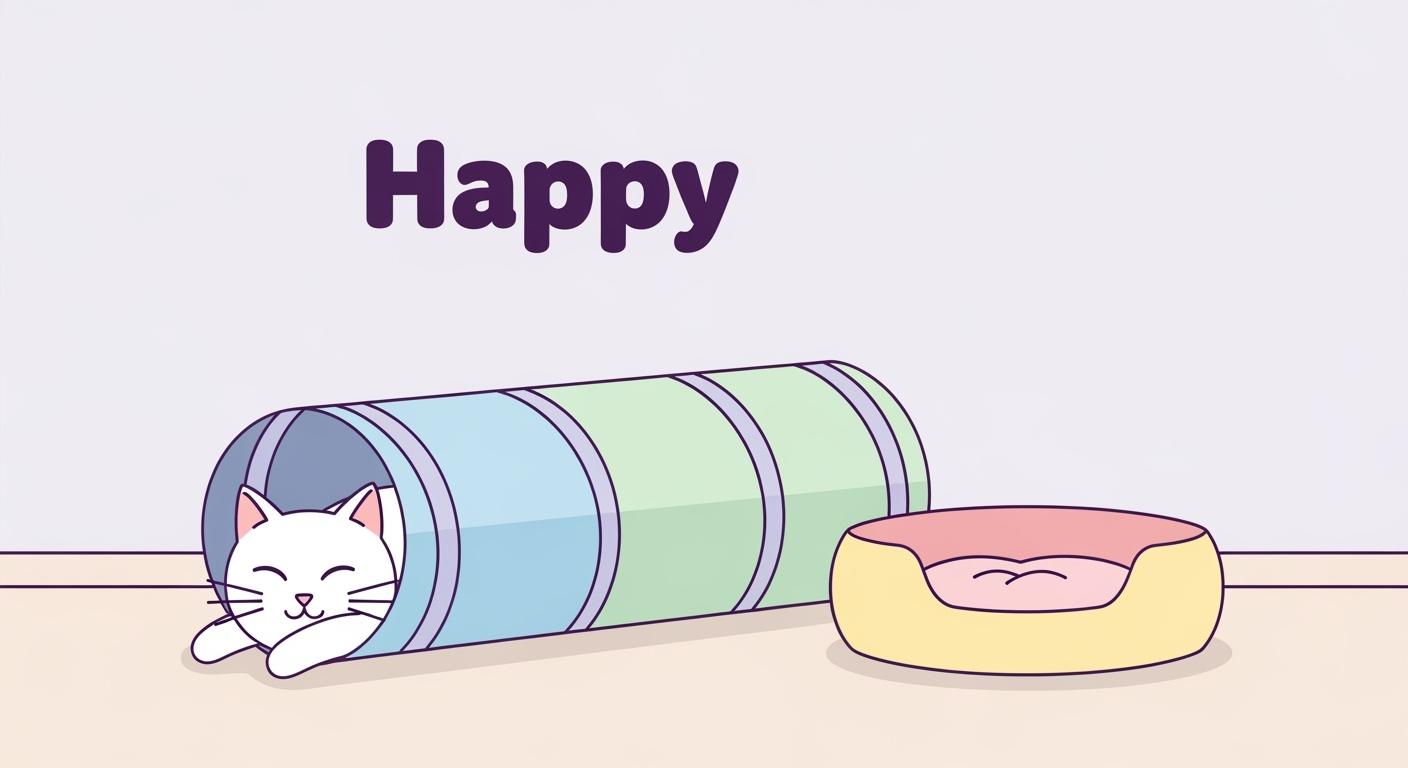
A cat that ignores every bed you bring home is not being difficult. It is telling you something about how the bed feels. Most regular beds fail on one of three dimensions: too exposed, too enclosed, or too unstable underfoot. A cat tunnel bed for cats who ignore regular beds addresses all three with a single design choice — it splits the resting surface into two zones. One covered, one open. That dual-mode layout gives the cat control over how much shelter it wants at any moment, which is what most bed-avoiding cats are actually negotiating.
What Regular Beds Get Wrong — And Why Cats Walk Away
A flat bed offers no cover. A cat lying on it can see the room, but it cannot hide. For a species that still carries the instincts of both predator and prey, that openness reads as vulnerability. Some cats tolerate it. Many do not.
Flip to the other extreme: a fully enclosed cave bed. It solves the exposure problem but creates a new one. There is one way in, one way out. A startled cat inside a cave bed has zero options except the entrance it came through. That is not how cats manage risk. They prefer multiple escape routes, or at minimum the ability to see what is coming before committing to a resting spot.
Then there is the surface itself. A cushion that sinks too deep under body weight sends a signal of instability before the cat ever settles. When a paw presses down and the fill keeps giving way, the cat’s proprioceptive feedback reads that surface as unreliable — not a place to let its guard down. Deep, pillowy beds look inviting to humans. To a cat, they can feel like quicksand.
The pattern repeats: regular beds lock the cat into one posture, one level of shelter, one entry path. A cat tunnel bed for cats who ignore regular beds breaks that pattern by offering two distinct zones on the same platform. The cat moves between them as its comfort shifts. That flexibility is not a bonus — it is the core mechanical reason these beds get accepted where others get ignored.
Tunnel Cover + Open Mattress — How Two Zones Change the Equation
The Shelter That Does Not Trap
The tunnel section works because it is a fabric arch, not a container. Structurally, it spans part of the mattress and stays open at both ends. A cat inside can see out both openings and exit forward or backward without turning around. In a standard cave bed, the single entrance forces the cat to either face the opening — exposing its back — or face the back wall — blocking its own exit. The tunnel arch removes that trade-off. The cat faces one opening, the other remains a clear exit at its rear, and the fabric overhead blocks sightlines from above.
This geometry also retains body heat without sealing the cat in. The arch creates a still-air pocket, so the cat gets warmth from retained body heat without the humidity buildup of a fully enclosed space.
The Open Mattress That Invites Trial Use
Cats do not commit to a new resting surface immediately. They test it — one paw, then two, a brief sit, maybe a circle before lying down. An open mattress with no raised sides removes every barrier to that testing sequence. The cat can step on and off from any angle. It can stretch fully across the surface without a bolster dictating where its legs go. If it feels uncertain mid-settle, it can leave without negotiating a lip or edge.
This is where placing a cat bed in a quiet corner with a wall behind it also matters — location shapes whether the cat starts the trial sequence at all. But the open-mattress end of a tunnel bed lowers the barrier for that first step. No climbing. No squeezing. Just walk on.
The combination of both zones changes how the cat uses the bed over time. A cat that starts in the open section, watching the room, may drift into the tunnel when it wants less stimulation. Or a cat that hides in the tunnel at first may gradually spend more time on the open mattress as it learns the room is safe. The bed accommodates that shift without anyone buying a different product. The cat’s state drives the bed choice, not the other way around.
Design Details That Separate a Working Tunnel Bed From One That Still Fails
Cushion Density — The Real Difference Maker
What determines whether a cat trusts a bed surface is not the thickness printed on the tag. It is how the fill responds under compression. A low-density polyfill cushion collapses quickly under the weight of a typical cat — weight concentrated on four small paw contact points. The fill compresses, the cat’s center of gravity drops, and surrounding cushion walls rise around it. The cat feels itself sinking. That proprioceptive signal reads: unstable ground, stay alert.
A denser cushion — one with higher-rebound foam or firmer polyfill with less loft — resists that collapse. The surface deforms less under point load, so the cat’s feet stay closer to the plane it stepped onto. The cat feels supported, not swallowed. Check this at home: press your palm firmly into the center of the mattress and hold for three seconds. If the indentation lingers and recovers slowly, the fill is too soft to give a cat stable feedback. If it springs back within a second, the density is in the right range for body support.
A shallow, firm pad tends to give a cat a stable platform. The same thickness with low-density fill bottoms out. Thicker is not better — density is.
Tunnel Diameter and Entry Edge Height
A tunnel too narrow forces the cat to crouch or squeeze. The cat cannot turn around inside without brushing both walls — which for a cautious cat reads as confinement, not shelter. A tunnel wide enough for the cat to stand, turn, and settle in any orientation reads as a safe hollow.
The entry edge of the open mattress section is just as critical. A lip much higher than a couple of inches creates a step-over barrier that older cats or cats with joint stiffness may decline to cross entirely. After ten minutes of the bed being available, observe whether the cat entered voluntarily or needed coaxing. If the cat steps on and off without pausing at the edge, the height is working. If it hesitates every time, it is negotiating a barrier.
Fabric and Structure That Hold Up
The tunnel arch needs to hold its shape. A fabric cover that sags or collapses onto the cat becomes a loose blanket rather than a defined shelter. The arch structure depends on either a semi-rigid frame insert or fabric tension maintained by secure attachment points at both ends. When the arch stays open on its own, the cat can enter without pushing through collapsing fabric. The same principle applies across cat bed types — a structure that maintains its intended shape under repeated use lasts longer and performs more consistently.
Fabric choice shapes both comfort and cleanup. Plush or felt surfaces give tactile warmth and paw traction — a cat’s feet grip rather than slide on slick synthetic weaves. Removable, machine-washable covers address hygiene: a bed that cannot be cleaned accumulates dander and odor, and a cat with a sensitive nose eventually stops using it. A tunnel bed that combines the covered section with a center mat also makes spot-cleaning simpler — the mat lifts out and washes separately from the tunnel shell.
| Design Difference | Why It Matters | Main Limitation |
|---|---|---|
| Tunnel arch vs. full enclosure | Two open ends prevent trapped feeling; cat exits forward or backward | Less heat retention than a fully sealed cave in very cold rooms |
| Open mattress vs. high-sided bolsters | Multi-angle entry and exit; cat tests the surface without climbing | No side wall for cats that prefer leaning against a bolster while sleeping |
| High-density fill vs. deep plush cushion | Stable surface under point load; cat does not sink or feel swallowed | Feels firmer — cats accustomed to very soft surfaces may need adjustment time |
| Low entry edge vs. raised lip | No step-over barrier; works for senior or stiff-jointed cats | Less draft protection at floor level compared to a raised-edge donut bed |
When a Tunnel Bed Is Not the Obvious Fix
A tunnel bed design solves specific problems: exposure anxiety, trapped feelings, and unstable surfaces. If the cat’s bed avoidance comes from something else entirely, changing the bed shape alone will not change the outcome.
Cats that avoid all soft surfaces — including couches, blankets, and carpeted perches — may prefer hard, cool surfaces by temperament, not because soft beds are designed wrong. A cat that consistently chooses tile, wood, or cardboard over any padded surface wants thermal conduction, not insulation. A tunnel bed will not override that preference.
Similarly, a cat in a multi-cat household that avoids beds because of resource competition needs placement and quantity solutions, not a different bed shape. The choice between a covered cave and an open donut bed matters less than having enough separate resting stations so each cat can claim space without conflict.
If the cat uses other soft surfaces but rejects every bed you have tried, the tunnel bed design addresses the most common failure points: too exposed, too enclosed, too unstable. Checking the fit between the cat’s size and the tunnel dimensions is worth doing before drawing conclusions — a tunnel scaled for a kitten will not work for a 15-pound cat.
Disclaimer: The tunnel-entry comfort checks described here assume a cat with typical mobility and body proportions. Cats with pronounced arthritis, recent surgery, or neurological conditions affecting balance may not be able to use even a low-entry bed safely — consult a veterinarian before introducing any new bed to a cat with known mobility limitations. Brachycephalic breeds like Persians and Exotic Shorthairs may find tunnel sections with restricted airflow uncomfortable during warmer months; monitor for panting or avoidance of the covered zone in temperatures above roughly 78°F.
FAQ
Will a tunnel bed work for a cat that has rejected multiple beds over years?
It often does, specifically because the dual-zone design removes the all-or-nothing commitment that regular beds demand. The cat can start on the open mattress — where it feels in control — and move into the tunnel only when it chooses. That gradual approach matches how cautious cats evaluate new surfaces. But if the cat has a strong, consistent preference for hard, cool surfaces, even a tunnel bed may not override it.
How do I know if the tunnel diameter is wide enough?
Your cat should be able to stand fully inside the tunnel without its back pressing against the fabric arch. A simple check: place a treat in the center of the tunnel and see whether the cat walks in, turns around, and settles without brushing both walls. Constant whisker or back contact with the fabric means the tunnel is too narrow.
Does the open mattress section get used, or do cats only use the tunnel?
Usage patterns vary, but the open section serves a critical function even when it is not the primary resting spot. It provides the entry and exit staging area that makes the tunnel feel safe. Cats that initially use only the tunnel often expand to the open mattress over weeks as their comfort with the bed grows. The mattress also gives the cat a place to stretch fully, which the confined tunnel space cannot offer.
What is the best placement for a tunnel bed in a home?
A quiet corner with a wall behind the tunnel opening tends to work best — the cat gets a protected rear approach and can watch the room through the front opening. Avoid placing the bed in the middle of a high-traffic walkway where movement passes directly in front of both tunnel openings. Partial cover from nearby furniture helps, but the bed should not be boxed in so tightly that the cat cannot see approaching people or animals from at least one exit.






