
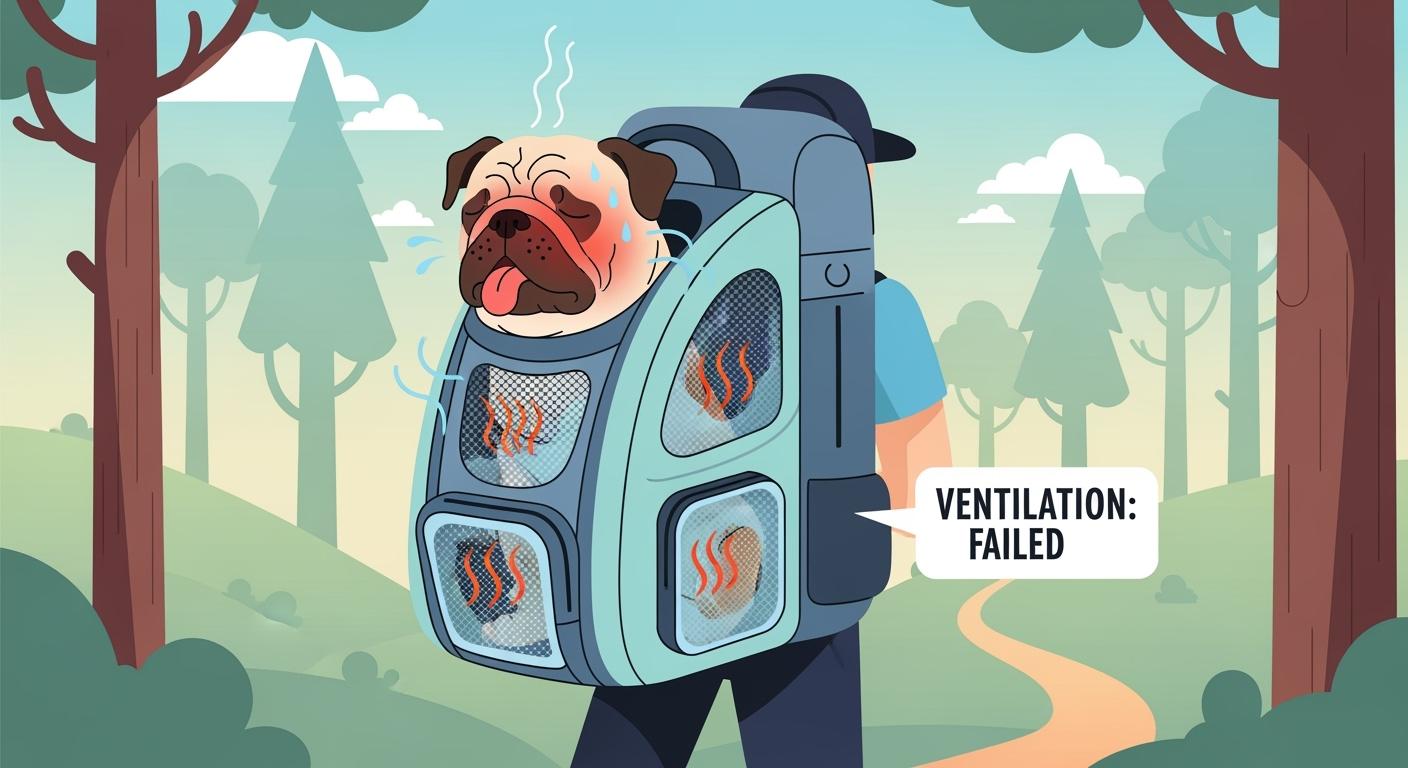
Mesh panels on a dog backpack carrier look like they should solve the heat problem. They often do not. The assumption that more mesh equals more cooling collapses the moment a dog sits inside and a hiker starts moving uphill. What actually determines whether a dog stays cool or overheats is not mesh quantity. Three design details do the heavy lifting: where the mesh sits relative to the dog’s heat zones, whether openings exist on opposing sides to create a pressure-driven air path, and whether the carrier structure holds those openings clear under load.
A carrier with mesh only on one face is a box with a window. Air enters but has nowhere to exit — no pressure differential, no flow. That window becomes a dead air pocket in under ten minutes of hiking. This is the central problem a backpacking carrier must solve, and it is why mesh placement and cross-ventilation architecture matter far more than mesh panel count.
Why Mesh Panels Fail on Trail
The failure starts with a simple physical mismatch. A dog’s primary heat-release zones are the upper back, shoulders, and neck. Most carriers place mesh panels low on the sides or near the bottom — precisely where the dog’s body blocks them when seated. The dog presses against those panels, air stops moving, and the mesh becomes decorative fabric.
Here is the causal chain. A dog sits inside the carrier. Its torso covers the low side mesh. Body heat radiates into the trapped air volume. Without an exit path, warm air accumulates. The carrier’s internal temperature rises. The dog pants to compensate. Panting adds humidity, which makes the air feel even warmer. Within 15–20 minutes of steady hiking, the internal environment shifts from warm to stifling — even with mesh covering 30% or more of the carrier surface.
This is why mesh placement must be evaluated as a function of the dog’s seated posture, not the carrier’s empty appearance. Carrier sizing and fit directly interact with ventilation performance — a carrier that is too snug presses the dog’s body against every interior surface, blocking airflow regardless of mesh count.
Gear makes it worse. A hiker’s hydration pack straps, trekking pole loops, or an extra layer cinched around the carrier can press against side mesh from the outside. The dog shifts, a blanket or pad slides, and another ventilation path closes. None of this is visible to the hiker while wearing the carrier.
In practice: After a 20-minute hike with the dog inside, open the carrier and place a hand against the interior lining at the lower rear corners. If those spots feel noticeably warmer than the center — dead air zones exist. That temperature gradient, not the number of mesh panels, is the real ventilation score.
Fabric collapse compounds every other problem. A soft-sided carrier with no internal frame will fold inward as the dog shifts weight. The mesh panels buckle, lose their open-weave geometry, and stop passing air. The same carrier that looked airy on a product page becomes a sealed pouch once the dog settles in and the hiker’s back presses against the rear panel.
| Poor airflow signal | Likely carrier design cause | Better design direction |
|---|---|---|
| Dog pants or shifts position repeatedly | Low mesh placement blocked by body | High mesh above the shoulder line, unblocked by seated posture |
| Carrier exterior feels warm to the touch | No back panel air gap; wearer body heat transfers in | Structured back panel with built-in standoff spacing |
| Mesh panels look folded or collapsed inward | Soft unstructured walls that deform under load | Rigid frame or semi-rigid edge construction that holds shape |
Where Heat Pools Inside a Carrier
The dog’s back and sides form the largest contact patch. When the dog sits, its torso presses against the interior walls. If mesh panels sit at or below shoulder height, that pressure seals them shut. The upper back — the dog’s primary heat radiator — gets zero fresh air. Brachycephalic breeds face disproportionate risk here because their respiratory cooling is already compromised before the carrier even closes.
The bottom seating area is the second trap. A dog’s full weight compresses any padding or mesh on the carrier floor. Air cannot circulate upward from below. If the only ventilation openings are on the bottom — a common cost-saving design shortcut — they contribute nothing once the dog is inside.
The rear back panel introduces an external heat source. The hiker’s back transfers body heat directly through the carrier wall via conduction. On uphill sections, when the hiker’s core temperature rises and the carrier is pulled tight against the spine, this transfer accelerates. Without a deliberate air gap — a structured standoff between the carrier back and the hiker’s back — the rear panel becomes a heating element, not a ventilation surface.
Disclaimer: This heat-zone analysis assumes a short-coated dog in moderate trail conditions between 50–75°F. Double-coated breeds retain substantially more body heat regardless of carrier airflow design, and ambient temperatures above 80°F can overwhelm even well-ventilated carriers. For double-coated dogs or hikes above 80°F, shorten carry duration and add rest breaks regardless of the carrier’s ventilation features.
Corners create the worst dead zones. With mesh on only one side, warm air rises into the upper corners and has no exit. It sits there, heats further from the dog’s body, and forms a stagnant pocket. An opening on a single face is a window, not a ventilation system. Air does not move through a window unless a pressure gradient pushes it — and a single opening, with no opposing exit, creates no gradient at slow hiking speeds.
You can verify this without instruments. With the dog inside, visually check whether mesh panels remain fully visible or whether the dog’s body, a pad, or folded fabric covers any panel. A covered mesh panel contributes zero airflow regardless of its size. Then check whether at least two mesh openings sit on opposing sides — front-and-back or left-and-right. Opposing openings are what turn a window into a ventilation channel. Large hiking carriers with more interior volume can mask this problem longer — the larger air volume takes more time to heat up — but the same dead-zone dynamics apply once the system reaches equilibrium.
Design Features That Actually Move Air
High mesh placement above the shoulder line. When mesh openings sit at or above the dog’s shoulders, the dog’s seated posture does not block them. These panels stay clear regardless of how the dog shifts. The upper back, neck, and head — the highest-priority heat-release surfaces — get direct air exchange. This is not a premium feature. It is a placement decision that costs nothing extra at the manufacturing stage but determines whether the entire ventilation system functions under load.
Opposing-side openings for cross-ventilation. Two mesh panels on opposite faces create a pressure differential during forward motion. The windward opening sees slightly higher dynamic pressure; the leeward opening sees slightly lower. Air moves from high to low — slowly at walking speed, but continuously. That continuous exchange prevents the gradual heat accumulation that turns a carrier uncomfortable after 30 minutes. Single-side mesh cannot produce this effect at hiking speeds. Trail reloading — taking the dog out for a water break and putting them back in — can temporarily reset the internal temperature, but it does not fix a carrier that lacks the geometry to sustain airflow between stops.
Structured back panel with deliberate standoff. A rigid or semi-rigid back panel that holds the carrier 1–2 inches away from the hiker’s back does two things. It breaks the conduction path that transfers body heat into the carrier. And it creates an air channel — a vertical chimney of sorts — through which warm air can rise and escape. The material choice for this panel matters less than its geometry; the gap itself is the feature.
Firm wall construction supports all three of these. A carrier that resists collapse keeps mesh panels open, maintains the air gap, and prevents the dog’s weight from deforming the ventilation channels. A hiking carrier backpack with a flimsy frame may pass a living-room inspection but fails on trail once the dog settles in and the hiker’s back presses against it.
Interior lining material is the final piece. A lining that wicks moisture and resists absorbing humidity keeps the microclimate drier, which makes the same airflow volume feel cooler to the dog. This is a secondary effect — airflow geometry is primary — but in humid conditions, a non-breathable lining can negate the benefit of well-designed ventilation. Post-hike cleanup reveals whether the lining trapped moisture: a damp, musty interior after a single hike signals a lining that is working against the ventilation design, not with it.
| Design difference | Why it matters | Where it falls short |
|---|---|---|
| High mesh (above shoulder line) | Stays unblocked by dog’s seated body; cools primary heat zones | Adds weight above the center of gravity; may reduce weather protection in rain |
| Opposing-side cross-ventilation openings | Creates pressure-driven airflow at walking speed; prevents gradual heat accumulation | Requires two open faces; limits insulated or weatherproof carrier designs |
| Structured back panel with air gap | Breaks conductive heat transfer from wearer; creates vertical chimney for warm air escape | Adds bulk and frame weight; may feel less form-fitting during scrambling or technical terrain |
| Firm anti-collapse walls | Preserves mesh geometry and air channels under dog’s weight and gear load | Increases packed volume for storage; may be overbuilt for very small or lightweight dogs |
When Even Good Airflow Design Reaches Its Limit
No carrier ventilation system can overcome physics entirely. At ambient temperatures above 85°F, the air entering the carrier is already warm — cross-ventilation moves hot air through instead of trapping it, but it cannot cool it. Direct sunlight on the carrier exterior adds radiant heat load that airflow alone cannot offset. High humidity reduces the dog’s evaporative cooling efficiency (panting becomes less effective), and no carrier design changes that equation.
Breed matters. Dogs with short noses — pugs, bulldogs, Boston terriers — rely on respiratory cooling that is mechanically less efficient even at rest. A carrier that keeps a Labrador comfortable on a 75°F hike may still overheat a French bulldog on the same trail. Double-coated breeds like huskies and malamutes retain body heat regardless of external airflow; their insulation works both ways.
The trail itself changes the airflow equation. Steep climbs pull the carrier tighter against the hiker’s back, compressing the air gap. Technical terrain where the hiker twists and leans can temporarily block one side of a cross-ventilation pair. A carrier that tests well on a flat fire road may perform differently on a 15% grade with switchbacks.
Disclaimer: If the dog’s chest shape falls outside the breed norms this carrier class was patterned for — particularly barrel-chested dogs or those with a very deep keel — the fit and ventilation checks described here may not catch every pressure point or dead-air zone. In these cases, a 15-minute stationary test indoors, with the dog inside and all openings zipped, followed by a hand-check of interior temperature at each corner, provides a more reliable ventilation reading than any spec sheet.
FAQ
How do I tell if my dog is overheating inside a backpack carrier?
Heavy panting that does not slow after stopping, excessive drooling, and repeated shifting or attempts to stand are the earliest signals. A dog that presses its nose against mesh openings is trying to reach cooler air. Stop, remove the dog, and offer water immediately if you see these signs. After the dog is out, feel the interior back corners — if they are hot to the touch, the carrier lacks functional cross-ventilation.
Does more mesh mean better airflow?
No. Mesh area matters less than mesh position and whether openings face each other to create a flow path. A carrier with 40% mesh surface concentrated on one side will trap more heat than a carrier with 20% mesh split across opposing faces. Mesh blocked by the dog’s body, gear, or a collapsed wall contributes zero airflow.
Can I use a dog backpack carrier in hot weather?
Yes, but the margin for error shrinks. Above 80°F, even a well-ventilated carrier depends on short carry durations, shaded trails, and frequent water breaks. Above 85°F, most carriers — regardless of ventilation design — become unsafe for extended hikes because the incoming air itself is too warm to provide meaningful cooling. The carrier becomes an oven, not a shade structure.
What is the quickest way to test carrier airflow before buying?
Place the dog inside and zip the carrier closed. Wait 5 minutes in a room-temperature environment. Open it and place your hand against the interior lining at the top rear corners and the bottom front corners. A temperature spread of more than a few degrees between these spots indicates dead-air zones. Then visually confirm that at least one pair of mesh panels sits on opposing sides and remains uncovered by the dog’s body.






