
A dog harness can match the size chart and still act wrong once the dog starts moving. The chest number may be correct, the neck opening may look acceptable, and the straps may have enough adjustment room, but the harness can still ride toward the throat, twist to one side, rub behind the elbows, or open gaps when the dog backs up.
That is why a dog harness size guide should not stop at body measurements. Size gives the starting point. Real walking shows whether the harness shape, strap path, chest panel, shoulder clearance, and adjustment range actually match the dog.
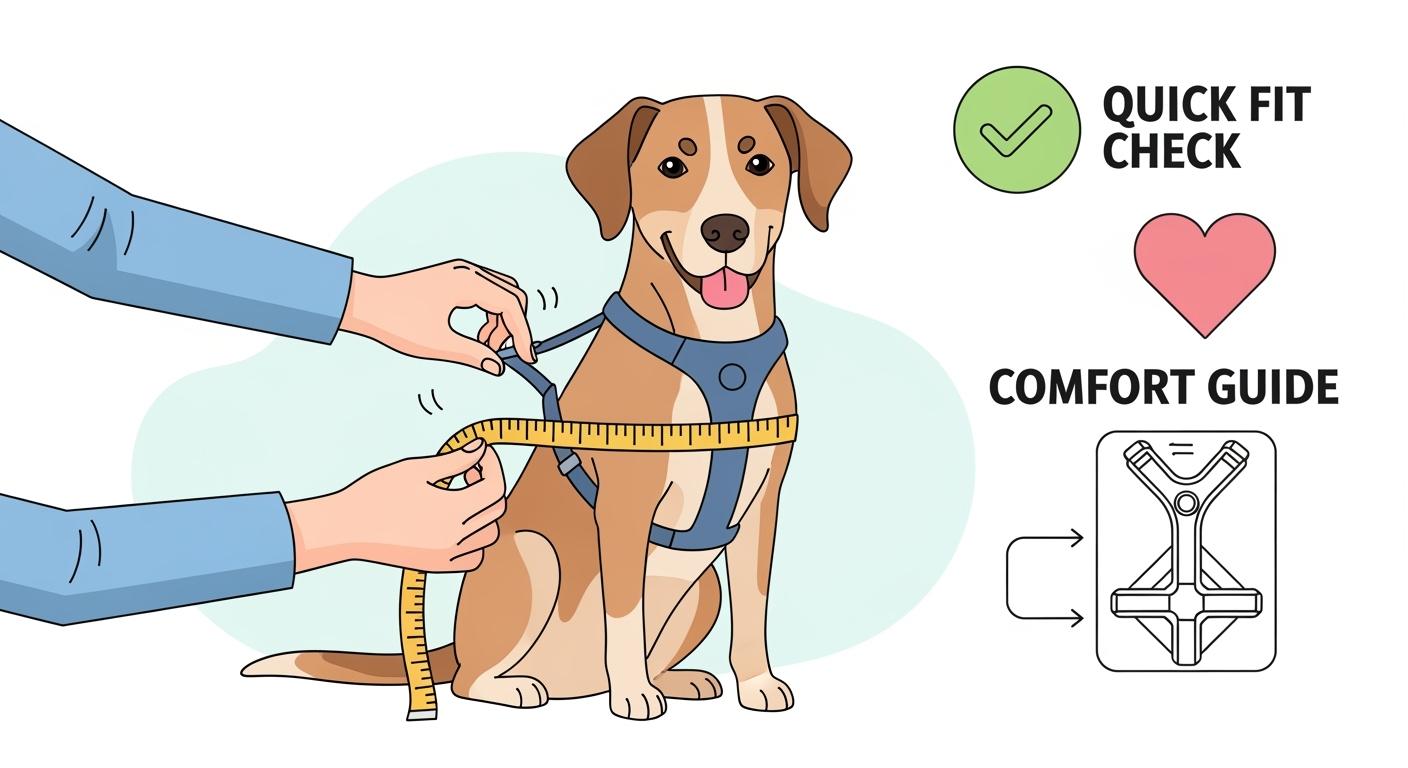
When the size looks right but the harness still moves wrong
A standing fit check can miss the problems that appear during walking. Dogs pull forward, lower the head, turn sideways, shake, sit, jump, and sometimes back out of the harness. If the structure is not stable through those movements, the size may look correct while the product still fails in use.
| Real-use sign | Likely cause | Better harness detail |
|---|---|---|
| The harness twists to one side | Uneven tension, weak body contour, or a leash point that pulls the frame off-center | More stable chest coverage, balanced strap routing, and a centered attachment area |
| The front section rides up toward the throat | The neckline starts too high or leash pressure pulls the harness upward | Lower chest placement and a front shape that stays away from throat pressure |
| Rubbing appears behind the elbows | The strap path sits too close to the moving front legs | Cleaner armpit clearance, softer edge binding, and better spacing behind the elbow |
| Gaps open when the dog backs up | The neck opening and chest control do not resist reverse movement | Better size grading, secure adjustment points, and coverage that controls backward escape |
| The dog shortens stride or resists walking | The panel blocks shoulder movement or concentrates pressure in one area | An open-shoulder layout, smoother padding transitions, and less bulky hardware placement |
Separate a size problem from a harness-shape problem
Before changing to another size, check whether the problem is truly the size number. Some issues come from loose adjustment. Others come from product geometry that does not match the dog body. Changing sizes will not fix every fit failure.
It is probably a size problem when
- The harness cannot keep safe finger room without looking obviously too loose or too tight.
- The chest area gaps even after the left and right straps are adjusted evenly.
- The neck opening cannot stay secure unless it crowds the throat.
- The dog sits at the edge of the size range with almost no useful adjustment room left.
It is probably an adjustment problem when
- One side sits longer than the other and the harness pulls off-center.
- The front section started too high but improves after repositioning.
- Minor drift disappears after a short re-fit.
- The dog moves normally again once the strap path is corrected.
It is probably a harness-shape problem when
- The harness keeps twisting after careful re-adjustment.
- The front section repeatedly climbs toward the throat.
- The harness always crowds the shoulders on the dog’s body type.
- Fixing one issue creates another, such as reducing chest gaps but causing elbow rub.
If the problem is still too broad, start with the best dog harness guide before narrowing it down. A general harness guide can help separate harness type, clip position, and daily-use structure before this page focuses on post-measurement fit problems.
Why a measured harness still twists, rubs, gaps, or rides up
Most harness fit failures follow a few repeat patterns. Once the pattern is clear, it becomes easier to decide whether the harness needs a small adjustment or a different design.
The harness twists to one side
Side twisting usually happens when the harness cannot hold even pressure around the chest. One strap may be longer, the chest section may not sit flat, or the leash attachment may pull more from one side. If the harness keeps rotating after symmetrical adjustment, the product shape is not stable enough for that body type.
The harness rides up toward the throat
A harness that climbs toward the throat is not only a comfort problem. It can change where leash pressure lands. The front section should stay lower on the chest instead of creeping upward every time the dog leans into the leash.
The harness rubs behind the elbows
Elbow rubbing is often a strap-path problem, not just a tightness problem. A harness can have acceptable finger room and still sit too close to moving joints. If the same red area appears after every short walk, the layout is too close to the armpit area.
The harness gaps when the dog backs up
Some harnesses feel secure while the dog walks forward but loosen when the dog reverses. This is a back-out warning. If the shoulder opening widens or the chest control disappears during backward movement, tightening the straps may only trade escape risk for pressure.
The dog looks stiff or unnatural
Shortened stride, head lowering, scratching at the harness, or repeated stopping can mean the harness is pressing in the wrong place. The problem may be shoulder restriction, bulky hardware, stiff edge binding, or pressure concentrated at one strap instead of spread through the structure.
What better harness structure should solve
A better size is not always the answer. The right structure should make the harness easier to fit and more stable during movement. This is especially important for deep-chested dogs, broad-shouldered dogs, compact dogs, narrow-waisted dogs, and dogs that pull into the leash.
| Product detail | What it should improve | What to avoid |
|---|---|---|
| Chest panel width | Keeps the harness centered without blocking shoulder movement | A panel that is so wide it shortens stride or so narrow it rotates |
| Strap path | Clears the armpit area and holds the chest without rubbing | Straps that sit directly behind the moving elbows |
| Neck opening | Stays away from the throat while keeping the harness secure | A high neckline that climbs under leash tension |
| Adjustment range | Allows fine tuning without forcing one strap to do all the work | A size range that fits on paper but leaves no real adjustment space |
| Hardware placement | Keeps pressure smooth and avoids bulky contact points | Buckles or rings that press into moving or weight-bearing areas |
| Edge finish | Reduces friction during repeated walking movement | Rough binding that creates redness after short use |
For dogs that pull, clip style and leash angle can make the problem stronger or weaker. If the leash setup is also changing how pressure moves through the harness, this dog harness and leash set guide can help check whether the leash length, attachment point, or walking setup is making the fit problem look worse.
When to stop adjusting and switch styles
Some harnesses are worth re-fitting once or twice. Others keep asking for compromise. If the only way to reduce a gap is to create rubbing, or the only way to prevent back-out risk is to tighten the neckline too much, the harness is not solving the fit problem. It is only moving the problem to another pressure point.
Stop adjusting and look for a different structure when:
- The harness repeatedly rides high no matter how carefully it is set.
- The same rub mark returns after each short walk.
- The dog moves stiffly, hesitates, or resists the harness.
- The harness only feels secure when tightened beyond normal comfort.
- Back-out risk stays visible even after patient adjustment.
- Each strap change fixes one issue but creates another.
A better harness should make fit simpler. Once the shape matches the dog, the harness should stay centered, leave the shoulder path open, avoid throat climb, and keep contact points clear during normal walking movement.
FAQ
Can a dog harness be the right size and still fit badly?
Yes. A size chart gives a starting point, but it does not guarantee that the harness shape matches the dog’s chest depth, shoulders, waist shape, or movement pattern.
Why does a harness twist even after careful measuring?
Twisting often means the harness is unstable on the dog’s body or the strap tension is uneven. If it continues after re-adjustment, the structure is usually a bigger issue than the measurement.
Why does the harness ride up to the throat?
The front section may start too high, or leash pressure may pull the structure upward during walking. A better harness should stay lower on the chest and avoid throat pressure.
Is elbow rubbing always caused by a tight size?
No. Elbow rubbing is often caused by strap path, edge finish, or panel placement. The harness can feel loose enough and still rub if the structure sits too close to the moving front legs.
Should I size up if the harness gaps?
Not automatically. Gapping can come from the wrong harness shape, not just a small size. Sizing up may increase slipping or back-out risk if the structure already lacks stable chest control.






