
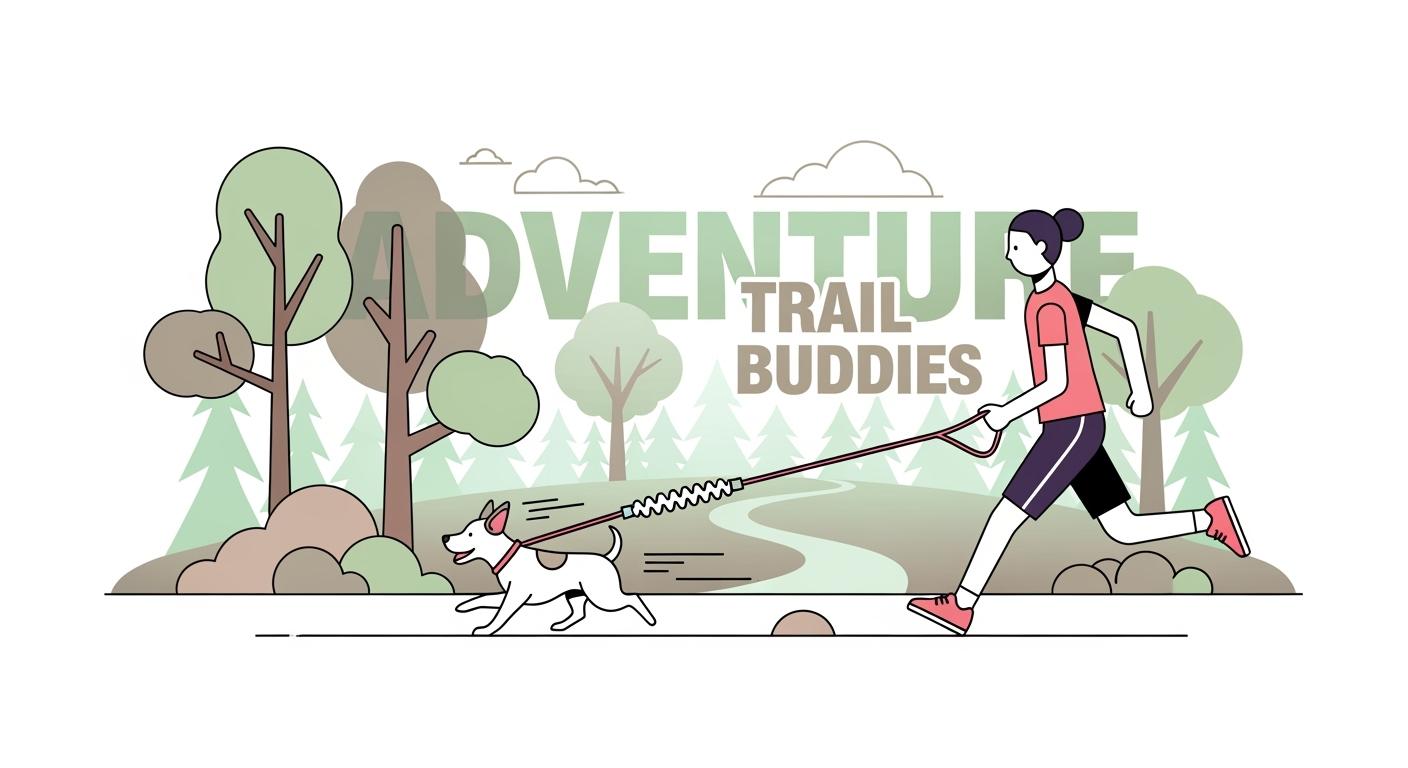
A dog leash for trail running small dog needs to do one thing well: stay out of the dog’s way. That sounds simple. It is not. A small dog’s stride is short and fast. Its body is light. Every ounce of leash hardware and every inch of excess slack registers as interference — a tug, a drag, a bounce — that the dog compensates for by shortening its stride or tensing its shoulders. The right leash design removes that interference. The wrong one amplifies it.
Why a Standard Leash Works Against a Small Dog’s Trail Stride
Most leashes are built around a simple assumption: connect point A to point B with enough length and tensile strength. That works on sidewalks. On trails, where a 12-pound dog navigates roots, rocks, and quick directional shifts, the physics changes.
Consider what happens when a standard 6-foot nylon leash hangs between a runner’s hand and a small dog’s harness clip. At rest, the leash drapes into a catenary curve. But at a running pace on uneven ground, the dog’s body rises and falls with each stride. The leash mass resists this vertical displacement — inertia keeps it at its current height. The result is an oscillating downward pull on the back clip, out of phase with the dog’s gait. The dog feels a rhythmic tug at the harness. It shortens its stride to stabilize. The shoulders tense. On the next root or rock, the dog has less available range of motion to absorb the irregularity. That is how leash weight, multiplied by trail surface variation, turns into compromised movement.
How Leash Weight Disrupts a Light Frame
Small dogs lack the body mass to counterbalance leash hardware. A clip that weighs two ounces is negligible on a 70-pound dog. On a 10-pound dog, it represents over 1% of body weight hanging from the harness — constantly. On flat ground, the pull is mostly vertical. On an incline or during a directional change, the force vector shifts laterally and the harness chest plate follows. The dog then runs slightly crooked to compensate. After ten minutes on trail, check whether the harness back clip has drifted more than an inch off the spine midline. Lateral drift signals the leash is pulling unevenly — a direct observation that the hardware is too heavy or the length is mismatched.
| Trail running failure | Likely leash design issue | Better design direction |
|---|---|---|
| Leash drags or snags on rocks and roots | Too long or too heavy for the dog’s frame | Shorter length, lighter webbing and hardware |
| Dog loses rhythm or shortens stride mid-run | Leash mass oscillates, pulling harness off-center | Lightweight materials, bungee section to decouple mass |
| Harness chest plate shifts laterally during run | Uneven downward pull from leash weight | Slim clips, narrower webbing, proper length |
Slack, Bounce, and the Rhythm Problem
A small dog’s stride on trail is fundamentally different from a large dog’s. Shorter legs mean higher cadence — often 180 to 200 steps per minute at a run. Each stride cycle includes a vertical oscillation of the dog’s body. If the leash has excess slack, that slack forms a loop between the handler and the dog. The loop bounces at its own frequency. When that bounce frequency nears the dog’s stride cadence — or a harmonic of it — the leash swing amplifies. It wraps around the dog’s legs. It catches on trail debris. The dog hesitates. The rhythm breaks.
A leash that stays between 4 and 5 feet reduces the slack loop enough that it cannot develop a full oscillation cycle at running speed. The leash stays taut without pulling. That is the window where a small dog’s stride stays independent of leash movement. When choosing among bungee, standard, and hands-free running leash designs, the length and stretch behavior matter more than the style label.
Three Design Changes That Shift Trail Dynamics
Materials That Do Not Weigh Down the Stride
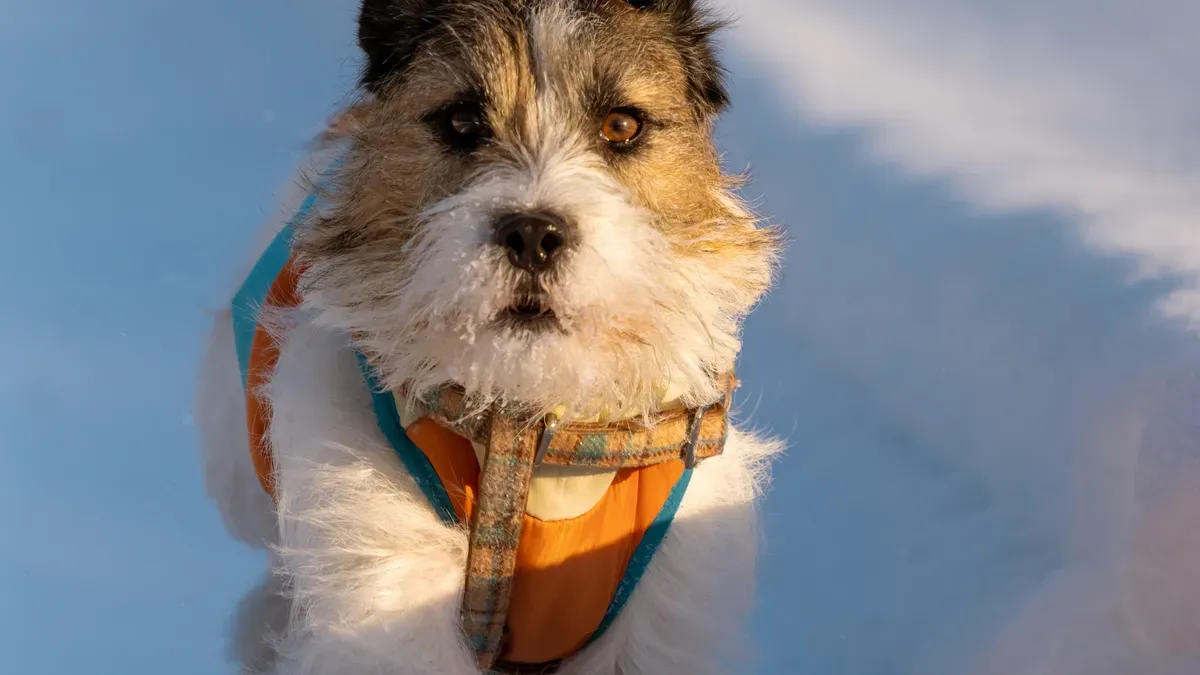
Material choice on a small-dog leash is not about durability alone. It is about mass per foot of webbing and mass per clip. Nylon webbing at 1-inch width weighs roughly 0.4 ounces per foot when dry. After a wet run, that same webbing can hold 30–40% more water weight if it lacks a weather-resistant coating. Polyester absorbs less water and dries faster. Both are viable, but the difference shows up on long runs or in wet conditions where absorbed water adds drag that the dog must work against.
Hardware matters just as much. A standard metal snap hook can weigh 2–3 ounces. A slim aluminum or coated clip cuts that by half or more. On a small dog, that difference is the difference between a harness that stays centered and one that drifts. For a closer look at how clip size and leash weight interact on small breeds, the design trade-offs between leash weight and clip dimensions become visible after a single trail loop — watch where the back clip sits at the start and at the finish.
Bungee Stretch That Absorbs Without Rebounding
A bungee section decouples the handler’s arm movement from the dog’s harness. When the dog surges forward or the runner slows, the bungee extends — absorbing the differential speed rather than transmitting it as a jerk. This is not just comfort. On technical trail, a sharp pull can unbalance a small dog mid-stride on a root or rock edge. The bungee gives the dog a fraction of a second to recover footing before tension arrives.
But too much stretch creates a different problem. If the bungee extends more than 12–18 inches under typical running loads, the return snap can surprise the dog. The dog stops. The bungee contracts. The harness gets yanked backward. This slingshot effect is worse than no bungee at all — it introduces unpredictable rearward force that the dog cannot anticipate. A reflective bungee leash with controlled stretch length keeps the absorption benefit while limiting the rebound arc to something the dog can manage. Test it before the run: clip the leash to a fixed point at harness height, step back to running distance, and pull steadily. The bungee should extend smoothly and return without a snap.
Note: Match bungee resistance to the dog’s weight. A bungee section designed for a 60-pound dog will barely stretch under a 12-pound dog’s pull — it functions as a static leash with extra bulk.
Length and Attachment Point
A 4-to-5-foot leash keeps a small dog in the runner’s peripheral movement zone — close enough to read body language and react to trail obstacles, long enough that the dog is not underfoot. At 6 feet, the slack loop on a small dog is large enough to develop the swing oscillation described earlier. On narrow singletrack, that extra foot drags across the trail edge, collecting mud and catching on brush.
The attachment point changes how leash force reaches the dog. A handheld leash gives the fastest feedback — the runner’s arm absorbs micro-adjustments before they reach the clip. A hands-free waist belt changes the force geometry: the pull originates lower, near the runner’s center of mass. This can reduce the lateral sway that happens when arm swing transmits side-to-side leash movement. The trade-off is that waist attachment removes the hand’s rapid damping — the runner cannot as quickly shorten or redirect the leash. On wide, predictable trails, this trade-off often favors the hands-free setup. On technical terrain with frequent stops and direction changes, handheld control tends to produce fewer leash-swing events. The material and attachment decisions that shape a running leash’s real-world behavior are best evaluated by walking the actual trail first — note where the leash would catch, swing, or pull before adding speed.
Where the Right Leash Excels — and Where It Reaches Its Limit
Trail Conditions That Amplify the Design Advantage
The design features described above — light materials, controlled bungee, 4-to-5-foot length — produce the largest difference under specific conditions. On rolling singletrack with frequent grade changes, the bungee absorbs the speed differential between a runner descending and a dog picking through rocks. In wet conditions, polyester or coated nylon webbing stays lighter than uncoated nylon, and the weight difference compounds over miles. In low light, reflective webbing woven into the leash body provides passive visibility without adding a separate accessory that can snag.
On wide, flat fire roads, the design advantage shrinks. There are fewer obstacles to catch slack. The surface is predictable. A standard leash may perform adequately here — the problems the design solves are less present. Knowing where the advantage appears and where it fades is what separates choosing well from overbuying. The dynamics of leash-based control across different walking and running scenarios follow the same principle: the rougher and more variable the terrain, the more the leash design matters.
| Design difference | Why it matters | Main limitation | Where it falls short |
|---|---|---|---|
| Lightweight webbing and slim clips | Reduces downward pull that shifts the harness during a run | Thinner webbing may wear faster under heavy abrasion | Rocky scrambles where the leash drags across sharp surfaces |
| Controlled bungee section | Absorbs speed differentials without slingshot rebound | Adds slight delay to hand-to-dog signal transmission | Technical descents where instant feedback is needed for safety |
| 4-to-5-foot running length | Prevents oscillation loops that tangle legs and catch debris | Less freedom for dogs that range wider on open trails | Wide, empty trails where the dog could safely use more range |
| Hands-free waist attachment | Eliminates arm-swing-induced lateral leash movement | Slower reaction to sudden stops or directional changes | Narrow, crowded, or high-traffic trail sections |
When a Different Setup Makes More Sense
Not every trail run calls for the same leash. A dog that runs reliably at heel on fire roads may do fine with a simple fixed-length lightweight leash and no bungee. A dog that darts after squirrels on wooded singletrack may need the faster hand feedback of a handheld leash rather than a waist belt, regardless of other design features. And the leash does not operate alone — the fit of the running harness determines how leash forces distribute across the dog’s body. A well-chosen leash attached to a poorly fitted harness still produces hotspots and drift. The harness fit and sizing checks that matter for everyday walks apply doubly at running speed, where small fit errors compound into visible rub patterns within a single outing.
After a run, flip the harness chest panel inside out and feel the inner lining with the back of your hand. If the fabric is damp on one side and dry on the other, leash tension was asymmetric during the run — the dog was compensating. Even dampness across both sides means tension stayed balanced through the stride cycle. This check costs ten seconds and tells you more about your leash-and-harness setup than any spec sheet.
Disclaimer: This analysis assumes a small dog with a typical chest shape — moderately deep but not barrel-chested. Dogs with extremely shallow chests or very deep keels may show different pressure patterns even with a well-chosen leash and harness. Double-coated breeds may show subtler rub marks that need hand-checking rather than visual inspection, since the undercoat can mask early signs of chafing.
FAQ
Does a bungee leash actually help a small dog on trails?
It does, but only when the bungee resistance is matched to the dog’s weight. A bungee built for a large dog barely stretches under a 12-pound pull and functions as a static leash. One built too light extends fully at minimal force and rebounds sharply. The benefit — absorbing speed differentials between runner and dog without jerking the harness — requires that the bungee section extend progressively under the dog’s typical pulling force, not bottom out immediately or stretch to full length at a touch.
Is a hands-free leash safer for trail running with a small dog?
Safer is conditional. A hands-free waist belt removes arm-swing-induced lateral leash movement and frees the hands for balance on technical terrain. But it also removes the hand’s rapid damping — you cannot shorten the leash or redirect the dog as quickly. On wide, predictable trails, the waist attachment often produces smoother runs. On tight singletrack with frequent stops and obstacles, a handheld leash gives faster feedback. The terrain should drive the choice.
What length is too long for a small dog on trails?
Beyond 5 feet, the slack loop on a small dog is large enough to develop an independent oscillation at running cadence. That loop swings, catches on brush and rocks, and can wrap around the dog’s legs. On narrow singletrack, even 5 feet can be too much if the trail forces the dog to run behind rather than beside the handler. The right length is the shortest one that lets the dog run naturally without pulling — usually between 4 and 5 feet for a dog under 25 pounds.
Why does leash weight matter more for a small dog than a large one?
A 3-ounce clip on a 70-pound dog is 0.27% of body weight. On a 10-pound dog, it is 1.9% — roughly seven times the relative load. That weight hangs from the harness back clip and pulls downward with every stride, shifting the chest plate and creating asymmetric tension. On flat pavement, the effect is minor. On an inclined trail where the dog’s body angle changes relative to the leash vector, that small constant pull becomes a lateral force that the dog must actively counter. Over miles, the compensation adds up to altered gait and earlier fatigue.






