
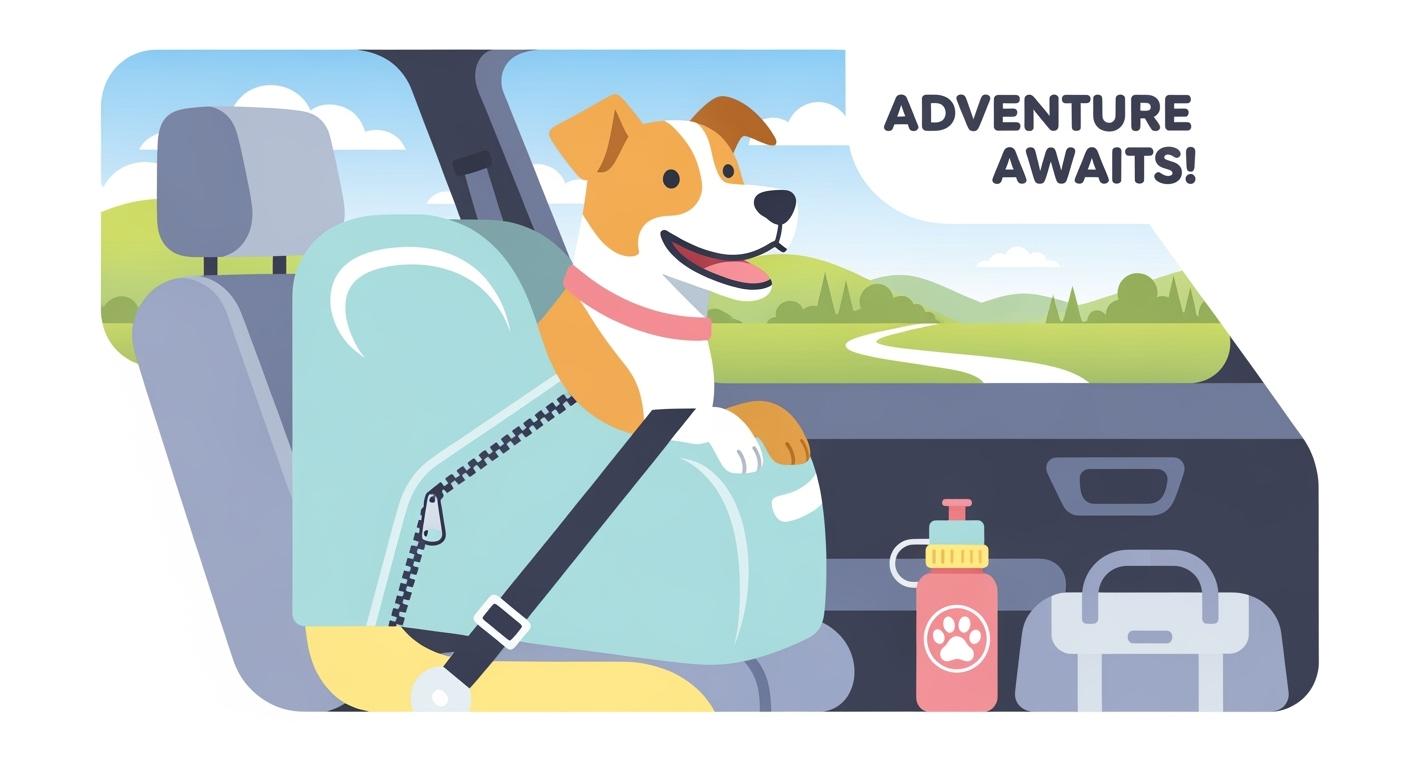
A dog car seat for medium dog road trips has to solve a problem that does not show up in product photos. Online, most seats look big enough. Three hours into a highway drive, with a 35-pound dog shifting weight every time the car changes lanes, the gap between adequate and cramped becomes obvious. Medium dogs occupy a middle ground that most car seat designs handle poorly — too large for the small-dog booster format, too compact to justify the extra-large SUV-only footprint. Three design dimensions separate seats that hold up from seats that fail on longer trips: usable sitting space, cushion recovery under sustained load, and tether geometry.
Why Medium Dogs Struggle With Car Seat Fit on Road Trips
Internal dimensions versus what the listing shows
The outer width printed on a box tells you almost nothing. What matters is the usable seat pan — the flat area a dog can occupy without leaning on bolsters or hanging a paw over the edge. A medium dog with an 18-inch shoulder span needs a seat pan wide enough to turn around and curl up without compressing against both side walls at once. When the seat pan is narrower than the dog’s shoulder width, the dog cannot redistribute weight by changing position. On a short errand, that is uncomfortable. On a four-hour drive, it means restlessness, repeated shifting, and pressure concentrated on the same contact points the entire trip.
Most listings quote external dimensions. That number includes side bolsters, outer fabric, and sometimes the frame. A seat advertised as 20 inches wide may offer only 14 inches of flat sitting surface, as detailed in fit checks for medium-dog booster seats. The gap between those two numbers is where medium dogs get stuck.
Cushion compression under medium-dog weight
A 40-pound dog places roughly 10 to 15 pounds of pressure per square inch on the cushion beneath the hips — more than a small dog, less than a large breed, but sustained for longer continuous periods on a road trip than on a daily commute. Low-density polyurethane foam, common in budget car seats, relies on trapped air pockets for loft. Under continuous compression, those air pockets collapse and do not recover until the load is removed. The result: after 45 minutes, the dog is essentially sitting on the base board with a thin layer of crushed foam in between.
This is where material choice becomes load-bearing in the physical sense. High-resilience foam uses a different cell structure — more open cells with thicker walls — that resists full collapse even under hours of compression. It costs more to produce and requires water-jet or die cutting rather than standard hot-wire cutting, adding a production step. But without it, the cushion is cosmetic after the first hour. That fails fast.
You can verify this directly. After a long drive, press your palm firmly into the center of the cushion for 10 seconds and release. If the indentation remains visible for more than 3 seconds, the foam has taken a compression set and will not support the dog on the next leg.
Where Space, Tether, and Cushion Design Usually Fail
Narrow seats and the side-lean cycle
When internal width is too tight, dogs do not stay centered. They lean into one side wall, redistributing weight unevenly. The side wall that takes the load either holds or folds. If it holds but the dog is still cramped, the dog shifts to the other side. If it folds, the dog slides toward the door panel and loses the containment the seat is supposed to provide. Either way, the dog keeps repositioning, and each shift works the seams and foam a little more.
After a 30-minute drive, look at where the dog’s spine sits relative to the seat centerline. If it has drifted more than 2 inches off center, the seat is either too narrow or the tether is pulling at an angle.
Tether geometry and asymmetric pull
A tether attached to a single point on one side of the seat creates an asymmetric pull vector. On right turns, inertia pushes the dog left. If the tether anchors on the right, the dog is pulled in two directions at once — inertia pushing one way, tether restraining the other. The dog braces against both forces simultaneously, which leads to faster fatigue and restless repositioning. The same cross-loading happens during braking if the tether anchors too low, pulling the dog’s shoulders downward instead of distributing restraint force across the chest.
A centered tether, anchored to a harness rather than a collar, distributes restraint force evenly. The dog can still shift slightly — enough to relieve pressure — but cannot rotate or slide off the seat pan. After any drive with significant cornering, check whether the harness sits evenly on the shoulders or has ridden up on one side. That asymmetry is the tether telling you it is pulling wrong.
Side wall collapse under lateral load
Side bolsters stuffed with foam alone have no anti-rotation resistance. When a dog leans into them at even a shallow angle, the force is not vertical compression — it is lateral. Foam alone buckles sideways because it has no structural resistance in that plane. Seats that add a rigid or semi-rigid insert — a plastic panel, denser foam core, or fabric tension strap — resist that lateral fold because the insert converts the sideways force into a compressive load the seat base can absorb.
How to check: after a drive where the dog was visibly leaning, look at the side walls from outside the car. If a bolster is permanently creased or angled outward, it failed structurally, not just cosmetically.
| Road-trip failure signal | Likely design cause | Better design direction |
|---|---|---|
| Dog leans or shifts awkwardly after 20 minutes | Internal width too narrow for shoulder span | Wider seat pan with at least 3 inches of clearance beyond shoulder width |
| Cushion bottoms out, dog sits on base frame | Low-density foam compresses fully under medium-dog weight | High-resilience foam or dual-layer construction that recovers between trips |
| Tether pulls dog sideways during turns | Off-center or single-point tether anchor | Centered tether connected to a harness, not a collar |
| Side walls fold outward | Padding without structural reinforcement | Reinforced side bolsters with rigid or semi-rigid inserts |
| Moisture soaks through to car seat | Non-waterproof cover or unsealed seams | Waterproof barrier with sealed seams and wipeable surface |
What Makes a Car Seat Hold Up on Longer Drives
Wider sitting space — beyond the spec sheet
A wider seat pan does more than add comfort. It gives the dog room to shift weight between front and rear contact points, which prevents any single pressure area from staying loaded the entire trip. It also lets the owner add a washable liner or waterproof blanket without eating into the dog’s usable space — a practical consideration that disappears when the seat is already tight. A seat built for medium-dog proportions starts with the seat pan, not the outer shell, as the design anchor.
Supportive cushion materials that last past the first leg
Beyond high-resilience foam, dual-layer construction — a firmer base for structural support topped with a softer comfort layer — separates the functions of load-bearing and pressure relief. In production, this means bonding two foam densities rather than pouring a single block, which increases per-unit cost but extends functional life across repeated trips. The base layer carries the weight; the top layer handles surface comfort. When a single foam tries to do both, it does neither well after the first few hours.
The second verification check applies here. Press into the cushion at the start of the trip and note how far your palm sinks before meeting resistance. Repeat at a rest stop two hours in. If the sink depth has increased noticeably — same pressure, deeper dip — the foam is losing structural integrity in real time. That seat will not make it through the return drive without the dog sitting on the frame.
Waterproofing that holds at the seams
A waterproof PU coating on the top fabric looks effective in a product photo. The failure point is almost always the stitching. Water follows thread holes through needle punctures in the coated fabric. A seat cover with sealed seams — achieved through hot-tape application or liquid seam sealant in production — prevents the most common failure mode: moisture wicking through stitch lines into the foam and eventually the car seat below. Without sealed seams, a waterproof fabric rating is only as strong as its weakest stitch.
A removable, machine-washable cover with sealed seams lets you wipe down after each leg and deep-clean after the trip. The difference in production cost between a coated fabric and a coated fabric with sealed seams is small. The difference in how the seat holds up after a dog climbs in with wet paws is not.
Tether placement and harness integration
For a car safety seating setup to work on a road trip, the tether must anchor to a harness, not a collar. In a sudden stop, a collar-attached tether concentrates force on the neck. A harness spreads that force across the chest and shoulders. The attachment point should sit at the dog’s mid-back so the tether does not become a pivot point that rotates the dog during turns — the same principle behind sizing and material choices for booster-style seats.
Stable tether placement also reduces the micro-adjustments a dog makes during a drive. Each adjustment shifts weight, compresses foam differently, and works seams. A dog that settles into one position and stays there puts less wear on every component. The tether is a structural part of the seat system, not an accessory.
When a Car Seat Is Not the Right Choice
Not every medium dog fits every medium-dog car seat. Dogs at the upper end of the medium weight range — around 50 to 60 pounds — may need a seat rated for large dogs if their build is broad-chested or long-bodied. A seat that supports a slender 30-pound dog through a full day of driving often bottoms out under a stocky 55-pound dog of the same length within the first hour. The weight rating on the tag is a starting point, not a guarantee. Knowing when a seat no longer fits is as important as picking the right one initially.
Car seats that prioritize a higher boosted position can also create instability for dogs that prefer to brace low during turns. A dog that feels perched rather than seated may tense continuously, which accelerates fatigue and increases the temptation to climb out. The tradeoff between a better view and a more grounded seating position is worth weighing — and so is the tradeoff between easier buckling and more cushion support, since a seat that is fast to strap in but thin under the dog trades convenience for the one thing the dog actually needs on hour four.
Disclaimer: This fit assessment assumes a dog within typical medium-breed proportions — around 30 to 50 pounds with a proportionate shoulder span and body length. Dogs with unusually deep chests, very short legs relative to body length, or barrel-shaped ribcages may need different spatial allowances that the shoulder-width and seat-pan checks described here cannot fully capture. For dogs with these builds, hand-check pressure points along the ribs and hips after a short trial drive before committing to a longer trip.
FAQ
How do you check whether a car seat is wide enough for a medium dog?
Measure the dog’s shoulder width while standing, then compare it to the seat’s internal sitting surface. A seat should provide at least 3 inches of clearance beyond shoulder width to allow turning and position changes. The outer dimensions printed in the listing include side walls and bolsters, so they overstate usable space.
Does tether placement actually affect how a dog settles?
It does. An off-center tether pulls the dog at an angle during turns, which forces continuous micro-adjustments. A centered tether anchored to a harness distributes restraint force evenly and lets the dog relax into a single position. After a drive with turns, check whether the harness sits evenly on the shoulders or has ridden up — that reveals the tether’s pull geometry.
How often should a car seat cover be cleaned on a road trip?
A wipe-down after each leg removes surface hair and drool before they work into seams. A machine wash after the trip handles deeper odor and allergen buildup. Waterproof covers with sealed seams make the wipe-down effective; without sealed seams, surface cleaning cannot prevent moisture from reaching the car seat underneath.
Should a harness always be used with a car seat tether?
Yes. A car seat tether should connect to a harness, not a collar. In a sudden stop, a collar-attached tether concentrates force on the neck. A harness spreads that force across the chest and shoulders, which reduces injury risk and keeps the dog contained in the seat.






