

A mesh panel stitched into a carrier does not guarantee your dog stays cool. You can buy a backpack carrier labeled “breathable,” load your dog in, and find the interior turning into a heat trap within 20 minutes of steady walking. The difference between a carrier that ventilates and one that bakes comes down to three design details most spec sheets never mention: where the mesh sits relative to the dog’s heat zones, whether the panels stay open under load, and whether there is an actual airflow path from one side to the other.
This is not about buying the carrier with the most mesh. It is about buying the carrier where the mesh, the frame, and the interior spacing work together to move air across the dog’s body.
Why a “Breathable” Label Does Not Mean a Cool Carrier
Dogs do not cool themselves the way humans do. Sweat does almost none of the work. A dog sheds heat primarily through panting and, to a lesser extent, through the paw pads and thinly furred areas like the belly. When you zip a dog into a backpack carrier and strap it against your own back, you introduce a second heat source: your body. Even at a walking pace, the gap between your back and the carrier’s back panel narrows with every step. Without a deliberate airflow design, that gap becomes a pocket of warm, still air that gets warmer as the hike continues.
The word “breathable” on a product tag describes the fabric, not the system. A mesh fabric can let air pass through its fibers in a lab test. But if that mesh panel sits low on the carrier where the dog’s body blocks it, or if only one side of the carrier has mesh while the opposite side is a solid nylon panel, no meaningful air exchange happens. The fabric breathes. The carrier does not.
What matters is whether there is a pressure difference across the carrier. Air moves from higher pressure to lower pressure. When you walk forward, the front of the carrier faces slightly higher dynamic pressure than the rear. If the carrier has mesh on both the front-facing side and the rear-facing side, that pressure gradient drives air through the interior. One mesh panel alone cannot create this effect. The physics demands two openings, and they must be far enough apart that the air has a reason to cross the dog’s body rather than eddy at the edges.
This is where sizing and vent placement are not separate decisions. A carrier that fits snugly may feel secure, but if the fit eliminates the air gap between the dog and the panels, even well-placed mesh cannot do its job. The dog’s own body becomes the seal that blocks the vent.
Where Heat Builds Up: Mesh Coverage, Body Contact, and Panel Design
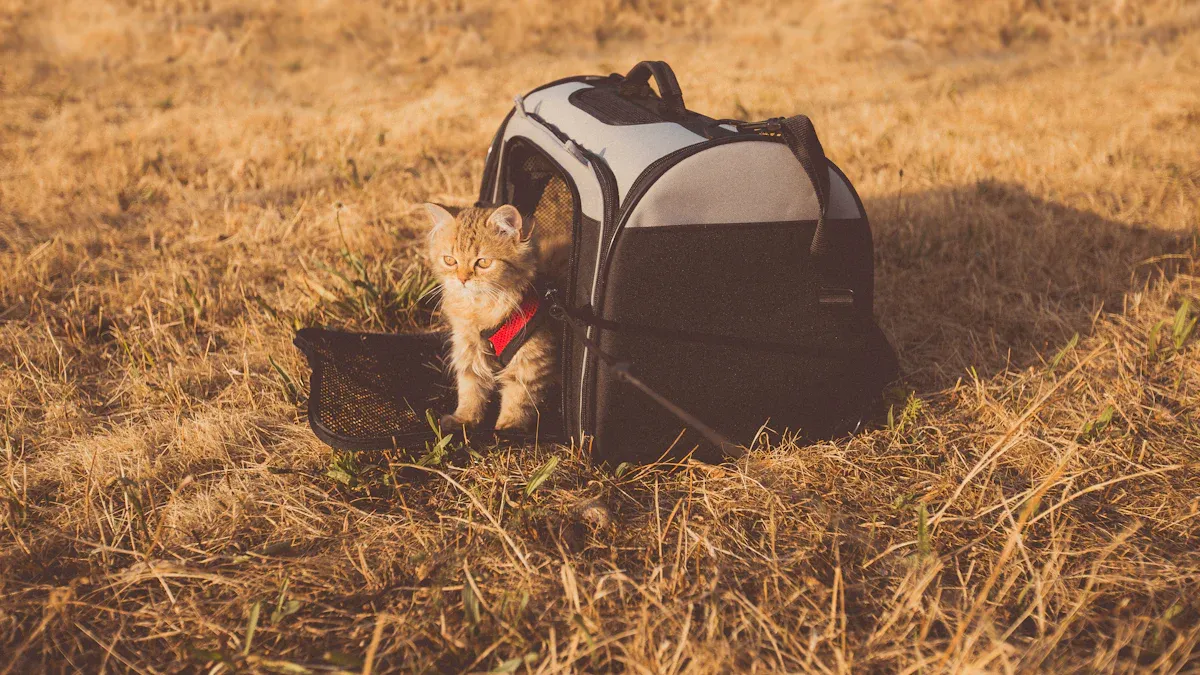
Three design variables control whether a carrier runs hot or stays ventilated: how much of the carrier wall is mesh, where that mesh is positioned relative to the dog’s heat-release zones, and whether the non-mesh panels block or allow residual airflow.
The first variable, mesh coverage, is the one most buyers check. And it is the least predictive. A carrier with 50% mesh that sits entirely below the dog’s shoulder line delivers less cooling than a carrier with 30% mesh placed across opposing upper-side panels. The dog’s primary heat-release zones are the chest, the upper sides behind the forelegs, and the belly. Mesh that misses these zones because it is positioned too low or concentrated on the top panel is decorative, not functional.
The second variable matters more: body contact. When a dog sits inside a carrier, its torso presses against the interior walls. If those walls are solid fabric, the contact points become thermal bridges — heat transfers from the dog’s skin into the fabric, where it accumulates because there is no airflow on the outer side to carry it away. Over 30 minutes, those contact patches can feel noticeably warmer than the surrounding mesh areas. You can verify this yourself. After a 15-minute walk, unzip the carrier and press your palm against the interior back panel, then against an interior side panel. If the back panel is warmer, the airflow path on that side is either absent or blocked by your own body.
The third variable is what happens when the carrier is under load. Soft-sided carriers with no internal frame tend to collapse inward when the dog shifts weight or leans. As the walls fold in, mesh panels that were taut and open become slack and pressed flat against the dog’s body. A mesh panel pressed flat is functionally identical to a solid panel. The air channel disappears. This is why a carrier that looks well-ventilated on a product page can fail on the trail — the photos show it empty and upright, not loaded with 15 pounds of dog leaning into the side wall.
Deep pouch designs amplify this problem. When the carrier bottom sits far below the dog’s center of mass, the dog sinks into the pouch. The sides wrap upward around the torso. What started as a mesh window becomes a sealed pocket with the dog’s body blocking the only opening.
Cross-Ventilation and Structural Rigidity: Two Design Features That Change the Outcome
Opposing vent placement creates a cross-flow path. Air enters through one side, moves across the dog’s body, and exits through the other. This works even at walking speed because your forward motion creates a slight but persistent pressure difference between the windward and leeward sides of the carrier. The effect is modest — this is not a wind tunnel — but it is enough to replace the interior air volume several times per minute rather than letting it stagnate. Carriers with mesh on only one side, or with mesh panels at mismatched heights, cannot create this path. Air enters and stalls. Heat accumulates.
Structural rigidity keeps that path open when the dog moves. A spring-wire frame or rigid edge piping holds the carrier walls in position even as the dog shifts, leans, or braces against a turn. Without this structure, the carrier conforms to the dog’s body shape. That sounds comfortable in theory — a custom fit — but it kills ventilation in practice because every mesh panel ends up flush against fur. The frame creates a small but critical standoff distance between the mesh and the dog’s body. That air gap is what allows convection to work.
You can test whether a carrier holds its ventilation shape. Load the carrier with a weight equivalent to your dog, set it on a table, and gently push sideways against one mesh panel. If the mesh immediately flattens against the weight inside, the frame is too weak to maintain an air channel during a hike where the dog leans into turns or braces during descents. This is also why a carrier with structured side panels and a rigid base tends to ventilate more consistently than a soft pouch with the same mesh percentage.
Internal space plays a supporting role. A carrier with enough depth to let the dog adjust its posture reduces the total body-contact area at any given moment. When the dog can shift from sitting upright to a relaxed lie-down, the contact patches move. Heat does not concentrate on the same square inches of fabric for the entire hike. A carrier with generous interior depth and high-mounted mesh above the shoulder line gives the dog room to reposition without blocking the vents. Tight, form-fitting carriers sacrifice this flexibility for a sleeker profile. That trade-off may be acceptable on a cool day. In warm weather, it works against you.
| Design feature | Why it matters for cooling | What happens when it is missing |
|---|---|---|
| Opposing side mesh panels at matching height | Creates a cross-flow path; forward motion drives air in one side and out the other | Air enters through the mesh, stalls inside, and heats up; no meaningful air exchange |
| Rigid frame or structured edge piping | Maintains a standoff gap between mesh and the dog’s body so convection can work | Mesh collapses against fur under load; the carrier becomes a sealed, warming pouch |
| Internal space for posture adjustment | Contact patches shift as the dog moves; heat does not concentrate in one spot | Fixed body position creates persistent hot spots on the fabric; temperature rises faster |
Stable strap geometry also contributes. A waist strap that transfers some of the carrier’s weight off your shoulders and onto your hips reduces the tendency of the carrier to press inward against your back with every stride. Less inward pressure means the back panel keeps a small air gap between your body heat and the carrier. That gap functions as a thermal break — it is not ventilation in the active sense, but it prevents your metabolic output from adding directly to the dog’s thermal load. In a tightly cinched carrier with no waist strap, the back panel presses flat against you, and your body heat conducts straight through the fabric to the dog’s side of the carrier.
Note: A carrier can pass every design check above and still overheat a dog if used beyond reasonable time limits. Ventilation design buys you margin. It does not remove the need to monitor the dog and take breaks.
When the Best Ventilation Design Reaches Its Limit
No carrier design can beat the physics of ambient temperature. Mesh allows air exchange, but the air being exchanged is the air outside. If the outside air is 85°F, the carrier interior will trend toward 85°F regardless of how well the vents are placed. Ventilation slows the rate at which the interior temperature rises above ambient by carrying away the dog’s metabolic heat. It cannot cool the dog below the surrounding air temperature. Evaporative cooling — the mechanism that makes sweating and panting effective — is the only way to drop body temperature below ambient, and a dog inside a carrier has limited capacity for both.
Useful rules of thumb emerge from this constraint. In temperatures above 75°F, carrier sessions should stay under 30 to 45 minutes, with at least a 10-minute out-of-carrier break between sessions. Above 80°F, halve those limits. These are not precision cutoffs — a fit Labrador on a shaded trail at 78°F with a light breeze is in a different thermal situation than a bulldog on an exposed sidewalk at the same temperature. But the pattern holds: as ambient temperature rises, the carrier’s ability to shed the dog’s metabolic heat shrinks, and the safe carry window narrows with it.
Breed matters enormously here. Brachycephalic breeds — bulldogs, pugs, boxers, Boston terriers — have structurally compressed airways. Panting, their primary cooling mechanism, is mechanically less efficient. In a carrier on a warm day, their thermal margin disappears faster than it does for a dolichocephalic breed with an open airway. Puppies and senior dogs add a second layer of reduced tolerance. A puppy’s thermoregulatory system is not fully developed. A senior dog’s cardiovascular response to heat stress is blunted. Both groups need shorter carrier sessions and longer recovery breaks than a healthy adult dog of the same breed.
Disclaimer: The fit and ventilation checks described here assume a smooth-coated or short-coated dog whose body contours are visible through the coat. Double-coated breeds like huskies, malamutes, and shepherds have an insulating underlayer that can mask contact pressure and make visual mesh-collapse checks less reliable. For these breeds, rely on hand-checking — reach into the carrier after 10 minutes of walking and feel whether the interior wall temperature at the back panel exceeds the side panel temperature by a noticeable margin. If it does, the back ventilation path is compromised even if the mesh appears open from the outside.
Weight distribution also shifts with heat. As a dog gets warmer, it may pant harder and shift position more frequently to find a cooler spot. If the carrier’s strap system cannot absorb that movement without sagging or tilting, the weight shifts off-center. The carrier leans. The vents on one side close. The thermal situation degrades quickly from that point. A carrier with a structured hip belt and a sternum strap keeps the load centered even when the dog is restless, which preserves the ventilation geometry. A hiking carrier built around weight distribution and vent stability does more for cooling than one that adds extra mesh but skimps on the harness architecture.
Plan your route to match the carrier’s limits. Trails with shade cover reduce radiant heat loading on the carrier’s outer panels. Routes with water access let you dampen the dog’s paws and belly during breaks — those are the surfaces where evaporative cooling has the most surface area to work with. Avoid extended climbs in direct sun if the temperature is above 75°F. The combination of your own exertion, which raises the back-panel contact temperature, and the dog’s restricted cooling capacity inside the carrier makes sustained climbs the highest-risk segment of any warm-weather hike.
The carriers that perform best in heat are not the ones with the most marketing claims about breathability. They are the ones with two opposing vent panels at shoulder height, a frame that holds those panels off the dog’s body when loaded, and a harness system that keeps the carrier stable without cinching it flat against your back. Those three things. Mesh percentage is downstream of all of them.
FAQ
How do you tell if your dog is overheating inside a backpack carrier?
Watch for panting that does not slow after two minutes of standing still, drool that thickens from clear and watery to white and ropey, and a head that droops or presses against the carrier wall. Any of these means stop, unzip, and get the dog into shade with water. Do not wait for all three.
Does more mesh always mean a cooler carrier?
No. Mesh that sits below the dog’s shoulder line or on only one side of the carrier adds almost nothing. Placement and the presence of a clear airflow path between opposing vents matter more than total mesh area.
How long can a dog safely stay in a backpack carrier during hot weather?
Thirty to 45 minutes per session in temperatures below 75°F, with at least a 10-minute out-of-carrier break between sessions. Cut these limits in half above 80°F. Brachycephalic breeds, puppies, and senior dogs need shorter intervals regardless of the temperature.
Can you use a cooling mat or damp towel inside a backpack carrier?
A thin damp towel placed under the dog can provide modest evaporative cooling, provided it does not block the side vents or reduce the interior space to the point where the dog cannot shift position. Check that airflow still reaches the dog’s upper body after adding anything to the carrier floor.
Which structural features matter most for ventilation?
The three that change the outcome: opposing side vents at matching shoulder height, a rigid frame or piping that prevents the mesh from collapsing against the dog’s body under load, and a waist strap that keeps the back panel from pressing flat against your body heat.






