
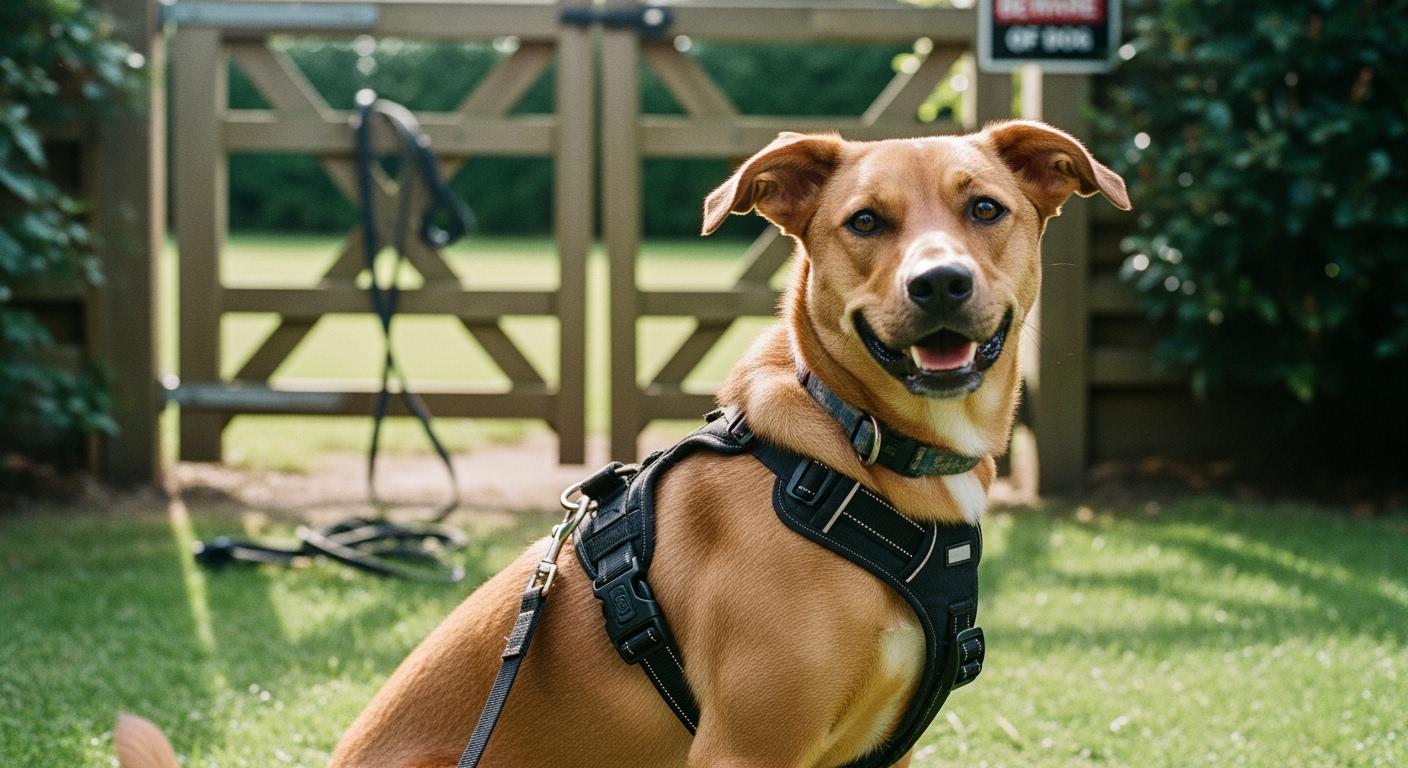
A harness that stops an escape artist without choking the dog — that is the design tension every escape-resistant harness has to resolve. Most attempts solve it by tightening the neck opening. That fails in two directions at once: it hurts the dog, and a panicked dog fights harder. The alternative runs through body geometry. A lower neck opening, a ribcage girth strap positioned behind the elbows, and multi-point adjustability create a structure the dog cannot back out of — without a single point of throat pressure.
Why Escape-Artist Dogs Back Out of Ordinary Harnesses
The Mechanics of a Back-Out
The escape sequence is predictable once you see it. The dog stops, drops its head toward the ground, rotates the shoulders inward, and reverses fast. In a harness with a high neck opening and a rear strap positioned too far forward on the soft belly, this sequence works every time.
Here is why. When the dog drops its head, the neck opening gapes at the base — the strap rides up toward the jaw, and a gap opens between the harness and the chest. At the same moment, the belly strap compresses soft tissue instead of catching on bone. There is no hard stop. The harness slides backward without resistance, the dog steps out, and the leash goes slack.
The causal chain is mechanical, not behavioral. The dog is not outsmarting the harness. The harness is missing two structural anchors: a front opening low enough to stay closed when the head drops, and a rear catch point rigid enough to stop backward travel before the chest panel clears the sternum. Without both, reversing out is not an escape — it is just the harness following the path of least resistance.
| Failure sign | Likely design problem | Better harness structure |
|---|---|---|
| Dog backs out at doorways | Neck opening too wide or rear strap too far forward | Lower neck opening, third belly strap |
| Harness rolls sideways | Uneven straps or chest panel too wide | Balanced side straps, stable rib cage fit |
| Dog scratches at harness | Rubbing or trapped heat | Smooth padding, breathable material |
Why Standing Fit Is Not Enough
A harness that looks centered when the dog stands still can shift dramatically under backward load. Short Y-shaped designs are especially vulnerable — they sit high on the chest, leave the ribcage mostly uncovered, and create a pivot point the dog can rotate around. The test is simple. Attach the leash, apply gentle backward pressure, and watch whether the back clip stays on the spine’s midline or drifts toward one shoulder. Drift of more than an inch signals the harness will rotate under a real escape attempt, opening gaps on the opposite side.
Dogs with a deep chest and narrow waist — Greyhounds, Whippets, Dobermans — are shaped exactly to slip this kind of harness. The ribcage tapers sharply behind the shoulders, so a strap that fits at rest slides backward with almost no friction once the dog reverses. A walking control setup built around body coverage rather than tension alone closes this gap before it opens.
Why Neck Pressure Is the Wrong Way to Stop Escape
Neck constriction looks like a quick fix. Crank the collar tighter, the dog cannot slip out. But the neck is the wrong anchor point — and tightening it triggers the exact response you are trying to prevent.
The anatomy problem is hard to overstate. A dog’s trachea and cervical spine sit just under the skin with minimal muscle padding. Even moderate pressure compresses the airway. For brachycephalic breeds — pugs, bulldogs, boxers — the margin is smaller because their airways are already structurally narrower. Pressure that a Labrador shrugs off can choke a Frenchie in seconds. The harness becomes a constriction point, and the dog’s instinct is to fight it, not relax into it.
Then the feedback loop takes over: throat pressure → pain → panic → stronger escape attempt → more pressure. The tighter the neck, the harder the dog pulls backward. It is a cycle the harness cannot win, because the dog’s survival reflex is stronger than any strap tension.
| Pressure pattern | What happens to the dog | Design alternative |
|---|---|---|
| Strap rides up to throat under load | Trachea compression, coughing, gagging | Lower neck opening anchored at sternum |
| Neck tightened to close escape gap | Panic response, harder reverse pulling | Ribcage girth strap as primary anchor |
| Constant throat contact at rest | Avoidance — dog freezes or refuses harness | Chest-panel-only front structure |
Neck pressure also changes behavior in ways that look like training problems. A dog that associates the harness with throat discomfort starts freezing at the door, scratching at the straps, or refusing to move forward. After a walk, check for coughing, throat-scratching, or hesitation when the harness comes out — these are not personality quirks. They are equipment feedback. The dog is telling you the harness rides up under load.
What Escape-Resistant Harness Structure Actually Works
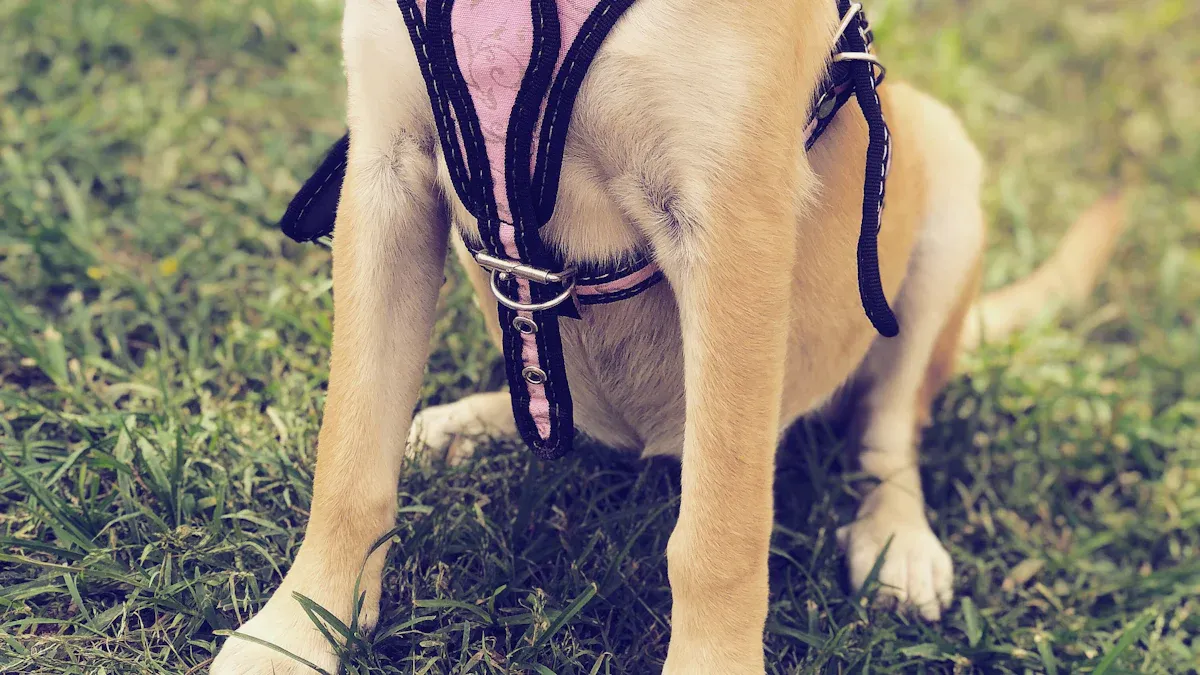
Three structural features do the work that neck tightening tries and fails to do. Each addresses a specific point in the escape sequence, and the three work together — remove one, and the escape route reopens.
Lower Neck Opening and Chest Panel
When the neck opening sits at the base of the neck rather than mid-throat, it stays closed when the dog lowers its head. The chest panel, centered over the sternum, resists rotation because it spreads lateral force across a flat bony surface rather than a curved soft one. Together they create a front anchor that moves with the dog’s shoulders instead of riding up toward the jaw.
If the neck opening feels loose at rest or you can slide two fingers under it without touching skin, the gap is already there — the dog just has not used it yet. A harness built around proper sizing and material selection closes this gap with geometry, not elastic tension.
Ribcage Girth and Optional Third Strap
The girth strap that wraps behind the elbows catches on the ribcage — a bony ring the harness cannot compress past. This is the mechanical block that stops backward slipping. The ribcage is rigid. Soft belly is not. A strap on the belly gives way; a strap on the ribs does not.
A third strap behind the ribs adds a second catch point. When the dog reverses, the rear strap hits the last rib and stops the motion before the harness can slide forward enough to free the neck opening. The difference between two straps and three is the difference between extra strap solutions that actually block motion and designs that rely on friction alone — which fails the moment the dog commits to the reversal.
After a 10-minute walk with some jogging and direction changes, check whether the girth strap has slid forward onto the soft belly. If it has, the strap was too loose at rest or positioned too far forward. A correctly placed girth strap stays behind the elbows regardless of movement.
Adjustable Fit Zones
A harness with independent adjustment at the neck, chest, and girth lets you close escape gaps that vary by body shape. A deep-chested Greyhound and a barrel-chested Bulldog need different strap angles to achieve the same security. Multi-point adjustment makes that possible without relying on self-tightening mechanisms that add unpredictable pressure under load.
The fit checklist for an escape-resistant harness starts with measuring chest girth at the deepest point behind the elbows — not the widest point of the ribcage. A half-inch error here shifts the girth strap forward, and forward means onto soft tissue, and soft tissue means the escape route is still open.
Stable Back Leash Point and Shoulder Clearance
The back clip should stay centered on the spine even when the dog pulls sideways. If it drifts toward one shoulder, the harness rotates, the chest panel tilts, and escape gaps open on the opposite side. A dog harness with balanced strap geometry keeps the leash point stable by distributing load evenly across both shoulder straps — one side does not take more tension than the other.
Shoulder clearance matters for a different reason. If the straps sit too close to the armpits, every stride rubs. The dog feels the restriction and starts fighting the harness itself — not to escape, but to relieve the irritation. Enough room behind the elbows for the front legs to extend fully eliminates this trigger. Run your finger along the inside edge of each shoulder strap after a walk. Warmth is normal. A raised red line is not — that is friction, and the strap needs to move back half an inch.
When Body Geometry Alone Is Not Enough
No harness design can close every escape route on every dog. Dogs with unusually deep keels — where the chest drops significantly below the elbow line — may still find rotation points even in a well-fitted three-strap harness. Dogs with very short coats and loose skin, like Shar-Peis or some hounds, can slip because the skin moves independently of the harness even when strap tension is correct.
Disclaimer: This fit analysis assumes a dog with smooth-to-medium coat and a chest shape within typical breed proportions. Double-coated breeds may hide rub marks under the fur — hand-checking the skin under each strap after the first few walks catches pressure points that visual inspection misses. If the dog’s chest falls well outside the breed norms this harness class is patterned for, particularly barrel chests with a very deep keel or extremely tapered waists, the fit checks described here may not catch every escape risk. A harness sized for small dogs with unusual proportions often needs a different strap layout entirely.
Dogs recovering from injury or surgery should not be tested with backward leash pressure until fully healed — even a well-fitted harness distributes force across the torso, and healing tissue may not tolerate it. When in doubt about fit, a short indoor session with the harness on and no leash attached reveals whether the dog moves freely or compensates for restriction.
FAQ
Can any harness stop all escapes?
No single design eliminates every escape route on every body shape. What a well-structured harness does is close the most common ones — high neck opening, forward girth strap, insufficient chest coverage. The remaining risk is fit-dependent and varies by the dog’s build and coat type.
How do you know if the harness fits correctly?
Two checks. First, slide two fingers under each strap at rest — they should fit snugly, not loosely. Second, apply gentle backward leash pressure and watch the back clip. If it stays within an inch of the spine’s midline and the neck opening does not ride toward the jaw, the fit is working under load.
What is the difference between a collar and a harness for escape prevention?
| Collar | Harness |
|---|---|
| Sits on the neck — the escape artist’s leverage point | Wraps around chest and ribs — bony anchors |
| Backward pull = direct throat pressure | Backward pull = force distributed across sternum and ribcage |
| Single anchor, single slip point | Multiple anchors at neck, chest, and girth |






