
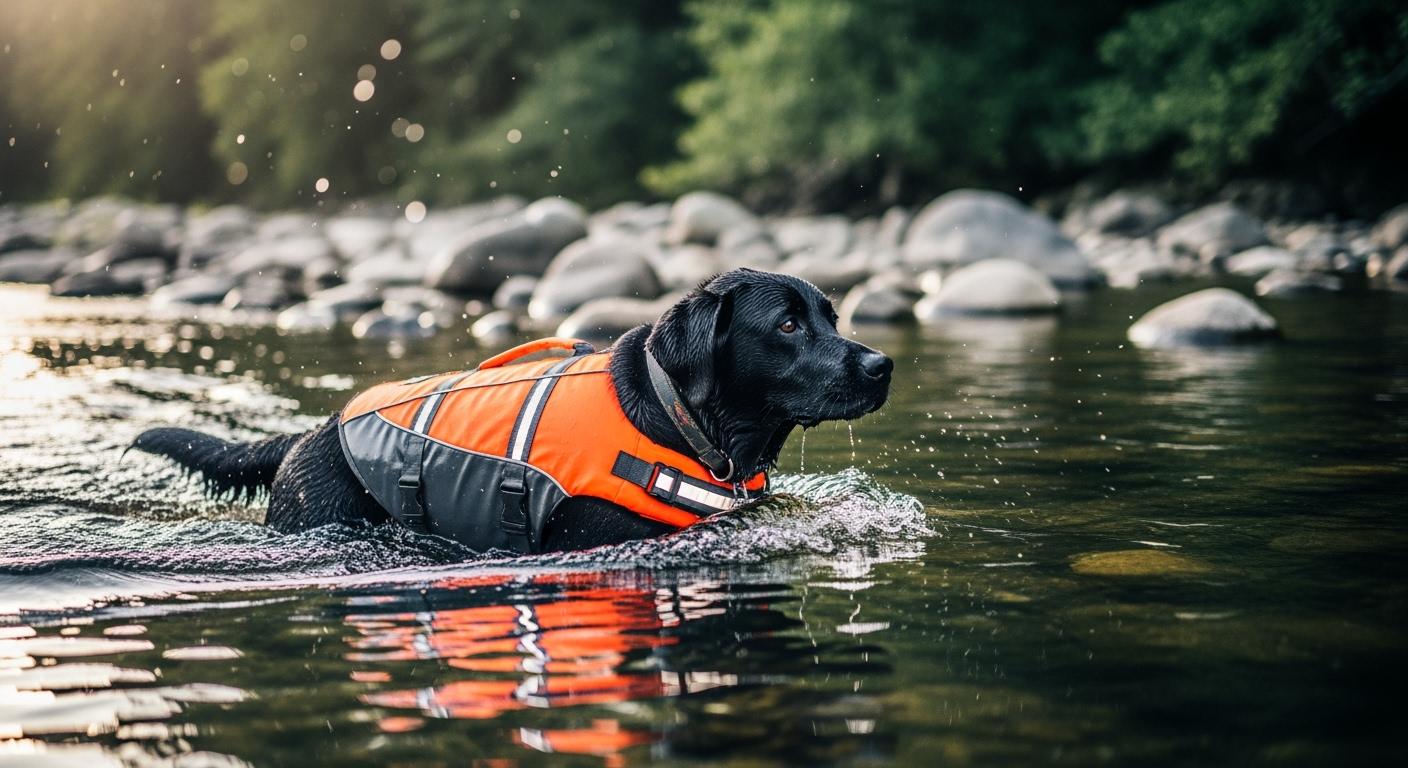
Reflective trim on a dog life jacket is only as useful as the angle it faces. During a river crossing, your dog is not swimming in a straight line toward you. They quarter across the current, turn to avoid submerged branches, climb out on uneven banks. The reflective strip that faces you at the put-in may point at the far shore ten seconds later. Wide reflective zones placed across the top, both sides, and the neck panel change that equation. At least one reflective surface catches your headlamp or flashlight no matter which direction the dog is facing.
The design problem is not whether a jacket has reflective trim. Most do. The problem is whether the trim stays exposed when water, current, and the dog’s own movement all work to hide it. A life jacket built around visibility treats reflective material as a structural element, not a decorative afterthought.
Where Reflective Trim Sits Determines What You See Mid-Crossing
A narrow reflective strip stitched across the back panel works on a calm lake at dusk. The dog faces away, the strip faces you, and your flashlight hits it square. River crossings break that assumption. When a dog angles into the current, the jacket presents its side to you. If the reflective material is only on the dorsal surface, it disappears. You see dark fabric and moving water.
The physics is straightforward. Reflective tape is a passive retroreflector — it sends light back toward its source, but only when the reflective surface is within roughly 30 degrees of perpendicular to the incoming beam. A strip running front-to-back along the spine has a narrow effective arc. Turn the dog 45 degrees, and the reflection drops to near zero. Now add a side panel with reflective trim. As the dog rotates, one strip leaves the reflection window while the other enters it. The transition is continuous rather than binary — visible, then partially visible, then visible again on the opposite surface. That is the difference between tracking your dog and guessing.
| Visibility failure | Product design cause | Better design direction |
|---|---|---|
| Reflective disappears in shadows | Low-contrast shell, narrow trim | Bright shell, wide reflective zones |
| Hard to spot from the side | Reflective only on top | Reflective elements on top, sides, and neck |
| Trim hidden by movement | Poor panel stability, loose fit | Stable buoyancy panels, secure three-point fit |
Small Trim Patches Versus Edge-to-Edge Coverage
Small reflective patches fail in predictable ways. A two-inch logo on the chest disappears when the dog turns broadside. A strip tucked under the rescue handle vanishes exactly when you reach for it. Straps and buckles that cross over reflective zones block the one surface that should be catching light. At night or in heavy tree cover, you cannot afford a design where the reflective element and the thing that obscures it occupy the same square inch of fabric.
Edge-to-edge placement solves this by running reflective material across the full width of the top panel and down both side panels. When the dog turns, the reflective surface moves but does not vanish — it transitions from the top plane to the side plane. A jacket with reflective trim only on the back panel gives you one viewing angle. A jacket with coverage wrapping from the dorsal surface down to the belly straps gives you nearly 270 degrees of passive visibility. That is the difference you notice when tracking a dog in open water with a headlamp.
Water pushes against every surface of the jacket. When the dog turns, the water resists. That resistance applies torque to the vest. If the vest fits loosely, it can rotate independently of the dog’s body — the reflective trim that faced you five seconds ago now points at the opposite bank.
Why Buoyancy Panel Stability Keeps Reflective Zones Above Water
Reflective trim cannot work if it is underwater. A river crossing puts the jacket through conditions that flat-water swimming never does: angled entry, current pushing from one side, the dog scrambling up a muddy bank at an incline. Each of those moments can submerge part of the jacket. If the reflective zones sit on panels that dip below the surface, they stop reflecting.
Buoyancy panel layout determines whether the jacket resists rotation or amplifies it. When foam panels are concentrated in the chest and back only, the jacket has no lateral stability. Water hits the side, and the whole vest spins around the dog’s torso like a loose sleeve. Wide foam sections that extend into the side panels create resistance to this rotation — the buoyant surface area is distributed across a broader arc, so lateral water pressure cannot find a clean lever arm to twist the jacket.
The three anchor points — chest, belly, and neck straps — form a triangular tension network. When all three are snug, the jacket becomes a fixed exoskeleton. The reflective trim moves with the dog’s torso, not independently of it. You can verify this before a trip: put the jacket on the dog, cinch all three straps, then push sideways against the side panel with moderate pressure. If the jacket shifts more than an inch relative to the dog’s spine, the panels are not stable enough for moving water. More detail on how buoyancy and fit interact determines whether those reflective zones stay where they belong.
| Visibility failure | Product design cause | Better design direction |
|---|---|---|
| Reflective disappears at angles | Trim only on top or under handle | Edge-to-edge trim on top and sides |
| Trim blocked by straps | Poor strap routing | Unobstructed reflective zones |
| Reflective rolls under body | Loose fit, unstable panels | Stable, three-point secure fit with wide reflective coverage |
Handle and Strap Placement That Preserve Visibility
The rescue handle creates a conflict. You need it centered on the back for lifting — it is the primary extraction point when the dog needs help up a bank or over a log. But the back panel is also prime real estate for reflective trim. A handle that spans the full width of the back blocks the reflective surface directly beneath it. The fix is not removing the handle. It is placing reflective material to both sides of the handle rather than only underneath it, and extending reflective coverage far enough down the side panels that the handle’s shadow does not matter.
Strap routing matters for the same reason. Belly straps that cross the side panels at a diagonal can cut across reflective zones. A life jacket with unobstructed reflective layout routes straps along seam lines or behind reflective panels rather than across them. The reflective material stays clear and exposed regardless of strap tension or how wet the jacket gets.
Shell Materials, Drainage, and What Happens Across Multiple Crossings
A jacket that works on the first crossing may fail on the third. Water weight changes the geometry. A soaked shell sags, pulling the reflective panels lower on the dog’s body. Mud and silt from the bank coat the reflective surface and kill its retroreflective properties. Plant debris catches in seams and strap junctions.
Weather-resistant shell fabric addresses the first problem. A tightly woven nylon shell with a water-repellent finish sheds most of the water on exit. The jacket does not become a sponge. Quick-drain construction — mesh panels, drain holes at the lowest points of the belly — lets the water that does enter the jacket escape within seconds of the dog leaving the water. You can observe the difference: after a crossing, lift the jacket at the shoulder. If water streams out of the belly seam for more than three seconds, the drainage is inadequate for repeated crossings. That retained water pulls the reflective trim lower on every subsequent entry.
Mud and debris create a different problem. Reflective tape relies on a clean, flat surface to return light. A film of silt cuts reflection by more than half. Jackets with smooth-faced reflective tape — rather than textured or fabric-backed — rinse clean with a quick splash. Check this before trusting the gear: after a practice swim in murky water, shine a light on the trim from twenty feet away. If the reflection is patchy or dull, the trim surface needs cleaning before it is reliable again. For a deeper look at how secure fit and material durability hold up across multiple outings, the sizing and construction details matter as much as the reflective features.
| Visibility failure | Product design cause | Better design direction |
|---|---|---|
| Trim covered by mud | Absorbent shell, slow drain | Weather-resistant shell, quick-drain mesh |
| Reflective sags below water | Heavy, waterlogged panels | Lightweight, fast-draining shell with drain holes |
When Reflective Trim Alone Is Not Enough
Reflective trim solves one problem: passive visibility in low light when you are actively looking for the dog with a light source. It does not help in several conditions that are common during river crossings. Thick fog scatters the flashlight beam before it reaches the jacket — the reflection is too weak to see at any distance. Heavy rain does something similar, and also makes it harder to keep your own light steady on the dog. Murky water with suspended sediment absorbs light across the visible spectrum; a dog submerged to the shoulders in silty water reflects almost nothing back, no matter how much trim the jacket carries.
Bright shell color is the backup system. A fluorescent orange or yellow panel is visible in daylight, in fog, and in conditions where your flashlight cannot reach. It does not replace reflective trim — it covers the conditions where reflective trim is useless. The two features work on opposite principles: reflective trim amplifies an artificial light source, while bright color creates contrast against natural backgrounds.
A secure, stable fit remains the foundation. If the jacket shifts, rotates, or sags, both the reflective trim and the bright shell color end up pointing in the wrong direction or dipping below the surface. The best visibility features in the world cannot compensate for a jacket that does not stay where it was designed to sit.
Disclaimer: These visibility checks assume a dog with a short to medium coat where the jacket sits close to the body. Double-coated breeds may show subtler shifts because the jacket rides on top of dense fur rather than against the torso — hand-check panel position rather than relying on visual seam alignment alone. Dogs with barrel chests or very deep keels, common in some bully breeds and sight hounds, may fall outside the torso patterns standard life jackets are patterned for; the fit checks described here may not catch every pressure point or rotation.
The way fit, buoyancy, and visibility work together matters more than any single feature in isolation. A jacket that scores high on reflective coverage but low on panel stability gives you a bright target that keeps disappearing. A jacket with modest reflective coverage that stays locked in position gives you a consistent signal you can actually track.
FAQ
Does reflective trim work differently in moving water versus still water?
Yes. In still water, the jacket sits relatively stable and the reflective surface stays oriented upward. In moving water, lateral current pressure can rotate the jacket around the dog’s torso, changing which surface faces you moment to moment. Wide reflective coverage across multiple panels compensates for this rotation.
Can aftermarket reflective tape replace built-in trim?
Adhesive reflective tape tends to peel at the edges after repeated wet-dry cycles. The adhesive bond weakens when the underlying fabric stretches while wet and contracts while drying. Stitched-in reflective trim integrates with the jacket’s seam structure and handles that expansion-contraction cycle without separating.
How do you test reflective trim performance before a trip?
Put the jacket on the dog at dusk. Walk thirty feet away and circle the dog with a flashlight at waist height. The trim should flash back at you from every angle. If there is a silent arc — an angle where no reflective surface catches the light — that is the angle where you will lose visual contact during a real crossing.
Does salt water affect reflective trim differently than fresh water?
Salt water leaves a crystalline residue when it dries that can cloud the reflective surface and reduce light return. Rinsing the jacket with fresh water after saltwater use and wiping the reflective tape with a damp cloth keeps the retroreflective surface clean. The effect is cosmetic and reversible — it does not permanently damage the reflective material.






