
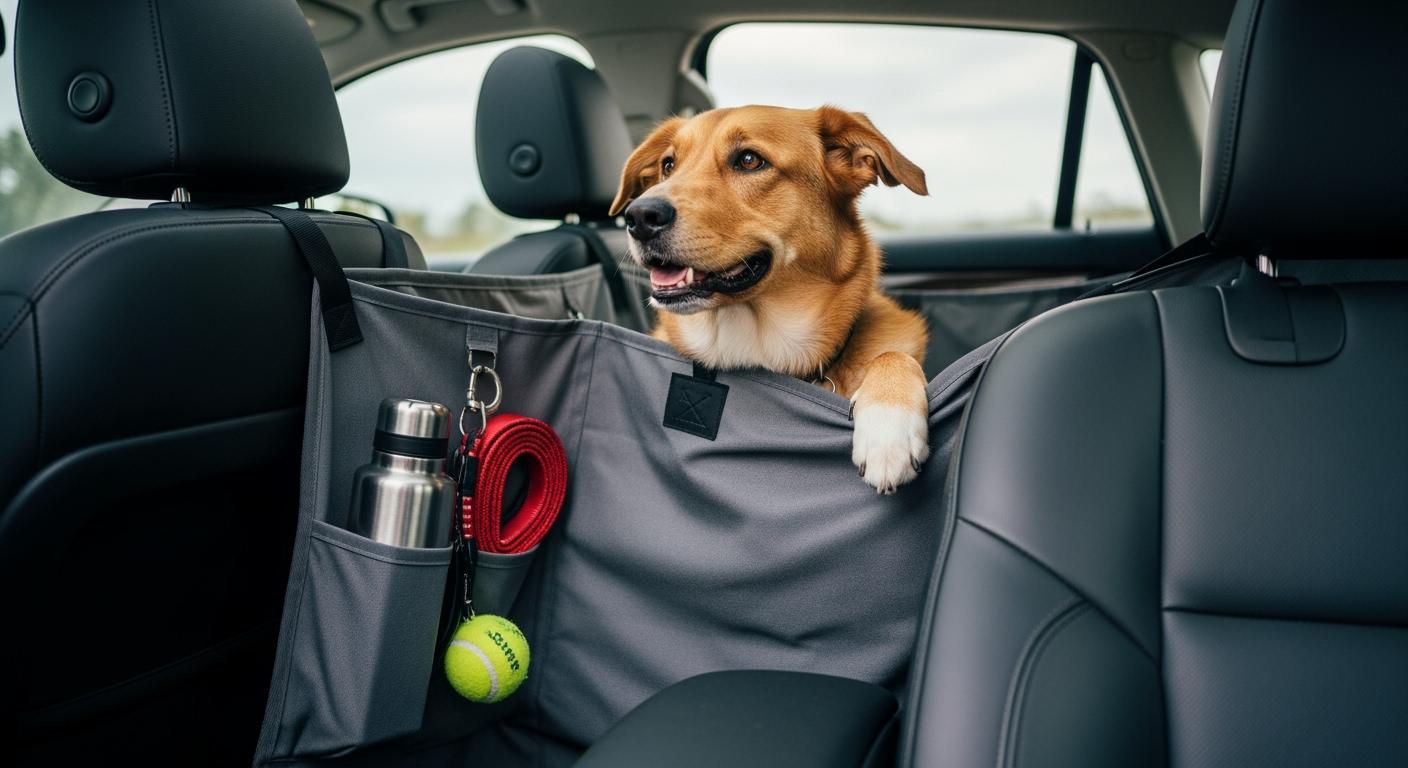
You pack leashes, treats, wipes, and a collapsible bowl for the road. Twenty minutes in, half of it has vanished into the gap between the seat back and cushion. A dog car hammock with storage pockets changes that equation — but only if the pocket placement and panel design work together.
The problem is not that you brought too much gear. The problem is that a flat car seat was never designed to hold loose objects during lateral acceleration. Every turn, brake, and lane change sends unsecured items sliding toward the nearest gap. A raised hammock panel interrupts that path. Pockets positioned above the dog’s paw line keep things within your reach but outside your dog’s. When those two features align, the gear stays put and the driver stays focused.
But they do not always align. Pocket height, anchor security, and panel tension each decide whether the system works or creates new frustrations. This article walks through which design details make the difference — and what to check before assuming a pocketed hammock will solve every road-trip organization problem.
Why Loose Gear Disappears Into Back Seat Gaps
The Physics of a Turning Car and Unsecured Items
A car changing direction applies lateral force to everything inside it. Loose items on a flat seat surface have nothing resisting that force except friction — and the friction between a nylon leash and seat fabric is negligible. When you take a right turn at 25 mph, a treat bag resting on the back seat experiences roughly 0.3 to 0.5 g of sideways acceleration. That is enough to start it sliding. Once it hits the seat crease, gravity takes over. The item drops into the footwell or wedges into the gap between the seat back and cushion.
This is not about driving style. It is about surface geometry. A standard back seat has two failure points: the horizontal gap where the seat bottom meets the seat back, and the vertical drop into the rear footwell. Anything that slides far enough in either direction will disappear. A hammock-style seat cover addresses both at once by converting the back seat into a suspended platform with raised edges.
The Gear-Collection Cycle
Road trips compound the problem. Unlike a five-minute drive to the park, a multi-hour trip means repeated braking, accelerating, and turning — each cycle sending loose items a few more inches toward a gap. Your dog shifting position adds another unpredictable force. A 50-pound dog repositioning on the seat applies enough pressure to bounce a leash or snack pack off the seat edge.
Most owners discover the loss only at the next rest stop, when the leash they need is wedged under the front seat and the waste bags are somewhere in the footwell. Reaching for lost items while driving is dangerous. Pulling over adds time and frustration. A well-designed hammock intercepts items before they reach either loss point.
In practice: Before a trip, place three lightweight items — a leash, a wipe pack, and a treat bag — on the back seat. Drive a route with three turns and one hard stop. Check how many are still on the seat. If any ended up in the footwell, the gap problem is real and a hammock panel will change the outcome.
The Raised Hammock Panel as a Gap Barrier
How the Vertical Panel Interrupts the Loss Path
A flat seat cover protects upholstery. It does not change where items go when the car moves. A hammock design adds a vertical component: the front edge attaches to the front seat headrests, the rear edge anchors to the back seat headrests, and the sides rise several inches above the seat surface. This creates a contained zone. Items sliding forward hit the raised front panel instead of dropping into the footwell. Items moving sideways meet the side walls before reaching the door gap.
The distinction matters more than it sounds. A bench-style cover and a hammock-style cover may look similar when laid flat, but under driving forces they behave differently. The bench cover follows the seat contours — including the very gaps items fall through. The hammock bridges those contours, suspending a continuous surface above the problem areas. Any item that slides reaches a raised edge, not a crease.
Anchors and Non-Slip Backing: What Keeps the Barrier Upright
A hammock panel only works if it stays in position. When a dog shifts weight against the front panel, an unsecured hammock can sag forward, creating a ramp into the footwell rather than a barrier. This is where anchor design separates functional hammocks from decorative ones.
Headrest straps control the front and rear attachment points. Seat anchors — typically push-fit discs that wedge into the seat crease — control the lateral position. Non-slip backing on the underside grips the seat surface. When all three work together, the hammock resists displacement from multiple directions. Lose one anchor point, and the panel tilts under load. The storage pockets that depend on that panel for stability then become unreliable too.
After a 30-minute drive with a restless dog, run your hand along the front edge of the hammock. If it has dropped more than an inch from its installed position, the anchor system is not holding. Adjust the headrest straps or check that the seat anchors are fully seated. A panel that sags is no longer a barrier — it is a funnel directing items toward the footwell.
What Pocket Height and Position Change About Accessibility
Why a Pocket Six Inches Higher Makes a Difference
Pocket placement is not a convenience feature. It is a functional decision that determines who can access the stored items — you or your dog. When pockets sit low, near the seat surface, a dog can nudge them open with a paw or muzzle. The items inside become chew toys. The fabric around the pocket takes repeated stress at the seam, and what started as an organizational feature becomes a tear point.
Raise those same pockets six inches higher — mounted along the side panel or near the top of the front barrier — and the dynamic changes. The dog’s paws cannot reach them without contorting. You, from the front seat, can reach back and access a side pocket without taking your eyes fully off the road. The height differential creates a functional boundary: human-accessible, dog-inaccessible.
This is the kind of detail that determines whether a car seat cover with storage actually delivers on the organization promise. A pocket that exists on the spec sheet but sits at paw level will cause more problems than it solves. A pocket placed with intention — high, side-mounted, with a secure closure — becomes the quick-access point that makes rest stops faster and driving less distracted.
The Weight Distribution Problem
Pockets do not just hold items. They add mass to one section of the hammock. Load a low side pocket with a full water bottle and the entire panel tilts toward that corner. The non-slip backing loses contact on the opposite side. The dog’s weight amplifies the imbalance.
Good pocket design accounts for this. Multiple smaller pockets spread across the panel distribute load more evenly than one large compartment. Zippered closures prevent items from spilling when the panel does shift slightly during aggressive driving. And the stitching around each pocket — particularly the bottom seam, which bears the full weight of stored items — needs reinforcement beyond what the surrounding fabric uses. The same principle applies to car travel gear sizing and fit: distribution matters more than total capacity.
Check this yourself: load the pockets with the items you would typically carry. Drive for 15 minutes on a route with curves. Park on a level surface and check whether the hammock panel sits evenly across the seat. A visible tilt means the pocket placement is working against the anchor system.
The Closure That Keeps Items In and Paws Out
A pocket without a closure is a suggestion, not a solution. Zippers hold better than hook-and-loop under repeated vibration, but they also require two hands to operate — one to stabilize the hammock, one to pull the zipper. Hook-and-loop closures open faster but degrade with dirt and fur accumulation. Neither is universally better. The right choice depends on what you store and how often you access it.
For items grabbed at every rest stop — waste bags, wipes — hook-and-loop gives the speed you need. For items stored for the full trip — backup leash, extra treats — a zipper prevents the slow creep of vibration from working the closure open over hours of driving. A stable back seat cover with well-placed closures means one less thing to monitor while you are driving.
When a Pocketed Hammock Is Not the Right Choice
A hammock with storage pockets organizes lightweight gear. It does not restrain a dog in a crash. It does not replace a crash-tested harness, a seat belt tether, or a travel crate. Treat the hammock as a containment and organization layer, not as safety equipment. The two functions are separate and both are necessary.
Pockets also have practical limits. They are designed for soft, light items: fabric leashes, treat pouches, wipe packs, collapsible silicone bowls. Heavy objects — metal water bottles, full glass containers, hard toys with sharp edges — concentrate force on the pocket seams and accelerate wear. They also become projectiles in a sudden stop. If you need to carry heavy or rigid items, store them in the cargo area or a secured floor compartment, not in hammock pockets.
Dogs that chew or dig at fabric will eventually find the pocket seams. No amount of reinforced stitching prevents a determined chewer from working through fabric over time. For these dogs, a hammock still provides the gap-barrier function — just leave the pockets empty, or choose a hammock without them. A solution that protects the car interior during travel can take more than one form.
Disclaimer: The fit checks and pocket-access observations described here assume a standard sedan or SUV back seat configuration with headrests on both front and rear rows. Vehicles without rear headrests, with integrated seat belts, or with non-removable rear seat cushions may not anchor a hammock securely. If your dog’s sitting height places its muzzle at or above the hammock side panel, items in side pockets may still be reachable — test this by loading an empty wipe pack into the pocket and observing whether your dog can make contact with it during a stationary trial before relying on the pocket for a road trip.
FAQ
Does a hammock with pockets replace a dog seat belt?
No. A hammock organizes gear and blocks gaps. It provides zero crash protection. Your dog needs a separate restraint system — a crash-tested harness tethered to a seat belt anchor — for safety during travel.
What should I store in the hammock pockets?
Lightweight, soft items only: fabric or nylon leashes, waste bag rolls, wipe packs, small treat pouches, a collapsible silicone bowl. Do not store anything heavy, rigid, or sharp. If an item would hurt if it hit you during a hard stop, it does not belong in a hammock pocket.
How do I know if the pocket placement works for my dog?
Load the pockets with the items you plan to carry. Park the car. Sit in the driver’s seat and reach back for each pocket. If you can access it without twisting fully around, the placement works for you. Then observe your dog in the back seat — if its muzzle reaches pocket height, the placement does not work for containment. Choose a design with higher or differently positioned pockets.
How do I clean the hammock and pockets?
Wipe the surface with a damp cloth after each trip. For deeper cleaning, most hammocks can be machine-washed on a gentle cycle — remove the cover from the anchors and check the care label first. Empty all pockets before washing. Air-dry rather than machine-dry to protect seam integrity.






