
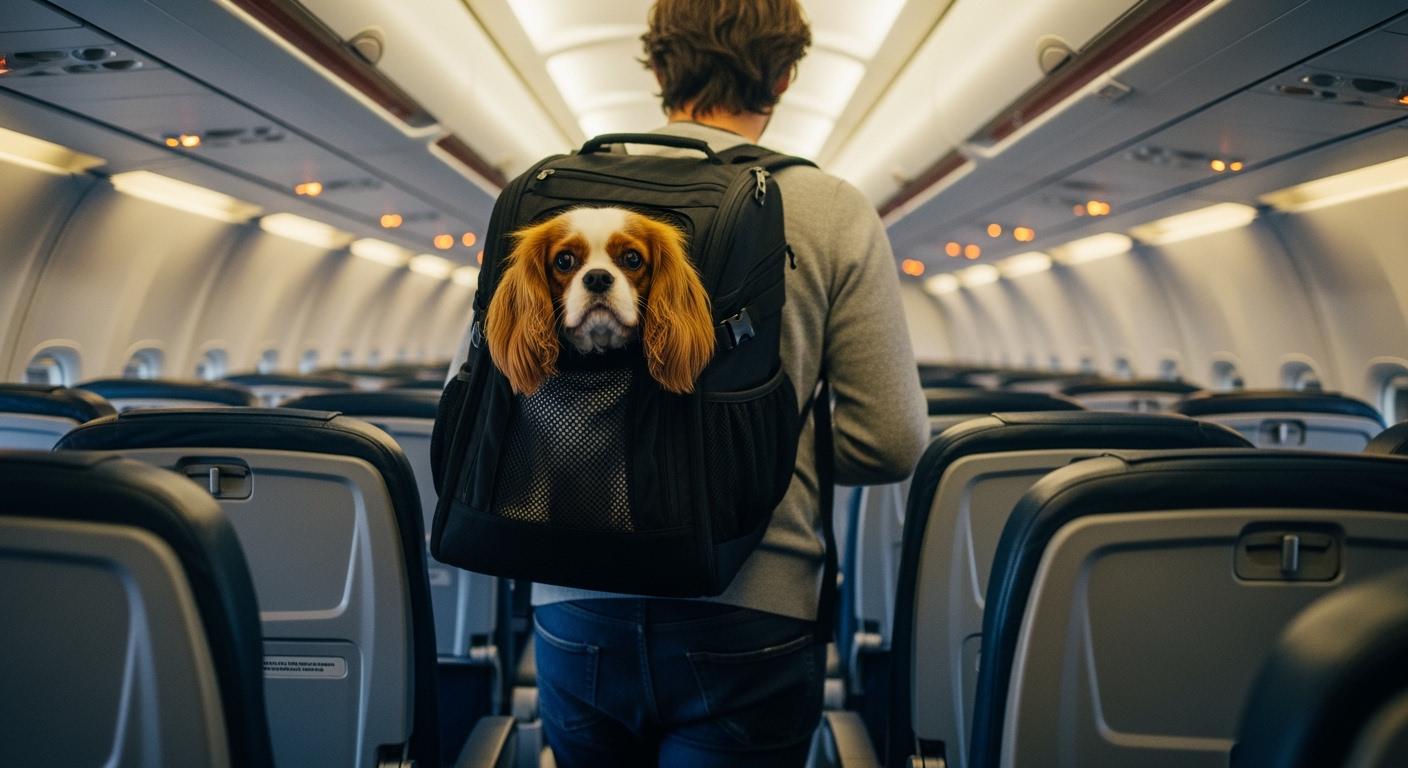
A dog backpack carrier moves through a narrow airline aisle the way its loaded shape allows — not the way its listed dimensions suggest. The difference between gliding past seat backs and catching every armrest comes down to how the carrier distributes width, where the weight sits, and whether the base resists rotation when you turn. Most carriers are measured empty and flat. An airline aisle tests the loaded profile: dog inside, straps tensioned, gravity pulling the mass downward while you pivot sideways to let someone pass. That test has no tolerance for extra width.
Why a Bulky Carrier Fails the Aisle Test
Boarding and Deplaning — What the Carrier’s Shape Demands
Boarding turns every inch of aisle into a clearance check. A carrier that measures 11 inches wide on a table can behave like 14 inches when the dog shifts weight to one side. The extra width does not come from the fabric stretching — it comes from the carrier rotating around the shoulder strap contact points. As you turn sideways to let another passenger pass, the carrier’s base swings outward in an arc. A soft, unstructured base offers no resistance to that rotation, so the arc widens. The carrier’s outermost edge sweeps through tray tables, armrests, and knees that a stable carrier would clear.
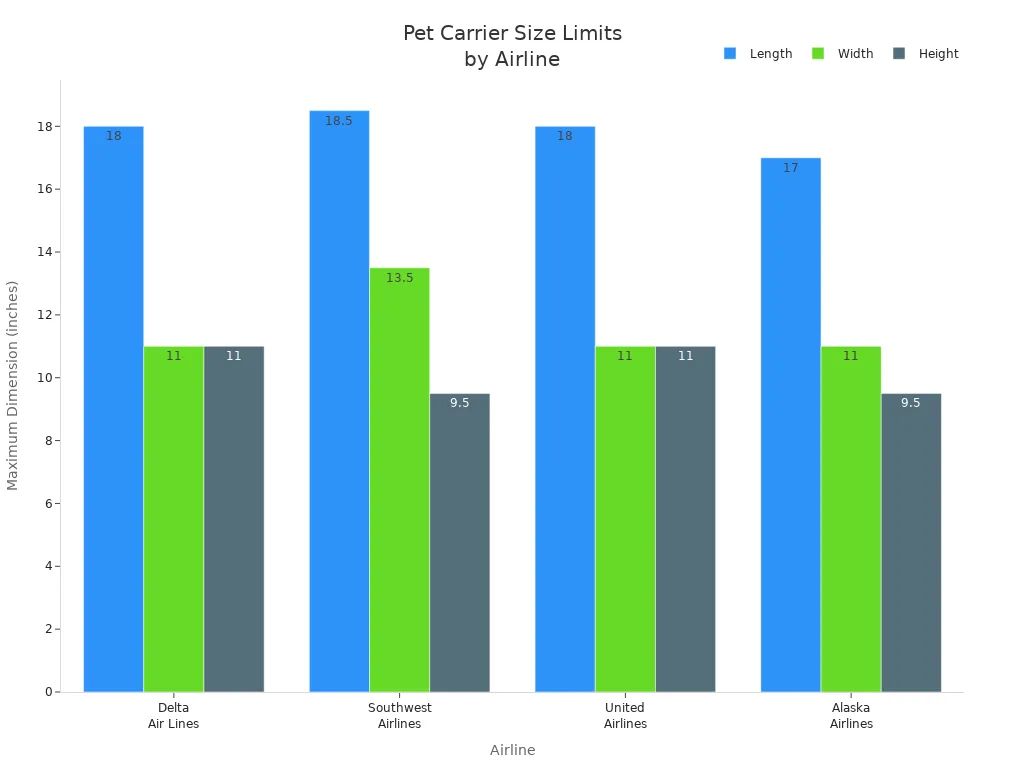
Airlines publish under-seat dimensions that define the maximum carrier footprint for in-cabin travel, but those numbers describe static storage space, not the dynamic clearance a carrier needs during boarding. A carrier that compresses to fit under a seat may still be too wide to walk through the aisle without contact.
Tip: The relevant measurement is the carrier’s loaded profile — the width and depth it occupies with the dog settled inside and the straps under tension — not the empty shell dimensions printed on the tag.
| Design Difference | Why It Matters | Main Limitation |
|---|---|---|
| Soft-sided shell vs. rigid plastic shell | Soft walls compress to match under-seat contours; rigid shells maintain fixed dimensions that may not fit all seat tracks | Soft-sided carriers offer less crush protection if overhead items shift during turbulence |
| Lightweight fabric body vs. heavy structural frame | Lower carrier weight reduces shoulder fatigue during boarding delays and gate changes | Ultralight fabrics may lack the panel stiffness needed to keep the base from collapsing under the dog’s weight |
| Padded interior vs. bare interior walls | Padding absorbs minor bumps against seat backs and distributes pressure evenly across the dog’s body | Excess padding adds bulk that works against the slim profile needed for aisle clearance |
Seat Backs, Armrests, and Overhead Bin Traffic
Aisle obstacles fall into two categories: stationary (seat backs, armrests) and moving (arms reaching into overhead bins, passengers stepping out). A carrier with hard corners or rigid edge binding turns every stationary obstacle into a contact point. The corner acts like a lever — a small nudge against an armrest transfers force directly into the carrier body because the rigid edge cannot deform. Rounded edges distribute that same contact across a larger surface, reducing the impulse felt by the dog inside.
Protruding storage pockets amplify the problem. A zippered pocket that adds half an inch to each side increases the carrier’s effective aisle width by a full inch. That inch is often the difference between clearing a seat back and catching it. Low-profile storage that sits flush against the carrier body eliminates this risk without sacrificing the ability to carry treats, boarding documents, or a collapsible water bowl.
Shape and Balance Decisions That Change Aisle Behavior

Outer Width, Rigid Corners, and Protruding Pockets
The outer width of a backpack carrier matters more during the walk to the seat than during the flight itself. Under the seat, the carrier sits in a confined rectangular space where compression is expected. In the aisle, there is no ceiling or side wall to compress against — the carrier’s natural loaded width is what passes between the seat rows. A carrier with a listed width of 11 inches that bulges to 13 inches when loaded will contact seat backs on a CRJ or ERJ regional jet, where aisle width can dip below 16 inches between armrests.
Rigid corner construction introduces a second failure mode. When a hard corner catches an armrest, the carrier stops abruptly while the wearer’s forward momentum continues. The dog inside experiences a sudden deceleration — the same physics that makes a hard stop uncomfortable in a car. Soft, rounded corners allow the carrier to glance off obstacles rather than hooking onto them, which keeps forward movement smooth and the dog undisturbed. Sizing a backpack carrier for airline use is less about matching the dog’s back length and more about controlling the loaded width at the carrier’s widest point after the dog settles.
Base Stability and Strap Design
The base panel is the single most influential design element for aisle behavior. Here is why. When you walk forward, the carrier’s weight vector points straight down. When you turn — to step aside, pivot into a row, or reverse direction — the weight vector tilts. A base panel that flexes under this lateral load allows the dog’s mass to shift toward the outside of the turn, which creates a rotational moment: the carrier swings wider, the shoulder straps act as the pivot point, and the carrier’s outermost edge traces an arc that grows with every degree of rotation. A stiff, structured base resists this shift. The dog’s weight stays centered, the rotational moment stays small, and the carrier stays within the wearer’s body profile.
Strap geometry determines where that body profile sits. Straps that allow the carrier to hang low and away from the back increase the lever arm between the wearer’s spine and the carrier’s center of mass. Shortening that distance — either through strap adjustment range or through a back panel that pulls the carrier closer to the lumbar region — reduces the swing radius. A close-carry position turns the carrier into an extension of the wearer’s torso, not a pendulum. Walk 10 steps through a mock aisle marked 18 inches wide with the dog loaded. After the walk, check whether the carrier’s outermost edge drifted more than 2 inches from the centerline of your back — that drift distance is what catches armrests.
| Design Difference | Why It Matters | Main Limitation |
|---|---|---|
| Slim, rounded profile vs. boxy, rigid shape | Reduces contact surface with seat backs and armrests; rounded edges glance off obstacles instead of catching | A profile that is too narrow may restrict the dog’s ability to turn around and settle during the flight |
| Stable, structured base vs. flexible, unstructured base | Prevents the carrier from swinging outward during turns by resisting lateral weight shift | A very stiff base adds carrier weight and may be less comfortable against the wearer’s lower back |
| Low-profile, flush storage vs. protruding zippered pockets | Eliminates catch points — every external protrusion adds effective aisle width | Flush storage offers less total capacity; bulky items like full-size water bottles may not fit |
Weight Distribution and Why Listed Dimensions Mislead
A carrier’s listed dimensions describe the empty shell laid flat. Load it with a dog, and the shape changes. The fabric panels bulge outward under tension, the base panel settles lower, and the zippers pull the top opening into a different contour. The gap between the empty measurement and the loaded measurement is where aisle clearance failures happen. A carrier that passes a home fit test between two chairs can still fail at the gate because the loaded width shifts throughout the flight — the dog stands, turns, curls up, and each position redistributes the carrier’s outer contour differently.
A collapsible backpack carrier with a structured base panel balances two competing needs: it folds flat for storage when empty, but resists deformation when loaded. That balance is what keeps the carrier’s loaded width predictable. Without it, the carrier’s shape becomes a function of the dog’s current position rather than a fixed design attribute.
When a Slim-Profile Carrier Earns Its Place — and When It Does Not
Where the Slim Advantage Holds
The slim-profile advantage is most pronounced on narrow-body aircraft — CRJ, ERJ, E-Jet series, and older 737 and A320 configurations with tighter seat pitch. On these planes, the aisle between armrests runs narrow enough that every inch of carrier width counts. Full flights compound this: overhead bin traffic, passengers leaning into the aisle, and gate-check bags blocking sections of the walkway all reduce the effective clearance further. An airline carrier’s under-seat dimensions define what fits once you reach the seat, but the aisle gauntlet between the jet bridge and the seat row is what tests the carrier’s loaded profile in motion.
Connecting flights add time pressure. A carrier that requires constant adjustment — pulling it back toward center, lifting it over obstacles, apologizing to passengers whose elbows it brushed — slows movement when speed matters most. A slim carrier that stays within the wearer’s body silhouette eliminates that overhead.
Where It Fades
The slim-profile advantage diminishes on wide-body aircraft where aisles are broader and seat pitch is more generous. It also fades when the dog’s weight pushes the upper limit of the carrier’s rating. A dog near the weight ceiling shifts more mass during turns, which increases the rotational force the base panel must resist — even a well-structured base may flex enough under maximum load to produce noticeable swing. Airline-specific carrier rules and aircraft type determine whether the marginal gain of a narrower profile is meaningful or whether a standard-width carrier clears the aisle just as well.
Disclaimer: This fit assessment assumes a smooth-coated dog within the carrier’s rated weight range. Double-coated breeds or dogs with prominent chest keels may show subtler pressure marks that require hand-checking rather than visual inspection — run your fingers along the dog’s ribs and shoulders after removing the carrier at the gate to catch pressure points a visual scan would miss.
After 15 minutes of carrying through the terminal, open the carrier and press a dry palm against the back interior panel. If the fabric feels damp, the ventilation panels are likely collapsing under the dog’s weight and body heat — a design flaw that matters more in the stale cabin air of a parked aircraft than in the open terminal.
Design features that influence real-world aisle performance:
- Smooth interior walls without exposed zipper tracks or bolt heads — interior protrusions press into the dog when the carrier compresses against a seat back
- Ventilation openings positioned high enough that the dog cannot extend a nose or paw through mesh at armrest height
- Lockable zippers that resist opening under the lateral pressure of a dog leaning against the carrier wall
- Top and side handles positioned to allow two-hand lift control when stepping over a bag or navigating around a service cart
- Water-resistant base fabric that holds its stiffness when exposed to a water bowl spill — some base materials soften when wet and lose the structural rigidity that prevents swing
- Removable, washable liner that comes out without unthreading straps or disassembling the carrier frame
FAQ
What determines whether a carrier swings into the aisle or stays close during a turn?
The base panel’s resistance to lateral flex is the primary factor. When the base bends during a turn, the dog’s weight shifts toward the outside of the rotation, creating a pendulum effect. A structured base panel keeps the dog’s mass centered over the wearer’s spine, which keeps the swing radius small enough to stay within the body silhouette.
Why do some carriers feel wider in the aisle than their listed dimensions suggest?
Listed dimensions are taken with the carrier empty and flat. With a dog inside, fabric panels bulge outward under tension, the base settles lower, and the zippered opening changes contour. The loaded width — which is what passes between seat backs — can exceed the tag measurement by one to two inches. Testing the carrier loaded with the dog between two chairs set at the airline’s stated aisle clearance gives a better read than checking the printed dimensions.
Does a collapsible carrier compromise base stability?
Not necessarily. The relevant design choice is whether the base panel includes a rigid or semi-rigid insert that stays flat when the carrier is unfolded. A removable base board or a sewn-in stiffener panel provides the same lateral resistance as a non-collapsible base, while still allowing the carrier to fold for storage. The trade-off is weight — a stiffer insert adds ounces.
How much does ventilation design affect the dog’s comfort during boarding versus in flight?
Boarding puts the carrier under the wearer’s body heat plus the dog’s body heat in an enclosed space with limited airflow. Mesh panels that cover at least two non-adjacent sides create a cross-ventilation path — air enters one side and exits another. Panels on only one side trap heat. During the flight, when the carrier is stowed under the seat, the ventilation situation changes: the carrier sits in a partially enclosed cavity, so side-panel mesh may be partially blocked by the seat support structure, making top-panel ventilation more important than it was during boarding.






