
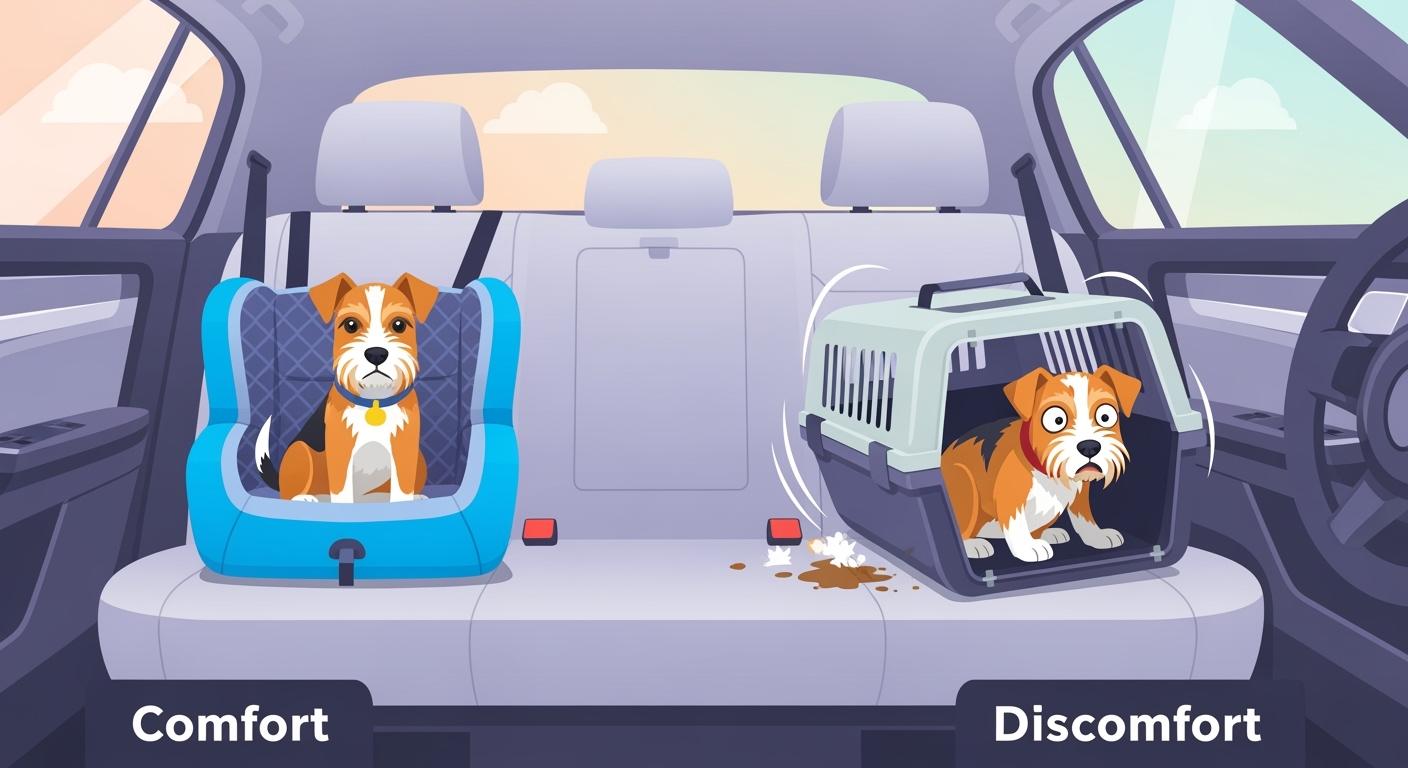
Two designs. One goal — keeping your dog from becoming a projectile, a distraction, or a cleanup project during car travel. A dog car seat elevates. A carrier encloses. The choice between a dog car seat vs carrier in car is not about which product is better. It is about which design solves your specific failure mode: sliding, mess, anxiety, or all three.
The open seat bets on visibility and comfort to keep a dog settled. The carrier bets on physical boundaries. Both bets pay off under different conditions. And both fail when those conditions are not met.
Why Open and Enclosed Handle Movement Differently
An open car seat gives a dog a raised platform with padded sides. The dog sits upright, looks out the window, and — if the design works — stays put. A carrier creates a box around the dog. Walls on all sides. One entry point. No window access.
These are not just aesthetic differences. They produce different physical outcomes when the car moves.
In an open seat, the dog’s center of mass sits above the seat base. During a turn, lateral force pushes the dog’s body outward. The side padding absorbs some of that force — but only if the dog stays against it. If the dog leans away from the turn, the padding does nothing. The dog’s mass shifts, the base of support narrows, and the dog slides. That is the physics of it: the open design relies on the dog’s willingness to stay pressed against the side wall. A dog that stands, turns, or paces defeats the geometry.
A carrier short-circuits this. The enclosed walls catch the dog’s mass regardless of what the dog chooses to do. The dog cannot shift far enough to narrow its base of support. The containment is passive — it works even when the dog does not cooperate.
In practice: After a 15-minute drive with turns, check whether your dog has migrated more than two inches from the starting position. In an open seat, a two-inch drift means the side padding is not engaging. In a carrier, any drift means the carrier itself is sliding — a mounting problem, not a design one.
But the trade-off is real. That enclosed space removes the horizon line. For a dog prone to motion sickness, losing the visual reference of the outside world can make nausea worse. An elevated booster seat aligns what the dog sees with how the car moves, reducing the sensory mismatch that triggers queasiness. For motion-sensitive dogs, that alignment matters more than containment.
Cleanup After the Walk: Covers, Liners, and What Stays Dry
Mud, sand, drool, shed fur — a dog does not have to be messy to leave a mess. The difference between a car seat and a carrier shows up most clearly after a wet walk.
An open car seat typically uses a removable cover. You unclip it, shake it out, toss it in the wash. The underlying seat foam stays protected if the cover has a waterproof backing. But the cover only protects the seat itself. It does not contain airborne fur or splatter. A dog that shakes off inside the car sprays the door panel and window regardless of how good the seat cover is.
A carrier liner handles this differently. The enclosure traps fur, dander, and most moisture inside the carrier walls. The liner itself may be simpler — often a thin pad rather than a structured cover — but the containment is more complete. Fur that would drift onto the center console in an open seat stays inside the carrier box.
Disclaimer: A waterproof cover or liner blocks liquid from soaking through, but no fabric stays dry on the surface indefinitely. After a heavy rain walk, towel the dog before loading. A saturated cover pressed against a car seat for hours can still transfer moisture through seam holes and stitching — waterproof does not mean seam-sealed.
The observable test is straightforward. After three trips, run your hand across the car seat surface under the cover or under the carrier. Dry? The barrier is holding. Damp or gritty? The design is not sealing at the edges. This check catches failures that visual inspection misses — moisture migrating under the cover through strap openings, or grit working its way past the carrier’s base fabric where it meets the seat.
A car seat that integrates a waterproof layer into the base design tends to hold up longer than one where the cover is the sole barrier. When the cover and the waterproofing are the same piece of fabric, every wash cycle degrades both functions simultaneously. When they are separate layers, the waterproof membrane stays intact even as the top cover wears.
When the Dog Decides the Answer
A small, calm dog that watches the world go by is the textbook candidate for an open booster seat. The elevation gives visual access. The dog stays settled because the view is engaging enough. Motion sickness tends to be lower because the horizon is visible. The design matches the dog’s natural travel posture — alert but still.
A restless dog that paces, repositions, or chews straps defeats the open-seat design. The side padding cannot engage if the dog refuses to lean into it. The seatbelt tether becomes a chew target if it is within reach. And a dog that shifts frequently creates a moving load that the seat base was not shaped to stabilize. That fails fast.
For anxious or reactive dogs, the carrier’s enclosed space often calms by reducing stimulus. There is less to react to. The walls block sightlines to pedestrians, other cars, and passing dogs. This is not about confinement for its own sake — it is about reducing the volume of input a reactive dog has to process while already stressed by motion.
But a carrier can backfire for a dog with confinement anxiety. The same walls that block stimulus also block escape. A dog that panics when enclosed will fight the carrier — scratching, digging, vocalizing — and that energy transfers into the car seat mounting. A carrier that shifts under a panicking dog amplifies the fear response because the dog feels the instability.
| Dog behavior or travel pattern | Usually the better starting point | Why |
|---|---|---|
| Calm, trained, short local trips | Open booster seat with tether | Visibility keeps the dog engaged; short duration limits restlessness buildup. |
| Anxious, restless, motion-sensitive | Carrier | Enclosed space reduces pacing; walls limit repositioning options. |
| Chews straps or gets tangled | Carrier | Keeps restraint straps out of reach and prevents spinning within the seat. |
| Reactive to traffic, people, or other dogs | Carrier | Blocked sightlines reduce trigger exposure and prevent seat-crossing. |
| Very small dog that does not settle | Secured rear-seat carrier | Stable enclosure provides more passive restraint than a tether alone. |
Disclaimer: This table assumes a dog without pre-existing confinement phobia. A dog that has previously injured itself trying to escape a crate or carrier may do worse in an enclosed space, even if the behavior column suggests otherwise. Observe the dog’s response to confinement at home before relying on a carrier in a moving vehicle.
Where Neither Design Fixes the Problem
Some problems sit between the product and the car. No design decision on the seat or carrier side resolves them.
Car space constraints. An elevated booster seat in a compact car’s rear bench can push a small dog too high — the dog’s head presses against the roof liner, which creates a hunched posture that stresses the spine on longer drives. A carrier that barely fits between the front and rear seats may ride against the seatback at an angle, tipping forward under braking. Measure the actual mounting footprint before choosing. The right product in the wrong car is still the wrong product.
Harness routing and tether geometry. A seatbelt tether clipped to a back-attach harness point allows the dog to spin 180 degrees before the tether engages. By the time it catches, the dog is facing backward and tangled. A front-attach point reduces the rotation radius. But neither attachment point matters if the tether is too long — more than about eight inches of slack lets a small dog climb onto the center console before the restraint engages. Tether length and clip position together determine whether the restraint actually restrains.
Sizing errors. A carrier sized for the dog’s standing height gives too much internal volume when the dog curls up — the extra space becomes slide room. A booster seat sized by weight alone ignores body length: a long-bodied small dog may fit the weight rating but hang over the front edge, making the side bolsters irrelevant. Checking both length and girth against the product dimensions catches mismatches that weight-based sizing misses. Sizing is not about the label on the box. It is about whether the dog’s body fills enough of the product’s internal volume that the design features — side bolsters, tether reach, base width — actually engage the dog during movement.
Neither an open seat nor a carrier is automatically safer. A poorly fitted carrier can tip. A too-large open seat can let a dog slide into the footwell. The product type matters less than whether the specific unit matches the specific dog in the specific car.
FAQ
Does a dog car seat or a carrier protect better in a crash?
Neither an open car seat nor a soft-sided carrier is engineered as a crash-rated restraint system unless the manufacturer explicitly tests and certifies it to a published standard. Most car seats and carriers on the market are designed for comfort, containment, and distraction reduction — not impact protection. A product marketed as a travel seat is not the same as a crash-tested restraint. If crash protection is the primary concern, look for a harness or carrier that carries a verifiable test certification from an independent lab, not a marketing claim.
Can a dog car seat cover replace a carrier for mess control?
A cover protects the seat surface underneath. It does not contain airborne fur, dander, or the spray from a wet dog shaking off. For dogs that shed heavily or drool, a carrier’s enclosed walls catch what a cover lets fly. Use a cover when the dog stays dry and calm. Use a carrier when controlling what leaves the dog’s immediate space matters as much as protecting the seat.
What if a dog refuses to settle in either option?
Start by checking whether the fit allows the dog’s natural resting posture. A dog that normally curls up will not settle in a shallow booster seat that forces an upright sit. A dog that prefers to sit tall and watch will fight a carrier that forces a crouch. The product must match the dog’s default posture first. If the fit is correct and the dog still will not settle, acclimate in a parked car across several short sessions before driving — the problem may be motion itself rather than the containment design.
Is one option easier to install and remove daily?
Carriers with a single seatbelt loop route through the rear handle tend to go in and come out faster than booster seats that require threading the seatbelt through base channels and clipping a tether. But speed of installation should not be the deciding factor. A carrier that is fast to install but wrong for the dog’s behavior creates a different kind of hassle — one that plays out on the road rather than in the driveway.






