
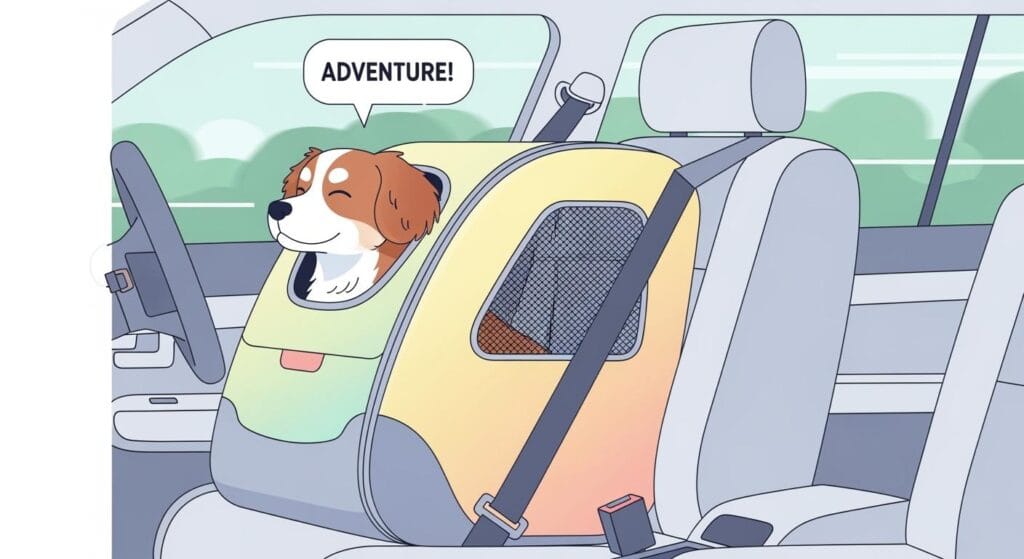
If your dog slides across the back seat, tries to climb forward, or refuses to settle, the problem is usually not just behavior. The travel setup may be too open, too cramped, or too awkward to secure. The right car seat carrier dog setup limits roaming, helps the driver stay focused, and gives your dog a more predictable place to rest.
No seat or carrier makes car travel risk-free. Still, a restrained dog is usually easier to manage than a dog moving around the cabin. Rear-seat placement, a stable base, and a harness-based restraint path often matter just as much as padding or style. If you are comparing the basics first, dog car seat safety and restraint setup is often what changes the outcome most.
Open seat, enclosed carrier, or low-profile bed?
The best choice depends on how your dog rides in real life. A calm dog that settles quickly may do well in an open seat. A dog that spins, whines, or tries to climb out usually does better with more containment. A low-profile bed or mat with a harness restraint can work when step-in height matters more than walls.
| Setup | Best match | Main advantage | Main drawback |
|---|---|---|---|
| Open seat | Calm dogs that like visibility | Easier entry and a clear view | Less containment if the dog is restless |
| Enclosed carrier | Dogs that pace, curl up, or need boundaries | Better containment and less cabin mess | Some dogs resist smaller openings at first |
| Low-profile bed or mat with harness restraint | Dogs that need easy step-in access or more room to stretch | Simple entry and lower sidewalls | Least containment during turns and stops |
When more containment helps
An enclosed carrier is usually the better option when your dog treats every ride like a moving obstacle course. It gives nervous dogs a clear boundary, cuts down on pacing, and can make short errands feel less chaotic. Hard-sided models may hold their shape better, while soft-sided models can be lighter and easier to store, but either style still needs a stable base on the rear seat.
Before buying, check back-seat contour and footprint with space and stability checks for a seat-mounted carrier. Even a well-made carrier can feel wrong if it rocks, tilts, or blocks the seatbelt path.
- Choose more containment when your dog keeps turning in circles or trying to climb out.
- Choose more containment when your dog settles better in den-like spaces than in open booster seats.
- Choose more containment when mud, shedding, or accidents make cleanup a regular problem.
- Skip deep or narrow entries if your dog has mobility limits or strongly resists stepping into enclosed spaces.
When a more open setup works
An open seat or lower-sided travel bed can be the better fit when your dog likes visibility, enters easily, and does not lunge, paw, or circle through the ride. In those cases, dog car seat and carrier sizing checks still matter, because tall bolsters, narrow bases, or short tether reach can make a seemingly roomy setup feel cramped.
A lower-sided option such as a dog car seat for a medium dog may be easier to load than a deeper carrier when your dog already rides calmly and needs simpler entry. The tradeoff is that you have to be stricter about fit, harness routing, and whether the dog actually stays centered once the car starts moving.
- Use an open setup when your dog stays seated or lies down without repeated correction.
- Use a lower step-in design when jumping over high sides is the biggest daily problem.
- Move away from open styles if your dog pants heavily, leans into one wall, or keeps trying to stand over the side.
Fit checks before every drive
A good setup should work before the car leaves the driveway. If loading feels clumsy, the base shifts when you press on it, or the tether twists the moment your dog turns around, those are not small details. They usually predict a worse ride once you brake, merge, or take a corner.
| Check item | Pass signal | Fail signal | What to change |
|---|---|---|---|
| Base position | Carrier or seat sits flat and steady | Setup tips, slides, or leans | Reposition it, tighten straps, or add a non-slip layer if appropriate |
| Entry and exit | Dog gets in and out without force | Dog freezes, backs away, or gets stuck | Try a wider opening or a lower-sided setup |
| Body position | Dog settles near the center | Dog keeps leaning, spinning, or bracing | Use more containment or a different shape |
| Restraint path | Harness stays clear and untwisted | Tether pulls at odd angles or catches under the body | Reroute the tether and recheck harness fit |
| Airflow and comfort | Dog breathes normally and relaxes | Heavy panting, drooling, or obvious stress | Stop, cool the cabin, shorten the ride, and reassess the setup |
Note: Place the setup on the rear seat, use a harness rather than a collar for restraint, and stop the ride if your dog shows breathing strain, heat stress, or motion discomfort.
Failure signs that mean it is time to adjust
Most bad travel setups fail in predictable ways. The dog keeps shifting, the base keeps moving, cleanup becomes a chore, or the tether turns into a knot by the second stoplight. Those patterns usually mean the setup does not match your dog’s body shape, confidence level, or the way your vehicle seat is built.
| Symptom | Likely cause | What usually helps |
|---|---|---|
| Sliding on turns | Base is not level or secure | Reposition the base and tighten the attachment points |
| Whining or repeated pacing | Dog feels exposed or cannot settle | Try a more enclosed shape or shorter practice rides |
| Tether tangles | Harness path is too long or poorly routed | Shorten or reroute the tether and recheck the harness |
| Refuses to enter | Opening is too tight or the setup feels unstable | Use a wider opening or a lower entry height |
| Hard cleanup after every ride | Fabric absorbs dirt, hair, or spills | Add a washable liner or choose simpler surfaces |
When the same issue keeps repeating, small habit changes usually matter more than extra padding. Tether length, base grip, and where you place the setup on the bench seat can change ride quality fast. That is why daily comfort and security habits are worth checking after a few short test drives instead of waiting for a long trip to expose the problem.
Cleaning and everyday friction
The setup you actually use every time is usually better than the one that looks perfect but takes too much effort. If buckles are hard to reach, the base blocks other passengers, or the liner takes too long to wash, you may start skipping the restraint altogether. Look for surfaces that wipe down easily, openings that do not force awkward lifting, and a shape that can stay in place without constant adjustment.
If your routine also includes carrying your dog from the car to a lobby, store, or waiting room, dog sling carrier sizing and fit checks plus durable materials can help you compare softer carry options with more structured car-only setups. That matters most for small dogs that move between multiple travel modes in one outing.
FAQ
Is an enclosed carrier safer than an open dog car seat?
It often gives better containment, but the safer choice still depends on rear-seat placement, stability, correct sizing, and a clear harness-based restraint path.
Should a dog ride in the front seat?
For most dogs, the rear seat is the better place because it usually reduces distraction and lowers exposure during sudden stops.
Can you attach a restraint to a collar?
A harness is usually the better choice because a collar can put too much force on the neck if the car stops suddenly.
How do you know the setup is too small?
If your dog cannot settle, keeps leaning against the sides, resists entry, or has trouble turning into a comfortable resting position, the setup may be too cramped or poorly shaped.






