
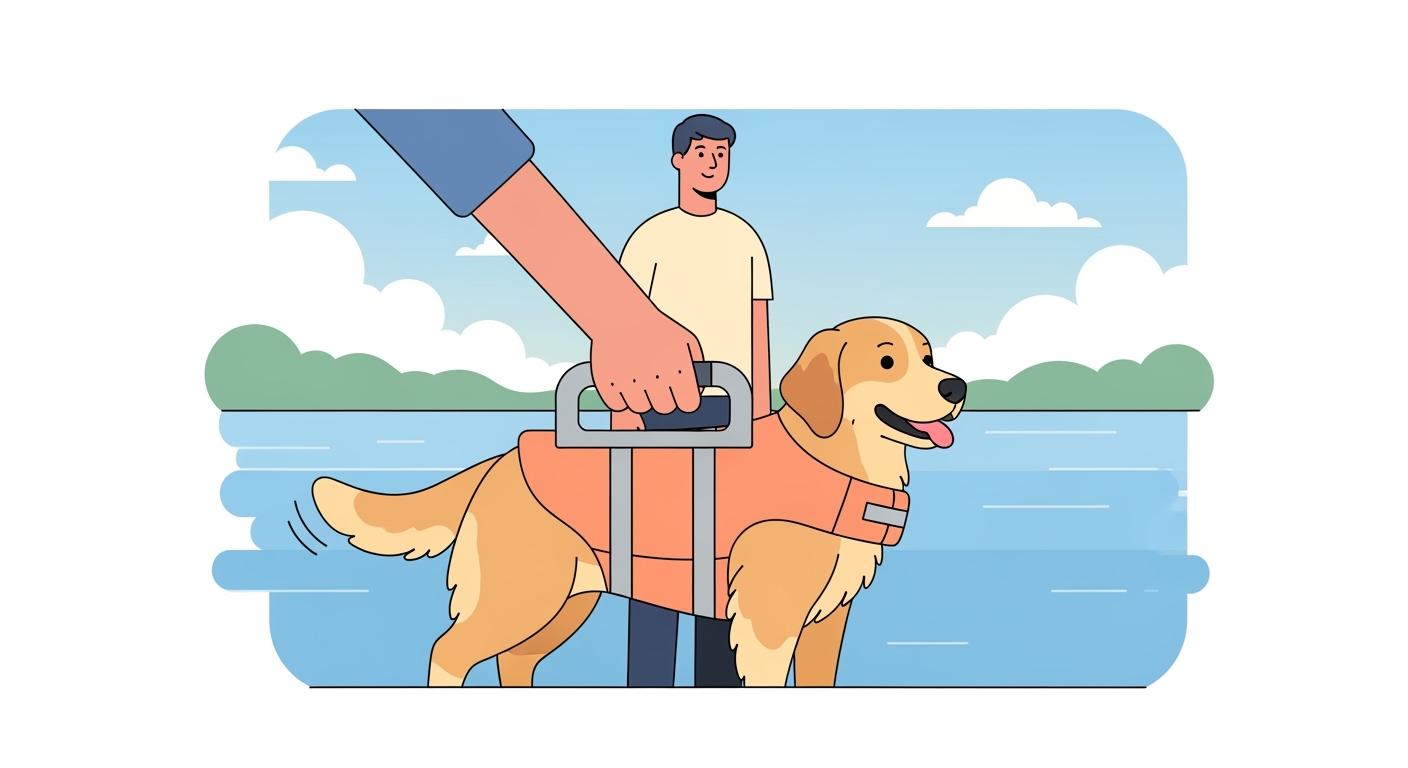
A bright orange panel on land is not the same thing as a bright orange panel in dark water at 40 yards. Water absorbs light. Waves break silhouettes. Shade near docks and boats kills contrast. When a dog life jacket disappears from view, it is rarely because the color was wrong — it is because the panel was too small, too low on the jacket body, or positioned where the handler cannot see it from the viewing angle that actually matters.
The design question is not “is this jacket bright.” It is “does the bright surface area face the handler’s line of sight under the conditions they will actually encounter.” That is a question of panel size, panel placement, and contrast — not color selection alone. A jacket with neon yellow panels that sit mostly on the sides will vanish during a top-down scan from a boat deck or dock. A handle that matches the jacket body will cost seconds when seconds count.
Visibility in water is a system: panel surface area × placement relative to viewing angle × contrast against the surrounding water surface. A design that scores high on color but low on placement fails the system.
Why Bright Panels Alone Fail in Real Water
Dark Water, Cloud Cover, and the Angle Problem
Water is not a neutral background. It absorbs light across the visible spectrum, with absorption increasing rapidly below the surface and in turbid conditions. A panel that reflects strongly on a sunny lawn may reflect far less when the light source is diffuse cloud cover and the background is dark, moving water.
The physics works like this: bright fabric gains its visibility from reflectance contrast — the difference between light bouncing off the panel and light bouncing off the surrounding water. Under full sun, a neon panel can reflect several times more visible light than dark water. Under heavy cloud, that ratio compresses sharply. A small panel with a weak contrast ratio against a dark background becomes a near-match — functionally invisible at distance. This is the causal chain that turns a “bright” jacket into a hidden one: reduced ambient light compresses the reflectance ratio, the panel blends into the water background, and the handler loses visual lock.
You can verify this yourself. On an overcast day, place the jacket on the water 30 yards out and scan from shore. If the panel does not read as a distinct patch separate from the water surface within the first glance, the contrast is too low for that light condition. Repeat at dusk with a flashlight — the reflective strips should catch light from the same distance. If they do not, the strips are positioned on surfaces that do not face the handler.
Waves, Splash, and the Silhouette Problem
Waves do more than obscure — they fragment. A dog’s outline broken by chop and whitewater becomes a collection of partial shapes. If the brightest panels sit below the waterline or on the lower sides of the jacket, each wave cycle hides them. The handler sees intermittent flashes of color, not a continuous trackable target.
This is where a life jacket designed for board sports and moving water differs from one designed for calm swimming alone. Panel placement matters more than total bright area. A jacket can have generous bright coverage and still disappear in chop if that coverage sits mostly below the shoulder line. What keeps a dog visible in rough water is bright surface area concentrated on the dorsal zone — the top panel and upper sides — where it stays above the wave troughs.
Distance and Top-Down Viewing
From a boat deck, dock, or paddle board, you view the dog from above. The side panels — no matter how bright — rotate away from your line of sight. Only the top panel and the handle remain in view. If the top panel is small or the handle color matches the jacket body, you are searching for a target that has effectively shrunk to a fraction of its actual size.
This is the viewing-angle constraint that drives top-panel design. A large uninterrupted bright panel across the dorsal surface, combined with reflective strips on the upper edges, maximizes the visible cross-section from the most common handler viewing positions. A jacket that looks generous from the side but has only a thin strip of color across the top will underperform every time the handler looks down at the water.
Panel Size, Placement, and Contrast — A System, Not a Checklist
Panel Size Determines Search Time
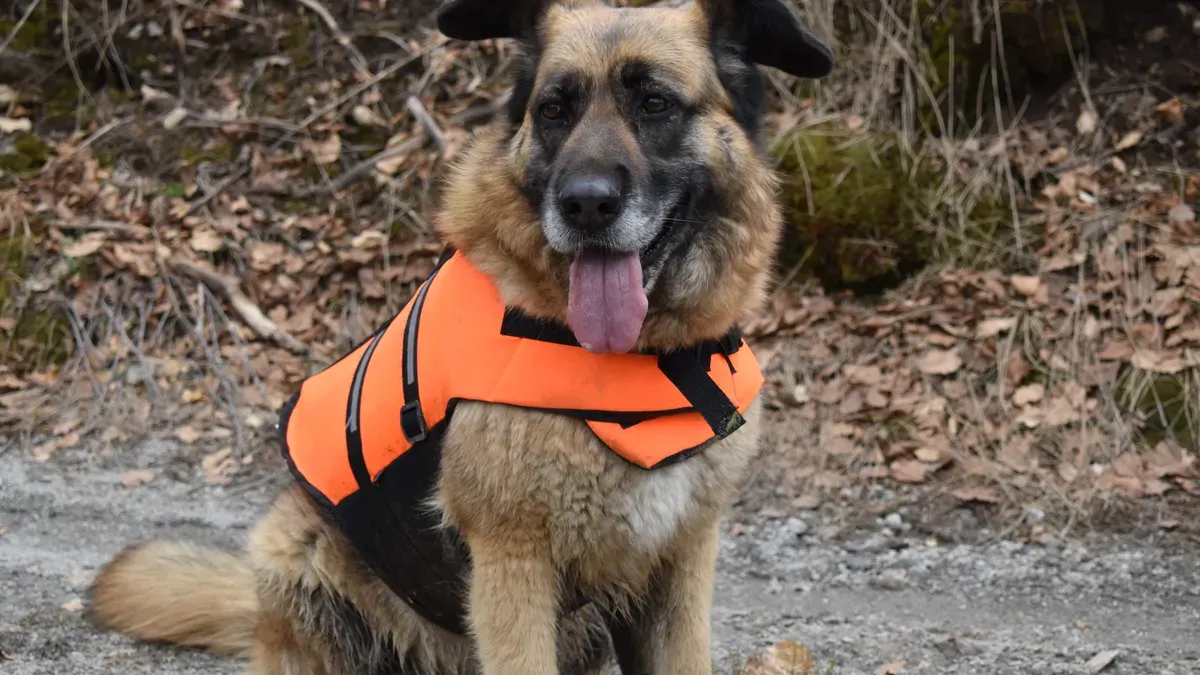
The larger the bright panel, the faster the human visual system can locate the target against a cluttered or moving background. This is not about preference — it is about search efficiency. A small panel requires the eye to scan and re-scan; a large panel registers on the first pass.
Panel size is especially important when the dog is moving. A swimming dog produces splashing, partial submersion, and constant orientation changes. A panel that covers a substantial fraction of the jacket’s visible surface area will register in peripheral vision far more reliably than one covering a small fraction. The difference is not subtle — it is the difference between tracking and searching.
To test this: walk 50 yards from the water and have someone move the jacket through the surface. If you lose visual contact for more than a second between wave cycles, the panel area is insufficient for that distance and water state.
Placement Beats Total Coverage
Material choice and panel layout work together in ways that total bright-coverage numbers do not capture. A jacket with half its bright coverage concentrated on the top and upper-side surfaces will outperform a jacket with more bright coverage scattered across the belly, lower sides, and hidden zones — because the visible fraction in real use is what matters, not the manufactured total.
The dorsal surface (top panel) is the single highest-value real estate on a dog life jacket. It faces the handler from boats, docks, and standing positions on shore. The upper-side surfaces are next in priority — they catch light during turns and angled approaches. Panels on the chest or lower belly contribute far less once the dog is in the water, because they face downward or forward, away from the handler’s typical sightline.
Contrast Against Water, Not Against the Jacket
High-contrast layouts matter, but the contrast that counts is between the jacket and the water — not between two panels on the jacket body. A jacket that uses two bright colors next to each other may look bold on land but read as a single merged patch against dark water. What works is a bright panel against a dark water background, with reflective strips at the panel edges to catch light at shallow angles when the sun is low or clouds diffuse the ambient light.
| Design Difference | Why It Matters | Main Limitation |
|---|---|---|
| Large top panel vs. small scattered panels | Maximizes visible cross-section from boat and dock viewing angles | Adds fabric weight to the dorsal zone; requires fit stability to prevent rotation |
| Upper-side reflective strips vs. lower-side placement | Catches light from the handler’s flashlight or boat lights at the angle that matters | Strips below the shoulder line are hidden by the dog’s own body in a top-down view |
| High-contrast panel-to-water ratio vs. multi-color jacket layouts | The visual system separates a bright target from a dark background faster than it parses internal pattern differences | Works only if the bright panel faces the handler; a bright belly panel contributes near zero in water |
Handle Visibility and Fit Stability — The Retrieval Side of Visibility
A Handle That Blends In Costs Seconds
Spotting the dog is step one. Grabbing the handle is step two — and step two has its own visibility requirement. A handle sewn from the same fabric as the jacket body, in the same color, becomes a hidden feature in low light and shade. When the dog is in the water and conditions are deteriorating, the handler’s visual system must locate the handle against a moving, partially submerged background.
The design fix is straightforward but often skipped: a handle in a contrasting color, with reflective trim, positioned on the highest point of the jacket’s dorsal surface. The contrast makes the handle a distinct visual target separate from the jacket body. The dorsal placement keeps it above the waterline and visible from above. Reflective trim on the handle catches light from a boat’s running lights or a flashlight, making retrieval viable in dusk and darkness.
A jacket built around visibility and quick-lift retrieval for boating treats the handle as a visual feature — not an afterthought sewn on after the panels are cut.
Fit Stability Keeps the Visibility System Intact
A jacket that rotates in the water defeats every visibility feature. If the top panel shifts to the dog’s side, the handler loses the dorsal visual target. If the handle migrates downward, retrieval becomes guesswork. Fit stability is a visibility feature — and it depends on adjustable straps that distribute tension across the chest and belly without creating pressure points that make the dog fight the jacket.
After a 10-minute swim, check whether the top handle still sits at the highest point of the dog’s back and whether the bright top panel faces directly upward. If the jacket has rotated more than an inch off-center, the strap tension is uneven or the chest-to-belly ratio is not matching the dog’s build. A well-fitted jacket stays oriented. An ill-fitted one drifts — and with it, the visibility system drifts out of the handler’s sightline.
Reinforced stitching around the handle attachment points is a separate but related concern. Secure fit and strong handle construction share a common requirement: the force path from the handler’s grip through the handle webbing into the jacket body must not concentrate at a single seam. A handle that attaches across a broad reinforced panel distributes lifting force. A handle stitched into a narrow strap concentrates it — and when that stitch line fails, retrieval becomes a two-arm lift under worse conditions.
| Design Difference | Why It Matters | Main Limitation |
|---|---|---|
| Contrasting handle vs. body-matched handle | Reduces search time for the grab point when visibility is already marginal | Bright handle color alone does not help if the handle has migrated out of position due to poor fit |
| Multi-point strap adjustment vs. single-point tightening | Prevents jacket rotation that pulls the top panel and handle out of the handler’s sightline | More adjustment points mean more setup time and more potential for user error in tension balance |
When Other Design Priorities Outweigh High Visibility
High visibility is a meaningful design advantage — but it is not always the most important one. A dog that swims exclusively in a clear, shallow backyard pool under full sun does not need the same visibility system as a dog that kayaks on a mountain lake at dusk.
In calm, confined water with short retrieval distances and a single handler always within arm’s reach, buoyancy distribution and swim-stroke freedom may matter more than panel coverage. A jacket optimized for visibility tends to have larger fabric panels and more reflective trim — which adds weight and slightly restricts shoulder rotation compared to a minimalist swim vest. For a dog that is a strong swimmer in predictable conditions, that trade-off may not be worth it.
Similarly, in hot, direct-sun conditions, the color that maximizes visibility — dark orange, neon red — also absorbs more solar radiation than lighter or reflective-surfaced fabrics. A dog wearing a dark, heat-absorbing jacket for hours on a boat deck may overheat before ever entering the water. The design decision balances visibility against heat load, and the right answer depends on the use pattern.
Disclaimer: The visibility checks described here assume the handler’s line of sight is unobstructed and the water surface is predominantly open. In heavy vegetation, dense reeds, or among multiple boats and floating objects, even a well-designed high-visibility jacket may not provide a reliable visual lock. These conditions require proximity management and an additional float line rather than relying on visual tracking alone. For double-coated breeds with thick, water-repellent fur, a jacket’s top panel may sit lower relative to the water surface than on a smooth-coated dog of the same size — verify panel visibility with the dog’s coat wet, not dry, before relying on it in open water.
FAQ
Does a bright color guarantee a dog life jacket will be visible in water?
No. Color is one variable in a system that also includes panel size, placement relative to the handler’s viewing angle, and contrast against the water background. A neon yellow panel the size of a palm, positioned on the lower side of the jacket, will not hold visibility in chop or from a boat deck even though the color is objectively bright.
Where should reflective strips be placed to actually work?
On the top panel edges and upper-side surfaces — the zones that face the handler from typical viewing positions. Reflective strips on the belly or lower chest are largely wasted because they face the water or the dog’s own body shadow in most swimming orientations. The strips work by catching light at shallow angles and returning it to the source; if the source cannot see the strip surface — because the strip faces down or is blocked by the dog’s body — the reflection does not reach the handler’s eye.
Can a dog life jacket stay visible in rough water?
It can, but the condition that matters most is panel placement on the dorsal zone. In waves, the dog’s body cycles above and below the water surface. Panels on the top and upper sides stay exposed during the visible phase of each cycle. Panels lower on the body are submerged or hidden by wave crests for a larger fraction of each cycle. The difference between a jacket that tracks well in rough water and one that disappears often comes down to how much bright surface area sits above the shoulder line.
Why does handle color matter if the jacket itself is already bright?
Because spotting the dog and locating the grab point are separate visual tasks. A handle in the same color as the jacket body blends into the panel and requires the handler to search for the grab point after already finding the dog. In low light or when the dog is moving in the water, that extra search time can be the difference between a clean retrieval and a missed grab. A contrasting handle turns the grab point into its own visual target.






