
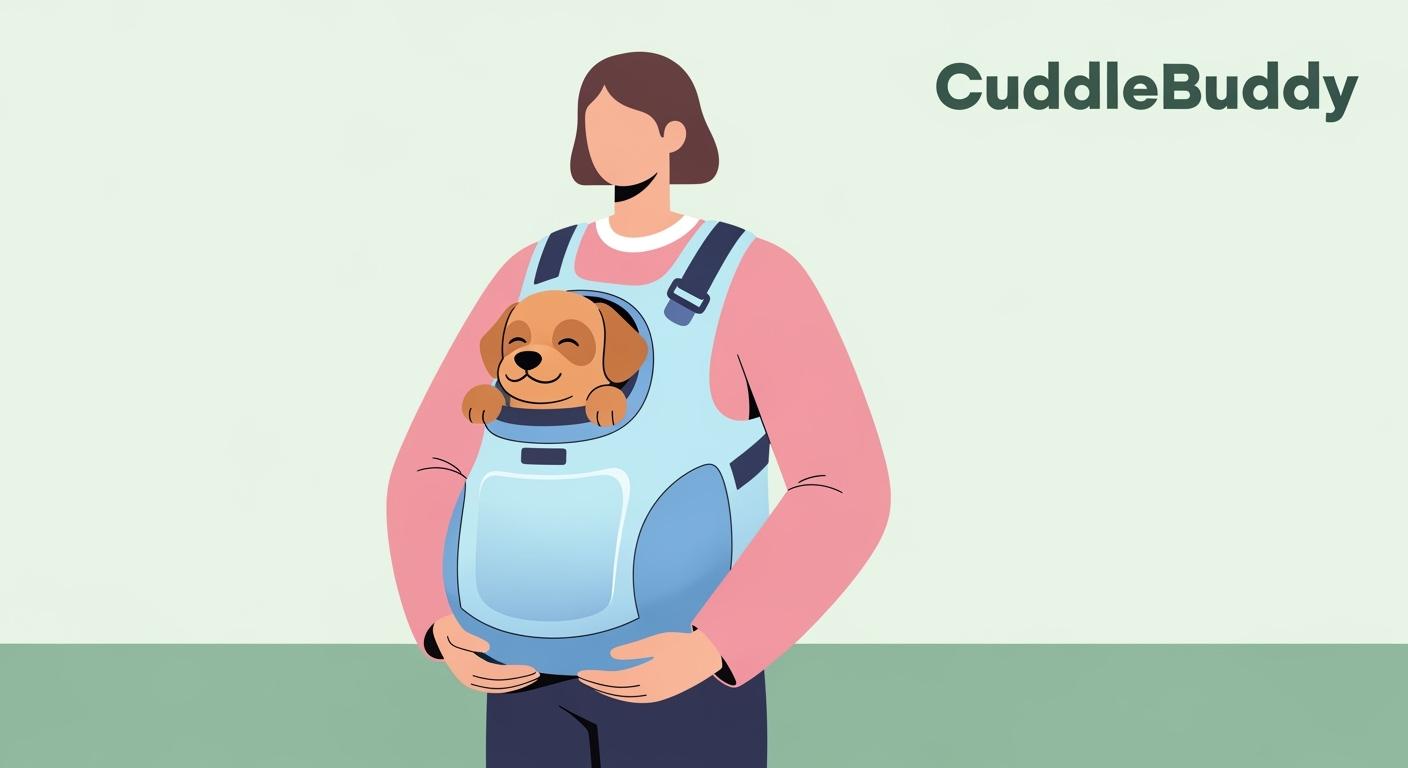
A dog slumps forward in a front-facing carrier for one reason: the floor underneath them stopped being a floor. The seat base folded, the load shifted, and now the dog’s weight presses into the front opening instead of resting on a stable platform. That is not a sizing problem. It is a structural one. And it is what separates carriers that work from carriers that collapse mid-errand.
A carrier that folds under weight is not a carrier. It is a fabric hammock with a dog sliding out the bottom of it.
Why Most Front-Facing Carriers Sag Within the First Ten Minutes
The mechanism is straightforward once you look at the forces involved. A small dog weighs 8 to 18 pounds. That weight does not distribute evenly across a flat surface — it concentrates under the sit bones, two small points near the rear. When those points press into a soft fabric base, the base deforms. The center drops. The edges curl inward.
Two things happen next, and both make the problem worse.
First, the dog’s center of mass shifts forward and down. The front edge of the carrier — the opening the dog looks through — becomes a load-bearing surface instead of a boundary. The dog is now leaning into the opening, chest pressing against fabric, spine curving. That pressure restricts breathing and makes the dog restless.
Second, the carrier’s attachment to your body changes. A soft base that sags pulls the entire structure downward. The shoulder straps that started snug go slack. The carrier tilts away from your chest at the top and droops at the bottom. The dog’s weight now hangs from the front opening, not from the supported base. Every step you take adds bounce to a dog that is already unstable.
Tip: After ten minutes of walking, check whether the carrier’s bottom edge has dropped more than an inch from where it started. If it has, the seat base is not doing its job.
Soft Pouch Bases Collapse Under Concentrated Load
A fabric-only base has no resistance to point loading. The material stretches, the stitching takes tension it was not designed for, and the floor the dog sits on becomes a bowl. Longer-bodied breeds suffer more here — their weight spans a longer arc, so the base must resist bending across a wider span. A dachshund in a soft pouch carrier folds the floor into a V-shape within minutes.
The fix at the manufacturing level is either a rigid insert or a multi-layer laminated base panel. A rigid insert — typically a thin HDPE or EVA board slipped into a sleeve — turns the seat into a true platform. A laminated base panel achieves similar stiffness through layered foam and stiffening fabric, bonded under heat rather than sewn, which avoids stitch holes that weaken under repeated loading. Both approaches add under three ounces of weight. Both prevent the failure mode entirely.
When the Carrier Hangs Away from the Body, the Dog Slides Forward
Strap geometry controls carrier tilt. If the shoulder straps attach only at the top corners of the carrier body, the bottom half of the carrier is free to swing outward with every step. The dog’s weight acts as a pendulum — small movements at the shoulder translate to larger swings at the bottom. That outward tilt angles the seat base downward at the front, and gravity does the rest.
Carriers that resist this use a second anchor point lower on the carrier body — a waist strap or a lower cross-body stabilizer that pulls the base against your torso. The physics is simple: two attachment points define a plane. One attachment point defines a hinge. A carrier attached only at the shoulders is a hinge. A carrier with a waist strap or lower stabilizer is a plane, and dogs do not slide off planes.
In practice: The waist strap is not a comfort feature for the person wearing the carrier. It is a structural element that changes how the load transfers from dog to carrier to body.
What Keeps a Dog Upright: Seat Base, Strap Layout, and Contact Points
The Seat Base Is a Platform, Not a Pouch
A firm seat base does two things structurally. It distributes the dog’s weight across its full footprint instead of concentrating it under the sit bones, which lowers the pressure any single point of fabric must resist. And it maintains a flat reference plane, so the dog’s pelvis stays level. A level pelvis keeps the spine neutral. A tilted pelvis curves the spine and pushes the chest forward into the carrier opening.
You can verify this at home. Place the empty carrier on a table and press down with your fist in the center of the seat area using roughly 15 pounds of force — about the weight of a small dog’s rear half. A base that folds more than a quarter-inch under that load will fold more under a live dog, because a live dog shifts and a fist does not.
Note: A rigid board insert that stops short of the front edge still leaves an unsupported lip the dog can slump into. The stiffened area should extend to within a half-inch of the front seam.
Close-to-Body Straps Eliminate the Pendulum
Wide, padded shoulder straps distribute the carrier’s weight across your shoulders — that much is obvious. What is less obvious is that strap width also affects carrier stability. A narrow strap can rotate against your shoulder. A wide strap resists rotation. When the carrier body torques to one side — because the dog shifted, because you turned, because you reached for something — a narrow strap twists with it. A wide strap fights the twist, and the carrier body stays where it was.
Chest and waist stabilizers convert the strap system from two independent shoulder loops into a single connected harness. The sternum strap prevents the shoulder straps from drifting apart, which would let the carrier body tilt outward at the top. The waist strap anchors the lower half. When both are engaged, the carrier moves as a unit with your torso, and the dog inside experiences less secondary motion.
Smooth Edges Where the Dog Makes Contact
The openings a dog’s legs pass through and the front edge the chest presses against are the two highest-friction zones in the entire carrier. If those edges are raw-cut fabric or narrow binding, they concentrate pressure into a line. After 15 minutes of walking, that line becomes a red mark. After 30 minutes, the dog starts fidgeting.
Rolled-edge binding or padded piping spreads the same force over a wider contact area. The difference in manufacturing cost is marginal — a few cents per unit at production volumes — but the difference in how long a dog tolerates the carrier is measured in multiples. A dog that shifts position every two minutes never settles into the carrier’s support structure, which means the structure never gets a chance to do its job.
Tip: After removing the carrier, run your finger along the inside of the leg openings and front edge. Any spot that feels harder than the surrounding fabric under light pressure will feel harder still to a dog that has been leaning against it for 20 minutes.
Mesh Panels and Why Placement Matters More Than Quantity
A carrier with mesh on the outward-facing side only vents to the room, not to the dog. The dog’s chest and belly — the two surfaces that generate the most heat — press against the inward-facing panel, which is typically solid fabric backed by your body heat. That is a sauna, not ventilation.
Effective ventilation in a front-facing carrier needs at least one mesh path on each side of the carrier body — outer-facing and inner-facing — to create cross-flow. A shallow carrier profile helps too. A deep pouch with a narrow opening traps still air; a shallower shape with a wider opening lets moving air reach the dog’s torso. The mesh is not the ventilation system. The mesh plus the carrier geometry is the ventilation system.
Getting the Fit Right: Measurements That Actually Predict Comfort
Weight ratings on carrier packaging tell you whether the seams will hold. They do not tell you whether the dog will fit. Two dogs of the same weight can have completely different body proportions — a 12-pound French bulldog and a 12-pound Chihuahua occupy different volumes in different shapes.
The measurement that matters most is back length: from the base of the neck to the base of the tail. This determines whether the dog’s rear will sit fully on the seat base or hang partially off the back edge. A dog whose rear overhangs the seat base has no stable platform under its hips, which means the seat base might as well not be there.
The second measurement is chest depth when the dog is sitting — the vertical distance from the top of the shoulders to the bottom of the chest in a natural seated position. This determines whether the front opening hits the dog at mid-chest (correct) or at the throat (dangerous). A carrier that is too short in the body forces the front edge up into the throat. One that is too tall lets the dog slide forward and down.
Disclaimer: These fit checks assume a smooth-coated or short-haired dog. Double-coated breeds compress their undercoat under pressure, which can mask fit gaps — what looks snug at rest may loosen after the undercoat compresses during movement. Hand-check fit by feeling for gaps between the carrier wall and the dog’s body, not by visual inspection alone.
Sizing charts that list only weight ranges skip the dimensions that govern posture inside the carrier. A chart that includes back length and seated chest depth — even as approximate ranges — gives you numbers you can compare against a tape measure. Charts that omit those dimensions leave you guessing whether “up to 15 pounds” means “up to 15 pounds if the dog is shaped like a cylinder.”
Strap adjustment order matters. Tighten the waist strap first — it sets the carrier’s vertical position. Then the shoulder straps, which pull the carrier body against your chest. The sternum strap goes last, locking the shoulder straps at a fixed width. Reversing this order — tightening shoulders first, then waist — usually leaves the carrier sitting too low, because the shoulders alone cannot hold the full weight at the correct height without the waist strap sharing the load.
A properly fitted carrier should let the dog sit with a neutral spine — no forward lean, no backward tilt — while the shoulder and waist straps remain snug but not restrictive against your body. The carrier body should not shift more than a half-inch in any direction when you twist your torso. If it does, one of the three strap points is not doing its share of the work.
When a Front-Facing Carrier Is Not the Right Tool
Long Walks, Hot Weather, Uneven Terrain
A front-facing carrier places the dog between your arms and directly against your torso. That position works for short errands where you need to see the dog, the dog needs to see out, and both of you are stationary more than moving. It stops working when the trip exceeds about 20 minutes of continuous walking.
On longer walks, the carrier’s limitations compound. Body heat from your chest transfers into the carrier faster than mesh can dissipate it. Your walking rhythm transmits directly into the dog’s spine — there is no suspension, no frame, no buffer between your steps and the dog’s experience of them. On uneven ground, every stumble or sudden correction becomes a jolt the dog absorbs through the seat base.
Heat stress is the fastest-accumulating risk. A carrier pressed between two warm bodies — yours and the dog’s — with only mesh panels for relief can push a dog past comfortable thermal regulation within 15 minutes on a warm day. For trips longer than a quick errand, a backpack-style carrier with an internal frame and greater airflow clearance tends to hold up better.
Dogs That Twist, Climb, or Pant Heavily
Some dogs never settle in a front-facing orientation. They twist to look back at you. They brace their front paws against the carrier opening and push upward. They pant even when the temperature is mild. None of these behaviors are the carrier’s fault — they signal that the position itself is wrong for that dog.
A dog that wants to face you rather than face outward needs a different carrier orientation. A dog that wants to curl into a ball rather than sit upright needs a different carrier shape. Pushing through these signals by tightening straps or extending the session does not acclimate the dog — it teaches the dog that the carrier is a place where discomfort is ignored.
Carrier Types and Where Each One Fits
| Design Difference | Why It Matters | Where It Falls Short |
|---|---|---|
| Front-facing carrier with firm seat base | Keeps the dog upright with a level pelvis; close-to-body strap layout reduces bounce | Heat builds between two bodies; limited to short errands and smooth surfaces |
| Backpack carrier with internal frame | Separates dog from body heat; framed structure handles longer walks and uneven ground | Heavier, bulkier, unable to monitor the dog visually without removing the carrier |
| Sling carrier with soft pouch | Lets the dog curl naturally; lightweight and fast to put on for one-arm support | No structured seat base; dog’s weight hangs from a single shoulder strap, which can shift during movement |
| Enclosed carrier with structured walls | Maximum protection from weather and impacts; secure zippered openings prevent escape | Heaviest option; limited ventilation; dog has no view, which some dogs find stressful |
Disclaimer: This comparison assumes the carrier is being used for short urban errands on paved surfaces with a dog under 20 pounds and a smooth or short coat. Double-coated breeds, dogs with respiratory conditions, trips longer than 20 minutes, hot-weather use, and off-pavement walking each shift the trade-offs — in some cases enough to rule out a front-facing carrier entirely for that scenario.
A carrier that matches the trip length, the weather, and the dog’s preferred body position is safer than an expensive carrier forced into a scenario it was never designed for. For quick trips on smooth ground — the grocery run, the coffee pickup, the stroll through a quiet store — a well-structured front-facing carrier solves a real urban carrying problem. For everything else, a wearable carrier with a different orientation or structure usually fits the job better.
FAQ
How long can a dog safely stay in a front-facing carrier?
Under 20 minutes of continuous walking for most small dogs in mild temperatures. Heat, the dog’s coat density, and your walking pace all shorten that window. Watch for panting that starts suddenly or intensifies — it is the earliest reliable signal that the dog needs a break.
What size dog fits best in a front-facing carrier?
Most front-facing carriers are built around dogs under 20 pounds with a back length under 14 inches. Weight alone is a poor predictor — a 12-pound dog with a long back may overhang the seat base while a 15-pound dog with a compact build fits securely. Back length, measured from neck base to tail base, is the dimension that governs seat base coverage.
How do I know if the fit is wrong mid-walk?
Three signals appear in sequence: the dog shifts position repeatedly without settling, the dog’s chest presses visibly against the front opening rather than resting behind it, and the dog begins pawing at the carrier edges or twisting to look back. Any one of these means stop and check — by the time all three appear, the dog has been uncomfortable for several minutes.
What is the difference between a front-facing carrier and a backpack carrier?
The dog’s orientation relative to your body. A front-facing carrier positions the dog on your chest, facing outward — you can see the dog, the dog can see what is ahead. A backpack carrier positions the dog on your back, typically facing you or to the side — the dog’s weight rides on your back and hips, which handles longer distances better but removes visual contact. The structural demands differ: front carriers need anti-tilt strap geometry more than backpack carriers do, while backpack carriers need framed load distribution more than front carriers do.






