
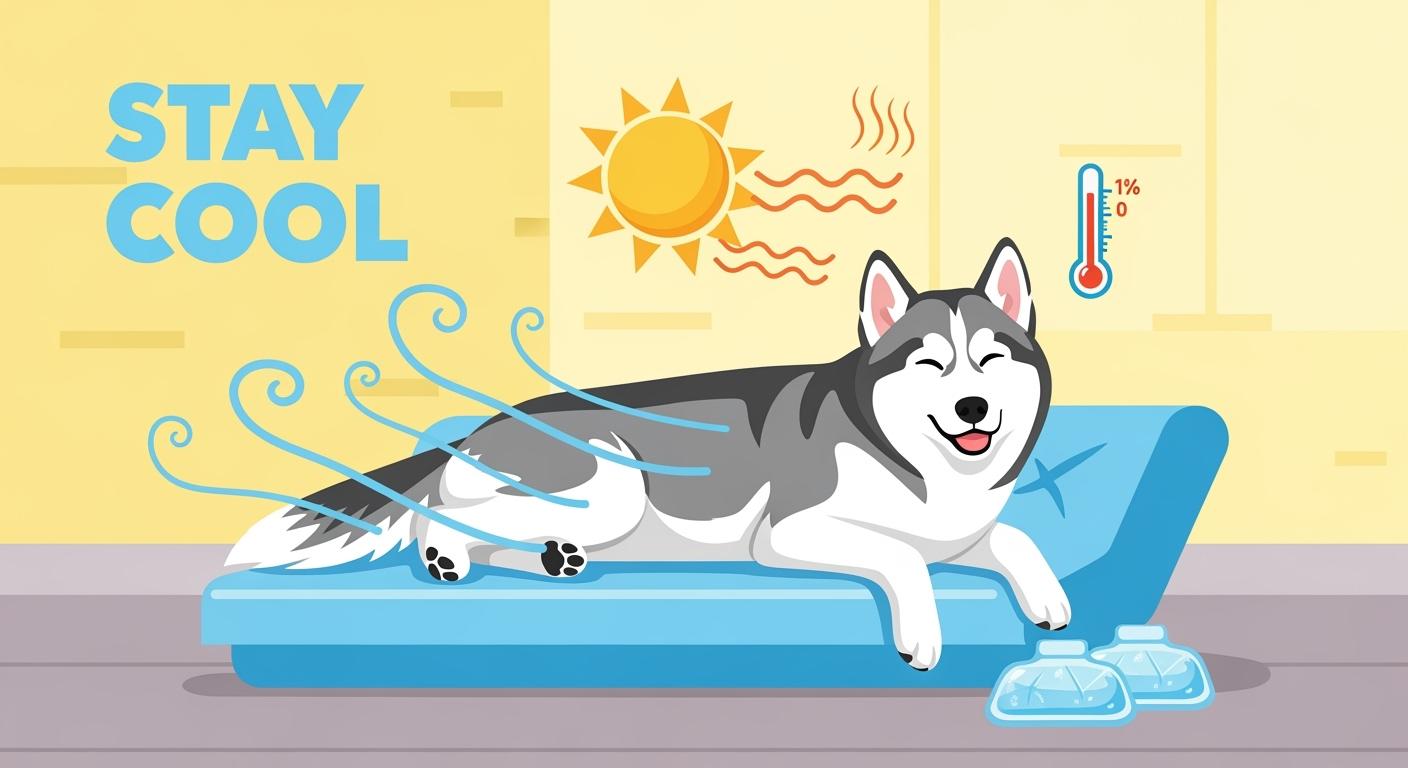
A husky sprawled on tile in July is not being dramatic. The dog is telling you something about the cooling surface you provided. Flat gel mats and plush beds trap heat under a double coat instead of carrying it away. The design problem is not the thickness of the mat or the gel formula inside it. The problem is what happens when body weight presses dense fur against a solid surface: the air gap disappears, and with it, any meaningful convective cooling.
A raised mesh bed changes the physics. It replaces conduction with convection by opening a column of moving air beneath the dog. For a breed whose coat was built to hold warmth, that distinction is the difference between a bed the dog uses and one it walks away from.
Why a Husky’s Coat Works Against Flat Cooling Surfaces
A husky’s double coat is two distinct layers working in sequence. The undercoat is a dense mat of short, soft fibers. The guard layer on top is made of longer, coarser hairs that shed water and block wind. Together they form what amounts to a self-regulating thermal envelope—one that excels at keeping cold out but is equally effective at holding body heat in.
Place that coat against a flat surface and the physics flips. Body weight compresses both layers, collapsing the natural loft that normally traps insulating air. The fur that once acted as a climate buffer becomes a conductive bridge: body heat moves directly into the mat surface, and the mat surface has nowhere to send it. No air moves. The gel or foam inside the mat starts absorbing heat instead of dissipating it. The dog gets warmer. It leaves.
This is why so many huskies abandon cooling mats within minutes. The mat may feel cool to a human palm at room temperature, but a palm weighs nothing compared to a seventy-pound dog pressing down through two inches of compressed fur. The cooling chemistry inside the mat can only pull heat away if there is a temperature gradient to drive it—and once the contact zone saturates, the gradient collapses. The mat becomes an insulator, not a cooler.
You can observe this directly. After your husky has been lying on a flat mat for five to ten minutes, lift the dog and press your hand flat against the surface where the chest and belly were resting. If it feels warm and slightly damp, the mat is trapping rather than releasing heat. That is the signal that airflow, not gel chemistry, needs to be the next variable you change. Dogs that repeatedly choose hard floors over cushioned beds are not being picky—they are thermal-voting with their feet.
How Raised Mesh Changes the Heat Equation
Lift a dog six inches off the ground and you do more than create clearance. You introduce convection into a system that was previously conduction-only. Air moves under the belly, across the paw pads, and along the inner thighs—three zones where huskies dump heat most efficiently. The mesh fabric is not the hero here. The air column is.
Convection Replaces Conduction
On a flat pad, heat travels from dog to surface through direct contact. There is one path and it dead-ends at the mat. On a raised mesh bed, heat radiates from the dog’s underside into an open air volume, and moving air carries it away. The mesh itself acts as a low-thermal-mass interface: it does not store enough energy to become a secondary heat source. A dog can lie in one spot for an hour and the mesh stays near ambient temperature because the breeze underneath is constantly resetting it.
The causal chain looks like this: elevation creates an air gap → the air gap enables cross-flow from ambient breezes or indoor circulation → moving air strips the boundary layer of warm, moisture-laden air clinging to the dog’s underside → the dog’s natural thermoregulation through the belly and paw pads stays online instead of being choked off by a solid surface.
This also explains why mesh beds dry fast. Moisture from panting, drool, or a damp coat drips through the open weave and evaporates from both sides simultaneously. The same physics that keeps the bed cool keeps it dry—and for a double-coated dog in humid weather, dry is half the cooling battle. The materials and frame dimensions that hold up outdoors tend to be the same ones that perform well inside on hot afternoons.
Frame Stability Matters as Much as Mesh
A cooling bed that slides across the floor when a husky steps onto it creates a trust problem. The dog learns the surface is unreliable and stops using it—not because of heat, but because of instability. A steel or aluminum frame with skid-resistant feet addresses this at the structural level. The mesh stays tensioned. The corners do not lift. The dog can shift, stretch, and reposition without the bed chasing it across the room.
Frame rigidity also affects cooling consistency. If the frame flexes under weight, the mesh sags, the air gap shrinks, and the convection column thins. A steel-frame elevated bed that holds the mesh under full tension preserves the full air gap regardless of where the dog chooses to settle. That is a structural detail most sizing charts ignore but the dog notices immediately.
| Design Difference | Why It Matters for a Husky | Main Limitation |
|---|---|---|
| Raised mesh vs. flat gel mat | Air flows under the body instead of heat collecting against compressed fur | Heavier or less mobile dogs may struggle to step up onto a raised platform |
| Steel frame vs. plastic frame | Less flex under load preserves the air gap at center span | Steel frames add weight and can get hot in direct sun |
| Tensioned mesh vs. loose fabric | Flat, tight mesh maximizes contact area for paw-pad cooling without sag | Tensioned mesh has less give; some dogs prefer a hammock-like contour |
| Skid-resistant feet vs. bare frame ends | Prevents bed from sliding when the dog steps on or off | Rubber feet can wear on rough outdoor surfaces over time |
How to Verify the Bed Is Working
Two quick field checks tell you whether the raised design is delivering real cooling for your dog. First, after the dog has been on the bed for ten minutes, slide your hand under the mesh from the side and hold it there for five seconds. If you feel moving air that is cooler than the surrounding floor, the convection column is active. If the air feels still or warm, reposition the bed where cross-breezes or a fan can drive airflow through the gap.
Second, after a thirty-minute rest session, run your fingers through the fur on the dog’s belly and inner thighs. The fur should feel dry and roughly room temperature. Dampness or noticeable retained warmth means the mesh weave may be too tight for the dog’s coat density, or the bed is placed in a dead-air corner. Both are fixable without replacing the bed.
When a Raised Bed Is Not the Answer
No single bed design covers every husky, every home, and every season. Raised mesh cots have real limits, and recognizing them upfront prevents the frustration of buying a bed the dog rejects.
The step-up height is the most common dealbreaker. Older huskies or dogs with hip issues may find the six-to-eight-inch elevation difficult or painful to navigate. A bed that requires a running start or an awkward climb is a bed that goes unused. In these cases, a low-profile mesh platform—under four inches of rise—can preserve most of the airflow benefit while keeping access manageable.
Nesting behavior is another factor. Some huskies genuinely prefer to curl into a bolus against something soft. A tensioned mesh surface offers zero give and no sides to press against, which can leave a nesting dog restless. This is not a cooling failure—it is a behavioral mismatch. The dog may use the raised bed during the hottest hours and migrate to a different surface at night. That is normal and does not mean either bed is broken.
Outdoor placement introduces its own constraints. A steel frame in direct midday sun absorbs radiant heat and can become uncomfortable to touch. Shade is non-negotiable. The mesh itself, if it is a coated polyester or PVC blend, holds up better under UV than uncoated nylon but will still degrade faster than indoor-only fabric. Rotating the bed between covered patio and indoor use extends the frame’s finish and the mesh life. For outdoor setups that get year-round exposure, material choice and placement matter more than frame style.
And not every cooling problem is a bed problem. A husky that is still overheating despite a raised mesh bed may need attention to hydration, coat management, or exercise timing before the bed gets blamed. Brushing out loose undercoat during shedding season, providing fresh water in multiple locations, and limiting activity to early morning or late evening hours all influence core temperature more than any bed surface can. The right bed supports indoor comfort and rest quality; it does not override the dog’s overall thermal load.
Disclaimer: The fit and cooling checks described here assume a smooth-coated or short-to-medium double-coated husky with typical breed proportions. Wooly-coated huskies or dogs with unusually dense undercoats may show subtler signs of heat retention that require hand-checking the fur depth rather than visual inspection of the bed surface. If the dog’s body condition or mobility falls outside typical breed norms—particularly dogs with arthritis, hip dysplasia, or recovering from surgery—the step-up height of a raised bed may pose a risk that outweighs the airflow benefit.

FAQ
Why does my husky choose the floor over a cooling mat?
Hard floors pull heat away through conduction across a large contact area and never saturate the way gel mats do. Tile, concrete, and wood stay cooler because their thermal mass is large enough to keep absorbing heat without warming up quickly. A raised mesh bed mimics this by replacing conduction with convection—the cooling mechanism is different, but the net result is the same: the surface does not heat-soak under the dog.
Can a raised mesh bed work inside the house year-round?
Yes, with one caveat: during winter, the same airflow that cools in summer can make the bed drafty. Some huskies will use it in any season. Others may avoid it once indoor temperatures drop. Adding a fleece liner or thin pad on top during cold months keeps the frame and elevation benefits while cutting the draft—the mesh still breathes, just with a warmer contact surface.
How do I know if the mesh weave is open enough for my husky?
Hold the bed up to a window or bright light before the dog uses it. If you can clearly see light dots through the weave across most of the surface, airflow should be adequate. If the mesh looks nearly solid or the light pattern is patchy, the weave is likely too tight for a dense-coated dog. After a use session, the belly-fur dryness check described earlier confirms whether the weave is working under real conditions.
What else helps a husky stay cool beyond the bed itself?
Regular brushing to remove loose undercoat is the single most effective non-bed intervention. A clogged undercoat traps heat regardless of what the dog lies on. Fresh drinking water in multiple locations, a fan positioned to push air across the bed at floor level, and restricting outdoor activity to cooler hours all compound the benefit of a well-chosen cooling bed. None of these replaces the bed; each makes it more effective.
How do I know if the bed frame will hold up to a husky’s weight and movement?
Check the center of the mesh after the dog has used the bed several times. If the fabric shows visible sag or the frame tubes have shifted inward at the midpoints, the frame gauge is under-spec for the dog’s weight. A frame that keeps the mesh drum-tight after repeated use is holding. A dog that hesitates before stepping onto the bed or circles without settling is often signaling that the surface feels unstable—the same avoidance pattern seen with beds that trap heat instead of releasing it.






