
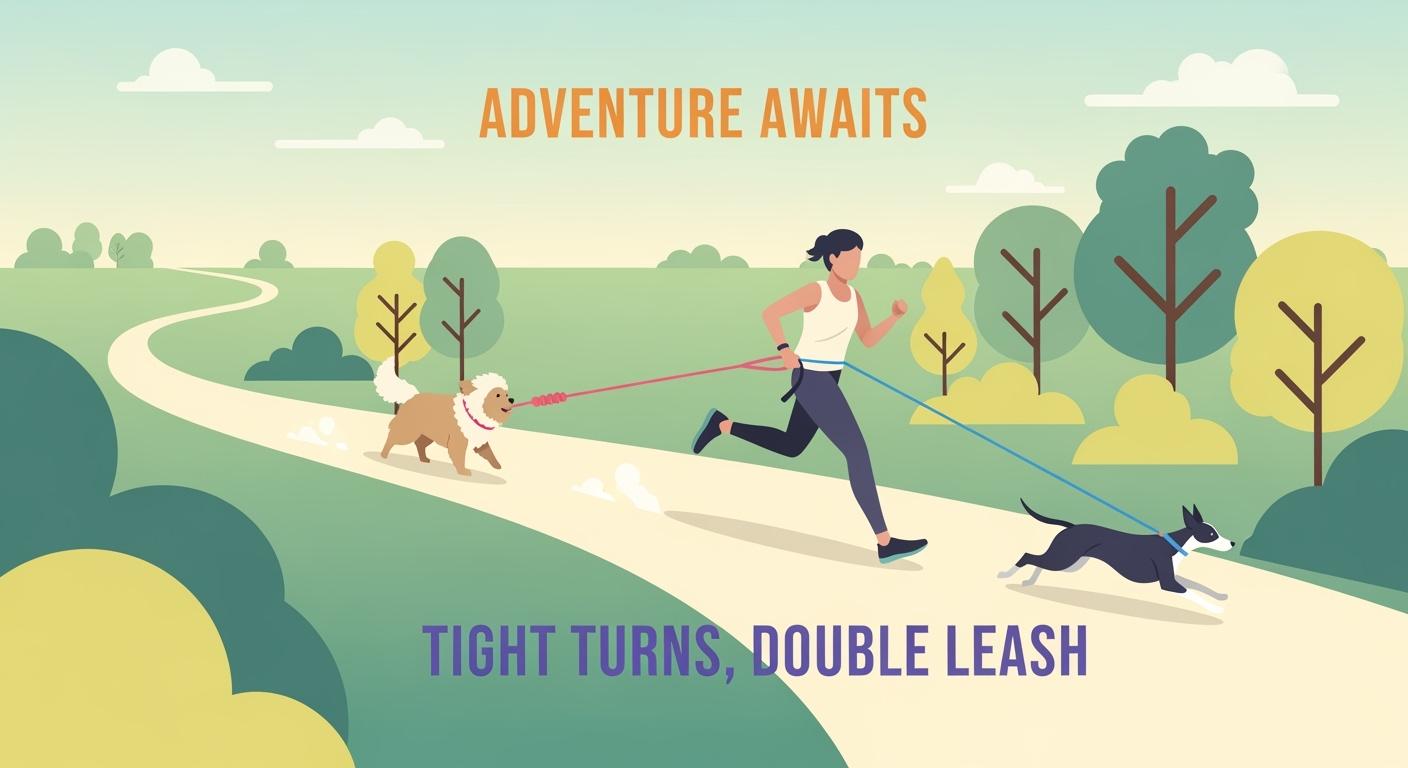
A bungee leash and a regular leash do not transmit force the same way. When a dog surges forward at running pace, the bungee section elongates before delivering the full tug to your hand. A regular leash delivers it all at once. That single mechanical difference reshapes everything about control during passing moments, cornering, and pace changes on a run.
What Makes the Two Leashes Feel Different at Running Pace
A bungee leash stretches. That stretch is not just a comfort feature. It spreads the same impulse over a longer time window. The elastic section must first deform, then build tension gradually, and only then transmit peak force. The result at your end is a softer, longer tug instead of a jerk. On open paths, this feels smoother. Your arm stays steadier, your pace does not break, and a dog that surges occasionally does not yank you off stride. Many runners find this makes a bungee leash with controlled elastic travel the more comfortable choice for steady-pace runs on quiet trails.
But the same physics that softens the tug also introduces a delay. The elastic section has a finite travel distance. While it stretches, the dog is still moving. By the time the leash goes taut, the dog may be 2 to 3 feet farther from you than when the surge started. That gap is what changes passing control.
In practice: You can measure this delay yourself. On your next run, count the number of strides your dog takes between the moment they accelerate and the moment you feel the leash lock. On a regular leash, that count is zero. On a bungee with 12 to 18 inches of elastic travel, expect 2 to 3 strides before full tension arrives.
Why the Same Stretch That Smooths Open Paths Creates Risk in Passing Moments
Open paths forgive delayed control. There is room. A dog that drifts 3 feet ahead on a fire road is not a problem. A dog that drifts 3 feet ahead on a sidewalk with an oncoming jogger and a cyclist is a different equation.
The core issue is feedback speed. When you shorten a regular leash, the effect is immediate. Your hand moves back, the leash shortens, the dog’s range shrinks. With a bungee leash, shortening your grip does not instantly shorten the dog’s effective radius. The elastic section must first contract, and that contraction happens on its own timeline, not yours. During passing moments on routes where mixed-terrain running demands frequent leash-length changes, that lag can put the dog into another person’s path before you can pull them clear.
Regular leashes do the opposite. Zero stretch means zero lag. The tradeoff is that every speed change, every surge, every sudden stop transmits directly to your shoulder and arm. Over a 5-mile run with a dog that pulls intermittently, that cumulative shock adds up. The table below breaks down how the same running moment plays out differently:
| Running Moment | Bungee Leash Behavior | Regular Leash Behavior | Design Detail That Matters |
|---|---|---|---|
| Passing a jogger | Elastic delays leash shortening, dog may gain 2-3 ft before taut | Immediate shortening, sharp tug to arm | Elastic travel distance |
| Tight trail corner | Leash length feels unpredictable mid-stretch | Fixed length, predictable radius | Webbing stiffness |
| Dog lunges at squirrel | Stretch absorbs peak force, slower recovery | Full force instant, fast recovery | Traffic handle placement |
Neither leash is inherently better here. Each handles one side of the tradeoff well and the other side poorly. What matters is which failure mode you can manage on your specific route.
Tip: After a run that included passing moments, check whether the leash clip point has drifted from where it started on your dog’s back or chest. A harness back clip that has rotated 2 or more inches off the spine midline signals the leash was fighting you during corrections rather than transmitting clean feedback.
Design Features That Narrow the Gap Between Comfort and Control
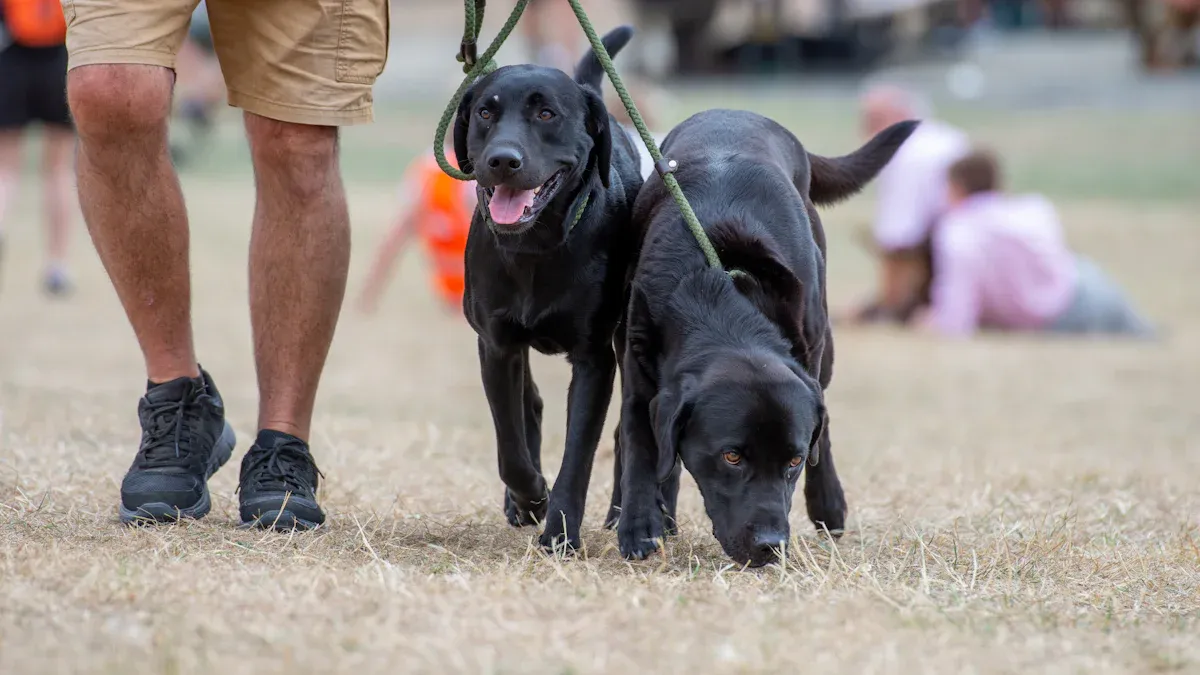
Three design details determine where a leash lands on the comfort-control spectrum: elastic travel limit, webbing stiffness, and secondary grip placement.
Limited elastic travel. A bungee section that stretches 6 to 10 inches under running loads gives meaningful shock absorption without the full delay of a longer elastic section. The stretch window is short enough that the dog cannot build significant distance before tension locks in. This is not the same as a fully rigid leash, and not the same as a leash with 18-plus inches of bungee give. The difference is noticeable within the first quarter mile.
Low-stretch webbing in the leash body. Even if a leash has a bungee section, the remaining length should resist elongation. Nylon webbing that stays dimensionally stable when wet or muddy keeps the effective leash length predictable. If the non-elastic portion stretches too, the combined elongation from bungee plus wet webbing can add unexpected slack that compounds the control delay during passing moments. Runners moving between bungee, standard, and hands-free leash setups often notice this variable most on rainy routes.
Traffic handle placement. A secondary grip 12 to 18 inches from the clip lets you bypass the elastic section entirely when you need fast, short-leash control. You grab the traffic handle, the bungee is out of the equation, and the dog’s range collapses to arm’s length. This is the feature that makes a bungee leash viable on mixed routes. Without it, you are stuck with the elastic’s timeline. With it, you get smooth shock absorption on open stretches and instant shortening when the path narrows.
| Design Feature | What It Changes During a Run |
|---|---|
| Limited elastic travel (6-10 in) | Absorbs surge shock without letting the dog build dangerous forward distance |
| Low-stretch body webbing | Keeps leash length predictable when wet, reducing unexpected slack during corrections |
| Traffic handle 12-18 in from clip | Bypasses elastic section for instant short-leash control in passing moments |
A leash that combines all three details handles both open-path comfort and narrow-route control without forcing you to switch gear mid-run. The same cannot be said for a pure bungee with unlimited stretch or a pure rigid leash with no give at all.
Tip: On your next run with a bungee leash, use the traffic handle for the first 3 passing moments and the main handle for the next 3. Note the difference in how many steps your dog takes before responding. That gap is the elastic delay cost, measured in strides.
When Each Leash Type Stops Being the Right Answer
A bungee leash works against you when your route demands more than 3 or 4 passing corrections per mile. The cumulative delay from repeated elastic cycles adds uncertainty. You start compensating by pulling earlier or harder, which defeats the comfort benefit. On a dense urban route with sidewalk traffic, a running leash built around low-stretch materials and a traffic grip tends to produce fewer near-misses.
A regular leash works against you when the dog runs with an inconsistent pace. Frequent surges and speed changes send shock after shock through a non-elastic leash, and after 20 minutes, most runners begin compensating by tensing the shoulder or shortening stride. That compensation introduces its own problems: upper-body fatigue, altered gait, and a dog that learns to lean into the tension rather than settle into a steady pace.
The leash length you choose interacts with both designs. On routes where walking and running control depend on fast leash-length adjustment, a 3- to 4-foot leash with a traffic handle keeps the dog within a manageable radius during tight passes. A 6-foot leash gives more exploration room but adds more elastic travel distance on a bungee model and more slack to manage on a regular model. Neither length is wrong. Each shifts the tradeoff in a specific direction.
Using a harness instead of a collar changes the force distribution regardless of leash type. A harness spreads the tug across the chest and shoulders rather than concentrating it at the neck. When a harness is sized and adjusted correctly for the dog’s build, the shock-absorption benefit of a bungee leash matters less because the force is already distributed. A regular leash becomes more tolerable. The gear works as a system, not as isolated pieces.
Disclaimer: The stride-count delay test described above assumes a medium-sized dog with a smooth coat running on pavement. Double-coated breeds may show subtler leash-tension signals that require hand-checking the webbing for sudden slack rather than relying on visual stride counts. If the dog’s chest shape falls outside typical breed proportions for the harness being used, the clip-point drift check may not catch every pressure-point shift during a run.
| Running Scenario | Leash Design That Matches Best |
|---|---|
| Open trails, steady pace, few passes | Bungee with moderate elastic travel |
| Urban sidewalks, frequent passing | Low-stretch webbing with traffic handle |
| Mixed routes, both open and tight | Limited bungee plus traffic handle |
FAQ
Does a bungee leash stop a dog from pulling during runs?
No. A bungee section absorbs shock from sudden surges. It does not teach the dog to maintain a loose leash. The stretch smooths the experience for both runner and dog, but consistent pulling still requires training, not a gear swap.
What leash length works best for running on mixed routes?
A 4- to 5-foot leash with a traffic handle covers most mixed-route scenarios. It is long enough for the dog to find a natural running position on open stretches and short enough to pull close without gathering excess slack during passing moments.
Is a traffic handle worth having if I mostly run open trails?
It depends on how many passing moments you actually encounter. Even on trail systems, blind corners, mountain bikers, and off-leash dogs create sudden close-control needs. A traffic handle adds negligible weight and bulk. Not having one when you need it means relying entirely on the elastic section’s timeline.
Can I use the same leash for running and everyday walks?
Yes, if the leash has limited elastic travel and a traffic handle. A pure long-travel bungee optimized for running shock absorption tends to feel sluggish on stop-and-go neighborhood walks where frequent leash-length changes matter more than sustained shock reduction.
Does wet webbing really change leash performance?
It can. Some nylon webbings elongate measurably when saturated. On a bungee leash, wet-webbing stretch adds to the elastic section’s travel, compounding the control delay. On a regular leash, wet elongation introduces a small amount of unpredictable give where none existed dry. Low-stretch webbing treatments reduce this effect but do not eliminate it entirely.






