
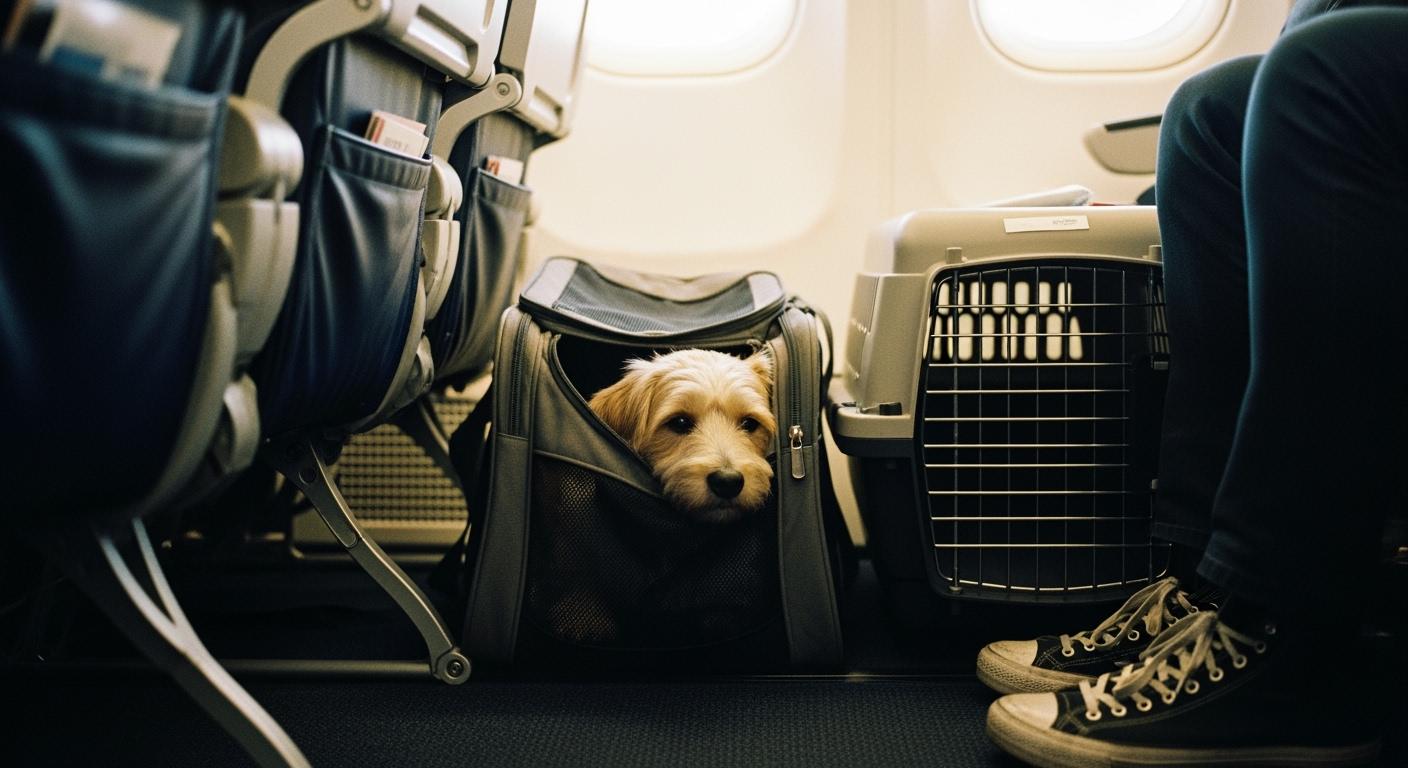
Airline size charts tell you a carrier’s outside measurements. They do not tell you whether it actually slides under a seat. A soft sided dog carrier that fits under seat areas on most commercial planes shares one trait: it bends where it needs to and stays rigid where it must. That balance is what separates carriers that glide into place from ones that jam three inches short of clearance. The difference is not about brand or price. It is about how the structure handles the moment of insertion — whether the top panel can compress without caving, whether the sidewalls stay vertical under pressure, and whether the base panel holds its shape when the carrier is wedged between floor rails and the seat frame above. Understanding which design choices produce that balance — and which ones undermine it — matters more than any specification sheet. For a broader look at how carrier design varies across airline scenarios, the under-seat fit sizing checks that apply to both cat and small-dog carriers walk through the same structural logic in more depth.
Where Listed Dimensions Stop Predicting Under-Seat Fit
Most carriers come with three numbers: length, width, and height. Those numbers assume the carrier sits on a flat surface with nothing pressing against it. An under-seat cavity looks nothing like that. Floor rails protrude upward. The seat support bar angles down from the aisle-side frame. One side might have a life-vest pouch bolted in. The space tapers — wider at the aisle opening, tighter toward the window. A carrier whose listed height is 10.5 inches can still fail if the top third of that height is a rigid panel that cannot deflect when the rail crosses at 9 inches. It fails harder if the sidewalls bulge outward once compressed, because the carrier’s effective width grows beyond what the spec stated.
This is the core mismatch: airline carrier fit problems start because a carrier that passes a living-room test has never been asked to deform around real seat hardware. Under-seat cavities vary by aircraft model, seat configuration, and even row position. A carrier that slid under seat 22C on a 737 may not clear seat 14A on an A320. The stiffer the carrier, the narrower the range of cavities it fits. The softer the carrier, the more it sacrifices internal space to make the clearance. The productive question is not “does it meet airline dimensions.” It is “where does this carrier put its stiffness, and where does it put its give.”
Controlled Flexibility: The Difference Between Fitting and Collapsing
Flexibility is not a single property. A carrier is an assembly of panels and joints, and each part can be stiff or compliant independently. The mistake most designs make is treating flexibility as uniform — either the whole body is rigid or the whole body is floppy. Both extremes fail, for opposite reasons.
A fully rigid body — hard plastic shell, metal-reinforced top, squared-off corners — preserves internal space perfectly. But it cannot negotiate the entry angle. Under-seat cavities are accessed from above, then slid forward. The carrier enters at a tilt. If the top leading edge cannot compress backward by even an inch, it catches on the seat frame and stops. Force it, and stress transfers into the zipper line, which can separate under the sideways tension. That is a structural failure at the worst possible moment.
A fully floppy body slides in easily. But once in, it offers no resistance to external pressure. The seat frame presses down. The carrier’s top collapses onto the dog’s back. The mesh side panels fold inward. Ventilation drops to near zero because there is no air gap between the dog’s body and the fabric. What looked like good airflow on the product page becomes a sealed-off pocket under real-world compression. Too much flexibility has the same outcome as total rigidity: the dog suffers, just for a different reason.
The design that works puts stiffness in the right planes and compliance in the right axes. A flexible top panel bends downward at its leading edge when you push — that is vertical-plane compliance, and it clears the rail. But the same panel resists folding along its length — that is longitudinal stiffness, and it prevents the ceiling from collapsing onto the dog. A supportive yet compressible frame achieves this. One common approach uses a spring-steel wire perimeter at the rear that compresses inward when you shove the carrier under, then expands back once it clears the obstruction. The frame gives in the direction of insertion but resists in the direction of gravity. After a 10-minute seated period, reach under and check whether the carrier’s top panel has sprung back to within half an inch of its original height at the center — if it has, the frame recovery is working. If the center is still depressed, the frame has yielded and internal space is permanently reduced.
Sidewall behavior matters just as much. Compression from above creates outward bulging forces on the sides. If the sidewalls have no internal battens or stiffening layers, they billow outward — widening the carrier beyond the listed spec and pressing mesh panels against seat legs or center-console structures. A bulging sidewall also pulls the zipper line into a curve. Zippers resist curved-force tracks. To test this before travel, load the carrier with a weighted equivalent of your dog’s torso dimension, compress the top by 20% of its listed height, and run a hand along each zipper line. If you feel the zipper teeth twisting or separating under the curve, the sidewall structure is insufficient for under-seat compression. For a detailed walk-through of how to evaluate these checks before selecting a carrier, the design features that separate carriers that fit under seats from ones that do not lay out the inspection sequence.
When This Design Is the Wrong Choice
A soft-sided carrier with controlled flexibility works best on narrow-body aircraft with standard under-seat cavities — 737s, A320-family planes, regional jets with consistent seat configurations. The design advantage shrinks in three scenarios.
First, bulkhead rows. The wall in front of a bulkhead seat has no under-seat space at all. The carrier must go in an overhead bin during taxi, takeoff, and landing. A soft-sided body offers no crush protection if luggage shifts in turbulence. For bulkhead travel, a hard-sided carrier with locking latches is the safer pick, even though it forfeits the under-seat option entirely.
Second, dogs that scratch or chew at confinement. A dog that paws aggressively at mesh panels under stress can tear through single-layer mesh within minutes. Controlled-flexibility designs prioritize ventilation over puncture resistance. If the dog has a history of clawing at carriers during car rides, a soft-sided carrier under a seat — where the dog is at eye level with feet and bags moving in the aisle — may escalate that behavior. A small hard-sided kennel with steel-door ventilation grates handles that stress profile better.
Third, connecting flights with tight layovers across different aircraft types. A carrier that fit perfectly on the first leg may face a seat with different under-seat geometry on the second leg. The flexibility that helps on one aircraft becomes a liability if the next seat has a protruding electronics box that presses directly into the carrier’s soft top. The carrier gives — and the dog loses space at the exact moment when heat and fatigue are peaking. If the itinerary involves three or more segments on different aircraft families, a hardshell carrier with verified fit across all booked equipment types reduces cumulative stress on the animal.
Disclaimer: The fit checks described above assume a short-coated dog under 18 pounds carried in-cabin on a narrow-body aircraft with standard under-seat cavities. Double-coated breeds generate more retained heat inside enclosed carriers — the mesh-panel recovery check after 10 minutes becomes critical because a compressed panel that blocks ventilation can push internal temperatures high enough to trigger panting even in a climate-controlled cabin. If the dog’s shoulder width plus carrier wall thickness leaves less than 1.5 inches of lateral clearance on each side, the airflow assumptions in this article do not hold — the dog’s own body blocks cross-ventilation regardless of how many mesh panels the carrier has.
Carriers that prioritize controlled flexibility make a specific trade-off: they prioritize fit adaptability over crush protection, and ventilation under normal compression over extreme-impact resistance. That trade-off makes sense for the bulk of in-cabin travel. It stops making sense when the cabin configuration, the dog’s stress behavior, or the itinerary complexity pushes the carrier outside the conditions it was designed for. For owners navigating multi-leg trips, the carrier fit and comfort rules that matter most on multi-segment flights offer a framework for matching carrier type to trip complexity.
Small Details That Determine Whether the Carrier Slides In
Handle and Strap Placement
Handles that sit proud of the carrier’s top surface add resistance at the worst possible moment — the final two inches of the slide. A handle that stands 1.5 inches above the top panel acts as a hook. It catches on the seat frame’s front rail and stops forward motion. The handler pushes harder. The dog feels the jolt. The handle stitching takes a shear load it was never designed for.
Flat handles sewn into the body panel, or straps that tuck into dedicated stow pockets, eliminate that catch point. The top surface stays smooth from leading edge to trailing edge. Carriers designed specifically for under-seat use tend to use webbing handles that lay flush against the sides, anchored with bar-tack stitching that distributes the lift force across a wider area. A separate shoulder strap that unclips entirely — rather than folding or tucking — removes another snag risk. Dangling strap ends find seat legs and frame corners with surprising consistency.
Zipper Line Stability Under Compression
A zipper is a series of interlocking teeth held in alignment by a tape backing. When the tape is pulled into a curve — which happens when sidewalls bulge under top-down compression — the teeth spread apart at the apex of the curve. The slider can still move, but the teeth no longer interlock securely. A dog pushing against the mesh from inside can separate the zipper at that weakened point.
Carriers that handle this well use one of two approaches: either the zipper line is placed away from the high-compression zones (along the top-center rather than the side-edge), or the sidewalls include a stiffening layer that prevents the bulging that curves the zipper in the first place. Before traveling, load the carrier and compress the top with 15–20 pounds of downward force — roughly the weight of a resting arm — then run the zipper open and closed. If the slider catches or the teeth visibly separate under the curve, the zipper will likely fail under real seat compression. This is a pass/fail check that takes seconds at home but can prevent a carrier from opening mid-flight. Carriers that pass this test share their under-seat design logic with the airline-approved pet carriers built with zipper paths that stay straight under seat compression.
Base Panel Integrity
The bottom panel does two jobs. It supports the dog’s weight across the full floor span. And it resists folding when the carrier is pushed forward and the leading edge encounters resistance from the floor surface — carpet, rail, or uneven track. A base that folds creates a ramp inside the carrier. The dog slides backward. Its body weight shifts to the rear panel, pulling the carrier’s back wall inward. The internal dimensions change shape. What started as a stable rectangular floor becomes a sloped V.
A reinforced bottom panel — typically a rigid plastic or dense fiberboard insert inside a fabric sleeve — solves this. The insert runs the full length and width of the floor and is not segmented (segmented panels fold at the seams). A single-piece insert cannot fold, so forward pressure transfers to the entire carrier body rather than concentrating at a hinge point. The carrier moves as a unit. The dog stays level.
Mesh Panel Positioning
Mesh coverage matters less than mesh placement. Three small panels — one high on the front, one high on each side — ventilate better than one large panel placed low. The reason is under-seat geometry. The carrier sits with its sides close to or touching the seat legs and center console. Side mesh below the halfway height of the carrier body often presses against an obstruction. Air cannot move through fabric that is in contact with a solid surface.
Panels positioned in the upper third of the sidewalls stay clear of most obstructions. Front-facing mesh benefits from the aisle-side opening, where there is typically more clearance below the seat’s front rail. After the carrier is in place, slide a hand along each side panel from outside: if the mesh on any side is pressed flat against a seat structure, ventilation through that panel is zero regardless of how large it looks. A carrier that places mesh only where it can stay open under typical seat geometries — such as the small-dog carrier solutions designed with ventilation placement matched to under-seat clearances — gets more effective airflow from less total mesh area than a carrier that covers half its body in blocked-off panels.
FAQ
How do you verify a carrier will fit your specific flight?
Look up the aircraft type on your booking (e.g., 737-800, A320, CRJ-900). Under-seat dimensions vary by aircraft model. Then measure your carrier’s compressed height — push the top down with the same force needed to slide it under a chair at home. If the compressed height is under the published underseat clearance for that aircraft, the carrier has a functional chance. If it only clears when uncompressed, it likely will not make it past the seat rail.
Does a carrier that flexes more fit more planes?
Up to a point. A carrier that compresses from 11 inches to 8 inches fits more cavities than one that only compresses to 10. But the trade-off is internal space. Each inch of compression is an inch the dog loses. The right carrier compresses just enough to clear the rail — no more. Over-flexing solves the fit problem by creating a space problem inside.
Can an airline-approved carrier still fail at the gate?
Yes. Airline approval typically means the carrier’s listed dimensions fall within the airline’s published limits. It does not mean the airline has tested the carrier under a real seat. Gate agents may check the tag and wave you through, but the under-seat cavity does not read tags. The carrier either fits the physical space or it does not.
What is the single most common point of under-seat failure?
The top leading edge. When the carrier is tilted forward and pushed, the upper front corner is the first point of contact with the seat frame. If that corner cannot deflect downward, the carrier stops. A rigid top panel or a squared-off frame with no forward compression zone causes this failure more often than any other single design feature.






