
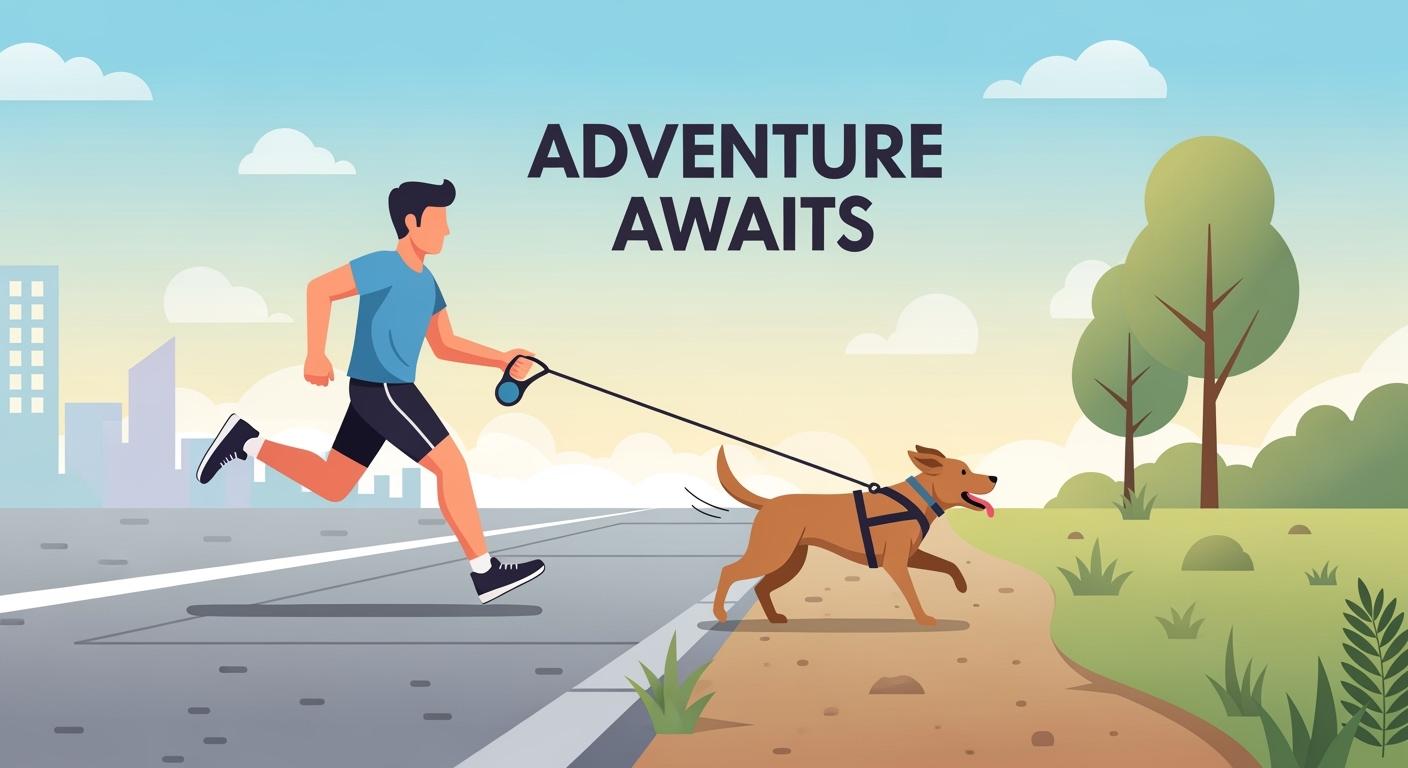
Choosing the best leash for running with dog depends on two things first: the route you actually run and how your dog behaves when pace, noise, or space changes. A leash that feels easy on a quiet path can feel slow near a crosswalk, a bike lane, or a crowded sidewalk.
For most runners, the safest setup balances freedom with fast control. That usually means a fixed-length leash or a hands-free leash with adjustable length, a quick-grab handle near the dog, and a secure harness attachment. The goal is not maximum range. It is being able to shorten the line quickly, keep your dog on one side, and avoid tangles when the run gets busy.
Key Takeaways
- Match the leash style to the route, not just your preferred running feel.
- Hands-free setups usually work best on open paths, while handheld control is often easier near traffic and tight turns.
- A quick-grab handle and easy length adjustment matter more than extra features you may never use.
- Practice stopping, turning, and shortening the leash before taking the setup on a real run.
Choose the leash style for the route you actually run
A freer setup can feel great when the path is wide, predictable, and lightly used. The same setup can become harder to manage when your run includes repeated crossings, parked cars, sharp corners, or frequent stops. That is why the best leash for running with dog is rarely about one universal style. It is about how quickly you can go from relaxed movement to close control.
Hands-free, standard, and bungee leashes each change control differently
Hands-free leashes let you keep a more natural arm swing and steady rhythm. They are often comfortable on longer runs, especially when your dog already knows how to stay beside you. Standard handheld leashes give more direct feedback and usually make it easier to pull your dog in quickly. Bungee leashes can soften sudden surges, but the stretch may also add a slight delay when you need an immediate response.
If your usual route mixes open stretches with busy sections, many runners prefer a hands-free setup only when it also includes a close handle and simple length adjustment. Without those features, it can be harder to react when your dog speeds up, slows down, or drifts across your stride.
| Leash type | Best use | Main strength | Main tradeoff | Control feel |
|---|---|---|---|---|
| Standard fixed-length | City blocks, crossings, mixed traffic | Direct handling and fast shortening | Less freedom for arm swing | High |
| Bungee | Dogs that make abrupt surges on more open routes | Absorbs some shock | Can feel slower in tight spaces | Moderate |
| Hands-free | Steady runs on quieter paths | Better freedom and comfort over distance | Depends heavily on adjustment and grab handle placement | Moderate |
A harness is usually the better match for running than attaching the leash to a collar, because it can reduce neck pressure and give more stable control. Fit still matters. If the harness shifts, rubs, or lets your dog twist out of position, the leash choice will not fix the problem by itself.
When to switch from freer movement to manual control
Busy sections call for shorter line, earlier decisions, and less slack. Before you reach a road, a trail pinch point, or a distraction such as another dog, shorten the leash before your dog reacts. Waiting until after the pull starts is where many runners lose the clean line they had a few seconds earlier.
- Shorten before crossings, not in the middle of them.
- Keep your dog on one consistent side when the route narrows.
- Watch for weaving, lag, or repeated tightening of the line.
- If the bungee stretch feels delayed downhill or around corners, switch to firmer control.
Tip: If you cannot shorten the leash in one smooth motion, the setup is probably too long, too stretchy, or missing a practical grab point.
What changes on real runs
Leash performance changes when the route changes. A setup that feels balanced on flat pavement may feel awkward on hills, on uneven trail sections, or anywhere you need to slow down fast. The practical question is simple: can you still keep your dog close, clear of your legs, and moving in the same direction as you?
Hills, speed changes, and tight spaces expose weak setups quickly
Uphill sections often slow the runner first. Downhill sections can speed the dog up first. Tight spaces reduce your margin for slack. All three situations make leash lag more obvious. If the line drifts behind your dog, snaps tight late, or crosses your knees, the setup is not giving you clean feedback.
Shorter fixed-length options tend to work better in city running and crowded areas because the dog starts closer and stays easier to read. On quieter trails or parks, a hands-free leash may feel smoother, especially when your dog keeps a steady position beside you. Reflective materials can help in low light, but visibility should never be treated as a substitute for control.
| Control check | Pass signal | Fail signal | What to change |
|---|---|---|---|
| Quick shortening | You bring the dog closer in one motion | You fumble, reach twice, or need extra time | Reduce slack or use a closer grab handle |
| Dog position | Your dog stays beside you on one side | Your dog cuts across your stride | Shorten earlier and reset side position before speed picks up |
| Leash path | The line stays clear of knees and front legs | The line wraps, drags, or bumps your legs | Adjust length and keep less slack between changes |
| Stops and turns | You can slow and redirect without a surge | The line goes tight late or rebounds | Use less stretch or switch to firmer handling in busy areas |
A simple pre-run check helps. Jog a few steps, stop once, turn once, and pull your dog in once. If those three movements feel smooth before the run starts, the leash is more likely to stay manageable when the route gets harder.
Note: Stop the run if your dog shows signs of overheating, stress, limping, or trouble breathing, and ask your veterinarian about safe activity levels if you are unsure.
Failure signs to fix before they become safety problems
The early warning signs are usually easy to spot once you know what matters. Leash lag means the line is not giving you timely feedback. Off-center pull means your dog is drifting out of position. Leg tangles mean the leash length is no longer matching the space you have. Slow shortening means you may not be able to react fast enough around traffic or distractions.
Common mistakes that create real problems on runs
- Using a hands-free leash on crowded routes without a fast grab option.
- Choosing too much stretch for a dog that already surges or changes speed suddenly.
- Letting the dog switch sides repeatedly instead of keeping one predictable running position.
- Starting with too much slack and trying to recover control after the pull begins.
- Using a retractable leash for running, which can make distance and response harder to manage.
| Problem | Likely cause | Fast check | Better choice |
|---|---|---|---|
| Leash lags or rebounds | Too much slack or stretch | Shorten the line during an easy jog | Use a firmer fixed-length setup or reduce slack |
| Off-center pull | Dog drifts across your stride | Watch whether your dog changes sides near distractions | Reset side position earlier and shorten before the trigger |
| Leg tangles | Leash is longer than the space allows | Check whether the line crosses your knees or the dog’s front legs | Run shorter in tight areas and avoid extra slack |
| Slow pull-in near traffic | Handle is too far away or the system is awkward to grab | Practice one quick pull-in before starting | Use a traffic handle or simpler adjustment system |
| Hard pace control | Retractable line or inconsistent tension | Notice whether the dog gains distance before you can respond | Switch to a non-retractable leash for running |
If you keep seeing those signs, do not try to solve everything by running slower for one day. Change the setup. In many cases, the best leash for running with dog is simply the one that lets you react early and keep the line readable at all times.
A good final check is whether the sentence “I can bring my dog close right now” is true in every section of the route you use most. If the answer changes between the park loop and the last two blocks home, you may need one leash style for open running and a shorter, more direct option for crowded sections.
FAQ
What is the safest way to attach a running leash to my dog?
For most dogs, a well-fitted harness is the safer running setup because it usually reduces neck strain and gives steadier control.
Can I use a retractable leash for running with my dog?
It is usually a poor choice for running because extra distance and changing tension can make quick control harder.
How do I keep my dog from weaving across my path?
Pick one side before the run starts, shorten early near distractions, and correct position before the leash crosses your stride.






