
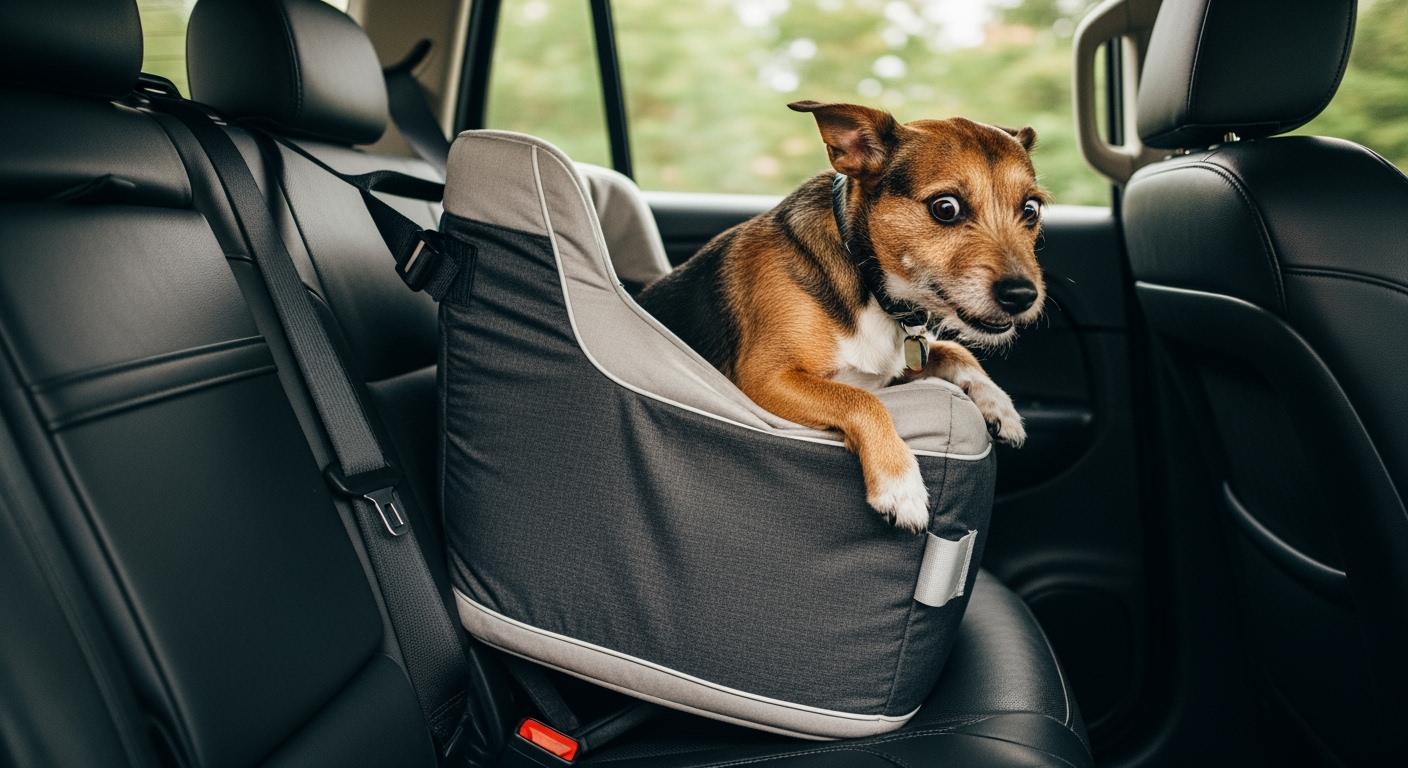
A small dog in a booster seat on an SUV rear bench faces a geometry problem most buyers do not see until the first hard stop. The bench slopes. The booster base was designed for a flat surface. The mismatch is not subtle — it compounds with every turn, every brake, every shift of the dog’s weight. The fix is not a better strap or a different brand. It is a base that stays flat when the seat underneath is not.
The design features that determine whether a booster seat stays level or tilts forward are specific and measurable. A rigid base panel, a low lift height, and strap routing that pulls the seat into the bench rather than merely looping around it. These are not premium add-ons. They are the difference between a seat that works on a sloped SUV rear bench and one that does not.
Why Small-Dog Booster Seats Tilt on SUV Rear Seats
SUV rear benches are rarely flat. Most have a rearward slope of 10 to 15 degrees and a contoured sitting surface that dips toward the seatback. A booster seat with a soft, flexible base lands on this surface and makes contact only at the high points. The contact patch shrinks. Weight concentrates on a smaller area.
Here is the chain reaction that follows. The narrow contact area compresses the seat foam more on the downhill edge than the uphill edge. This creates a forward tilt angle in the booster itself. The dog’s weight, already biased toward the front of the booster by the initial slope, shifts further forward. More weight on the front edge compresses that foam even more. The tilt angle increases. The dog braces or shifts. The cycle repeats.
The physics is straightforward but rarely discussed in product descriptions. A booster base that flexes under load turns a static slope into a dynamic instability — the seat feeds the forward lean instead of resisting it. A rigid flat panel breaks this loop at the first step: the base cannot compress unevenly because it does not compress at all. The weight spreads across the full footprint regardless of the bench contour beneath it. That single difference in booster seat sizing and base construction determines whether every subsequent design feature — straps, sidewalls, cushion shape — actually matters or gets defeated by the foundation.
Deeply contoured rear seats, common in luxury SUVs and vehicles with pronounced bolstering, amplify this effect. A narrow-base booster sitting inside a sculpted bucket may contact only the center third of its bottom panel. The outer edges float. The dog feels the wobble immediately.
Where Soft Bases and Tall Lift Make Instability Worse
A booster seat with a soft, compressible base can look stable on the showroom floor. Set it on a flat counter and it sits dead level. Put it on a sloped SUV bench with a 10-pound dog inside, and the front edge sinks — sometimes by half an inch or more. That half-inch at the base translates to several inches of forward lean at the dog’s shoulders.
An observable check takes about ten minutes. Install the booster, place the dog, and drive a loop with a few normal stops. After the drive, measure the gap between the booster’s front edge and the seat surface. If the front edge has dug into the seat cushion and the rear edge has lifted, the base is compressing unevenly. Creep of more than an inch from the original position is a clear signal that the base and strap system are not holding.
Tall lift height compounds the problem for the same reason a top-heavy load shifts more on a tilted truck bed. Raise the dog four or five inches above the seat, and the center of gravity sits high enough that any tilt in the base produces a meaningful lateral weight shift. The dog feels the lean and braces against it — which adds more side force, which can push a soft-sided booster further out of shape. A lower lift, in the two-to-three-inch range, keeps the dog’s mass closer to the pivot point. The same base tilt produces less displacement. Less displacement means less dog reaction, and the instability does not self-amplify.
| What you see | Design cause | Better approach |
|---|---|---|
| Booster tilts forward during stops | Base compresses at front edge under load | Rigid panel spanning full base footprint |
| Dog slides to one side in turns | Sidewalls lack internal structure, lean outward | Reinforced side bolsters that resist lateral collapse |
| Booster creeps forward across the seat | Strap routing loosens; bottom surface slides | Non-slip base material plus cinch-down anchor routing |
Loose or poorly routed anchor straps let the seat walk forward before the dog has even settled. The difference between a strap that wraps once around the seatback and one that cinches through the LATCH anchors and pulls downward into the seat bite is large. The latter uses the vehicle’s own anchor points to create a tension vector that presses the booster into the bench. But many booster seats ship with a single loop strap that relies on seatback friction alone — and on a leather or leatherette SUV seat, there is almost none. On the measurements that prevent a car seat from tipping or sliding, base rigidity and anchor routing are the two numbers that matter first.
What Design Keeps a Booster Seat Level on an SUV Bench
Three design features separate a booster seat that stays put on a sloped SUV rear bench from one that fights it.
A flat, rigid base panel. Typically a sheet of HDPE or plywood laminated into the bottom of the seat, this panel cannot flex or compress. It bridges the contours of the bench and keeps the sitting surface level regardless of what is underneath. A secondary benefit: the rigid panel gives the anchor straps a solid mounting point. When you cinch the straps, the tension pulls on the panel, not on foam that deforms under load. The cinch stays tight.
An observable check after installation: run your hand under the front edge of the booster. If you can feel air between the base and the seat surface — a gap wider than roughly the thickness of two fingers — the base is bridging rather than bedding into the seat. That gap will close under the dog’s weight on a soft-base seat (as the foam compresses), but on a rigid-base seat, full contact should be present from the start.
A lower, firmer lift. Two to three inches of closed-cell or high-density foam under the dog performs differently than four to six inches of plush fill. The shorter column resists compression more effectively — not because the material is necessarily different, but because a shorter column has less distance over which to deform. At the same foam density, halving the height roughly doubles the compressive stiffness. The low lift also keeps the dog’s center of gravity closer to the seat surface. On a flat bench this matters less. On a slope, it matters a great deal.
Adjustable anchor straps with downward pull geometry. Straps that route through the seat bite — the gap between the backrest and the bench — and connect to the vehicle’s LATCH anchors create a downward-and-rearward tension vector. This pulls the booster into the bench rather than merely holding it against the seatback. The strap angle matters. A strap that runs horizontally from the booster to the seatback applies almost no downward force. A strap that drops into the seat bite and pulls at a 45-degree angle downward converts cinch tension into both rearward and downward clamping force. This is the same principle that secures a child safety seat, applied to a product category where booster seat sizing and material choices often overlook anchor geometry entirely.
| Design feature | Why it matters on sloped SUV seats | Main limitation |
|---|---|---|
| Flat rigid base panel | Prevents concentrated compression at the front edge; distributes weight across full footprint | Adds weight; cannot be folded or compressed for storage |
| Lower lift (2–3 in) | Keeps center of gravity low; reduces forward weight shift during braking | Less window visibility for the dog; may not suit dogs that prefer an elevated vantage point |
| Downward-pull anchor routing | Converts strap tension into clamping force that presses the booster into the bench | Requires accessible LATCH anchors; harder to install on seats with recessed anchor points |
These three features compound. A rigid base without good anchor routing still creeps. Tight straps without a rigid base pull on foam that deforms. A low lift without a stable base still wobbles on a contoured bench. Together, they form a system where each element reinforces the others — the approach to in-car safety seating that treats the booster not as a cushion on top of the seat but as an extension of the seat itself.
The same geometry that makes sloped benches problematic also makes them predictable. Once you accept that the booster must bridge a non-flat surface, the design requirements become clear: rigid bridge, low payload height, tension that clamps rather than wraps. A small dog car seat built around a folding rigid base applies these principles in a way that a soft-sided cushion-style booster cannot.
When a Booster Seat Is Not the Right Solution
A booster seat with a flat rigid base and low lift works well on most SUV rear benches with typical slope angles. But it is not the right tool for every situation.
On deeply sculpted bucket-style rear seats — the kind found in some luxury SUVs where each seating position is individually contoured — even a rigid base may not find enough flat contact area. The base bridges the hollow and contacts only at the outer bolsters. The seat rocks side to side. In these vehicles, a hammock-style rear seat cover combined with a safety-rated harness and tether may provide more predictable containment than any booster.
A booster seat is also not crash protection. Most booster seats in this category are designed for containment and comfort — keeping the dog in one area and giving them a view out the window — not for absorbing collision forces. If crash-tested restraint is a priority, the product packaging must state that explicitly and cite a recognized test standard. No booster seat should be assumed to provide crash safety unless the manufacturer publishes test results.
Disclaimer: The fit checks described here — measuring base-to-seat contact, checking for forward creep, and verifying anchor tension — assume a smooth-coated dog whose weight distribution is predictable at rest. Dogs with barrel chests, very deep keels, or breeds that shift weight forward when anxious (common in brachycephalic breeds that may lean toward airflow) can produce different pressure patterns. If your dog’s chest shape falls well outside breed norms or the booster was sized using weight alone rather than girth and sitting height, the contact checks described here may miss a pressure point that only appears after twenty minutes of driving.
For small dogs in booster seats where the view matters as much as stability, the tradeoff between lift height and stability becomes the central decision. Some dogs are calmer with a higher vantage point even if it means slightly more movement. Others settle only when the seat feels planted. The right choice depends on the individual dog.
FAQ
Why does my small dog slide forward in the booster seat when I brake?
The base of the booster is likely compressing at the front edge. On a sloped SUV bench, weight concentrates forward during braking, the front foam compresses more than the rear, and the sitting surface tilts. The dog’s momentum then carries them into that tilt. A rigid base panel breaks this mechanism by preventing uneven compression.
Does a taller booster seat give my dog a better ride?
Not on a sloped seat. Added lift height raises the center of gravity. On a contoured or angled bench, every extra inch of height amplifies the tilt produced by uneven base compression. A lower, firmer lift typically produces less motion and a calmer dog — even though the view out the window is reduced.
Can I use the vehicle’s seat belt to secure the booster instead of LATCH anchors?
Some booster seats route the seat belt through designated pass-through points, but this is less effective than LATCH anchor routing on sloped seats. A seat belt applies tension horizontally. LATCH routing through the seat bite produces a downward force component that presses the booster into the bench. If the booster lacks LATCH-compatible straps, the seat belt is the only option — but the base must be rigid enough to bridge the bench contour without relying on downward clamping.
How do I know if the base is rigid enough before buying?
Product photos rarely show the base. Look for descriptions that mention a rigid bottom panel, an HDPE insert, or a “hard bottom.” If the booster can be folded or rolled, it lacks a rigid base and will compress unevenly on a sloped bench. Customer photos showing the underside of the seat are often more informative than listing copy.






