
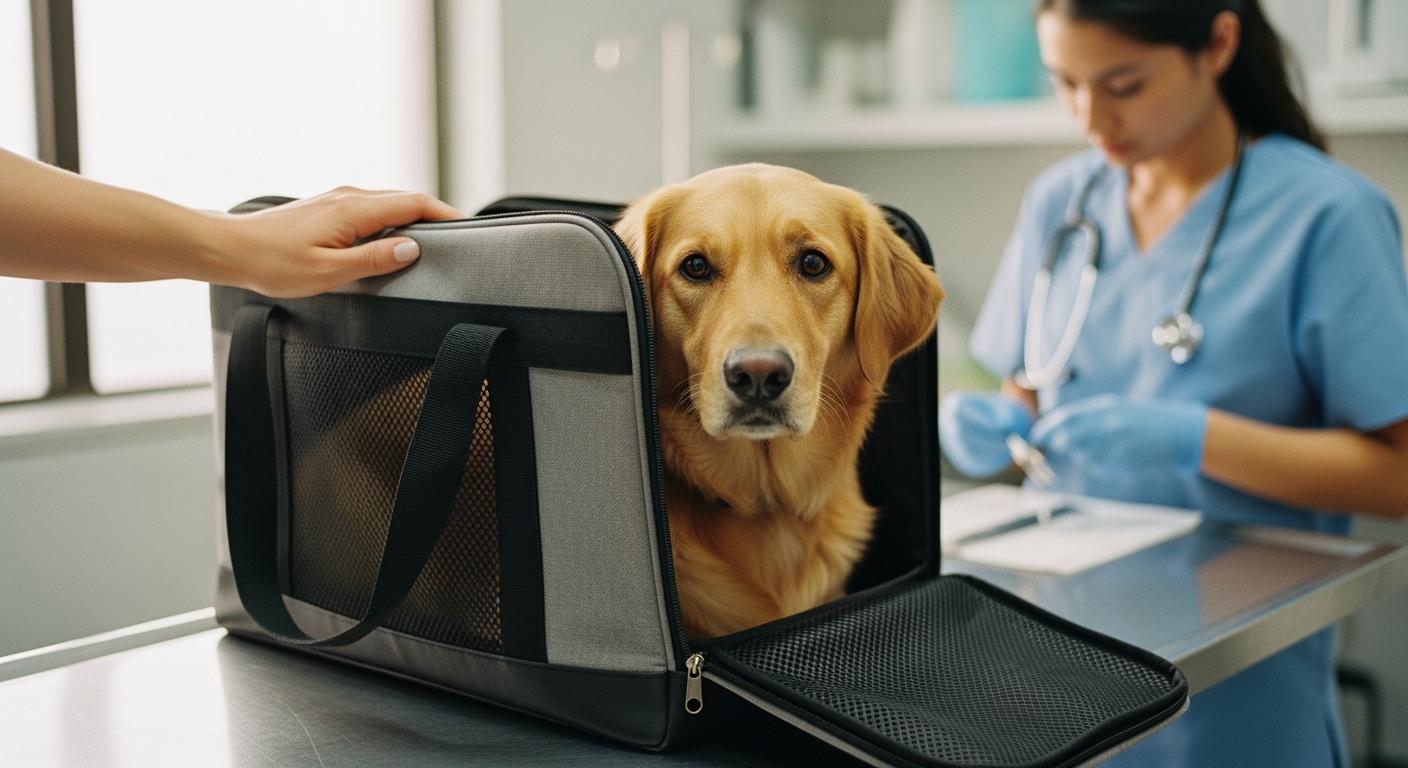
A vet waiting room is not a normal carry. It is loud, unfamiliar, and packed with triggers that push a calm dog into restlessness within minutes. Most tote carriers are designed for benign trips — short errands, quick coffee stops — where the dog stays still. Shift that same tote into a clinic and the design gaps surface fast. A soft base sags under a dog that keeps standing. A wide open top lets a nervous dog lean halfway out. A zipper that does not lock gives a determined dog a way through.
This is not about buying a better bag. It is about two structural features that determine whether a carrier holds up or folds under clinic stress: what the base rests on, and how the opening stays shut.
What the Vet Waiting Room Exposes in a Tote Carrier
Why the Environment Hits Harder Than the Trip
A dog that rides calmly in the car can still unravel the moment the clinic door opens. New scents layer on each other — antiseptic, other animals, medications. Barking echoes off hard floors. Strangers and other pets move through the same narrow space. These inputs stack. A carrier built around the assumption of a still, relaxed dog gets tested beyond its design limits the moment the dog starts shifting, standing, turning, and pressing against the walls.
Clinics often use calming pheromones or separate dog and cat seating. Those measures help, but they do not eliminate the root mechanical problem: a nervous dog moves, and a soft-sided tote moves with it — until the structure gives way.
| Environmental Factor | Why It Matters for the Carrier |
|---|---|
| Barking and noise | Triggers standing, turning, and pawing inside the tote — tests sidewall rigidity |
| Unfamiliar scents | Provokes restless repositioning — tests base stability under shifting weight |
| Close proximity to other animals | May trigger escape attempts — tests zipper and closure security |
| Long wait times | Extends stress duration — exposes cumulative material fatigue in straps and seams |
How Dogs Signal That the Carrier Design Is Failing
Before a dog escapes or a zipper breaks, the dog sends signals. Trembling, tucked tail, flattened ears — those are stress markers. But the design-relevant signals are mechanical: the dog stands and will not settle, turns in tight circles, presses its weight against one sidewall, paws at the mesh. Each of these actions applies force to a specific part of the carrier. A soft base buckles under a standing dog. An unstructured sidewall folds inward under lateral pressure. A non-locking zipper separates under persistent pawing.
After the visit, a dog that hides or sleeps more than usual does not necessarily mean the vet was traumatic. It can mean the carrier itself added to the stress — wobbling, collapsing, trapping the dog in an unstable space for the entire wait.
Where Soft Bases and Loose Openings Start to Fail
Base Sag and Why It Accelerates Panic
A dog that feels the floor drop under its feet does not relax. The physics here is direct: a soft base panel — typically a thin foam sheet or unsupported fabric — bends under load. When the dog shifts weight to one side, the base tilts along that axis. The dog corrects. The base tilts the other way. The dog corrects again. This feedback loop turns a nervous shuffle into a sustained panic response, because the dog never reaches a stable equilibrium.
The threshold where this becomes visible depends on weight distribution, not just total weight. A 15-pound dog that stands and leans can produce more localized base deflection than a 25-pound dog lying flat. Tote carriers built around a rigid base insert interrupt this feedback loop. The floor stays flat regardless of where the dog places its weight. The dog finds a stable surface. The corrective shuffling stops.
Note: Base rigidity matters more than overall carrier weight. A slightly heavier tote with a firm floor insert outperforms a lighter one with a padded-but-flexible base in any situation where the dog will not stay still.
Sidewall Collapse and the Loss of Containment Cue
Structured sidewalls do two jobs. The obvious one is keeping the carrier open so the dog has room. The less obvious one is providing a containment cue — a firm boundary the dog can feel and lean against without the wall giving way. When sidewalls are soft and unstayed, lateral pressure from a leaning or turning dog folds them inward. The dog’s perceived space shrinks. The boundary that was supposed to feel secure now feels like it is closing in.
This is a material and construction question, not a padding question. Mesh panels backed by rigid stays hold their shape under side load. Stitched-in plastic or composite boning in the seams prevents the wall from caving at its weakest axis. Padding without structure — a thick fabric wall with no internal frame — collapses just as easily as thin fabric once the dog leans. Designs that integrate framing into the sidewall seams distribute lateral force along the frame rather than letting it concentrate at a single fold point.
| Failure Signal | Design Cause | Better Direction |
|---|---|---|
| Base bends or sags under the dog | Foam-only or unsupported fabric floor | Rigid insert panel with removable comfort pad |
| Sidewalls fold inward when the dog leans | Unstayed fabric walls | Internal framing or composite boning in wall seams |
| Dog leans out through the top opening | Wide open top, non-locking zipper | Locking zipper closure with limited-access opening |
| Zipper separates under pressure from inside | Standard coil zipper without lock tab | Self-locking zipper that cannot be pushed open from within |
What Happens When a Zipper Is the Only Gate
A non-locking zipper is a one-way invitation in a vet clinic. A dog that paws at a mesh panel and catches a zipper tab can work it open. Self-locking zippers solve this mechanically: the pull tab locks in the down position, and pressure from inside tightens the coil rather than separating it. This is the same mechanism used on luggage and tactical gear — it fails closed, not open.
Clasps and snaps are weaker alternatives. A plastic side-release buckle can be shouldered open if the dog presses against it at the right angle. Over time, the spring inside the buckle fatigues and the retention force drops. A self-locking zipper has no spring to fatigue and no angle where internal pressure defeats it. For a carrier used in high-stress environments where the dog is actively testing the boundaries, that distinction determines whether the trip ends with a contained dog or a loose one in a crowded waiting room.
In practice: If you can open the zipper by pressing outward from inside the bag with two fingers, a determined dog can open it with one paw. Locking zippers require a deliberate pull from outside — a mechanical asymmetry that works in the handler’s favor.
What Tote Carrier Design Holds Up Under Clinic Stress
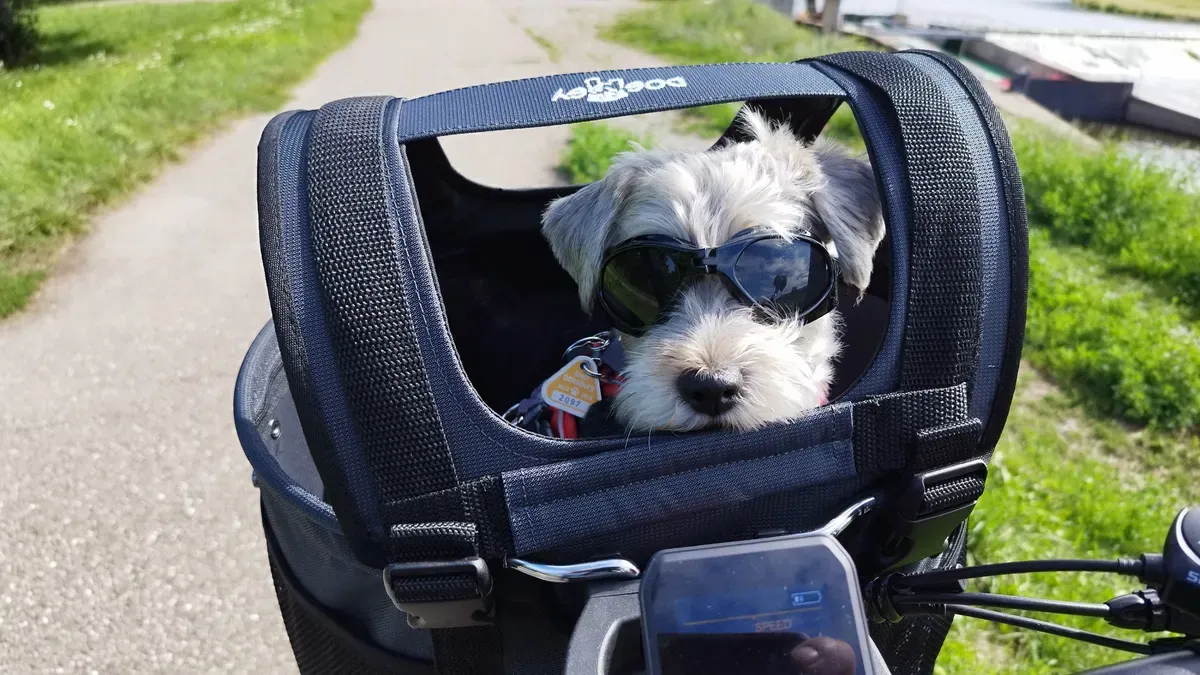
A Firm Base Keeps the Dog From Fighting the Floor
The base is a platform, not a cushion. A rigid insert — typically a composite board or dense plastic sheet — prevents the floor from deforming under load. When the dog stands, the base distributes weight across its full surface area instead of concentrating it at the paw contact points and bending the panel. The dog’s feet stay on the same plane. No tilt correction loop kicks in.
The test is simple and observable: place the empty carrier on a flat surface, press down with one hand in the center, and release. A rigid base returns to flat immediately. A soft base retains a dent. After a 15-minute vet wait, press the base from underneath — if it has sagged into a bowl shape, the carrier was never structurally adequate for a dog that does not lie still. This observable check is covered in more detail in sizing and structural checks for soft-sided carriers, where material choice interacts with fit to determine real-world stability.
A removable comfort pad layered over the rigid insert is the practical combination. The pad handles warmth and cushioning. The insert handles structure. Separating them means the structural component never gets soaked, compressed, or degraded by cleaning cycles — the pad can be washed while the insert stays intact.
Locking Zippers and Access That Does Not Double as an Exit
A carrier opening serves two conflicting goals: easy handler access and zero dog escape. Most designs optimize for access and bolt on security as an afterthought — a clip here, a velcro flap there. Locking zippers treat security as the primary function and design access around it.
The mechanical difference: a standard zipper’s coils can be wedged apart by outward pressure. When a dog leans against a mesh panel and the panel transfers force to the zipper teeth, the teeth separate. A locking zipper uses a detent mechanism in the slider — the pull tab locks when laid flat, preventing the slider from moving in either direction without first lifting the tab. From inside the carrier, a dog cannot lift the tab. From outside, the handler lifts and pulls in one motion.
An internal tether placed near the center of the carrier adds a second layer without introducing a new failure point. A poorly placed tether — too close to the opening, too short, or attached at an angle — pulls the dog into an awkward posture and can actually increase escape attempts. A center-anchored tether keeps the dog oriented inward while the zipper handles containment.
| Closure Feature | How It Fails | How a Better Design Prevents It |
|---|---|---|
| Standard zipper | Coils separate under outward pressure | Locking slider stops movement unless tab is lifted from outside |
| Side-release buckle | Spring fatigues; dog can shoulder it open | Locking zipper has no spring to fatigue |
| Velcro flap | Loses grip with dirt and fur; noisy opening stresses the dog | Zipper is silent and unaffected by debris |
Handles and Straps That Do Not Amplify Instability
A crossbody strap changes the physics of carrying a restless dog. When the strap runs diagonally across the torso, the carrier stays close to the body’s center of mass. The dog’s shifting weight transfers into the handler’s core rather than pulling at one shoulder. This matters most when the handler is doing something else — checking in at the desk, opening a door, reaching for paperwork.
Reinforced handle attachment points are equally critical. A handle stitched only to the outer fabric layer tears under repeated lifting with a moving load inside. Handles anchored through the body fabric to an internal frame or rigid base panel spread the load across the structure rather than concentrating it at the stitch line. Walk into the clinic, lift the tote onto a chair, lift it again, carry it to the exam room — each lift cycles the handle stitching. Reinforcement at the anchor points is what lets the carrier survive a year of vet visits rather than six months. A single-shoulder tote with crossbody strap capability distributes the load across the handler’s body rather than concentrating it at one grip point.
Ventilation as a Stress-Reduction Tool
Mesh panels do more than let air through. Visibility reduces the dog’s sense of being trapped — a dog that can see its surroundings typically shows lower stress markers than one sealed inside an opaque box. But mesh also introduces a structural tradeoff: the panel itself is less rigid than the surrounding fabric. The solution is to size mesh panels so they are bordered on all four sides by structured fabric, creating a window-within-a-frame rather than an entire wall of mesh. This preserves ventilation without sacrificing sidewall integrity.
After a vet visit, check the mesh for claw marks and the interior for moisture. If the mesh has stretched or the interior padding is damp after a 20-minute wait, the ventilation design is undersized for the dog’s stress level. A well-ventilated tote carrier should show dry interior fabric and no condensation on the mesh after a typical clinic wait.
When a Structured Tote Carrier Is Not the Right Tool
A rigid-base tote carrier is designed for a specific use profile: short to medium trips where the dog is carried, set down, and carried again. It solves the vet-visit problem well. Outside that profile, its advantages thin out.
Dogs over roughly 25 pounds produce forces that can overwhelm even a well-built tote’s structural limits — not because the base breaks, but because the handler’s arms and shoulders become the limiting factor. A crossbody strap helps, but the load is still asymmetrical. For larger dogs in stressful environments, a structured carrier with wheels or a two-handed carry design makes more sense.
Dogs that are actively aggressive at the vet — lunging, snapping, throwing their full body weight against the carrier walls — need a containment solution beyond what any soft-sided tote can provide. Locking zippers stop escape through the opening. They do not stop a dog from tearing through mesh with teeth. No tote carrier design on the market solves for that scenario. A hard-sided crate is the appropriate tool.
For dogs that settle quickly and rarely shift once inside, a soft-sided tote with a padded base may be sufficient. The rigid base and locking zippers solve for instability — if instability is not the problem, the extra weight and cost bring no benefit.
Disclaimer: The stability checks described here assume a smooth-coated dog in a carrier that fits — the dog should be able to stand and turn without pressing against the ceiling. Double-coated breeds may show subtler signs of overheating inside a carrier even with adequate ventilation panels; hand-check the interior fabric temperature rather than relying on visual condensation checks alone. If the dog’s chest shape falls outside the breed norms this carrier style was patterned for — particularly barrel-chested breeds or dogs with very deep keels — the internal space may not distribute pressure evenly, and the fit checks described may not catch every pressure point.
FAQ
How do you tell if a carrier base is rigid enough before the vet visit?
Place the empty carrier on a table. Press down firmly with one hand in the center of the floor panel and release. The base should return to flat immediately, with no visible dent or curve. Repeat with pressure off-center near the edges — a rigid insert resists bending across the entire surface, not just the middle. If the floor holds a dish shape for even a second, it will sag under a standing dog within the first few minutes of a vet wait.
Do locking zippers make it harder to get the dog out quickly?
No. A locking zipper adds one motion — lift the pull tab before sliding — which takes a fraction of a second and becomes automatic after a few uses. The difference is that the dog cannot perform that motion from inside. Access speed for the handler is unchanged; access for the dog is eliminated.
Why does base structure matter more than carrier size?
Extra interior space without a rigid floor gives the dog more room to shift, slide, and build momentum. A slightly smaller carrier with a firm, flat base keeps the dog on a stable platform. The dog braces against the floor, not the walls. When the floor stays flat, the dog stops correcting and settles faster — regardless of how much room is around it.
Can a soft-sided tote ever work for a nervous dog at the vet?
Only if the dog’s particular stress response is freezing rather than moving. A dog that goes still and stays still does not test the base or sidewalls. But that is not knowable before the first vet visit with a new carrier. A rigid base and locking zippers cover both possibilities — the dog that freezes and the dog that does not.
What is the first sign that a carrier is not holding up during a visit?
Watch the zipper line. If it curves or bows rather than running straight, internal pressure is separating the coils. A straight zipper under load means the locking mechanism is holding. A curved zipper means it is about to separate. If the zipper bows, close the opening and keep one hand on the closure until you reach the exam room.






