
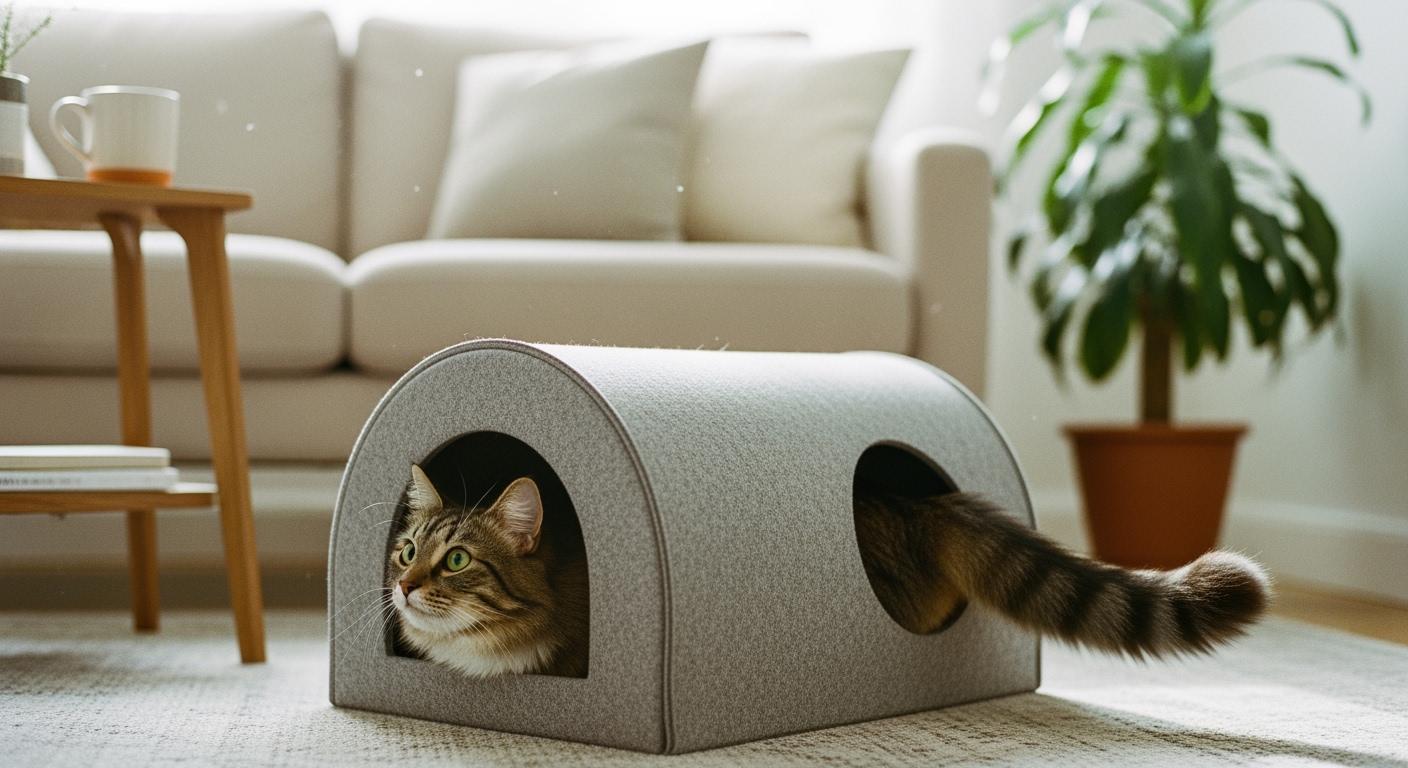
A cat cave bed looks like a safe retreat. Push it against a wall, slide it into a corner, or set it where another pet can camp at the entrance, and that retreat turns into a dead end. The design feature that prevents this is not thicker padding or a quieter fabric. It is a second exit — and specifically, a tunnel shape with two openings that stay open under pressure.
Single-entrance cat beds work until they do not. The moment the only opening faces a sofa arm, a passing dog, or a busy walkway, the cat inside loses the one thing it depends on: a usable escape path. A tunnel bed with two supported exits changes the geometry of that problem entirely.
Why a Single Entrance Creates a Trap
A single-entrance cat cave has one fundamental flaw: the entrance is also the only exit. When something blocks it from the outside, the cat inside has zero options. This is not a rare edge case. In a typical home, the entrance gets blocked by furniture shifted during cleaning, by a child sitting nearby, or by another pet that stops to investigate the opening. The cat does not need to be in danger. It only needs to feel that the path is closed.
Cats are both predator and prey animals. Their threat-assessment routine runs on a simple rule: if the only exit is compromised, the hiding spot is a liability. A cat that hesitates to enter its bed or bolts out the moment the path clears is not being skittish. It is acting on exactly that calculus.
Soft-sided caves make this worse. When the entrance rim has no internal structure, the fabric depends entirely on fill loft to hold its shape. Body weight compresses the fill. The opening oval collapses into a slit. Now the cat faces two problems at once: the exit is blocked by outside conditions and the opening itself is physically shrinking.
| Design Flaw | Impact on Use | Reason for Failure |
|---|---|---|
| Low-density fiberfill walls | Reduces loft and support | Compresses when wet or under sustained weight, losing structural recovery |
| Unreinforced entrance rim | Prone to folding and collapsing | Lacks a load path around the opening circumference; compression travels straight through the fill |
| Thin outer shell fabric | Stretches and loses form | Cannot maintain tension after repeated washing cycles without an internal frame |
The difference between a blocked exit and a collapsed opening matters. One is an environmental problem. The other is a design failure. A single-entrance bed with an unsupported rim combines both. The fix is not a bigger cave. It is a tunnel with two structurally independent openings. That way, even if one path closes, the other stays open — and stays shaped like an opening, not a crease.
Check this yourself. Place a single-entrance bed flush against a wall. Walk past it normally. If the cat inside freezes or waits to exit until the path clears entirely, the single-entrance geometry is blocking movement flow. That is observable blockage, not speculation.
How Two Exits Change the Movement Equation
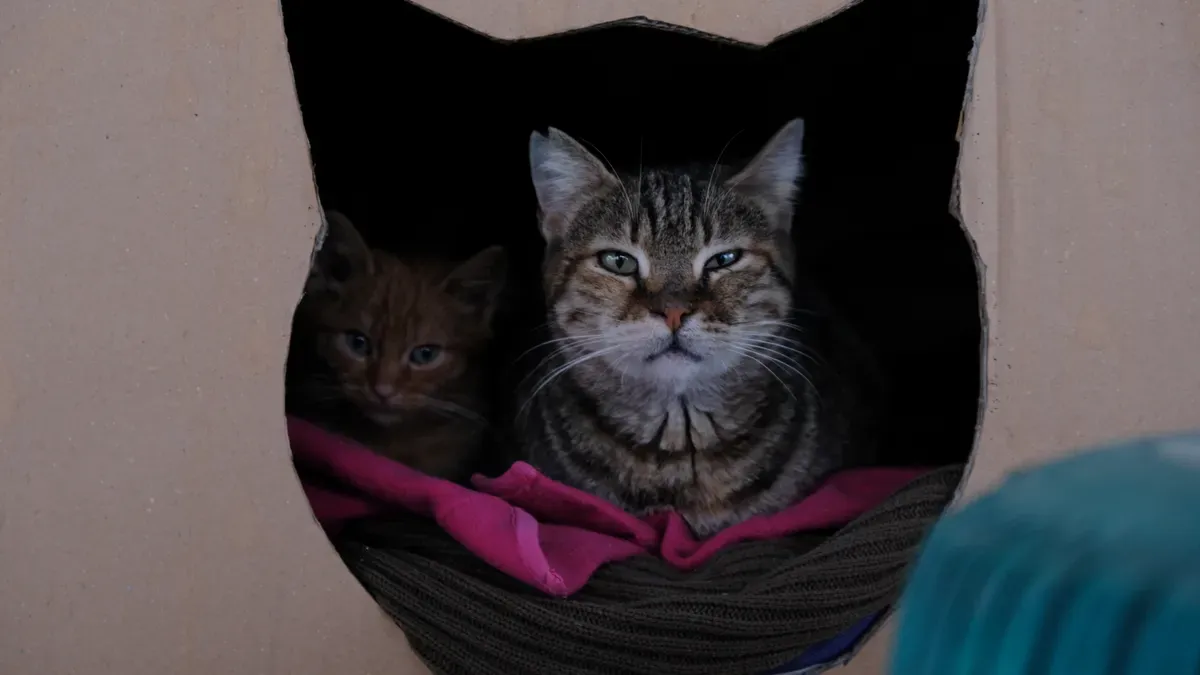
A two-exit tunnel bed does not just add a second hole. It changes how the cat moves through the space. The cat enters from one side, repositions inside the tube, and leaves from the other — without turning around. That is the core design advantage. A dome or round cave forces the cat to exit the same way it entered, which means it must turn its back to whatever is outside. That contradicts a cat’s instinct to face potential threats before moving.
Movement flow through a tunnel follows a straight axis. The cat can pause inside, observe from either end, and choose the exit with the clearer path. This is not about “freedom.” It is about reducing the number of decisions the cat has to make under stress. Fewer decisions, faster escape. Faster escape, lower stress accumulation over repeated use.
The tunnel shape matters here as much as the exit count. A tunnel bed with a flat center mat gives the cat a defined resting zone that is not directly in the path of either opening. The cat settles in the middle, not at the entrance, which keeps both exits clear and reduces the chance that body position blocks one path.
Why Supported Openings Determine Whether the Design Works
Two exits mean nothing if they collapse. The structural problem is the same one that defeats single-entrance caves: when the rim has no internal reinforcement, pressure on any part of the fabric transfers through the fill and folds the opening.
Here is the causal chain: cat weight compresses the fill → fabric loses circumferential tension → the opening oval deforms into a slit → the cat perceives the exit as blocked → the cat stops using the bed. The failure starts in the material but finishes in the cat’s behavior.
A reinforced rim redirects compression around the opening’s circumference instead of through it. The load travels the hoop — whether that hoop is a wire frame, a dense fiber ring, or a structured seam — rather than crushing the fill. The opening keeps its shape because the structure carries the force, not the stuffing. This is the same principle that keeps a tunnel tent from collapsing: tension distributed along a continuous frame resists point loads better than unsupported fabric ever can.
| Material | Durability | Cleanability | Feel to Touch |
|---|---|---|---|
| Fiber ring / dense felt | Very good | Very good | Warm |
| Stainless steel wire frame | Very good | Very good | Cool |
| PVC-type structured tubing | Very good | Very good | Warm |
| Plastic hoop | Good | Good | Warm |
| Laminate hoop | Good | Very good | Warm |
After a week of use, test the rim yourself. Press down on the entrance with your hand and release. If the opening stays partially folded or takes more than a second to spring back, the support is failing. A properly reinforced opening snaps back immediately. This check takes five seconds and tells you more about the bed’s long-term function than any product photo can.
A cat tunnel bed with supported openings at both ends solves the collapse problem at the design level. The openings stay accessible regardless of how the bed is positioned against walls or furniture. That means setting up a quiet, functional cat bed becomes a matter of finding a spot the cat likes — not a spot where the entrance happens to stay clear.
Where a Two-Exit Bed Still Comes Up Short
The dual-exit design solves one class of problems and does nothing for others. Recognizing which problems it does not solve prevents misplaced expectations.
Tight spaces with no clearance at either end. If both openings face solid surfaces — such as inside a furniture cubby where the bed fits snugly — even two exits provide no usable path. The design needs at least 6 inches of clearance at each opening to function as intended. A tunnel bed jammed into a shelf slot is just a tube with two blocked ends.
Cats that prefer open sleeping surfaces. The enclosed tunnel shape that makes the bed feel secure to one cat makes it feel confining to another. Cats that sleep stretched out, cats in warm climates, and cats that prefer to monitor their surroundings without a fabric wall between them and the room may never use a tunnel bed regardless of exit count. Whether a cat prefers a covered cave or an open donut bed depends on sleep style, not on exit geometry alone.
Very large cats or cats with mobility issues. Tunnel beds tend to have a defined internal diameter. A cat that cannot comfortably turn around inside the tube — or that struggles to step over a raised entrance rim — will find the bed unusable even with two perfectly supported openings. Checking the fit and dimensions against the cat’s actual size is as critical as evaluating the exit design.
Disclaimer: The escape-path advantage of a two-exit tunnel bed assumes both openings remain unobstructed. This bed design works best with at least 6 inches of clearance at each exit and suits cats that prefer enclosed sleeping spaces. Cats with barrel chests, very deep keels, or mobility limitations may find tunnel entry and internal turning difficult regardless of exit count. If your cat has never used an enclosed bed before, the exit design alone will not guarantee acceptance — the cat’s sleep-style preference matters more.
The two-exit tunnel is not a universal cat bed. It is a specific answer to a specific problem: a cat that needs a covered retreat but has stopped using it because the only exit keeps getting blocked. When that is the problem, the design difference is decisive. When it is not, adding exits does not fix the mismatch.
FAQ
Does a two-exit bed work if placed against a wall?
Yes, as long as one of the two openings faces an open area. Even with one exit against a wall, the remaining opening gives the cat a usable path. The cat can also use the tunnel length to turn around and exit from the open side without backing out blindly.
How do I know if the rim support is holding up over time?
Press the entrance rim down with your palm and release. A healthy rim snaps back to its original shape within one second. If it stays creased, takes multiple seconds to recover, or feels soft rather than springy, the internal structure is degrading. Wash the bed according to the label — heat and agitation can accelerate frame fatigue in certain materials.
Will a two-exit tunnel bed reduce conflict in a multi-cat home?
It can reduce one specific type of conflict: one cat blocking another cat’s only exit. But it does not solve resource competition. If two cats want the same bed, a second exit does not make the bed bigger. For multi-cat homes where one cat ambushes another at the bed entrance, the tunnel design gives the target cat an alternative escape direction — which can de-escalate before a chase starts.
What separates a decorative second hole from a functional second exit?
A functional second exit is the same diameter as the main entrance, has the same rim reinforcement, and sits at the opposite end of a tunnel that is long enough for the cat to fit between the two openings. A decorative hole is smaller, unreinforced, or placed in a side wall where the cat cannot reach it without contorting. Check both openings the same way: press the rim, measure the diameter, and confirm the cat can pass through from inside. Materials and opening construction determine whether the second exit stays functional after repeated use — a side vent that collapses is not an exit.






