
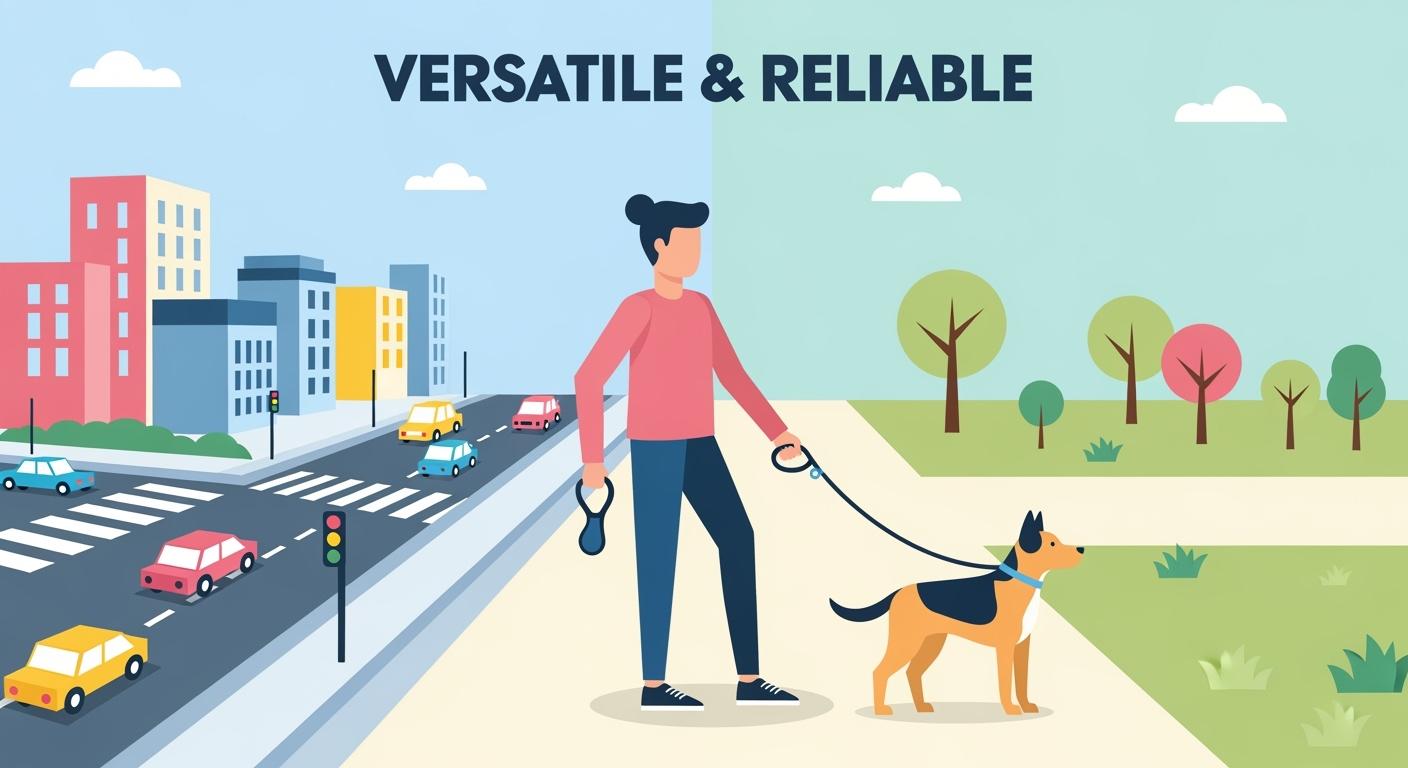
The best dog training leash lets you shorten distance fast, keep slack when possible, and stay composed when the route gets busy.
A leash can feel fine in your hand at home and still become awkward when your dog surges at a curb, stalls at a smell patch, or speeds up near another dog. The better choice is usually the one that matches your route, your timing, and how quickly you need to change distance without turning the walk into a constant grip adjustment.
Note: This is a guide to leash choice and handling flow, not a diagnosis of pulling, fear, pain, or aggression.
Key Takeaways
- A standard leash usually feels best for calm daily walks when you want simple hand feel and low clutter.
- A two handle leash often works better in tight sidewalks, near curbs, or with dogs that need faster distance changes.
- A long line is usually the better tool for recall practice in open areas, while dogs that pull on leash often need training changes as much as gear changes.
What Usually Works Best on Different Walks
Control quality matters because faster hand changes usually reduce fumbling when the environment changes suddenly. Most owners do not need more hardware all the time. They need the amount of control that matches the route they actually walk.
Standard, two-handle, and long line each do a different job
| Leash Type | Best Use Case | Feel in Use | What to Watch |
|---|---|---|---|
| Standard leash | Calm daily walks | Simple, low clutter, steady grip | Slower close control in sudden traffic |
| Two handle leash | Busy sidewalks, curb work, passing people | Faster distance change, clearer close handling | Extra handle can feel crowded in calm routes |
| Long line | Recall practice in open space | More range, softer distance work | Poor fit for crowded or narrow routes |
| Double leash | Two dog management | Shared control for paired walks | Not useful for one dog training |
A standard leash usually works best when your dog can stay within a predictable lane and you do not need repeated close grabs. A two handle leash often earns its place when the route keeps forcing quick shortening, especially near curbs, cars, strollers, or narrow pass-through points.
The route usually decides more than the product label
| Route Type | Usually Best Choice | Why it Helps | What to Watch |
|---|---|---|---|
| Quiet neighborhood | Standard leash | Easy rhythm, relaxed hand feel | May feel slow if triggers appear suddenly |
| Busy sidewalk | Two handle leash | Quick grab near your side | Can encourage over handling if used constantly |
| Open field or training space | Long line | Distance for recall and check ins | Needs space and active line management |
| Mixed route with variable traffic | Two handle leash | Better transition between loose and short work | Choose only if you really use both positions |
If your walks are calm most of the time, a standard leash usually remains the cleaner choice. If the route keeps asking for rapid shortening, a two handle leash often feels more repeatable than trying to gather extra line by hand. The same kind of tradeoff shows up in a hands free leash setup, where convenience and quick control also keep competing with each other.
Tip: If you keep grabbing the middle of a standard leash to get through people, your route is usually telling you that a traffic handle could help.
What to Check Once the Walk Starts
Handler timing matters because late hand changes often create tension first and guidance second. The best dog training leash is usually the one you can shorten, release, and reset without wrapping line around your hand or fighting the hardware every few minutes.
These four checks matter more than most feature lists
| Check Item | Pass Signal | Fail Signal | Improvement Plan |
|---|---|---|---|
| Leash shortening speed | One smooth grab, no line wrapping | Fumbling, twisting, delayed shortening | Try a traffic handle or shorter working length |
| Slack recovery | Slack returns after turns and stops | Constant tension after each change | Lower distraction level and reward sooner |
| Hand comfort | Grip stays relaxed for full walk | Forearm fatigue, finger pinch, grip shifting | Use simpler hardware or adjust handle style |
| Close control | Dog can move beside you briefly when needed | Dog swings wide or surges at your knee | Practice short close segments before busy routes |
If you pass most of these checks with a standard leash, you usually do not need more features. If you repeatedly fail shortening speed or close control in real traffic, a two handle leash often becomes the more practical tool.
The dog in front of you changes the answer
Dogs that forge ahead often make leash length feel like the problem when timing is the real issue. Dogs that hesitate or scan often need more distance from triggers, not more restraint.
A fast, social dog in city traffic often benefits from shorter control options, while a thoughtful dog in a quiet area may do better with a plain leash and cleaner reinforcement timing. The same route-based difference shows up in leash length for crowded vs open areas, where the leash stops being a simple size choice and starts acting more like a handling tool.
Try the leash across several normal walks
Testing matters because a leash that feels good in a store or at home may behave differently once timing, speed, and distractions show up. Run the same short protocol before deciding that one leash style is truly better.
- Quiet start test: Use a calm indoor space, yard, or quiet path for one short session. Watch shortening speed, clip twist, and whether your hand stays relaxed during one stop, one turn, and one close-in moment.
- Loaded walk test: Repeat the walk on two separate neighborhood routes with normal distractions such as curbs, parked cars, and passing people. Watch whether leash slack returns after each trigger and whether reward timing still feels clear.
- Real session test: Use the leash on your usual route across three walks on three different days. Watch whether the setup still feels clear at the end of the walk, not only during the first few minutes.
Most dogs and handlers show the real answer only after repeated sessions. If the leash starts to feel worse as the walk gets longer, that usually matters more than a strong first impression.
Keep a short record before you switch styles
Record for three walks before changing leash style: route type, shortening speed, slack recovery, trigger recovery, and hand comfort.
| Route Type | Shortening Speed | Slack Recovery | Trigger Recovery | Hand Comfort |
|---|---|---|---|---|
| Quiet, mixed, or busy | Fast, fair, or slow | Usually returns, delayed, or absent | Quick, moderate, or prolonged | Easy, tiring, or awkward |
| Quiet, mixed, or busy | Fast, fair, or slow | Usually returns, delayed, or absent | Quick, moderate, or prolonged | Easy, tiring, or awkward |
| Quiet, mixed, or busy | Fast, fair, or slow | Usually returns, delayed, or absent | Quick, moderate, or prolonged | Easy, tiring, or awkward |
When the Leash Is the Problem, and When It Isn’t
Early warning signs matter because awkward handling usually shows up before a full loss of control. Slow grab access, tangled slack, and repeated grip shifting often mean the leash is asking too much of your hands for that route.
Behavior signs matter too. If your dog starts scanning hard, surging to the end of the line, ignoring known cues, or struggling to take food, the environment may already be beyond what the current setup can support well.
Common failure signs and what they usually mean
| Problem | Likely Cause | Quick Check | What to Watch |
|---|---|---|---|
| Tangled slack | Too much line for the route | Count how often you gather line by hand | Usually improves with shorter working distance |
| Slow close control | No fast grab point | Test one curb stop and one pass by | Two handle styles often help here |
| Constant pulling | Trigger load or unclear reinforcement | Watch whether the dog can still take food | Gear alone rarely solves this pattern |
| Handler hand fatigue | Grip shape or hardware clutter | Notice finger tension by mid walk | Simpler setups often work better |
If your dog needs stronger close control only in narrow or crowded spots, a two handle leash often makes sense. If every walk feels tense regardless of leash type, the real issue is usually training pace, route difficulty, or trigger distance.
The common mistake is blaming the leash for everything
Many owners buy more control features when the real problem is that the route is too hard for the current skill level. Others use long lines in busy areas, which usually turns extra distance into delayed handling.
Another common mistake is rewarding too late, after the dog has already leaned into pressure or passed the trigger. That makes the leash feel less effective even when the hardware itself is fine.
Tip: The most common mistake is choosing more hardware when the real fix is usually earlier rewards, more distance, and a route your dog can actually handle.
Disclaimer: A leash can improve handling, but it is not a treatment for pain, panic, or serious behavior problems.
What Makes a Leash Worth Keeping
A leash is worth keeping when it still feels clear on ordinary days, not only on ideal ones. For many owners, the best dog training leash is the one that creates consistent slack, fast shortening when needed, and low hand fatigue by the end of a normal walk.
If you are still deciding between simple daily formats, the difference often becomes clearer when you compare a fixed length leash against other everyday options. And if you are narrowing down the basic everyday choices, the broader dog leash range usually makes more sense once you already know whether your real problem is hand clutter, shortening speed, or route pressure.
| Walk Pattern | Usually Better Setup | Why it Matters | Main Limitation |
|---|---|---|---|
| Calm daily route | Standard leash | Cleaner hand feel, fewer decisions | Less immediate close control |
| Busy mixed route | Two handle leash | Faster curb and pass by handling | May feel unnecessary in quiet areas |
| Recall practice | Long line | Distance for check ins and returns | Not suited to crowded paths |
| Frequent pulling episodes | Leash plus training plan | Usually improves clarity and timing | Needs consistent practice, not gear alone |
If your dog regularly surges toward triggers, the same close-control questions usually become more obvious in a best leash for a pulling dog comparison. And if your route is dark, rainy, or traffic heavy, visibility may end up mattering more than another handle, which is where a reflective dog leash starts changing the answer.
FAQ
How do you clean a dog training leash?
Use mild soap, rinse well, and let it air dry fully before the next walk.
Can you use a two handle leash for puppies?
Yes, a two handle leash can work for puppies when the route is busy and the added handle does not create hand clutter.
What leash length usually works best for recall practice?
A long line usually works best for recall practice when you have enough open space to manage the extra line safely.
The right answer is usually the leash that fits your real route, your dog’s current skill, and your own timing under pressure. More control is not automatically better. Better match is better.
- Keep the setup simple when the route is simple.
- Choose faster shortening only when the route truly demands it.
- Test across several walks before deciding a leash is the right long-term choice.
Disclaimer: This guide helps you choose a leash, not diagnose why a dog is struggling on leash or decide when medical or behavior treatment is needed.






