
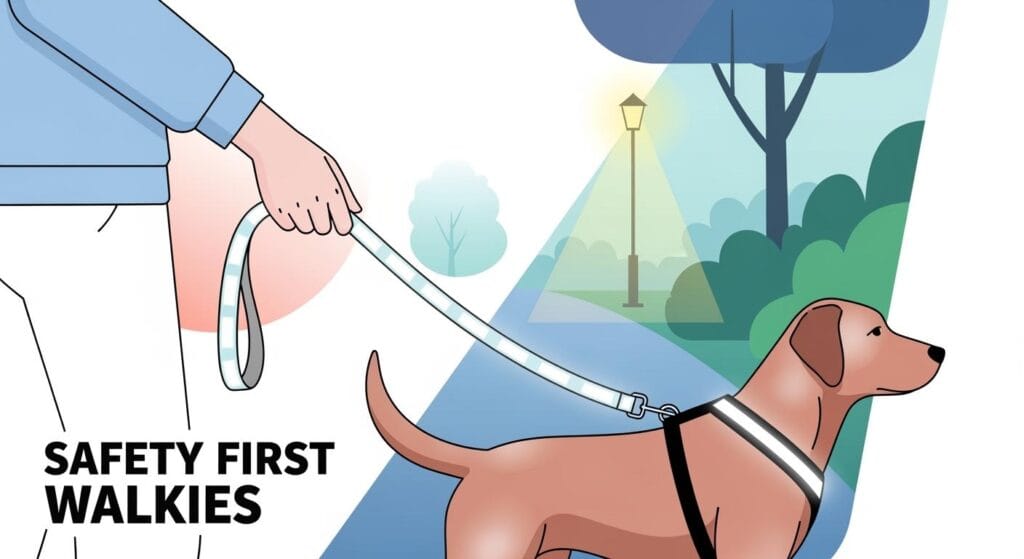
A reflective dog leash is not safer just because it looks bright in a product photo. In real walks, visibility depends on outside light, reflective placement, leash length, handle grip, clip reliability, and whether the route needs active lighting too.
For retailers, distributors, and pet brands comparing a dog leash line, the useful question is not only whether the leash has reflective material. The better question is where the product may fail during ordinary evening walks: poor side visibility, a slick handle, weak stitching near the clip, too much slack near traffic, or reflective trim that loses effect when dirty.
Where a reflective dog leash actually helps
A reflective leash works best when light can reach it from cars, bikes, porch lights, streetlights, or a handheld light. In those conditions, the line between the handler and dog is easier to read, so the leash can help other people understand the dog’s position sooner.
That does not mean reflective trim solves every night-walk problem. If the route is a dark trail, a poorly lit park edge, a rainy street, or a long block with no headlights or streetlights, reflective material may do very little. The product can still be useful, but it should not be presented as a full night-safety solution by itself.
- Best fit for reflective-only designs: dusk walks, low-light sidewalks, and routes where outside light regularly reaches the leash.
- Better fit for reflective plus active light: changing routes where some blocks are lit and others are dark.
- High-risk use case: very dark paths, heavy rain, fog, or traffic areas where the handler also needs shorter control.
Product details that decide whether buyers trust it
Reflective trim may win the first glance, but daily handling decides whether the leash feels reliable. A leash can be visible and still feel poor if the handle slips, the clip sticks, the stitching bunches near the hardware, or the leash is too long for close passing.
For B2B selection, the strongest reflective leash is usually the one that balances visibility with control. The leash should catch light from useful angles, stay comfortable in wet or cold hands, and hold up after normal dirt, pulling, wiping, and repeated clipping.
- Reflective placement: check whether the visible zones run along enough of the leash to catch light from different angles, not only from one narrow strip.
- Handle control: the grip should still feel secure when hands are wet, cold, or moving quickly.
- Clip action: the clip should open and close smoothly without sticking, wobbling, or feeling loose under repeat use.
- Stitching near stress points: weak seams around the clip, handle, and reflective overlay are more important than a bright surface photo.
- Length choice: busy roads and tight passing spaces usually need shorter control than open fields or casual paths.
If the real issue is pulling, body control, or sudden direction changes, the leash is only one part of the walking system. A dog training harness guide helps separate leash problems from harness fit and control problems.
Use-case checks before adding it to a leash line
Before treating reflective leash as a simple product upgrade, match the design to the route and user behavior. A city buyer may care about close control near crossings. An outdoor buyer may care more about dirt, moisture, and mixed lighting. A training-focused buyer may care about grip, clip strength, and how quickly the handler can shorten the leash.
This is where the product page, packaging copy, and customer instructions should avoid overpromising. Reflective material helps when light reaches it. It does not replace a flashlight, headlamp, clip-on light, or better route control when the walking environment stays dark.
- Check whether the leash remains easy to shorten before crossings, bikes, and tight passing spaces.
- Make sure dirt can be wiped from reflective zones without damaging the material.
- Avoid overly heavy reflective overlays that make the leash stiff, twisted, or awkward to fold.
- Pair reflective leash with active light when the route has long dark stretches.
- Review the full walking and training setup when visibility, pulling, and close control all matter at the same time.
FAQ
Does a reflective dog leash work in total darkness?
No. Reflective material needs outside light such as headlights, streetlights, a flashlight, or another light source. Without light reaching the leash, the reflective area has very limited value.
Is a reflective leash enough for night walks?
Only on routes where light already reaches the leash. For darker routes, reflective trim should be paired with active light and closer route control.
What leash length is safer for low-light walking?
Shorter control is usually safer near roads, crossings, bikes, and crowded paths because it reduces slack and helps the handler bring the dog closer before passing.
When should a reflective leash be replaced?
Replace it when the clip sticks, stitching loosens, the handle feels unsafe, the webbing is damaged, or the reflective sections stay dull even after cleaning.
Should a reflective leash be paired with a collar or a harness?
A harness is often the better match when the buyer needs steadier control, lower neck pressure, or better handling during close passing and quick corrections.






