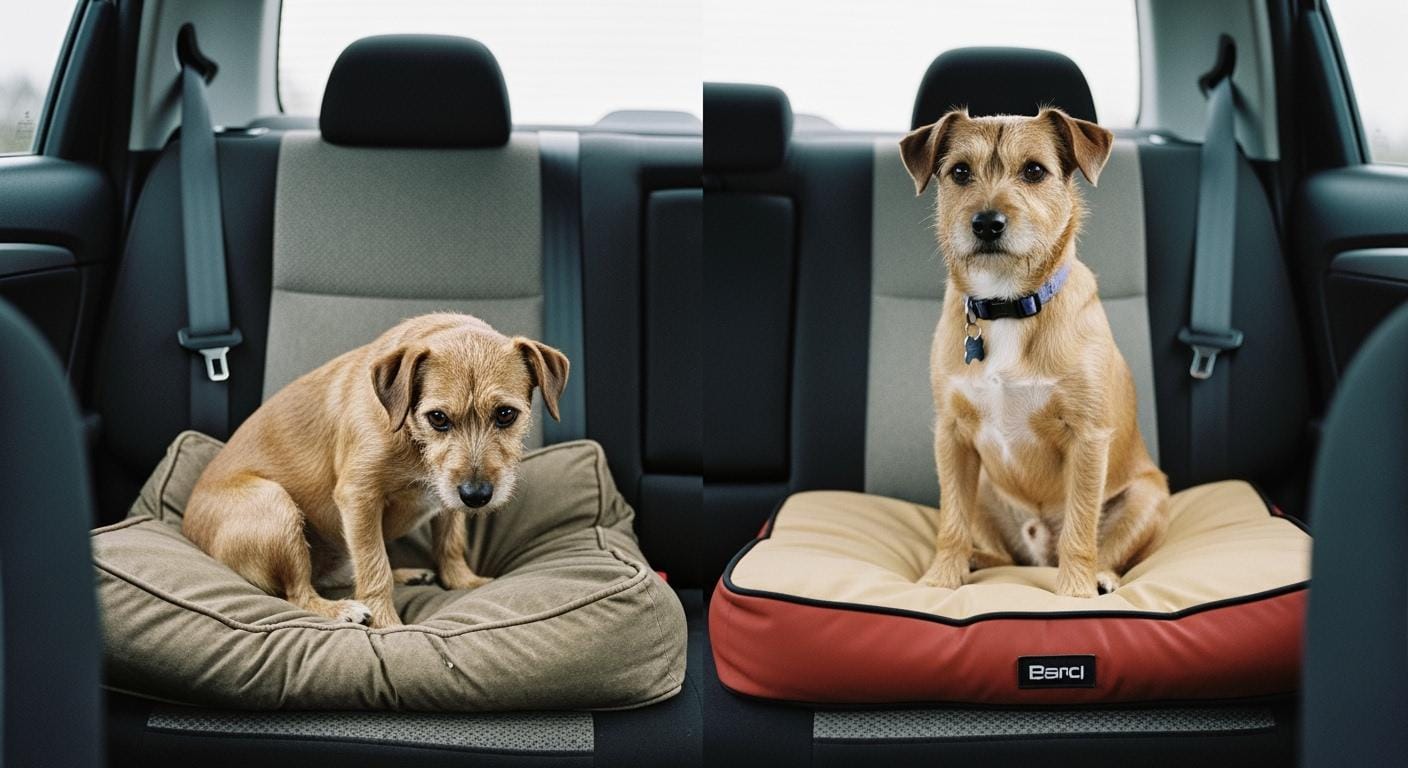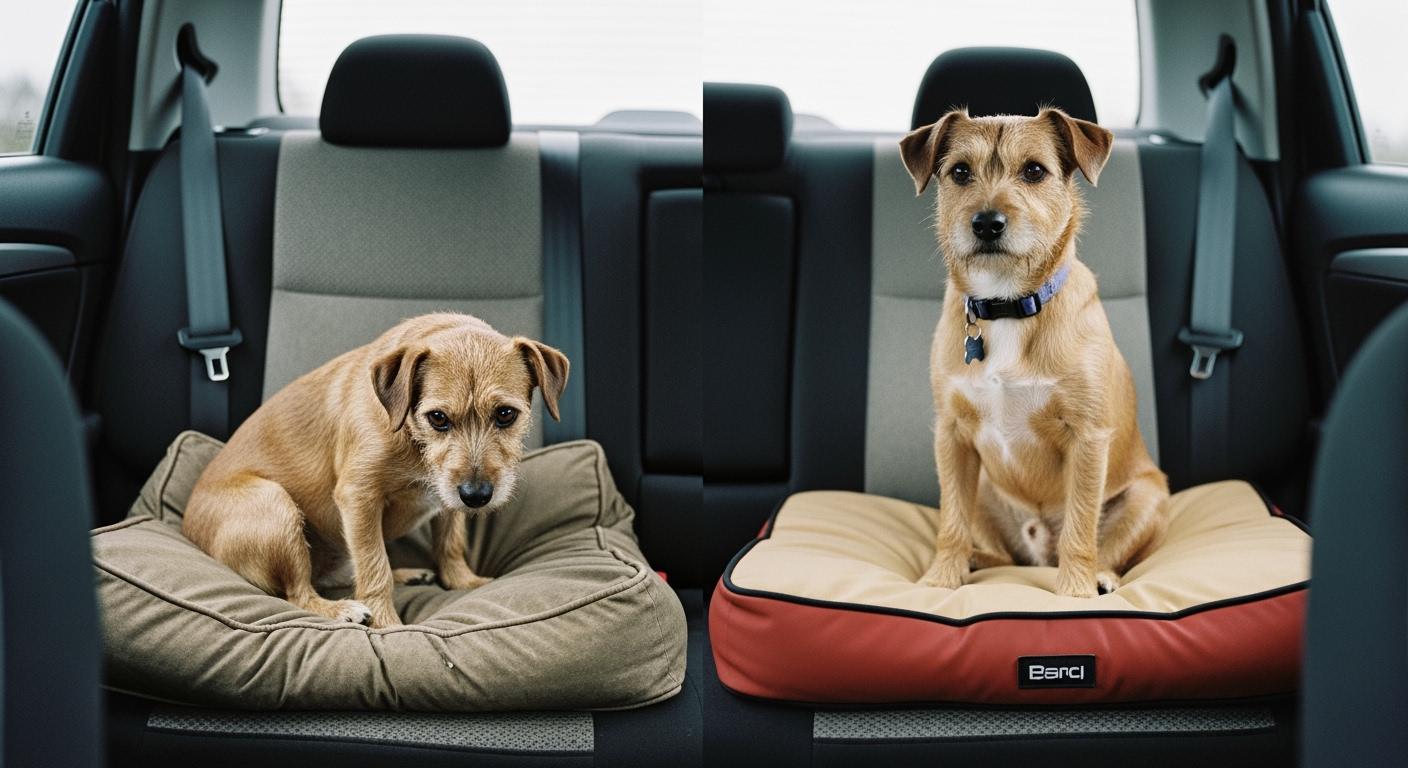
A dog car seat cushion that flattens after repeated trips is not a mystery — it is a material failure pattern with a clear cause. Soft, low-density foam compresses under the dog’s weight, individual cell walls buckle, and the structure never fully rebounds. Each trip adds another compression cycle. After enough cycles, the cushion stays thin. The design question is not whether a cushion feels plush on day one. It is whether the foam density, base structure, and edge reinforcement can recover after the 50th trip the same way they did after the first.
Most cushions marketed as “thick” or “soft” fail precisely because those qualities work against long-term shape retention. Thickness without density is just more material to collapse. Softness without a rigid base is just faster sag. The features that prevent a seat cover from going flat after daily drives are structural, not superficial.
Why Dog Car Seat Cushion Flattening After Repeated Trips Happens
Repeated Pressure and the Compression Cycle
Each time a dog jumps into the back seat, the cushion undergoes a full compression cycle. Body weight presses the foam down. Cells collapse. When the dog exits, the foam should rebound. But every cycle leaves behind micro-damage — a few cell walls that did not spring back, a fraction of a millimeter of permanent set. Multiply that by dozens or hundreds of trips, and the cumulative loss of rebound becomes visible as a flattened cushion.
The mechanism accelerates geometrically, not linearly. Here is the causal chain: as the center loses height, the dog sits lower in the seat. More of the dog’s body surface contacts the cushion. That wider contact patch redistributes pressure toward the edges and bolsters — areas never designed to bear concentrated load. The edges, now overloaded, collapse faster. The entire cushion degrades in a cascade, not a gradual fade.
Soft, open-cell foam is the worst offender. Its cell structure has large voids and thin walls. Under repeated loading, walls buckle and cells merge, permanently reducing the foam’s ability to push back. Higher-density foam with smaller, thicker-walled cells survives far more cycles before permanent set becomes noticeable. This is not about comfort preference — it is about whether the material’s internal architecture can survive repeated use without structural collapse.
Material Fatigue Beyond the Foam
The foam is not the only component that fatigues. Fabric covers stretch under repeated tension, losing their ability to hold the filling in place. Stitching at seam junctions absorbs shear forces every time the dog shifts weight during a turn or braking. Thread tension that was uniform on day one develops slack in high-stress zones. Loose stuffing materials — common in budget cushions — migrate away from pressure points, leaving voids the cover cannot hide.
After a 30-minute drive, press your palm into the center of the cushion for 5 seconds and release. If the indent stays visible for more than 3 seconds, the foam has already lost meaningful rebound capacity. That is an early warning — the cushion is degrading faster than it should.
Tip: Rotate the cushion front-to-back every two weeks. This shifts the primary compression zone and slows the rate at which any single area accumulates permanent set. It does not fix a cushion with inadequate foam density, but it extends the useful life of a well-built one.
Uneven Weight Distribution and Wear Patterns
A dog’s weight does not spread evenly across the seat. The hips and shoulders create concentrated pressure points. The center bears the most load during straight-line driving. During turns, lateral forces shift weight toward one bolster. During braking, the front edge takes a surge of pressure. These patterns create predictable failure zones.
| Flattening Signal | Likely Structure Problem | Better Design Direction |
|---|---|---|
| Thinning cushion center | Low-density foam with insufficient rebound | Firmer foam, layered density panels |
| Sagging base | No rigid foundation layer beneath foam | Hard-bottom panel or reinforced base board |
| Collapsing side bolsters | Filling migration, weak seam reinforcement | Reinforced edges, compartmentalized filling |
You can verify uneven wear yourself. After a trip, place a yardstick or level across the cushion from bolster to bolster. If the center dips more than half an inch below the straight edge, the base support has compressed beyond the point where the cushion can distribute your dog’s weight evenly. The seat is now concentrating pressure rather than spreading it — the opposite of what a supportive design should do.
Where Soft Cushions and Seat Covers Lose Structure First
Thinning Cushion Center
The center fails first because it accumulates the most compression cycles. A dog that settles in the same position every trip — common with a back seat cover with structured support — creates a defined wear zone. Soft foam in this zone loses height incrementally, and the thinning is often invisible until the dog’s posture changes: sitting lower, shifting more often, or refusing to settle.
Sagging Base and Structural Weakness
A weak base dooms the entire cushion regardless of how good the top foam is. When the foundation layer flexes under load, the foam above it has nowhere to push back from. The cushion sinks as a unit. Fabric pools in the middle. The cover no longer stays in position against the seat upholstery, which means it stops protecting the car interior — the very reason for using a car seat cover for interior protection in the first place.
Hard-bottom designs solve this by giving the foam a rigid platform to work against. The dog’s weight transfers through the foam into the base panel, which spreads it across the seat surface. The foam compresses but rebounds because the base does not flex. Without that rigid layer, the entire assembly behaves like a spring with no fixed end — it compresses and stays compressed.
Collapsing Side Bolsters
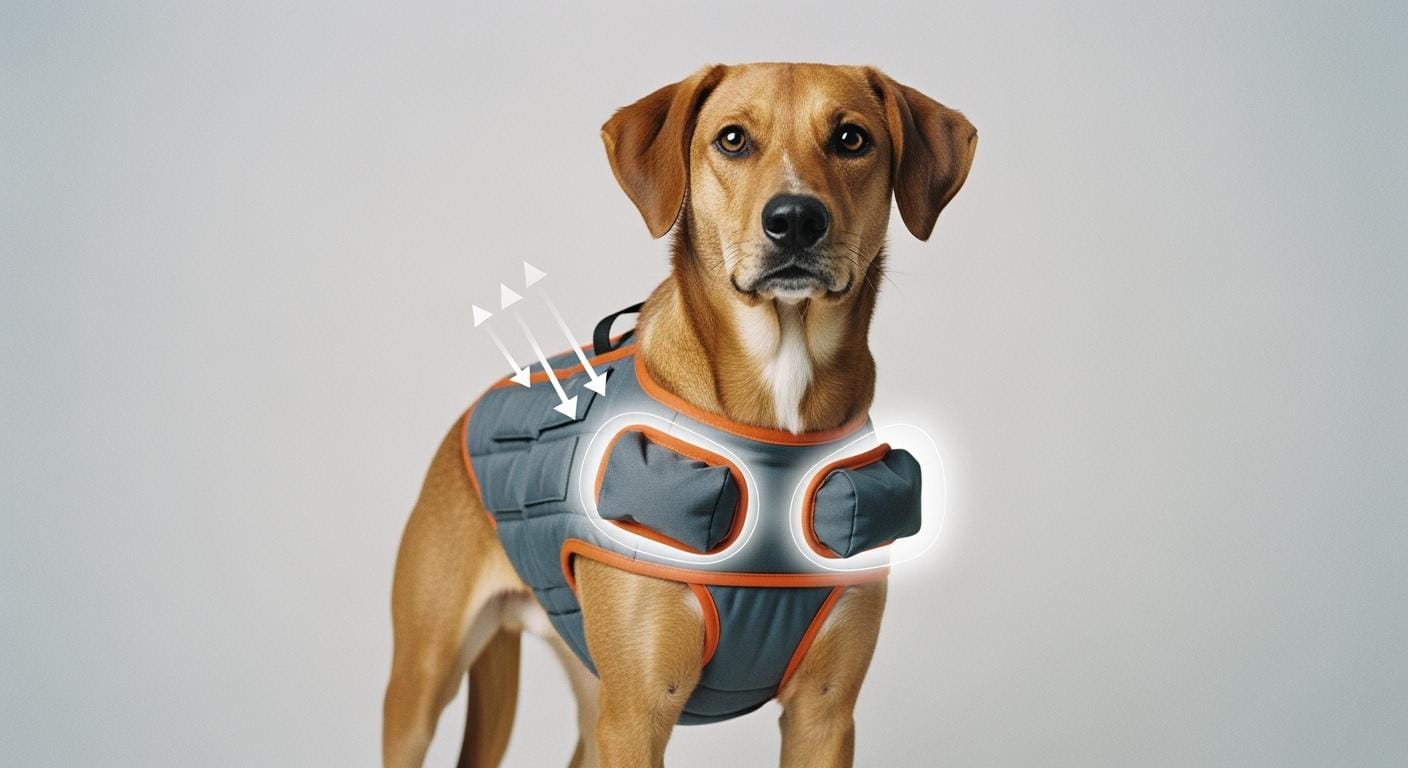
Side bolsters provide lateral boundary — they tell the dog where the seat ends. When filling shifts or seams stretch, bolsters fold outward or flatten. A dog that previously stayed centered begins sliding toward the door panel during turns. The problem is not just comfort; it is that the seat stops doing its job of keeping the dog in a predictable position.
Reinforced bolsters with compartmentalized filling — separate chambers that prevent material from migrating — hold their shape far longer than single-cavity designs where stuffing can drift to the corners. Combined with anchoring features that keep the cover stable, this keeps the dog centered and the cushion symmetrical.
Folding Front Edge and Filling Shift
The front edge takes abuse from entry and exit — claws, body weight concentrated on a narrow lip, repeated step-on pressure. Without reinforcement, it curls downward. The dog then steps onto a sloped surface, which makes entry harder and accelerates edge degradation. Quilted or compartmentalized panel construction prevents filling from migrating away from the edge zone. Each chamber holds its material in place independently, so a shift in one section does not cascade into the neighboring sections.
Note: A cover that looks intact on the outside can hide failed internals. Press across the surface systematically — firm everywhere means the internal structure is holding. Soft spots or voids under a smooth cover mean the filling or foam has collapsed while the fabric survived. The cover cannot compensate for what the core has lost.
Design Features That Resist Compression Over Repeated Trips
Firmer Foam Density Resists Compression Cycles
Foam density — the mass of material per unit volume — is the single strongest predictor of how many compression cycles a cushion survives before permanent set becomes visible. Higher-density foam packs more polymer into the same space. More cell walls per cubic inch means more structural members sharing the load. When one cell wall buckles, adjacent walls carry the stress without the whole structure collapsing.
This is a production-level decision that separates durable cushions from disposable ones. Low-density foam costs less per board-foot, cuts faster, and ships lighter — all attractive at the manufacturing level. But its cycle life is a fraction of high-density alternatives. The tradeoff is invisible at purchase and undeniable after 30 trips.
| Property | Why It Matters for Repeated Trips |
|---|---|
| Foam Density | Higher density = more cell walls per cubic inch = more load-sharing members that delay permanent set across hundreds of compression cycles |
| Firmness (ILD) | Firmer foam requires more force to compress to the same depth. Under a dog’s weight, this means less total deflection and less cell-wall strain per cycle |
Rigid Base Support Prevents Cushion Sinking
A rigid base gives the foam a fixed surface to rebound from. Without it, the entire assembly — foam, cover, filling — flexes as one unit into the contour of the car seat. Each flex cycle strains not just the foam but the seams connecting panels. Over time, the whole cover drifts out of position.
Hard-bottom designs reverse the load path: the dog’s weight travels through the foam, hits the rigid panel, and spreads across the car seat surface. The foam compresses within its elastic range and recovers. The base does not deflect. The cover stays flat and positioned. This is why hard-bottom seat covers tend to outlast their soft-bottom counterparts — the foundation removes flex as a failure mode entirely.
Reinforced Edges, Structured Panels, and Removable Inserts
Reinforced edges prevent the most common early failure: seam separation at the bolster junction. When a dog’s weight presses one panel down while the adjacent panel stays supported by the seat contour, the stitch line between them experiences a shear force. Higher stitch density and stronger thread resist this repeated shear. Overlapping panel folds distribute the stress across a wider area rather than concentrating it on a single stitch line — a production detail that is invisible in product photos but obvious after months of use.
Structured multi-layer panels go further. Each layer serves a distinct mechanical function: a wear-resistant surface layer, a comfort-distribution middle layer, and a structural base layer that prevents bottoming out. This is the same principle behind material selection for car travel gear that holds up over time — let each material do what it is best at rather than asking one foam to solve every problem.
Removable inserts add a maintenance path that fixed-fill cushions lack. When an insert begins to thin, it can be replaced without discarding the entire cover. You spot wear early — pull the insert, press it flat, check for thin zones — before the cushion visibly sags.
In practice: The difference between a cushion that lasts three months and one that lasts three years is rarely visible in a product listing. It is in the foam density specification, the base panel rigidity, and the seam reinforcement — decisions made at the factory, not the showroom floor.
When a Structured Cushion Is Not the Right Choice
A firmer, more structured cushion is not always the better option. Dogs with pronounced joint sensitivity — particularly older dogs with arthritis in the hips or elbows — may find a rigid base uncomfortable on long drives, even if it holds shape longer. The same hard-bottom panel that prevents sag can create pressure points against bony prominences in lean, short-coated breeds like Greyhounds or Vizslas.
Similarly, a cushion designed with high-density foam and reinforced bolsters adds weight and bulk. In a compact car where rear seat space is already tight, a thick structured cover may reduce the usable seating area enough that a larger dog cannot turn around comfortably. The tradeoff between structural durability and spatial fit is real and worth measuring before committing.
Disclaimer: The compression checks described above — palm-press rebound timing and the straight-edge gap measurement — assume a smooth-coated dog whose weight is distributed typically across the cushion surface. Double-coated breeds may show subtler wear patterns that require hand-checking rather than visual inspection, since thick fur masks the early signs of cushion thinning. If the dog has a known joint condition, prioritize veterinary guidance on support surfaces over structural durability comparisons.
FAQ
How can you tell if a cushion is losing support before it looks flat?
Press into the center with firm palm pressure for 5 seconds. If the indent remains visible longer than 3 seconds after you lift your hand, the foam’s rebound capacity is declining. Also check the dog’s behavior: a dog that previously settled quickly but now circles and repositions multiple times is reacting to uneven support the eyes cannot see.
Does a thicker cushion resist flattening better?
Not on its own. Thickness without sufficient density is just more material to collapse. A thin, high-density foam panel often outlasts a thick, low-density one because the structural integrity of the cell walls matters more than how many layers of them are stacked.
What is the most overlooked feature that prevents sagging?
The base layer. Most attention goes to the visible top surface, but a rigid base panel — whether hard plastic, reinforced board, or dense structural foam — prevents the entire assembly from flexing into the car seat contour. Without it, even good top foam eventually follows the seat’s curve and loses flat support.
Can a flattened cushion be restored?
If the insert is removable, replacing it with a higher-density insert can restore support. For fixed-fill cushions, rotating front-to-back may buy time by shifting the primary wear zone, but foam that has taken a permanent set cannot be un-set. At that point the structural damage is irreversible — the cell walls have buckled and merged, and no amount of fluffing rebuilds them.