
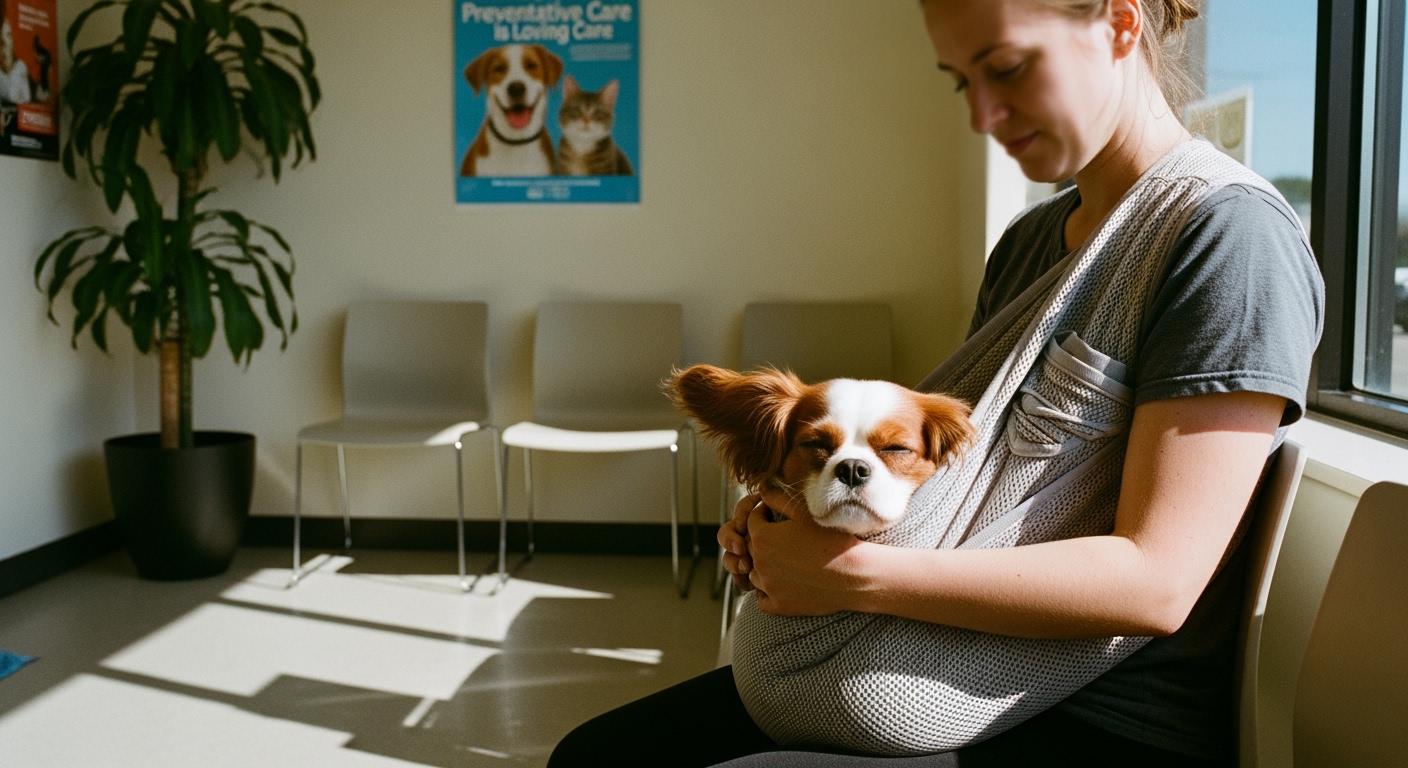
A dog sling carrier for summer vet visits turns a short parking-lot walk into a heat-management problem. The carrier presses the dog against your torso. Your body radiates at roughly 91°F at the skin surface. On an 85°F day, the gap between your chest and the carrier fabric becomes a microclimate with almost no air exchange. Within ten minutes, that pocket can rise well above the ambient temperature. Add direct sun on the walk from the car, and the dog inside is working against three heat sources at once: your body, the outdoor air, and radiant heat absorbed by the carrier fabric itself.
That is the central physics problem every sling carrier design either solves or ignores. The question is not whether a sling keeps a dog close—all of them do. The question is which design choices let heat escape rather than accumulate, and which ones turn a short vet trip into an overheating risk.
Why Close-Body Carry Heats Up Fast During Summer Vet Visits
Body Heat and Summer Temperatures Compound
The carrier fabric sits between two warm surfaces: your torso on one side, the dog on the other. Heat flows from warmer to cooler, so your body heat moves into the dog’s space while the dog’s own body heat has nowhere to go. The fabric itself acts as a thermal buffer—thin cotton dissipates some of this, but dense padding or multi-layer construction stores it. That stored heat radiates back into the carrier cavity on both sides.
In a parked car with windows cracked, the problem tightens. Cabin air is already warm and moving slowly. The carrier interior, with restricted air exchange, lags behind ambient cooling even after you step outside. A sling carrier with mesh on only one side still relies on passive diffusion through a single opening—warm air rises, but without a cross-path for cooler air to enter, the exchange stalls.
Tip: After a five-minute walk in warm weather, slip your hand inside the carrier and press the inner lining against your wrist. If the fabric feels warmer than the back of your other hand in open air, the carrier is trapping more heat than it is releasing.
Here is how common summer vet-visit problems map to carrier design choices:
| Summer vet-visit problem | Why the carrier fails | Better design direction |
|---|---|---|
| Body heat + outdoor warmth combine | Thick fabric stores and re-radiates heat | Mesh panels, lighter single-layer fabric |
| Poor airflow in car or waiting room | Closed sides block cross-ventilation | Openings on opposing sides |
| Hard to monitor the dog | Deep pocket, narrow opening | Wide top access |
Nervous Movement Raises Heat Faster
An anxious dog shifts and readjusts inside the carrier. Each movement compresses the fabric, reducing the already-thin air layer between the dog’s coat and the carrier wall. This matters because that air layer is the primary medium for convective cooling. When the dog sinks into a soft, unsupported base, the fabric wraps around more of the body surface, increasing contact area and conductive heat transfer from your torso into the dog’s side. A structured base that resists sagging keeps a small air channel open beneath the dog, preserving what little convective cooling is available in a close-carry setup.
Where Thick or Poorly Ventilated Sling Carriers Fail First
Heavy Fabrics Trap Warmth
Thick sling carriers feel substantial in the hand, but that density works against the dog in summer. Heavy woven fabrics and multi-layer padded shells absorb body heat from both sides and release it slowly. The result is a carrier interior that stays warm even after you move from a hot parking lot into an air-conditioned clinic. A dog already stressed by the vet visit now has to thermoregulate inside a fabric pocket that resists cooling down.
Closed Sides and Single-Panel Mesh Limit Ventilation
Mesh on one side is better than none. But airflow physics favor a pressure differential: air enters where pressure is higher and exits where it is lower. With mesh on only one side, there is no defined exit path. The carrier becomes a dead-end cavity. Warm, humid air from the dog’s breathing and panting accumulates near the top of the carrier, and with no opposing opening, it cycles rather than flushes out. A panel of mesh on each side creates a cross-path—even a modest one—that turns passive diffusion into directed air exchange.
| Design weakness | How it fails in summer conditions |
|---|---|
| Closed sides, no opposing mesh | No cross-ventilation path; warm air recirculates inside the cavity |
| Soft, collapsible base | Sags under the dog’s weight, sealing off the bottom air channel and increasing body-contact surface area |
| Snug, unadjustable fit | Restricts the dog’s ability to shift away from your body heat; any air gap collapses under tension |
Deep Pockets Maximize Body Contact
A deep-pocket sling wraps the dog on three sides and presses the inner flank against your body. That maximizes the surface area where conductive heat transfer occurs. The physics is straightforward: more square inches of contact between your torso and the dog’s body equals more watts of heat moving into the dog. A shallower pocket with a structured floor reduces that contact area and leaves the dog’s upper body exposed to whatever airflow is available.
Unstable Base Causes Shifting and Hot Spots
When the carrier floor sags, the dog’s weight concentrates into a single depression. Fabric bunches under the chest and hips, creating localized pressure points. These are hot spots not in the thermal sense alone—they are points where the carrier lining is pressed flush against the dog’s coat with zero air gap, eliminating even the thin convective boundary layer that skin relies on for cooling. Longer-bodied breeds feel this more because their weight spans a greater area, increasing the total sag depth.
Shoulder Strap Discomfort During Waits
A narrow, unpadded strap concentrates the combined weight of the dog and carrier onto a strip of fabric perhaps an inch wide. Over a twenty-minute wait in the clinic, that pressure digs into the soft tissue above the collarbone. You adjust. The carrier shifts. The dog shifts in response. Each adjustment compresses and releases the carrier interior, pumping warm air against the dog’s body like a bellows. A wide, padded strap that stays put avoids this cycle.
In practice: After carrying for 20 minutes, check whether the strap has wandered toward your neck or slipped toward the edge of your shoulder. Either movement means the strap width or adjustability is not matching your body geometry, and the resulting micro-adjustments unsettle the dog inside.
What Sling Carrier Design Works Better for Hot-Weather Short Trips

Mesh on Two Sides for Cross-Ventilation
Air moves from higher pressure to lower pressure. A carrier with mesh panels on opposing sides creates exactly that path. As the dog breathes and shifts, small pressure differentials push stale air out one side and draw fresh air in through the other. The temperature inside the carrier tracks closer to the room or outdoor ambient temperature rather than climbing above it. If the air inside feels noticeably warmer than the air outside the carrier, the ventilation path is too restricted or absent on one side.
Lighter Fabrics for Less Heat Storage
Fabric weight matters for heat retention in the same way pan thickness matters on a stove: a heavy cast-iron pan holds heat long after the burner is off, while a thin aluminum pan cools almost immediately. A lightweight, single-layer carrier body stores less thermal energy. When you step from a hot parking lot into an air-conditioned waiting room, the carrier temperature drops faster. The dog is not sitting inside a thermal battery that stays warm for minutes after the environment changed.
Stable, Rigid Base for Even Weight Distribution
A base that does not sag under the dog’s weight preserves the small air channel beneath the body. This matters because dogs dissipate a meaningful portion of heat through their underside, where fur is typically thinner. When a soft floor collapses, it seals that surface against warm fabric. A structured base—whether a stiffened insert or tensioned panel—keeps the dog supported without wrapping fabric around the belly and groin, where heat loss is most needed. The difference between a sagging carrier floor and a rigid one is the difference between a dog that settles still and one that keeps shifting to escape trapped warmth.
Secure but Not Tight Close-Carry Shape
A sling should hold the dog without compressing. Compression reduces the air gaps that convective cooling depends on. A carrier shaped to cup the dog’s weight from below, rather than wrap tightly from the sides, supports without sealing off ventilation. The dog stays upright and balanced, which also reduces anxious shifting—fewer movements means fewer fabric-compression cycles that pump warm air against the body.
Easy Top Access for Quick Checks
An open-top or wide-opening design lets you glance down and see your dog’s face, breathing rate, and posture without adjusting the carrier. In a crowded waiting room, the difference between a quick glance and having to unzip a narrow opening is the difference between catching early panting and missing it until the dog is visibly distressed.
Adjustable Padded Straps and Washable Lining
A strap that adjusts for torso length and shoulder slope stays put. It does not migrate, slide, or need re-adjusting every few minutes. Wide padding spreads the load across more square inches of shoulder surface, reducing the pressure that makes you unconsciously shift your posture. A stable carrier fit is not just about your comfort—every time you readjust, the dog inside feels the movement and often responds with its own position shift, restarting the heat-pump cycle. A washable lining handles the sweat, shed fur, and clinic-floor dust that accumulate over a summer of short trips, keeping the carrier interior hygienic between washes.
Here is how design features map to specific summer problems:
| Summer vet-visit problem | Why the carrier fails | Better design direction |
|---|---|---|
| Body heat + outdoor warmth | Thick fabric stores thermal energy | Mesh panels, lighter single-layer fabric |
| Poor airflow in car or waiting room | Closed sides, no cross-path | Mesh on opposing sides |
| Hard to check on the dog | Deep pocket, narrow opening | Wide top access |
| Dog shifts and sinks | Unstable base, soft floor | Structured, rigid base panel |
Disclaimer: Cross-ventilation through mesh panels assumes the dog is a short-coated breed where airflow reaches the skin. Double-coated breeds like Huskies or Malamutes have a dense undercoat that insulates against both cold and moving air; for these dogs, the cooling benefit of mesh panels is reduced, and the primary heat-management check becomes whether the carrier base stays rigid under the dog’s weight rather than collapsing and trapping body heat against the belly. If the dog’s chest shape falls well outside the breed norms this carrier style is patterned for—particularly barrel-chested dogs or those with a very deep keel—fit checks described here may not catch every pressure point.
FAQ
How do mesh panels actually keep a dog cooler during summer vet visits?
Mesh on two opposing sides creates a pressure-differential path. As the dog breathes and shifts, warm air exits one side while cooler ambient air enters the other, preventing the carrier interior from becoming a stagnant heat pocket.
Can a sling carrier work for dogs over 15 pounds in summer?
Carrier weight limits are structural, not thermal. A heavier dog generates more body heat and creates more contact surface area against your torso. If the carrier base sags under that weight, the heat problem compounds. A rigid base and cross-ventilation become more important, not less, as the dog’s weight increases.
What makes a sling carrier comfortable for the person carrying it?
A wide, padded strap that adjusts for torso length prevents the carrier from digging into one spot on the shoulder. When the strap stays put, you stop micro-adjusting, and the dog inside stays calmer.
How do I clean the sling carrier after a hot vet visit?
A removable, machine-washable lining is the most practical feature. Summer trips mean sweat, shed fur, and clinic-floor debris accumulate fast. If the lining is not removable, wiping with a damp cloth after each use keeps bacteria and odor from building up between washes.






