
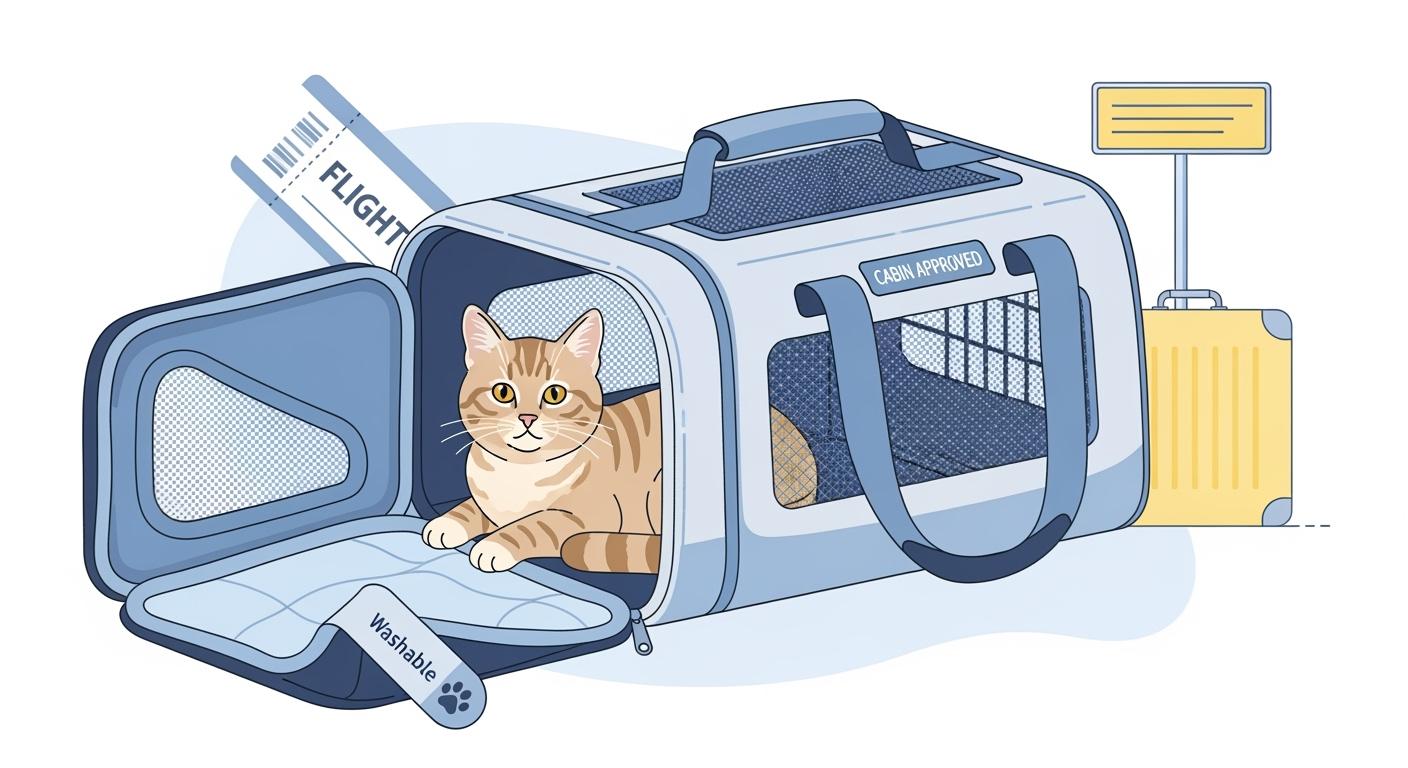
The carrier might meet every airline size restriction on paper. But if the liner cannot come out and get washed between flight legs, a single accident at hour two turns the remaining five hours into a hygiene problem. An airline pet carrier with a washable liner changes that math. The design question is not whether a liner looks soft in product photos. It is whether the liner can be removed, cleaned, and dried before the next stage of travel begins.
Two design features carry most of that load: removability and material absorbency. Together they determine whether a carrier resets fast or stays wet. The rest of this article picks apart where non-washable liners fail, which design details actually solve those problems, and when a washable liner alone is not enough.
Why Fixed Liners Cannot Keep Up During Airline Travel
Trapped Moisture Starts a Chain Reaction That Fixed Padding Cannot Stop
A pet inside a carrier generates moisture continuously. Body heat, breath condensation, drool, and the occasional spill all feed the same cycle. The liner absorbs it. In a carrier with fixed, non-removable padding, that moisture has nowhere to go.
Here is the physical chain that follows: moisture saturates the padding fibers → the carrier interior becomes a sustained-wet microenvironment → bacteria metabolize organic residue from drool, food particles, and urine → odor compounds form within two to four hours. The carrier stays sealed in an under-seat space with limited airflow, so evaporation cannot keep pace. By the time the flight lands, the padding is damp, the smell is set, and there is no way to pull the liner out and dry it.
This sequence is not about pet behavior. It is about material physics. A fixed liner turns a small accident into a persistent condition because the design offers no interruption point. The moisture stays locked in the padding through boarding, takeoff, cruise, and landing.
In practice: Flip the carrier’s bottom pad over and press a dry paper towel against the underside after a flight. If the towel picks up moisture, the liner is not blocking liquid from reaching the carrier base. That dampness is exactly where odor bacteria colonize first.
Seams Collect What Surface Wiping Cannot Reach
Even a liner that looks clean on the surface can hold odor inside its seams. Stitched edges create narrow channels where liquid wicks in through capillary action and stays trapped. Wiping the flat surface does nothing for what has already seeped into the stitch line.
In airline pet carriers, seam contamination matters more than it does in everyday carriers because travel days are long. A carrier gets zipped, handled, slid under a seat, and reopened multiple times. Each handling cycle presses the liner against the carrier walls and shifts any trapped liquid deeper into the seam interior. By the second flight leg, the smell becomes noticeable — and it comes from inside the seam, not from anything on top of the fabric.
Run a finger along the bottom seam after pulling the liner out. If the seam feels damp or carries a sour note, the liner design is not keeping liquid out of the stitch line. That is a material-pathway problem, not a cleaning-frequency problem. Carriers with fully sealed base compartments prevent this by removing the seam from the liquid-contact zone entirely.
Thin Fabric Bottoms Turn Small Spills Into Full-Base Problems
A few milliliters of spilled water — a tipped bowl, damp paws — can spread across an entire carrier floor in seconds when the liner fabric is thin and non-absorbent. Thin liners lack the fiber density to hold liquid in place. Instead, the liquid pools on the surface and runs to the lowest point, which is often a seam or a corner where the fabric meets the frame.
The result looks worse than the actual spill. The pet ends up sitting on a damp surface that covers far more area than the original accident. And because the liner is fixed in place, there is no way to blot it from underneath or air it out mid-trip.
What a Removable Washable Liner Design Actually Changes
Removability Creates an Interruption Point in the Moisture Cycle
The single design decision that changes carrier hygiene is whether the liner detaches. A removable liner lets you pull it out at a layover, shake off debris, and either wash it or swap in a spare. That interruption breaks the moisture-bacteria-odor chain before it completes.
Machine-washable liners take this further. A gentle cycle with mild detergent removes the organic residue that bacteria feed on — not just the liquid, but the nutrient source. The liner comes out dry and resets to a clean baseline. The carrier itself stays dry because the liner was the only layer that contacted moisture.
From a manufacturing standpoint, removable liners also make the carrier easier to produce consistently. A separate liner panel can be cut, sewn, and QC-checked independently from the carrier shell. Stitching defects that would let liquid through are caught before assembly, not after. This is why carriers designed with detachable base systems tend to show fewer seam-failure complaints — the liner bears the liquid load, and the seams are isolated from it.
Absorbent Materials + Quick-Dry Fabric: Two Properties That Must Work Together
Absorbency without drying speed creates a liner that holds moisture but stays wet. Quick-dry fabric without absorbency creates a liner that repels liquid but lets it pool on the surface. The combination is what matters.
An absorbent inner pad — typically a composite of foam or polyester fill sandwiched between fabric layers — pulls liquid away from the surface. That keeps the pet’s coat dry. Quick-dry outer fabric lets the pad release moisture during washing and drying cycles so the liner is ready for the next travel stage within hours, not days.
Here is how the material choices play out across real travel conditions:
| Design Difference | Why It Matters | Where It Falls Short |
|---|---|---|
| Faux-shearling plush top layer | Wicks surface moisture downward; feels dry against the pet’s coat even when the pad below is damp | Longer dry time after washing; needs low-heat machine drying or a full air-dry cycle between uses |
| Foam-core absorbent pad | Holds liquid in suspension within the foam matrix, preventing runoff that spreads the mess | Hand-washing needed for the pad itself; machine cycling the foam core too often degrades the cell structure |
| Water-resistant base layer | Keeps liquid from reaching the carrier shell; the carrier floor stays dry regardless of what the liner absorbs | Traps moisture inside the pad if the top and base are both impermeable; breathability in at least one layer is essential |
| Quick-dry woven outer shell | Releases moisture during machine drying; the liner goes from washed to packable in under two hours | Thinner woven fabrics offer less cushioning; the tradeoff between dry time and padding thickness is unavoidable |
In practice: After washing and drying the liner, press the center of the pad firmly with your palm for five seconds, then release. If the fabric feels cool or damp against your skin, the core is still holding moisture and needs more drying time. A fully dry liner returns to ambient temperature within two seconds of pressure release.
Stable Bottom Support Keeps the Liner Working as Designed
A washable liner performs differently when the carrier base bends. If the bottom panel flexes under the pet’s weight, the liner shifts, bunches, or folds — and any liquid already absorbed gets squeezed out of the foam like water from a sponge. That is when a removable liner stops being a cleanup tool and becomes part of the mess.
A reinforced base board with foam padding underneath the liner solves this. The board absorbs compressive force from the pet’s body weight and distributes it across a flat plane, so the liner stays in place and the absorbent core stays uncompressed. The side walls of soft-sided carriers also need a stable internal frame to prevent inward collapse, which would push the liner edges up and create gaps where liquid can bypass the pad entirely. A carrier built with a rigid base and framed side walls keeps the liner geometry stable through handling and seat stowage.
Mesh ventilation panels complement this by reducing interior humidity. Less condensation on the carrier walls means less secondary moisture reaching the liner from the environment rather than from the pet. Airflow and a stable base work together — the base keeps the liner flat, and the mesh keeps the air moving.
Edge Reinforcement Determines How Many Wash Cycles the Liner Survives
A liner that fits snugly and washes easily still fails if the edges fray after five cycles. The perimeter stitching takes the most mechanical stress during removal, machine washing, and reinsertion. Reinforced edges — typically a double-fold hem with a second stitch line — prevent the fabric from unraveling at the cut edge.
Liners with bound edges outlast those with raw-cut edges by a wide margin in repeated wash testing, because the binding tape distributes tensile force across the entire edge rather than concentrating it on individual threads. This matters for anyone flying more than once or twice a year. Carrier designs that specify edge binding in the liner spec tend to maintain fit consistency — a liner that does not shrink or stretch at the edges stays flat inside the carrier and does not create the folds where liquid pools.
When a Washable Liner Alone Is Not Enough
Carrier Ventilation Can Override Liner Performance
A washable liner only controls moisture that reaches it. If the carrier itself lacks adequate mesh panel area, interior humidity stays high regardless of how absorbent the pad is. Condensation forms on the walls and drips down onto the liner from above — a moisture source the liner was never positioned to block.
The relationship between ventilation and liner performance is direct: more airflow through the carrier reduces the vapor pressure inside, which lowers the rate at which the liner absorbs environmental moisture. A well-designed carrier pairs mesh panels on at least two opposing sides with a washable liner, so the liner handles liquid from the pet while the mesh handles humidity from the cabin. One without the other leaves a gap in the moisture-control system. Under-seat spaces on most narrow-body aircraft restrict airflow further, which amplifies the effect of any ventilation shortfall.
Liner Fit and Sizing: Gaps Create Bypass Paths
A removable liner that is too small for the carrier base leaves exposed floor area where liquid can pool without contacting the absorbent pad. A liner that is too large bunches at the edges and creates the same problem — liquid runs along the fold and seeps under the pad rather than into it.
The liner should match the interior base dimensions within a small tolerance. A gap larger than half an inch on any side creates a liquid bypass path. Check this before the first flight: insert the liner, run a finger along each edge, and verify the pad covers the full floor without riding up the side walls.
Disclaimer: This liner assessment assumes a pet traveling in an airline-approved soft-sided carrier under standard cabin conditions. Pets in cargo holds face different temperature and pressure conditions that can change how materials absorb and retain moisture. For brachycephalic breeds or pets with known respiratory conditions, carrier ventilation takes priority over liner washability in preventing travel distress. If the pet’s chest shape falls well outside breed norms — particularly barrel-chested or deep-keeled dogs — the fit checks described here may not catch every pressure point, and a hands-on assessment with the specific carrier model is the safer path.
FAQ
How do you clean a washable liner between connecting flights?
Remove the liner from the carrier and shake off loose debris. If you have access to a sink, rinse the affected area with cool water and press it between towels to pull out moisture. Machine washing on a gentle cycle with mild detergent is ideal when you reach a destination. Carry a spare liner for multi-leg trips so one can dry while the other is in use. Air drying is gentler on foam-core pads than machine drying.
Can disposable pads work with a washable liner?
Yes, layering a disposable absorbent pad on top of a washable liner adds a fast-swap layer. The disposable pad catches the bulk of the liquid, and the washable liner underneath handles any overflow. Swap the disposable pad at layovers. The washable liner stays cleaner longer, but still needs inspection at each stop.
How often should the liner be checked during a full travel day?
Check the liner surface after security screening, after boarding (before the carrier goes under the seat), and immediately after landing. Each checkpoint is a chance to catch moisture before it saturates the pad. For flights longer than four hours, an additional mid-flight check — if the pet is calm enough for a brief carrier opening — prevents small damp spots from spreading.
What liner material dries fastest after washing?
Lightweight woven polyester shells with open-cell foam cores dry faster than plush or faux-shearling surfaces. The tradeoff is less cushioning. For same-day turnaround between flights, a thin woven-shell liner on a rigid base board dries in roughly two hours of air drying, while a plush liner with the same core may need four to six hours depending on humidity.
Why do some washable liners still hold odor after washing?
Odor retention usually points to incomplete drying, not incomplete cleaning. If the foam core stays damp after a wash cycle, bacteria resume metabolism as soon as the liner warms up. Enzyme-based cleaners break down the organic residue that standard detergent leaves behind inside foam cells. After washing, the palm-press test — five seconds of firm pressure, then release — confirms whether the core is fully dry.






