
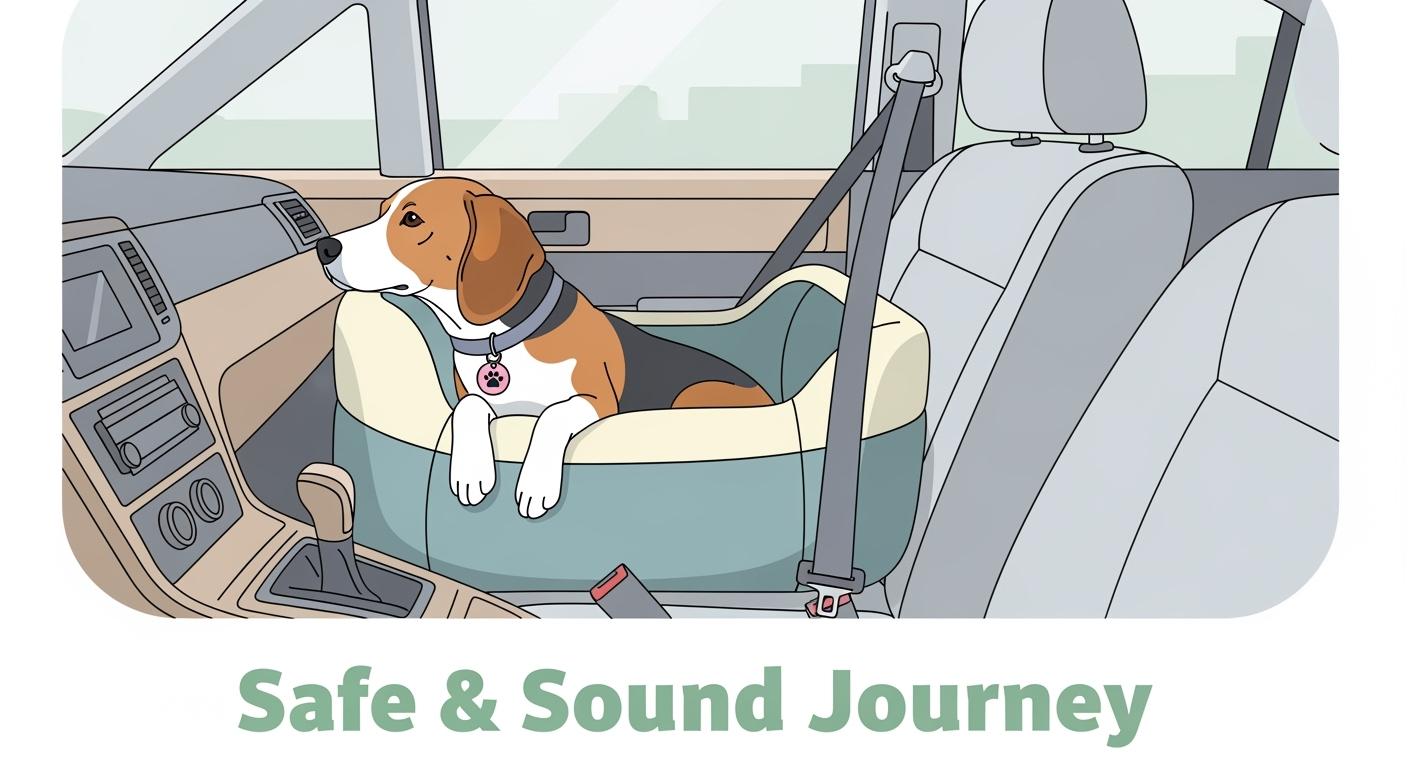
An anxious dog does not need more space in the car. It needs fewer things to monitor. A seat that leaves the dog visually exposed to every passing vehicle, or one that wobbles through every turn, gives an already-nervous animal more data to process — and more reasons to stay on alert. The design features that matter come down to two things: whether the seat creates a boundary the dog’s nervous system reads as safety, and whether the base stays still enough to let the dog stop bracing.
When the Seat Itself Becomes the Stressor
Open Sides Keep the Threat-Detection System Switched On
A dog in a car is already processing unfamiliar motion, engine vibration, and a stream of visual input through the windows. A seat with low or open sides adds another layer: the dog has no physical boundary marking where its space ends and the outside world begins. Every passing truck, every sudden shadow, every pedestrian near the window registers as data the dog’s threat-detection system must evaluate. That is cognitive load an anxious dog does not need.
Raised sides cut the dog’s visual field down to what is inside the seat and what is directly ahead. That reduction is not a comfort feature — it is a nervous-system intervention. Less visual input means fewer startle triggers, which means the dog spends less time in a heightened arousal state. Whether a higher vantage point calms the dog or fuels its anxiety depends on the individual animal, but the boundary itself removes the ambiguity: the dog knows where the safe zone ends.
An Unstable Base Forces the Dog to Brace, Not Rest
Every time a car turns, brakes, or accelerates, the dog’s body shifts. On a stable surface, that shift is absorbed by the seat structure. On an unstable one, the dog plants its paws, tenses its muscles, and compensates. That is bracing, not resting.
For an anxious dog, this compounding problem runs deeper. The dog is already hyper-vigilant. When the seat itself moves unpredictably, it confirms the dog’s read that the environment is unstable — literally. The dog stays in a state of anticipatory tension because the next bump or swerve could come at any moment. A non-slip, rigid base interrupts this loop. When the seat does not slide or tip, the dog gets fewer proprioceptive signals that say “adjust now.” Over a 20-minute drive, that adds up — less panting, less repositioning, less whining. Getting the measurements right before choosing a seat prevents the tipping and sliding that would otherwise undermine the stable-base advantage from the start.
Three Design Features That Change the Anxiety Equation
Raised Padded Sides as a Nervous-System Signal
The mechanism here goes beyond physical containment. When a dog leans against a padded side wall, the pressure receptors in the skin and the proprioceptors in the joints send a steady stream of input to the brain. That input says: “There is a surface here. It has not changed. It is still here.” For a brain wired to scan for threats, a signal that stays constant is a signal that can be tuned out.
This is why side height and padding density are not interchangeable. A low side that the dog can see over does not block visual triggers. A thin side that collapses under body weight does not maintain the contact that lets the nervous system settle. A side wall with enough height to reach the dog’s shoulder, and enough padding to hold its shape under body weight, creates the proprioceptive equivalent of a steady background rhythm — predictable, unremarkable, ignorable. That is the precondition for calm.
In practice: After 10 minutes of driving, check whether the dog is leaning into the side wall with relaxed muscle tone or sitting rigidly upright with ears scanning. A dog that has settled into the padding has down-regulated. A dog still bracing upright is still managing its own stability — and the seat design is not yet doing its job.
A Stable Base Removes the Startle Trigger
The physics is straightforward. When a car brakes, the dog’s body wants to continue forward. If the seat base grips the car seat and does not shift, the only force the dog experiences is the deceleration — which ends when the car stops. If the base slides forward even half an inch, the dog feels two forces: the deceleration and a separate, unpredictable lateral shift. That second signal is what triggers the startle response.
A stable base also changes what happens between events. If the dog learns over the first five minutes that the seat moves under them during turns, it will preemptively brace before every intersection — even intersections where the car goes straight through. That anticipatory tension burns energy and keeps cortisol elevated. A seat that stays put through the first few turns gives the dog data that says “this platform is reliable.” After that, the bracing tends to stop.
A car seat with an integrated non-slip base and padded interior combines the stable platform with the boundary contact in a single structure — the two features reinforcing each other rather than operating as isolated design choices.
Soft Walls Distribute Pressure and Sustain Calm
A wall that is structurally firm but surface-soft works on a different principle. Firm structure maintains the boundary. Soft surface prevents pressure points. If the padding is too thin, the dog’s weight against the wall concentrates at the shoulder or hip joint. After 15 minutes, that localized pressure becomes uncomfortable — and the dog shifts. Shifting restarts the settling cycle.
This is where material choice intersects with behavior. A foam with high resilience — the kind that returns to shape after compression rather than flattening — maintains uniform pressure distribution across the contact area. The dog does not develop a hot spot, so it does not need to move. Not moving is what allows the nervous system to stay in a low-arousal state. How seat geometry, materials, and fit interact determines whether the dog can sustain that settled state through an entire trip or whether the seat design itself forces a reset every few miles.
| Design Feature | Why It Changes Behavior | Where It Can Fall Short |
|---|---|---|
| Raised padded sides | Reduces visual field; provides constant proprioceptive input that signals safety | Dogs with confinement anxiety may find the enclosure itself triggering |
| Stable non-slip base | Eliminates micro-movements that trigger repeated startle responses | Smooth leather seats may need an additional grip layer underneath |
| Resilient wall padding | Distributes pressure evenly so the dog does not need to shift and restart the calming cycle | Padding that is too soft collapses and loses its boundary function |
When Raised Sides Are Not the Answer
Not every dog that struggles in the car has stimulus-triggered anxiety. Some dogs drool, pant, or vomit not because the seat is unstable but because their vestibular system cannot reconcile motion signals from the inner ear with visual signals from the eyes. That is motion sickness — and a better car seat design addresses only the anxiety half of the equation.
The distinction matters in practice. An owner who buys a seat with raised sides for a motion-sick dog may see no change. The dog is not overstimulated by the environment; its brain is struggling with conflicting balance signals. In those cases, a stable base still helps — less motion amplification — but the sides are solving a problem the dog does not have.
There is a second case where the same design that calms one dog can backfire. A dog with confinement anxiety or claustrophobic tendencies may find raised sides threatening rather than reassuring. Instead of leaning into the walls, this dog pushes against them, tries to climb out, or pants more intensely once enclosed. Keeping a dog safe and seated during car travel means matching the solution to the specific root cause — the enclosure that one dog reads as a den, another reads as a trap.
Observable check: On the first drive with a new seat, watch whether the dog voluntarily leans into the side walls within the first 10 minutes. A dog pressing its body into the padding is using the boundary as a calming aid. A dog bracing against the far wall, trying to stand over the side, or repeatedly turning to face the opening is signaling that enclosure increases rather than decreases its stress.
Disclaimer: This boundary-preference check assumes a dog with primarily stimulus-driven car anxiety. If the dog’s anxiety is rooted in confinement or past trauma associated with enclosed spaces, raised sides may intensify rather than reduce stress signals. For dogs with a known history of panic in crates or small spaces, introduce the car seat gradually in a stationary vehicle before attempting a drive — and treat escape behavior, not lack of settling, as the primary indicator that this design is the wrong match.
FAQ
Why do raised sides help an anxious dog more than a flat car bed?
A flat car bed gives the dog a place to lie down but does nothing to reduce the visual field or provide the proprioceptive contact that down-regulates the nervous system. The dog stays visually exposed to every passing stimulus. Raised sides remove the environmental data the brain would otherwise feel compelled to process — the same reason a person closes the curtains before trying to sleep.
Does a stable base matter if the roads are smooth?
Yes. The forces that shift a car seat come from braking, accelerating, and turning — not just from bumps. A smooth highway still involves lane changes and speed adjustments. Every one of those events sends a small lateral or forward force through the seat. If the base lacks grip, those forces accumulate into position shifts the dog registers.
What if my dog is between sizes?
A seat that is too large gives the dog room to slide during turns, recreating the instability problem even if the base grips well. A seat that is too small forces the dog into a position it cannot hold comfortably — a different stressor entirely. A snugger fit tends to serve the anxious dog better, since the boundary contact stays more consistent, as long as the dog can still sit, turn around, and lie down without being compressed against the walls.
Should a harness be used with the car seat, or is the seat enough?
The seat handles the anxiety equation during normal driving — the enclosure and the stability. A harness clipped to a seat belt tether handles the safety equation at the moment of impact. Pairing the seat with a properly fitted harness closes a gap neither product can cover alone. The tether also prevents an anxious dog from jumping or climbing out of the seat mid-drive, which matters for dogs that may try to escape the enclosed space.






