
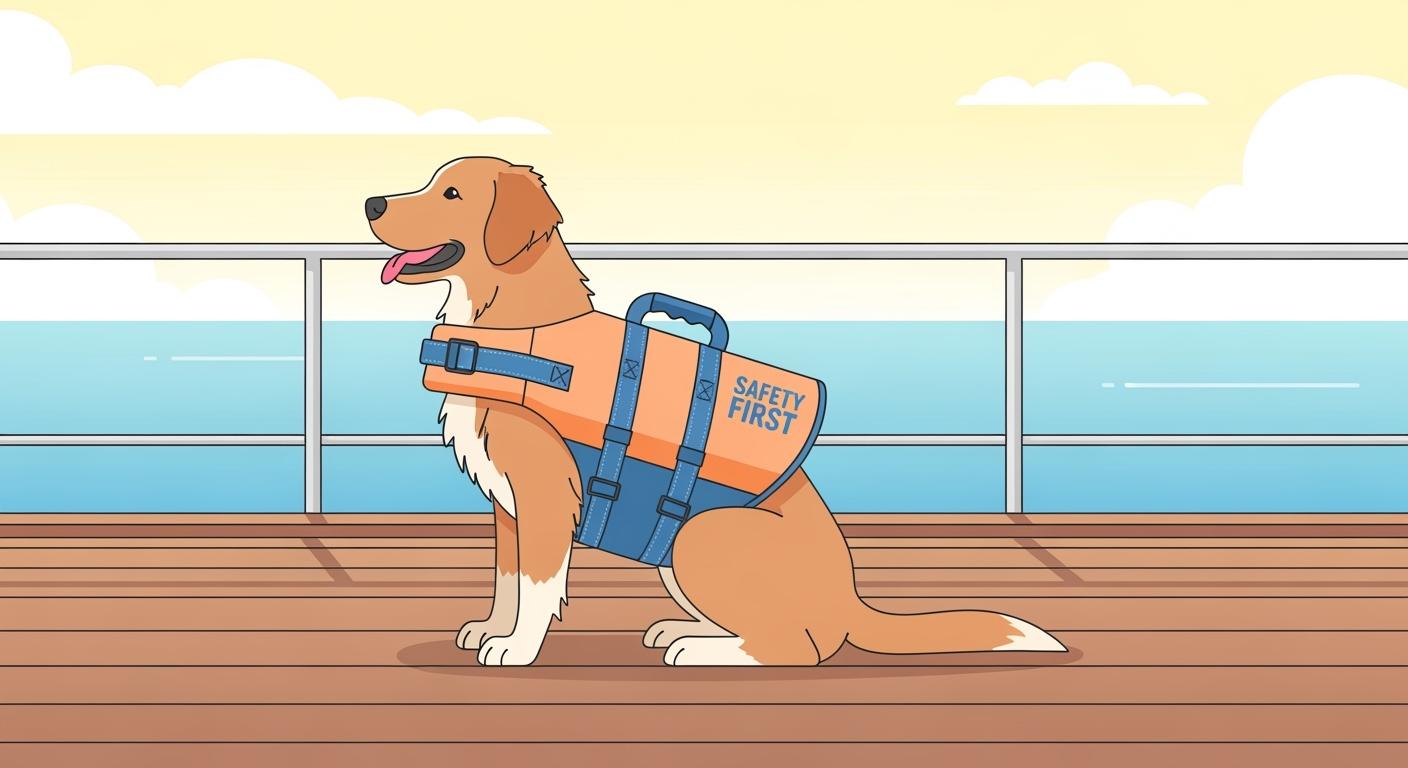
A dog life jacket can float in a pool test and still fail during boating. The difference is not the label. It is whether three design features — visibility fabric, handle reinforcement, and strap geometry — work together as one system under boat-deck conditions. A jacket that checks one box and compromises the other two creates a false sense of security.
Boating amplifies design weaknesses that stay hidden in calm swimming. Wet decks, sudden maneuvers, shifting currents, and the distance between boat and dog all punish partial solutions. A dark vest disappears against open water. A handle sewn only to the outer shell tears under a wet dog’s full weight. Straps that loosen under sustained tension let the jacket rotate until the flotation panels sit in the wrong position. Each failure mode traces back to a specific design decision.
The three features are not independent. Visibility locates the dog. The handle lifts the dog. Secure fit keeps the jacket positioned so both visibility and the handle stay usable. Break one link and the other two cannot compensate. That is why evaluating a life jacket for boating means inspecting all three as a single integrated system, not as a checklist of isolated features.
When the Visibility-Handle-Fit Triad Comes Apart
What Happens When Each Link Breaks
Visibility fails first in open water. A dark or low-contrast vest blends into the water surface within 30 feet. Add glare, chop, or dusk and the dog effectively disappears. Bright colors — hi-vis yellow, orange — create luminance contrast against blue and gray water. Reflective trim catches beam light from boat lamps or the sun at low angles. If the trim is placed only on the top panel, it vanishes the moment the dog turns away. Effective placement runs reflective piping along the bottom edge and across the handle, where it catches light from multiple approach angles.
Handle failure is a structural problem. When a wet dog is lifted, the handle pulls upward on its attachment points. If the handle bar-tacks to the outer shell alone, the load concentrates along a single stitch line. The fabric can tear before the stitches break — the stitches hold, but they pull through the weave. A handle that connects through to internal body panels converts a point load into distributed pressure across the dog’s torso. The stitching path matters as much as the thread strength. A jacket built this way spreads the force so no single seam carries the full lift load.
Fit failure shows up as rotation. When belly and chest straps are narrow or adjust through simple friction buckles, sustained tension from a current pulls the strap loose. The jacket twists, the flotation panels shift to one side, and the dog rolls. A stable fit requires wide webbing that resists bunching, buckles that lock rather than slip, and strap angles that follow the dog’s body contour instead of cutting straight across. The difference in strap layout — whether the belly strap sits perpendicular to the spine or angles slightly rearward — changes how the jacket responds to forward pull in the water.
Design Details That Separate Boating Jackets from Swimming Vests
Outer Fabric, Reflective Trim, and Neck Opening
Fabric color is the first decision. Hi-vis yellow and orange reflect more of the visible spectrum than red or blue, which darken to near-black at a distance over water. The color must sit in the outer fabric itself — printed-on reflective stripes on a dark base fabric leave large non-reflective zones. Neck opening design follows the same logic as strap fit: loose enough to avoid throat pressure during a lift, snug enough that the dog cannot back out if the jacket rotates. A two-finger clearance at the neck opening under tension tends to hit the balance, though this varies by coat density — a dog with thick neck fur compresses differently than a smooth-coated breed.
Handle Reinforcement and Stitching Path
The handle’s failure mode is predictable: the stitches hold, the fabric gives. Preventing this requires the handle attachment to engage the jacket’s internal structure — either a full-length webbing spine that runs from the handle down to the belly panel, or reinforced box-stitch anchors that connect through to the inner flotation compartment. Either approach turns the handle into part of the jacket’s load-bearing frame rather than a grab point attached to the surface.
In practice: After a trip, check whether the handle sits centered on the dog’s spine. If it has migrated more than an inch to either side, the belly straps loosened during use and the jacket rotated under load — the handle was pulling against shifted body panels, not the original anchor position.
Strap Layout, Buoyancy Balance, and Lift-Point Strength
Strap geometry controls rotation. A belly strap that sits perpendicular to the spine resists forward-backward shift but allows side-to-side roll. A strap angled slightly rearward, combined with a chest strap that wraps the sternum rather than riding up toward the throat, creates opposing tension vectors that lock the jacket in place. This is the same principle that keeps a climbing harness stable under load — two straps pulling in different directions create a stable plane.
Balanced buoyancy keeps the dog upright in the water. Flotation panels must distribute evenly across the chest, sides, and back. If the back panel holds significantly more foam than the chest panel, the jacket acts like a keel — the heavier-flotation side rotates upward, flipping the dog onto its back. Test buoyancy in shallow water before trusting it in open water. Watch whether the dog floats with the spine horizontal and the head above water without effort. If the hindquarters sink or the dog tilts to one side, the flotation distribution is off for that body shape.
Webbing width and buckle construction at lift points determine whether the jacket survives a rescue. Narrow webbing concentrates pressure into a thin line — under a 60-pound dog’s wet weight, that line can dig into the dog’s skin and load the buckle at an angle that causes it to slip. Wide webbing spreads the same load across more surface area. Marine-grade buckles with a positive locking mechanism — ones that click into place and require deliberate pressure to release — resist accidental opening under twisting loads.
| Design Difference | Why It Matters During Boating | Main Limitation |
|---|---|---|
| Hi-vis outer fabric with reflective edge trim | Visible from multiple approach angles, not just from directly above | Reflective trim loses effectiveness when submerged; color contrast becomes the sole visibility cue |
| Handle connected through to internal body panels | Converts point load into distributed pressure; prevents stitch-line tear-out | Adds production complexity — each anchor point requires precise alignment between outer shell and internal panel |
| Angled belly strap with locking buckle | Creates opposing tension vectors that resist rotation in currents | Fit is less forgiving — a half-inch adjustment changes the tension angle noticeably |
| Balanced flotation across chest and back panels | Keeps the dog upright without active swimming effort | Panel distribution that works for a deep-chested breed may tilt a barrel-chested dog |
When the Design Reaches Its Limit
Conditions That Overwhelm Any Jacket
Fast currents, rough water, cold shock, panic, and distance from the boat all exceed what a life jacket can compensate for. A jacket provides flotation and a grab point — it does not steer the dog, warm the dog, or calm the dog. In water below 50°F, cold incapacitation can set in within minutes regardless of how well the jacket floats. Strong currents can carry a dog hundreds of feet beyond reach before a rescue can start. These are conditions where the decision to keep the dog on board matters more than any design feature.
Building water confidence through gradual exposure helps, but it does not override physics. The jacket is one layer in a safety approach that starts with reading weather and water conditions before launching.
Disclaimer: The fit checks and buoyancy observations described here assume a dog with standard body proportions — a defined chest, narrower waist, and a back length proportional to leg height. Dogs with cylindrical torsos, very short backs relative to chest depth, or brachycephalic head structures may float differently even in a properly fitted jacket. For these builds, verify buoyancy behavior in controlled shallow water before relying on the jacket in open water. The two-finger neck check may also read differently on thick-coated breeds, where fur compression under load changes the effective opening size.
Handle Use and Pre-Launch Checks
The top handle is built for short, controlled lifts — hauling a dog from the water onto a deck, dock, or kayak. It is not a carry handle for extended transport. Lifting for more than a few seconds concentrates pressure under the chest and belly straps. Practice the lift on dry land first: confirm the handle feels rigid, the stitching shows no stretching, and the dog’s weight distributes across the torso without the jacket riding up.
Pre-launch checks take under a minute. Pull each strap to verify it holds tension without slipping through the buckle. Snap each buckle open and closed — listen for the lock click. Grab the handle and apply steady upward force. Look at the stitch lines around every attachment point. If the jacket shifted during the last trip, adjust the strap tension and re-test. A jacket that rode up once tends to do it again unless the strap tension is corrected. Run checks in daylight — small tears and frayed webbing are harder to spot in low light.
FAQ
Why does a life jacket that works for swimming fail during boating?
Swimming happens close to shore, in predictable conditions, with the dog entering the water voluntarily. Boating adds distance from the dog, wet and moving deck surfaces, currents, and the possibility that the dog enters the water unexpectedly — all of which multiply the consequences of a visibility, handle, or fit failure.
What is the actual difference between a reinforced handle and a standard one?
A standard handle is sewn to the outer shell along a single stitch line. Under a wet dog’s full weight, the load concentrates along those stitches. A reinforced handle connects through to internal body panels — the force distributes across the panel surface area instead of along a single seam. The failure mode shifts from fabric tear-out to the much higher threshold of the webbing itself breaking.
How can a dog owner check buoyancy balance before a trip?
Place the dog in calm, shallow water wearing the jacket. Observe the floating position from the side: the spine should stay horizontal and the head should clear the water without the dog actively paddling to stay level. If one side sinks or the hindquarters drop, the flotation panels are not distributing evenly for that dog’s build. Adjust strap tension and re-test before trusting the jacket in open water.
Does reflective trim work when the jacket is submerged?
No. Reflective trim requires a light source and a direct line of sight — it works above the water surface. Once the jacket is partially submerged, the primary visibility cue shifts to the outer fabric color. That is why hi-vis fabric matters independently of reflective trim: color contrast is the backup when trim stops working.
How often should the handle and stitching be checked?
Before every trip. The inspection takes seconds: pull the handle with steady force, look for stretched stitches or fabric deformation around the attachment points, and confirm the handle has not migrated from its centered position since the last use. Saltwater exposure accelerates thread degradation — rinse the jacket with fresh water after saltwater use and air-dry before storage.






