
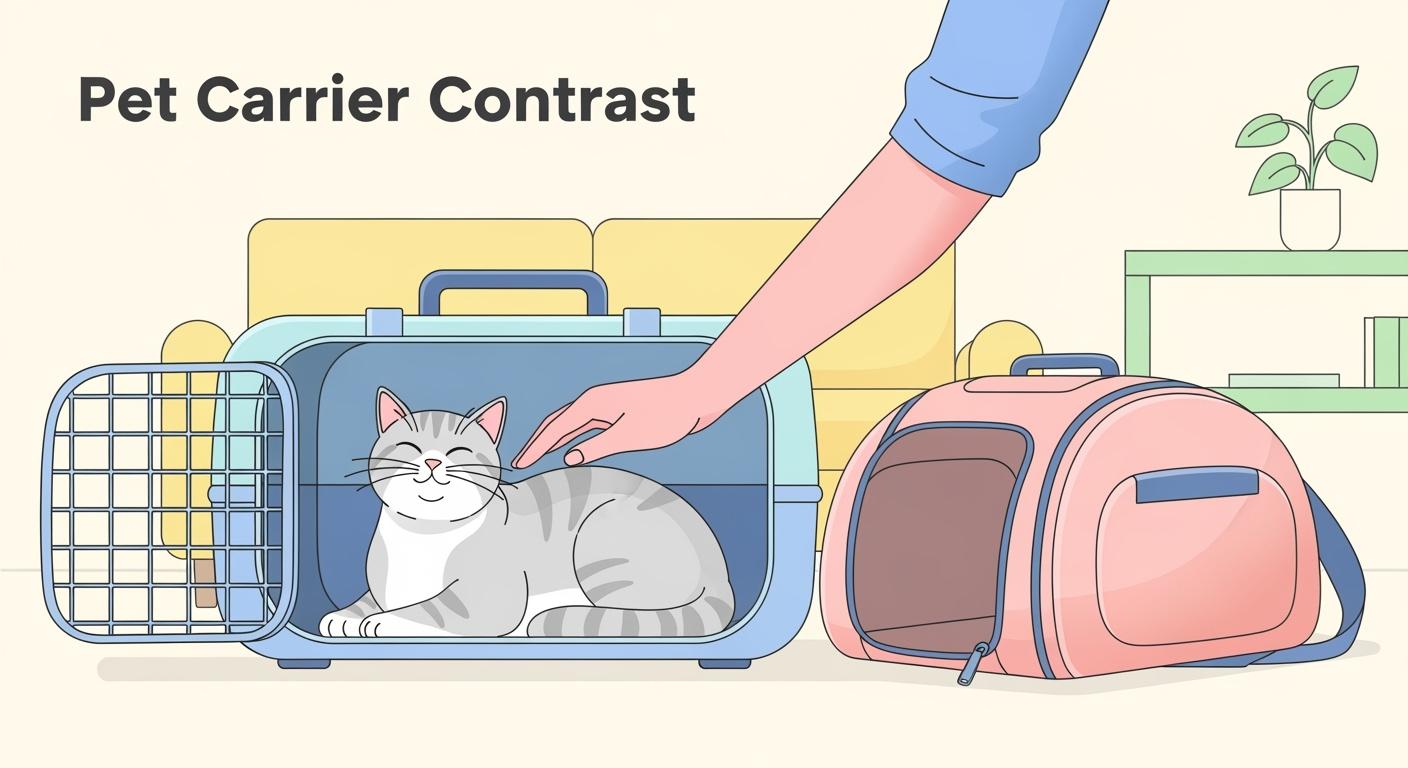
A cat that backs out of a pet carrier is not being difficult. It is responding to a doorway that reads as a trap. When the opening is narrow and positioned at the front, the cat must walk toward what it perceives as confinement — and that geometry, more than the carrier’s interior volume, is what triggers the panic. A top-opening carrier changes the entry axis entirely.
Why a Narrow Front Opening Triggers Backing Out
The Mechanics of Paw Bracing
A cat entering a front-loading carrier must move forward into a space it cannot see clearly. The narrow doorway occludes the interior. When the cat’s whiskers brush the edges, the signal is simple: the path is too tight. The cat braces its front paws against the door frame and pushes backward.
That bracing is not stubbornness. It is a spinal reflex chain. Pressure on the whiskers and facial vibrissae activates a retreat pattern before the cat consciously evaluates the space. The horizontal entry vector means every forward nudge from the owner is met with equal and opposite resistance — the cat’s own body mechanics work against loading. A top-entry carrier bypasses this entirely. The cat is lowered along the vertical axis, and the first surface its paws contact is the floor, not the door frame. No whisker contact, no bracing trigger.
Tip: If your cat plants its paws on the door edge and locks its elbows, the doorway is too narrow — not the carrier. A wider structured opening or top access changes the loading geometry.
Visual Barriers and Spatial Assessment
Cats map entry paths before committing. A narrow front doorway blocks most of that visual scan. The cat sees a dark rectangle, not a room. If the carrier’s front edges are soft or unsupported, they deform when the cat tests them with a paw — and that deformation reads as structural instability. The cat then categorizes the entire carrier as unsafe and refuses to proceed.
Structured sidewalls and a defined, rigid doorway eliminate that variable. The cat pushes and the frame does not give. That feedback — a solid push against a solid surface — is how a cat confirms that a space is real. When the doorway collapses even slightly, the space behind it becomes unknowable, so the cat stays out. A wide, framed opening paired with a firm, non-slip base lets the cat complete its spatial check in under three seconds and commit to entry without a panic break.
Where Standard Carrier Design Falls Short
Doorway Collapse and the Stability Problem
Most carriers fail at the door frame before the cat ever gets inside. A soft-sided carrier with an unsupported zippered flap presents a moving target. The cat places a paw on the threshold and the edge folds under minimal weight. That is enough. The cat reads the deformation as a sign the entire enclosure is unstable.
The physics is straightforward. A fabric edge under vertical paw load acts as a cantilever with no bending resistance. The moment the cat applies force off-center, the flap rotates inward and the perceived opening shrinks. A rigid-framed doorway distributes that same load into the carrier’s sidewall structure, keeping the opening geometry fixed regardless of where the cat steps.
| Design Difference | Why It Matters | Main Limitation |
|---|---|---|
| Rigid-framed entry vs. soft zippered flap | A framed opening stays fixed when the cat tests it; a soft flap deforms, triggering retreat. | Rigid frames add weight and reduce collapsibility for storage. |
| Wide doorway vs. narrow front slot | Wider openings let the cat see the interior before committing; narrow slots force blind entry. | Extra-wide openings can weaken sidewall tension if the frame is not reinforced. |
Note: A doorway that keeps its shape under a paw test removes the single biggest variable that causes cats to abort entry mid-step.
Base Grip and Floor Stability
When a cat steps onto a carrier floor, it expects zero movement. A thin, flexible base panel bows under the cat’s weight. That micro-sag triggers the same instability alarm as a branch that bends too far — the cat freezes, claws extend, and forward motion stops. If the floor slides on the surface beneath it during loading, the problem compounds.
A rigid, non-slip base solves both problems at once. The floor panel resists bending, so the cat feels a solid substrate identical to the floor outside the carrier. The non-slip bottom locks the carrier in place during entry, so the cat’s own movement does not shift the structure. This is especially important on tile, hardwood, and veterinary exam tables — surfaces where a sliding carrier can reset the cat’s trust to zero in under a second.
In practice: After a trip, run your hand across the carrier base from underneath. If you find any flex deeper than a quarter-inch under moderate palm pressure, the floor panel is not rigid enough for a cat that hesitates on entry.
What Structural Choices Change the Loading Experience
Top Entry Changes the Loading Vector
A cat lowered through a top opening experiences entry as a descent, not a confrontation. The owner’s hands guide the cat downward. Gravity does the rest. The cat’s paws meet the floor first, and the body follows. No forward push, no face-first entry into a dark opening.
This vertical loading path matters for a second reason: it lets the owner use both hands to stabilize the cat during entry, which reduces lateral twisting and struggling. A front-entry carrier forces a one-handed push while the other hand holds the carrier steady. Top entry decouples the loading action from the stabilizing action, so each can be done cleanly. Dual-entry designs — combining a top opening with a front door — add flexibility for cats that prefer to exit forward after the ride, a pattern common in carriers used for routine veterinary trips where airline-approved cat carriers with structured top access also meet under-seat dimensional requirements.
| Design Difference | Why It Matters | Where It Works | Where It Falls Short |
|---|---|---|---|
| Top-loading only | Eliminates the forward-push vector; cat descends vertically onto a stable floor. | Cats that brace, scratch, or back out of front doors. | Cats comfortable with front exit may resist being lifted out after travel. |
| Dual-entry (top + front) | Offers top loading and front exit flexibility; useful when the cat needs to step out onto an exam table. | Multi-stop trips, vet visits, cats that prefer forward-facing exit. | More openings mean more potential failure points at zippers and seams. |
| Removable top panel | Converts the carrier into an open tray; the cat can be examined without full extraction. | Veterinary exams, post-surgery loading, anxious cats that freeze when lifted. | Removable tops add assembly steps and can be misplaced in transit. |
A Firm Base and Stable Sidewalls Reduce the Variables Cats Track
Cats register instability through multiple channels simultaneously — paw pressure, whisker deflection, and shifts in the visual field. A carrier floor that flexes even slightly under the cat’s weight sends a proprioceptive signal that the surface is unreliable. Stable sidewalls prevent the visual field from shifting when the cat leans against the interior, which matters because cats use their peripheral vision to confirm enclosure boundaries.
A rigid base panel laminated with a non-slip outer layer resolves the proprioceptive signal. The cat steps, the floor holds, forward motion continues. Sidewalls with internal stiffening panels — rigid plastic sheets sewn into fabric sleeves, common in better-built structured pet carriers designed for cat transport — maintain their shape under lateral pressure, so the cat never feels the walls closing in. This combination of floor rigidity and wall stability is what lets a cat settle inside and stay calm during transit rather than bracing against every turn.
Sizing: Why the Numbers Alone Miss the Point
A carrier that fits on paper can fail in practice. The standard formula — measure the cat’s length and height, multiply by 1.5 — gives minimum interior dimensions. But what that formula does not account for is usable volume. A carrier with heavily sloped sidewalls loses headroom at the edges. A cat that prefers to sit upright needs full ceiling height across enough of the footprint to hold that posture without pressing against the roof.
Measure your cat from nose to tail base in a natural standing position, then from floor to ear tip. Multiply both by 1.5. That gives the minimum interior length and height. Then check whether the carrier’s walls taper — if they do, the actual standing height near the sides may be less than the stated spec. The cat should be able to turn a full circle without its whiskers touching both sides simultaneously. If the whiskers brush, the carrier is too narrow regardless of what the length number says. For cats that travel long distances, the interior needs to accommodate a full sprawled resting posture, which typically requires about 20 percent more floor area than the standing-turn test suggests. These fit checks mirror the approach used when evaluating whether extra carrier room improves comfort or sacrifices support during longer trips.
When Top-Opening Design Is Not the Full Answer
Top entry solves the loading problem. It does not solve every carrier problem. A top-opening carrier with a weak base or collapsible sidewalls still fails the stability checks that matter once the cat is inside. The design advantage applies specifically to the entry phase. Once the carrier is closed and in motion, the cat’s experience depends on ventilation placement, base grip during vehicle movement, and whether the interior feels like a defined space or a shifting sack.
For cats that have already learned to tolerate front entry, the vertical loading advantage of a top-opening carrier may be irrelevant. These cats walk in on their own. The additional cost and seam count of a dual-entry design brings no benefit for them. Similarly, cats that panic when lifted — common in feral rescues or cats with handling trauma — may find the top-entry loading motion more stressful than a ground-level front door they can choose to enter. The best design is the one that aligns with the specific cat’s entry behavior, not the one with the longest feature list.
The carrier’s stability during vehicle transport often matters more than its entry mechanism. A carrier that slides across the back seat on every turn keeps the cat in a constant state of micro-recovery, regardless of how smoothly the loading went. Securing the carrier with a seat-belt pass-through or non-slip base addresses the in-transit stability that top-entry design alone cannot provide. The same principle applies to carriers used in tote-bag style designs where weight balance and one-handed access determine how steadily the carrier moves through doorways and crowded spaces.
Disclaimer: The fit checks described here assume a cat of typical proportion for its size. Cats with barrel chests, very deep keels, or pronounced shoulder breadth — common in breeds like the British Shorthair, Maine Coon, or Persian — may need sizing that exceeds the standard 1.5x formula. For these cats, prioritize interior width at shoulder height, and verify that the ceiling does not slope into the cat’s standing space at the edges. A carrier that fits on length alone can still force a broad-chested cat into a hunched posture that restricts breathing during long trips.
Entry design matters most when it aligns with the specific cat’s stress profile. A cat that braces at the doorway needs a top opening. A cat that freezes when lifted needs a wide, ground-level front entry it can self-load into. A cat that panics mid-ride needs base stability and sidewall structure more than any particular door configuration. Understanding which problem the cat is actually presenting — and matching the carrier’s materials and fit to that behavior — is what turns a failed loading into a routine one.
FAQ
Why does my cat back out of a carrier that looks big enough?
Interior volume and doorway geometry are separate variables. A carrier can have generous interior space but still trigger retreat if the front opening is narrow, soft-edged, or positioned so the cat cannot see a clear path inside. Cats assess entry feasibility visually before committing. A narrow doorway blocks that assessment. They back out because the doorway fails the visual scan, not because the carrier is too small.
Does a top-opening carrier work for cats that panic when lifted?
Not necessarily. Top entry assumes the cat tolerates being held and lowered. For cats with handling trauma or strong lift aversion, a wide ground-level front door they can enter voluntarily may produce less stress than any vertical loading design, regardless of how well the top opening is constructed.
How do I check whether a carrier base is rigid enough?
Press the center of the unloaded floor panel with your palm using moderate pressure. If the deflection exceeds roughly a quarter-inch, the panel will flex noticeably under a cat’s weight during entry. A rigid base should resist palm pressure with minimal give. Also check that the base panel is sewn or fastened into the carrier shell so it cannot shift independently of the sidewalls.
What size carrier does my cat actually need?
Measure the cat’s standing length (nose to tail base) and height (floor to ear tip). Multiply both by 1.5 for minimum interior dimensions. Then verify the cat can turn a full circle without whiskers touching both sides, and can sit upright without the head pressing against the ceiling. If the carrier walls taper inward, measure usable height at the sides, not just the center peak.






