A large dog pushes off with real force. When an 80-pound dog jumps onto a bed, the lateral load can exceed the static friction between the bed base and a smooth floor by a wide margin. The bed shoots sideways. The dog learns not to trust it. That is not a cushion problem. It is a base-design problem — and once you see the mechanics, the fix is straightforward.
The standard advice stops at “get a non-slip bottom.” That misses half the equation. Three variables control whether a large dog bed stays put on hardwood, tile, or laminate: the friction coefficient of the underside material, the normal force pressing the bed into the floor (which depends on bed weight, not just dog weight), and the shape of the contact patch. Change any one of them and the bed behaves differently. A bed with a rubberized underside but a featherweight foam core still skates. A heavy bed with a slick polyester bottom does too. The design has to get all three right at once.
Why Large Dog Beds Slide on Hard Floors
A 20-pound dog stepping onto a bed generates modest lateral force. An 80-pound dog doing the same thing — or turning, or pushing off — generates four times the mass and a proportionally larger push. The physics is simple: the static friction holding the bed in place equals the friction coefficient of the underside multiplied by the normal force. When the dog’s lateral push exceeds that product, the bed moves.
Two things make this worse with large dogs. First, they do not step gently. A large dog approaching a bed often plants a paw near the edge and pushes off at an angle, concentrating force on a single point rather than distributing it. Second, the bed’s own mass is usually a small fraction of the dog’s mass — so the bed has little inertial resistance of its own. A 5-pound foam cushion hit with 30 pounds of lateral force will move almost every time, regardless of what is printed on the bottom.
Hard floors amplify the problem because they are smooth by design. Polished hardwood, glazed tile, and laminate all present low-friction surfaces. The table below shows how common wood flooring types differ — not in abstract hardness, but in how they interact with a bed base under lateral load.
| Wood Type | Surface Behavior Under a Dog Bed | Slip Tendency |
|---|---|---|
| Hickory | Hard, fine grain; resists micro-scratches that could otherwise create grip points | Moderate to high |
| Hard Maple | Dense, uniformly smooth; few natural texture points for the bed base to catch | High |
| White Oak | Slightly open grain; minor surface texture can aid grip with rubberized undersides | Moderate |
| Red Oak | More pronounced grain than white oak; slightly better mechanical interlock with textured bases | Moderate |
| Pine | Soft, dents under pressure; dents can create small anchor points but damage the floor | Low (at floor’s expense) |
| Cherry | Smooth, uniform polish; offers little for even a grippy base to work with | High |
| Walnut | Moderate hardness, tight grain; behaves similarly to maple in practice | High |
One way to check whether your current setup is failing: after your dog stands up and walks away, look at where the bed sits relative to a floorboard seam or tile line. If it has drifted more than two inches from its original position after a single use session, the base is not holding. That is the observable test — no guessing required.
Where the Bed Base Design Fails
Slick Bottom Fabrics and Friction Mismatches
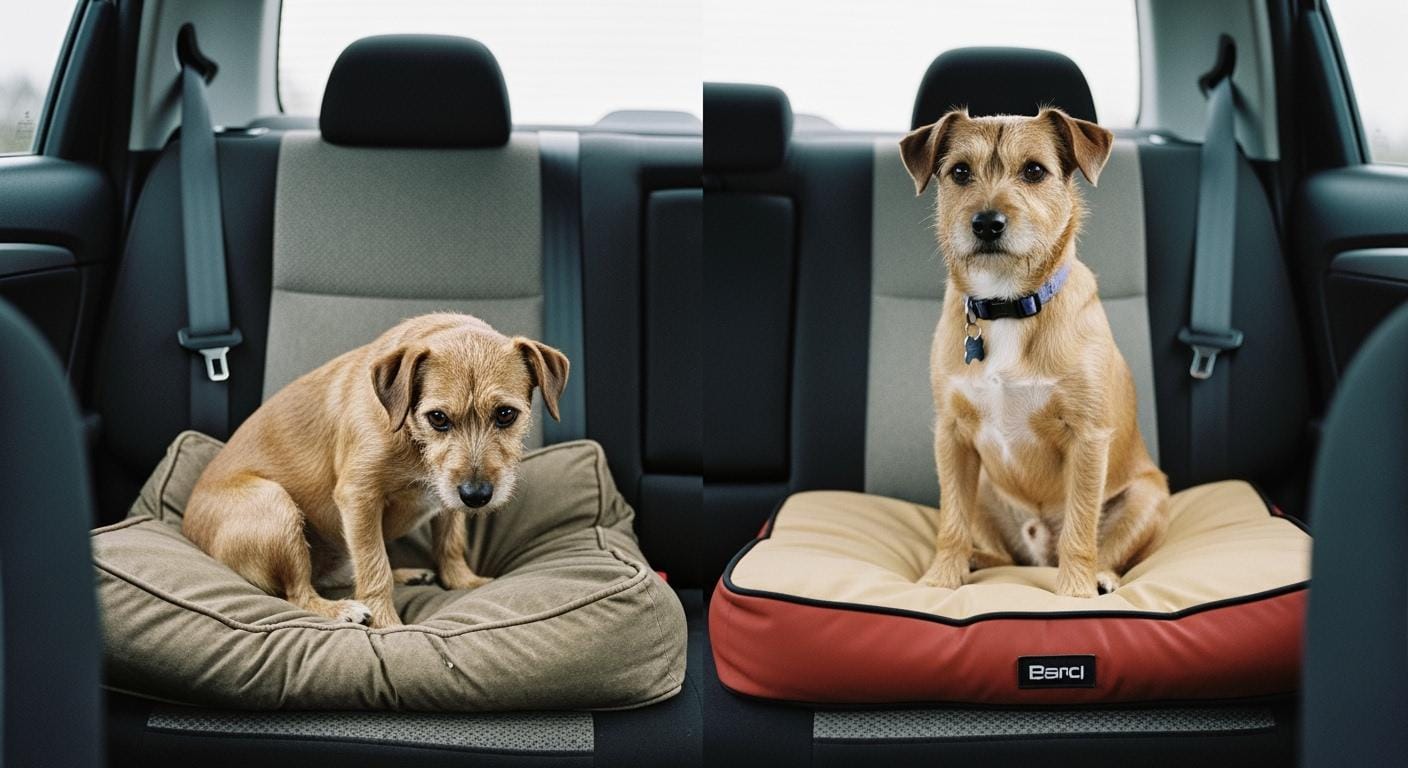
Some bed covers use the same fabric on the bottom as on the sleeping surface — a polyester weave or smooth nylon that looks consistent but has no mechanical grip on hard flooring. The material might feel fine to the hand, but under the shear load of a large dog stepping onto the edge, it behaves like a sled runner. A bed stabilized by floor contact across its entire underside in theory loses that contact in practice the moment the fabric is too smooth.
Partial-coverage non-slip dots make this worse. A ring of silicone dots around the perimeter leaves the center of the base floating. When the dog’s weight compresses the cushion, the center of the bed bows downward and the dotted rim lifts slightly — breaking whatever grip the dots were providing. Full-coverage rubberized or textured undersides avoid this failure mode entirely. If only the perimeter is treated, the bed is unstable at the point of maximum load — which is exactly where a large dog’s weight concentrates.
Lightweight Cushions That Cannot Resist Lateral Force
A thick foam cushion that weighs four pounds cannot anchor an 80-pound dog. The physics is unforgiving here: the bed’s own mass contributes to the normal force in the friction equation, but a four-pound bed adds roughly five pounds of normal force — negligible against a lateral push of thirty pounds or more. The bed moves because there is simply not enough downward pressure to generate meaningful friction, even with a grippy underside.
A heavier, low-profile base changes the calculation. A bed with a dense orthopedic foam layer weighing fifteen to twenty pounds doubles or triples the inertial resistance simply by sitting there. The dog’s push has to overcome not just the friction at the contact surface but also the bed’s own reluctance to accelerate. That is the difference between a bed that stays and one that shoots across the room on first contact.
Narrow Edges and Reduced Contact Geometry
The shape of the base determines how much of the underside actually touches the floor under load. A bed with rounded or tapered edges reduces the effective contact patch — the area that transmits normal force into friction. When a large dog steps near the edge, a rounded profile can act as a pivot, concentrating force onto a narrow line rather than spreading it across a flat plane. Less contact area means less total friction, and the bed tips or slides.
A wide, flat base with squared edges maximizes the contact patch and keeps it stable even when the dog’s weight shifts off-center. This is not about the bed looking substantial — it is about the bed maintaining full-floor engagement when forces are applied near the perimeter. Stability on tile and wood starts with how much of the base actually meets the floor under real use conditions, not just how it sits on a showroom shelf.
| Sliding Signal | Likely Base Problem | Better Design Direction |
|---|---|---|
| Bed shifts on entry | Slick bottom fabric | Grippy, full-coverage underside |
| Bed bunches or moves during use | Lightweight cushion | Heavier, low-profile base |
| Bed tips at edges | Narrow or rounded edges | Wide, flat base |
| Cover slips or wrinkles | Loose cover or weak corners | Tight, reinforced cover with deep gusset |
Loose Covers and Corner Separation
A cover that fits loosely does more than look sloppy — it introduces intermittent contact between the bed base and the floor. When the dog circles or digs, a loose cover bunches underfoot, creating a fabric ridge that lifts part of the base off the floor. The bed loses contact area at the exact moment lateral force peaks. Corners that pull away from the base have the same effect: once a corner lifts, the bed is resting on a smaller effective footprint, and the grip drops accordingly.
Deep gussets — the fabric panel that wraps around the bed’s side — keep the cover in tension across the base. A 5-inch gusset sewn with reinforced corner seams pulls the bottom surface flat and holds it there, even when the dog works the edges. Zippered closures that run along the perimeter rather than one short edge make removal for cleaning practical without compromising that tension.
Tall, Soft Sides That Work Against Stability
Bolster sides that stand tall and yield easily create a leverage problem. When a large dog leans against a tall soft side, the force is applied well above the bed’s center of mass. The side compresses, the force vector tilts, and the bed scoots — even if the base itself has decent grip. Soft sides also reduce effective base contact when compressed, because the bolster material folds under and lifts the bed edge. A firmer, lower-profile sidewall keeps the dog’s leaning force closer to the floor plane, where it is less likely to translate into lateral bed movement.
What Base Design Creates Real Stability

Full-Coverage Non-Slip Undersides
The bottom material has one job: maximize the coefficient of static friction against smooth flooring. Rubberized coatings, PVC dot matrices that cover the entire underside (not just the perimeter), and textured thermoplastic panels all do this by creating micro-scale mechanical interlock with the floor surface. The difference is not subtle. A full-coverage rubberized base on smooth tile can produce two to three times the static friction of an untreated polyester bottom, and that ratio tends to hold across hardwood and laminate as well.
The key design distinction is coverage, not material label. A bed marketed as having a “non-slip bottom” that only applies grippy material to 20% of the underside — typically a ring of dots or strips — leaves 80% of the contact area untreated. Under a large dog’s weight, the untreated center bows down and makes floor contact, while the grippy perimeter lifts. The bed slides on the slick center exactly when it should be gripping. Full-coverage means the entire underside is treated, edge to edge. That is the difference between a feature that works on a spec sheet and one that works under a dog.
You can test this directly: press one hand flat on the bed and push sideways with moderate force. If the bed skids with less effort than it takes to slide a full laundry basket across the same floor, the underside is not doing its job. A bed with a properly grippy base will resist that push noticeably — you will feel the difference before the bed moves.
Heavier Low-Profile Bases and Inertial Resistance
Adding base weight is the most direct way to improve stability because it increases the normal force in the friction equation without relying on the dog’s weight alone. A bed with a dense orthopedic foam base — the kind used in designs built for joint support and easy cleaning — typically weighs two to three times more than a standard polyfill cushion of the same dimensions. That extra mass sits flat on the floor, lowering the bed’s center of gravity and making it harder for a lateral push to overcome static friction.
A low-profile base keeps that mass close to the floor. When the center of gravity is low, lateral forces produce less rotational moment — the bed is less likely to tip or lift at the edges when force comes in from the side. This also helps dogs with mobility issues: a bed that sits closer to the ground requires less effort to step onto and off of, which reduces the forceful push-off that triggers sliding in the first place. Bed sizing and support considerations apply whether the bed sits indoors or out — the principles scale.
Wide, Flat Contact and Edge Geometry
The shape of the base matters as much as what it is made of. A rectangular bed with a fully flat underside and squared edges puts nearly 100% of its footprint in contact with the floor. A bed with rounded edges, tapered sides, or a curved bottom profile sacrifices contact area — sometimes 15 to 20% of the potential footprint — and that lost area is concentrated at the perimeter, where off-center forces are most likely to act.
Wide, flat contact also distributes the dog’s weight more evenly, which prevents pressure points that can cause localized slipping. When a bed has a narrow contact patch, the dog’s weight concentrates on a smaller area, increasing the pressure but not necessarily the friction — because friction depends on total normal force, not pressure per square inch. Spreading the same force across more square inches does not reduce friction, but concentrating it on fewer square inches can create uneven grip that lets one section of the bed break free while another holds, producing a twisting motion that is more destabilizing than a straight slide.
Tight Covers and Reinforced Corners
A cover that fits under tension does more than stay put — it preserves the base geometry under load. When a loose cover bunches, it effectively changes the shape of the underside contact patch moment by moment, making the bed’s grip unpredictable. A cover with deep gussets, reinforced corner stitching, and a full-perimeter zipper maintains a consistent flat bottom surface regardless of how the dog moves on top of it.
| Design Feature | Why It Affects Stability | What Fails Without It |
|---|---|---|
| Deep gusset (5-inch typical) | Keeps the cover in tension across the base so the underside stays flat | Cover rides up, exposing slick base edges |
| Reinforced corner seams | Prevents corner lift that reduces effective contact area | Corners peel away; bed rests on smaller footprint |
| Full-perimeter zipper | Allows cover removal for cleaning without distorting fit | Short zippers stretch fabric during removal; cover never fits the same |
Tight cover fit also matters for long-term stability. A cover that loosens after a few wash cycles gradually reduces the bed’s grip in a way that is easy to miss — the decline is slow enough that the dog’s behavior changes before the owner notices the bed has shifted. A removable cover that holds its shape through washing is not just a convenience feature; it is a stability feature that degrades if the cover stretches out.
When a Stable Design Still Is Not Enough
Even a bed with a full-coverage non-slip underside, a heavy low-profile base, and a tight cover can struggle under certain conditions. The design is sound — the environment works against it.
Dust and fine debris on hard floors act as a lubricant layer between the bed base and the floor. A rubberized underside that grips clean tile aggressively can skate across the same tile if a layer of dust or pet hair has accumulated. The fix is not a different bed design — it is keeping the floor under the bed clean. Run a dry microfiber cloth across the area every few days. If the cloth comes up with visible dust, the bed’s grip is already compromised.
Moisture matters too. A slightly damp floor — from a water bowl spill, a wet paw, or humidity — can reduce the friction coefficient of even the best non-slip materials by a significant margin. This is especially relevant in kitchens, near exterior doors, or in basements with concrete floors that wick moisture.
Some dogs are simply harder on beds than any passive stability design can fully handle. A young, high-energy dog that launches onto the bed at a sprint generates forces that can overwhelm a base that holds fine under normal use. In those cases, placing the bed in a corner where two walls limit the directions it can slide is a practical workaround — not a design failure, but an acknowledgment that force scales faster than friction.
Disclaimer: The stability checks described here assume a bed placed on a clean, dry, smooth floor. If the floor is textured stone, heavily waxed, or sloped — or if the dog has a condition that affects mobility, such as hip dysplasia or neurological issues — the bed may behave differently. For dogs with joint conditions, stability is only one variable; the bed’s support profile and entry height matter at least as much for safe use. Double-coated breeds that shed heavily may need more frequent floor cleaning under the bed to maintain grip, since shed fur acts as a low-friction layer between the base and the floor.
An elevated bed frame with skid-resistant feet can sidestep some of these problems entirely by reducing the contact area to four discrete points with high-friction foot caps — but that design trades the cushion contact patch for a different stability model. Steel-frame elevated designs solve the sliding problem through point-load grip rather than full-surface friction, which works well on hard floors but changes the comfort profile. A large dog that prefers to sprawl may find the elevated surface less accommodating than a full cushion base, even if the frame never moves. The trade-off between side support and stretch-out room becomes more relevant once stability is no longer the limiting factor.
FAQ
What makes a large dog bed stay put on hardwood or tile?
Three design elements work together: a full-coverage non-slip underside (not just perimeter dots), a base heavy enough to resist lateral acceleration, and a wide, flat contact patch that keeps the entire underside engaged with the floor. These matter more than cushion thickness.
Can a non-slip rug pad fix a bed that already slides?
A rubber rug pad placed under the bed can improve grip temporarily, but it introduces a new failure point: the pad can migrate independently from the bed, bunch up, or slip against the floor if it is not sized to extend beyond all bed edges. It is a patch, not a substitute for a bed designed with stability in mind.
Do elevated dog beds slide less than cushion beds on hard floors?
Elevated beds with skid-resistant feet tend to slide less because they concentrate weight onto four high-friction points rather than relying on full-surface contact. The trade-off is a firmer resting surface — not every large dog will switch from a cushion bed to a cot without a transition period.