
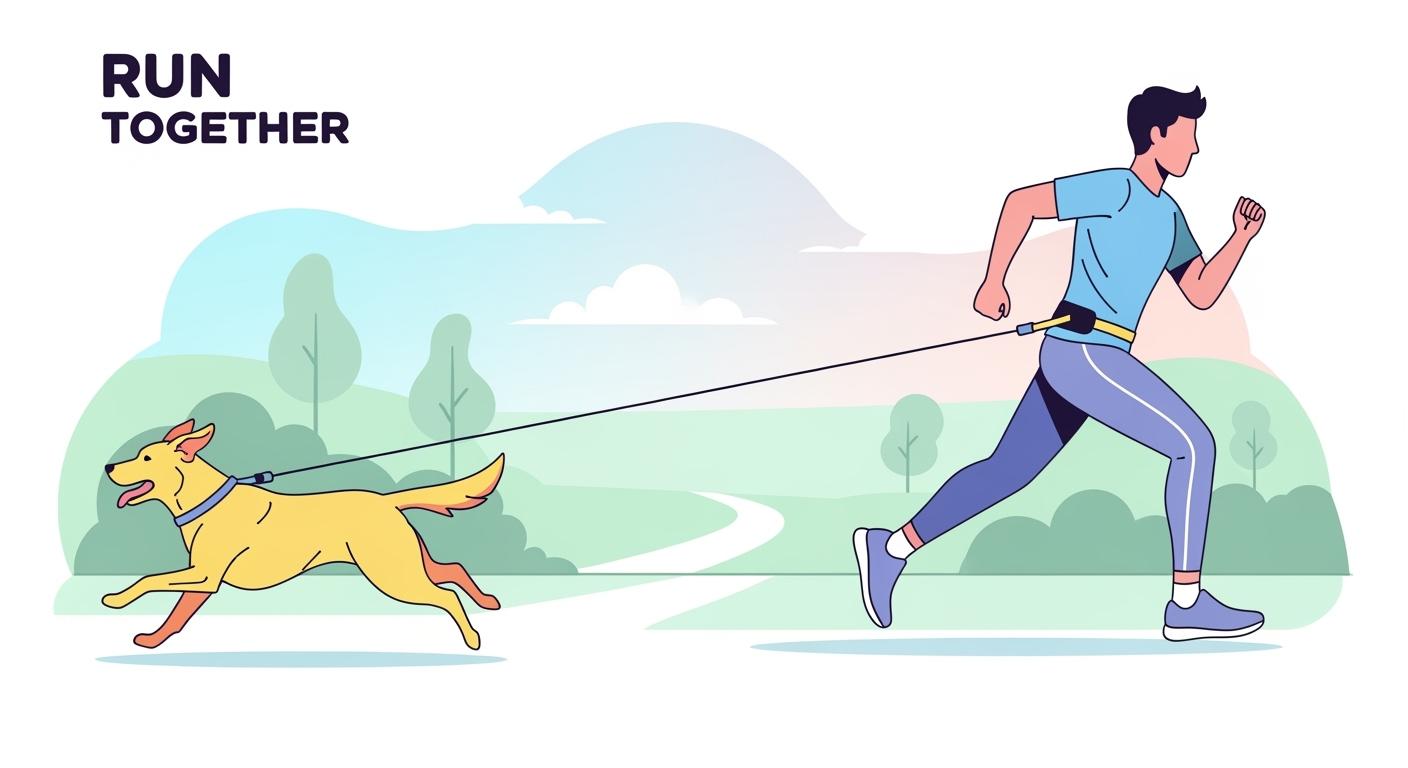
A hands-free dog leash for running puts the anchor point at your waist instead of your hand. That change sounds like it should keep the leash line away from your knees. But the attachment position alone does not decide the outcome. The leash geometry changes completely depending on where the clip sits, whether the belt resists rotation, and how fast you can shorten the line when the dog veers.
Most knee tangling during a run is not a length problem. It is an attachment-point problem. A leash anchored at the center-front of a waist belt sweeps across both knees when the dog crosses your path. A leash anchored at the hip with side control keeps the line in a controlled arc behind you. The same dog, the same distance. Different geometry. Different outcome.
Why Knee Tangling Happens With a Running Leash
A hand-held leash pivots from the shoulder joint. When the dog moves laterally, the line sweeps through a cone roughly 3 to 4 feet wide. If the arm is low or the leash runs long, the bottom of that cone passes at knee height. The runner clears the line by lifting the arm — but that breaks running form and fatigues the shoulder within minutes.
A belt-attached leash moves the pivot to the hip. That shifts the entire sweep zone lower and narrower. But here is where the geometry gets specific. If the clip is at the front — centered near the navel — a dog crossing from left to right pulls the leash diagonally across both shins. The pivot is fixed at midline, so the line has to cross the body to follow the dog. A hip-mounted clip changes that path. The leash swings through a smaller arc behind the runner’s back, not across the front of the legs.
The causal chain is mechanical, not behavioral. Lateral leash force applied at a front-center clip creates a moment arm that pulls the line across the frontal plane. The same force applied at a hip-mounted side-control clip produces a rotational load around the lumbar — the line tracks behind the back instead. The dog’s movement did not change. The attachment geometry did.
Tip: The fastest field check for leash-path problems is to glance down mid-run. If the leash line crosses in front of either knee at any point during a straight stretch, the attachment geometry — not the dog — is creating the hazard.
Three Failure Signals That Point to the Leash Setup
| Failure Signal | Likely Leash Design Cause | Better Design Direction |
|---|---|---|
| Leash swings at knee level on straight sections | Excessive line length or front-center clip | Shorter line, side-control hip attachment |
| Delayed response when dog changes direction | Too much bungee stretch before tension builds | Progressive-resistance bungee, quick-grab handle |
| Belt clip migrates forward during run | Belt rotates under lateral load | Wider belt with high-friction inner face |
Two of those three failures trace to the belt, not the leash itself. That is where most running leash designs break down. A bungee running leash with controlled stretch still fails if the belt attachment drifts out of position.
Side Control, Belt Stability, and the Arc the Leash Travels
Hip Attachment vs. Front-Center: Two Different Leash Paths
Side control keeps the leash attachment at the hip — roughly the 3 o’clock or 9 o’clock position. A dog running on that same side simply increases tension along the existing line without changing the leash angle relative to the leg. A dog crossing to the opposite side pulls the leash behind the runner’s lumbar, not across the front of the knees. The line tracks across the back, where it cannot interfere with the stride.
Front-center attachment cannot do this. When the dog crosses to either side, the line must pass across the body’s midline. It sweeps through the running lane every time. The wider the dog’s lateral movement, the larger the sweep.
But side control is only as good as the belt that holds it. A belt can be wide enough to feel stable when stationary, yet still rotate under dynamic lateral load. When the dog pulls sideways, the belt-clip assembly experiences torque around the vertical axis of the runner’s torso. The belt resists this through surface friction and body contour interlock. A 3-to-4-inch-wide belt with a textured or silicone-dotted inner face increases both the contact radius and the friction coefficient, raising the lateral-force threshold at which rotation begins. Narrow webbing with a smooth backing rotates under far less force.
In practice: Before committing to a belt, load it with a weight roughly matching your dog’s typical pull and jog in place for 30 seconds. Check whether the clip has migrated. If the clip moved more than an inch, the belt lacks the rotational stability to hold side control during a real run.
What Changes When the Clip Can Travel
A smooth-moving clip along the belt track is not a defect — when the track wraps around the hip, the clip can follow the dog’s position without pulling the belt out of alignment. A clip that drags or catches forces the belt to rotate with it. A swivel design prevents the leash from twisting as it moves, keeping the line flat and predictable.
What matters is whether the clip moves freely along the intended track while the belt stays anchored. Walking and running control setups that combine a wide, grippy belt with a low-friction clip track let the attachment follow the dog without rotating the whole system. That is the functional difference between a leash that stays behind you and one that ends up in front of your knees.
Quick-Grab Handle and Controlled Stretch: Two Systems That Must Agree
Handle Position Decides Whether You Can Reach It Mid-Stride
A quick-grab handle gives the runner manual override. The dog lunges at a squirrel. The handle lets you shorten the line instantly — no bending, no twisting, no breaking stride.
But handle position makes or breaks this. A handle placed at the midpoint of the bungee section requires reaching forward and down, pulling the shoulder out of alignment. A handle within 4 to 6 inches of the hip attachment can be reached by dropping the near hand to hip level. No torso rotation. No change in cadence.
Position alone is not enough. A flat nylon loop sewn flush against the bungee is hard to find by touch during a run. A handle with enough internal structure to hold its shape, or a contrast-texture surface, is findable without looking. That matters when your eyes are on the path ahead and the dog just veered.
Why Bungee Stretch and Handle Response Need to Match
A bungee that stretches too freely absorbs shock but delays re-tensioning. The dog gains an extra stride or two in the wrong direction before the line tightens enough for the runner to respond. A bungee that is too stiff transmits every micro-movement, fatiguing both runner and dog.
The design sweet spot is progressive resistance. Soft at initial elongation — the first 12 to 18 inches of stretch absorb small pace variations without tugging. Firmer as elongation increases — the resistance ramps to set a clear tension limit that the dog learns to read. This gives the runner a predictable window. When the bungee and handle work as one system, the dog feels the tension ceiling before the handle is needed.
| Bungee Behavior | Shock Absorption | Response Time | Knee Tangling Risk |
|---|---|---|---|
| Progressive resistance | Good on small surges, firms up on lunges | Predictable | Low |
| Too soft / linear stretch | High absorption, no tension limit | Delayed | High — dog gains distance before line tightens |
| Too stiff / minimal stretch | Low — shocks transfer to runner | Immediate but fatiguing | Medium — line stays tight but runner tires faster |
Running leash design is not about picking one feature over another. It is about whether the bungee’s tension curve, the handle’s reach, and the belt’s rotational grip all point toward the same outcome: a line that stays behind the runner at every pace change.
When a Hands-Free Running Leash Is Not the Right Setup
A hands-free running leash works within a specific movement envelope. It assumes the dog runs predominantly on one side, holds a consistent pace, and responds to tension cues. Outside those conditions, the design’s advantages reverse.
Dogs that weave continuously — crossing back and forth every few strides — defeat side control. No hip attachment keeps the line clear when the dog is on the left one moment and the right the next. The leash crosses the runner’s path regardless of where it starts, because the dog’s position changes faster than the belt system can track. For weave-prone dogs, a short handheld leash with active arm management may produce a cleaner line.
Trail running on narrow single-track presents another edge case. Side control keeps the leash at hip height, but on a 12-inch-wide path with vegetation on both sides, any lateral leash movement catches brush. A shorter fixed-length leash held in hand, with the dog running directly ahead, avoids snags that a belt system cannot prevent.
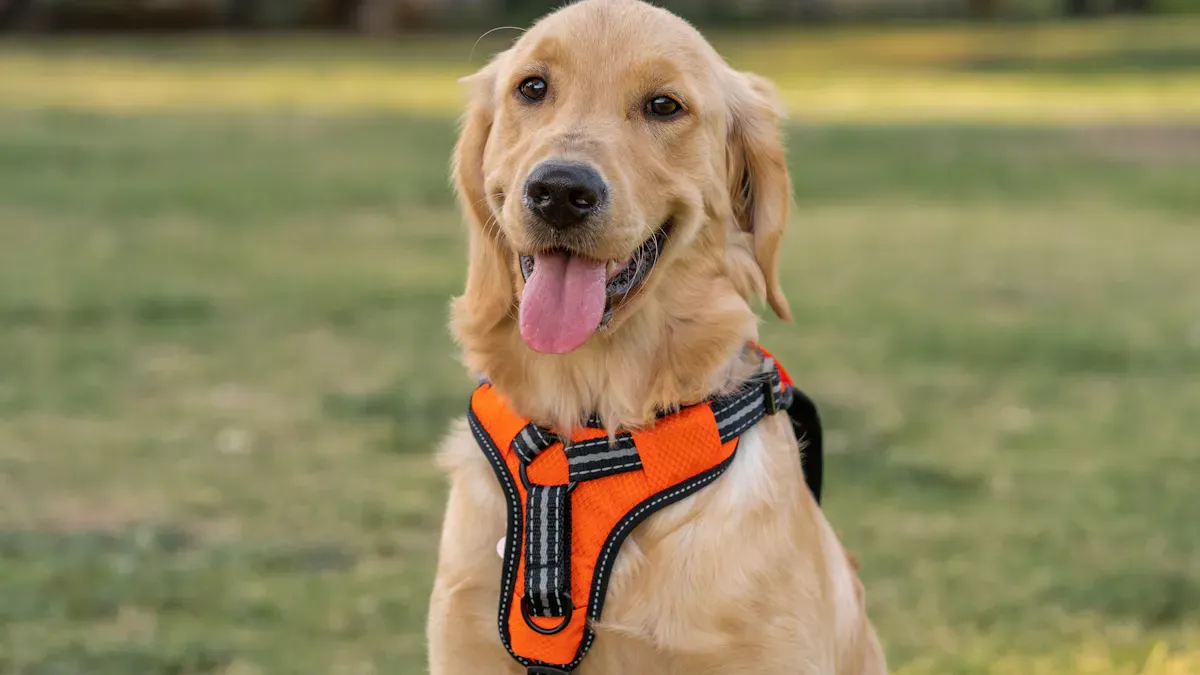
Small runners paired with large, strong dogs face a force-multiplication problem. The belt distributes pull across the hips and core — but if the dog outweighs the runner by a wide margin, sudden lunges can pull the runner off balance at the waist. A handheld leash lets the runner brace with arm and shoulder, creating a longer lever arm against the pull. Harness fit and material choice also shift how much of the dog’s force reaches the leash, and a harness that rides up under load amplifies the problem regardless of which leash type is used.
Disclaimer: The side-control and belt-stability checks described here assume a smooth-coated dog running on paved or packed-surface paths. Dogs with thick double coats may show less visible belt drift because fur adds passive friction that masks rotational instability. For double-coated breeds, check belt position by feel — place a finger on the clip at the start of the run and note its position relative to your hip bone. If that distance changes after 10 minutes, side control is degrading even if the belt looks stationary.
FAQ
How does a hands-free dog leash prevent knee tangling during runs?
A hip-mounted side-control attachment keeps the leash arc behind the runner’s back instead of sweeping across the frontal plane. When the dog moves laterally, the line tracks across the lumbar region, not the knees. A front-center belt clip cannot produce this path — any lateral dog movement pulls the line diagonally across both shins.
Why does belt stability matter more than leash length?
Even a short leash crosses the knees if the belt clip rotates from hip to navel under lateral load. The belt is the anchor. If it shifts, the entire leash geometry changes. A wide belt with a high-friction inner face resists the rotational torque that sideways dog pull creates, keeping the clip at the hip where the line stays behind the runner.
Can a bungee leash make knee tangling worse?
Yes, if the bungee has linear stretch with no progressive resistance. The dog surges, the bungee extends fully, and the runner loses the ability to re-tension the line quickly. The dog gains ground in the wrong direction before the runner can respond. A progressive-resistance bungee — soft initially, firmer as it elongates — gives the dog a tension ceiling without stealing response time from the runner.
Where should the quick-grab handle be placed on a running leash?
Within 4 to 6 inches of the hip attachment. This lets the runner reach it by dropping the near hand to hip level — no bending, no shoulder rotation, no change in stride. A handle placed farther down the bungee section forces the runner to reach forward and down, breaking running posture at the exact moment control is needed most.






