
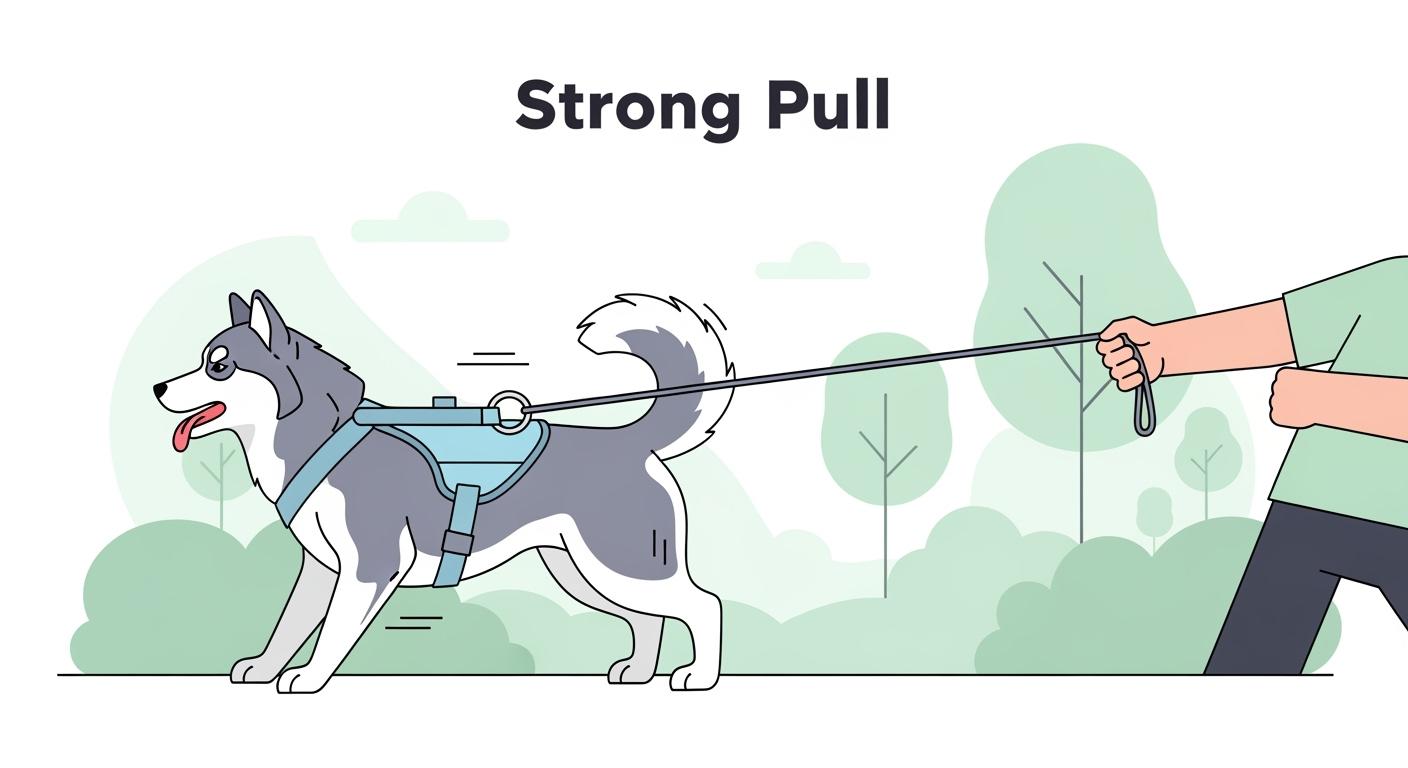
A Husky leans forward, the leash goes tight, and the walk turns into a tug-of-war. Many owners reach for a harness expecting better control—then discover the dog pulls with even more power than before. The issue is not the dog. It is where the leash attaches. A back-clip harness channels pulling force straight through the dog’s body, giving a strong breed the mechanical advantage to drive forward. Change the clip point, and you change where that force goes.
Why a Back-Clip Harness Amplifies a Husky’s Natural Drive
The Sled-Dog Instinct Is Built Into the Breed
Huskies were bred to pull—over long distances, in harsh conditions, with steady forward pressure. That instinct does not disappear on a neighborhood sidewalk. When a Husky feels resistance behind them, the response is not to slow down. It is to lean in and push harder. The right equipment either works with that biomechanics or fights against it. A harness that anchors the leash behind the shoulders mimics the feel of a sled line. The dog drops its weight, engages its chest, and drives. The design itself reinforces the behavior it is meant to solve.
In practice: A harness that feels comfortable at a standstill can still give a Husky the leverage to pull at full strength the moment the walk starts. Static fit and dynamic performance are two different things.
How the Back-Clip Force Path Works Against You
With a back-clip attachment, the leash pulls from a point high on the dog’s back. Force travels in a straight line from the handler’s hand through the leash to the rear attachment, letting the dog push against the chest strap like a sled dog pushing into a tow line. The harder the dog pulls, the more the chest panel distributes that load across the shoulders—which only makes the pulling more comfortable and more sustained. This is why the wrong harness can turn a manageable walk into a constant battle for control. The dog is not being stubborn. The design is rewarding the forward drive.
- Back-clip placement supports straight-line pulling with minimal resistance.
- The chest panel spreads the load, removing the discomfort that would otherwise discourage pulling.
- The leash pulls from behind, so the dog keeps moving forward rather than turning to reorient.
A harness that redirects force rather than channeling it rearward changes the dynamic. Front-clip and dual-clip designs alter the direction of leash tension so the dog’s own forward motion turns them slightly toward the handler. That shift is small mechanically but significant in practice—it interrupts the straight-line drive without restricting the dog’s natural stride.
Where the Force Goes When the Clip Point Changes
Front-Clip Mechanics: Turning Forward Drive Into a Pivot
When the leash attaches at the chest instead of the back, pulling no longer produces a straight-line result. The dog lunges forward, the leash tension pulls from the front, and the dog’s own momentum rotates its body toward the handler. It is not a correction. It is a redirection—the dog’s forward energy gets steered, not blocked. For a strong breed like a Husky, this matters. Blocking a sled dog’s drive with raw arm strength is a losing proposition. Redirecting it through geometry is not.
Front-clip designs work best when the chest strap sits high enough to avoid the shoulder joint and stays in place under load. If the strap slides down toward the dog’s legs, the redirection effect weakens and the harness can chafe. This is where chest strap stability under tension matters more than padding thickness at rest.
Dual-Clip Designs: One Harness, Two Force Paths
A dual-clip harness gives two attachment points—front and back—and lets the handler choose based on the situation. On a quiet trail where the dog walks calmly, the back clip offers relaxed, tangle-free movement. On a busy street where sudden lunges are likely, the front clip provides the redirection needed for better control during brief, high-tension moments. The design advantage is not that one clip is better. It is that the handler can match the attachment point to the environment without switching gear.
But the dual-clip design carries a trade-off: more hardware means more potential failure points. The front ring needs solid reinforcement stitching—a ring that tears out under a sudden lunge from a 50-pound Husky renders the harness useless at the moment it is needed most. The back ring on a dual-clip harness also sits farther forward than on a pure back-clip design, which changes the force angle slightly even in back-clip mode.
Sport Pulling Harnesses vs. Walking Harnesses: Two Completely Different Tools
A Husky in an X-back pulling harness doing canicross or bikejoring is doing exactly what that harness was built for. The long, padded design keeps pressure off the throat, gives full shoulder rotation, and lets the dog drop into a pulling posture without restriction. That is not a design flaw. It is the entire point. Using that same harness for a sidewalk walk, however, means handing a strong dog the ideal tool to drag a handler down the block.
Walking harnesses prioritize a different set of design goals: limited forward leverage, the ability to redirect, and visibility in traffic. Sport harnesses are built for sustained forward drive. A well-designed everyday harness includes features like reflective strips and adjustable strap positions that a sled harness does not need. The choice is not about which is the better product. It is about which activity the dog is doing.
Where the line gets blurry is with dogs that do both—a Husky that runs canicross on weekends but walks on sidewalks during the week. The answer is almost always two separate harnesses. A sport harness that controls pulling on a sidewalk would compromise the shoulder freedom needed for running. A walking harness used for canicross would restrict the stride and potentially chafe under sustained load. Different force paths, different design requirements. Matching the harness type to the activity matters more than buying one product that claims to do both.
Fit at Rest Tells You Almost Nothing About Performance Under Load
The two-finger test—sliding one or two fingers between the strap and the dog’s body—checks whether the harness is dangerously tight at a standstill. It does not check whether the chest panel will slide sideways when the dog lunges, whether the shoulder straps will ride up and rub the armpits, or whether the back strap will shift and let the dog twist out. Those failures only appear in motion.
Watch the dog walk for ten minutes. Look for the chest strap drifting toward one side, which indicates uneven tension in the adjustment points. Watch for the back strap pulling toward the tail, a sign that the harness is riding backward under load. Check the armpit area after the walk—redness or ruffled fur there means the strap edge is sawing against the skin with each stride. A harness that passes all three checks during actual movement is more reliable than one that simply feels snug at rest.
Padding adds comfort, but padding alone does not reduce pulling force. A thickly padded back-clip harness is still a back-clip harness—the dog pushes into the cushion and keeps driving. The design of the force path matters more than the softness of the materials along that path. Steady pullers and sudden lungers put different kinds of stress on a harness, and a design that handles one may fail under the other.
FAQ
How do you know if a harness fits correctly for a pulling dog?
Slide one or two fingers under each strap at rest, then watch the dog walk for several minutes. If the chest panel stays centered, the back strap does not ride toward the tail, and there is no redness or fur disruption at the armpits after the walk, the fit is working. Recheck fit after the first few walks—straps can settle and loosen as the fabric breaks in.
Can a back-clip harness ever work for a Husky?
A back-clip harness works for a Husky that already walks on a loose leash. If the dog does not pull, the back clip offers tangle-free movement and simplicity. For a Husky that pulls, the same design gives the dog a mechanical advantage that makes the pulling worse. The harness is not the problem—the mismatch between the design and the dog’s behavior is.
Why does a Husky pull harder in a harness than on a collar?
A collar concentrates pressure on a small area of the neck, which creates discomfort that can discourage pulling—at the cost of potential trachea damage. A harness spreads the same pulling force across the chest and shoulders, removing that discomfort. The dog feels no negative feedback from pulling, so it pulls with more sustained force. A front-clip harness reintroduces a redirecting force without concentrating pressure on the throat.
What is the difference between a sport pulling harness and a no-pull walking harness?
A sport pulling harness is designed to make pulling comfortable and efficient—long body coverage, unrestricted shoulder movement, and a rear attachment that keeps the line clear of the dog’s legs. A no-pull walking harness uses a front attachment point to redirect forward momentum, turning the dog’s own pulling force into a pivot toward the handler. Using one for the other’s purpose creates frustration for both dog and handler.
How often should harness fit be checked?
Check before and after the first few walks, then weekly after that. Dogs gain and lose muscle with seasonal activity changes, and nylon straps stretch slightly over the first month of use. A harness that fit perfectly in November may sit differently by February if the dog’s winter activity level changes its build.






