
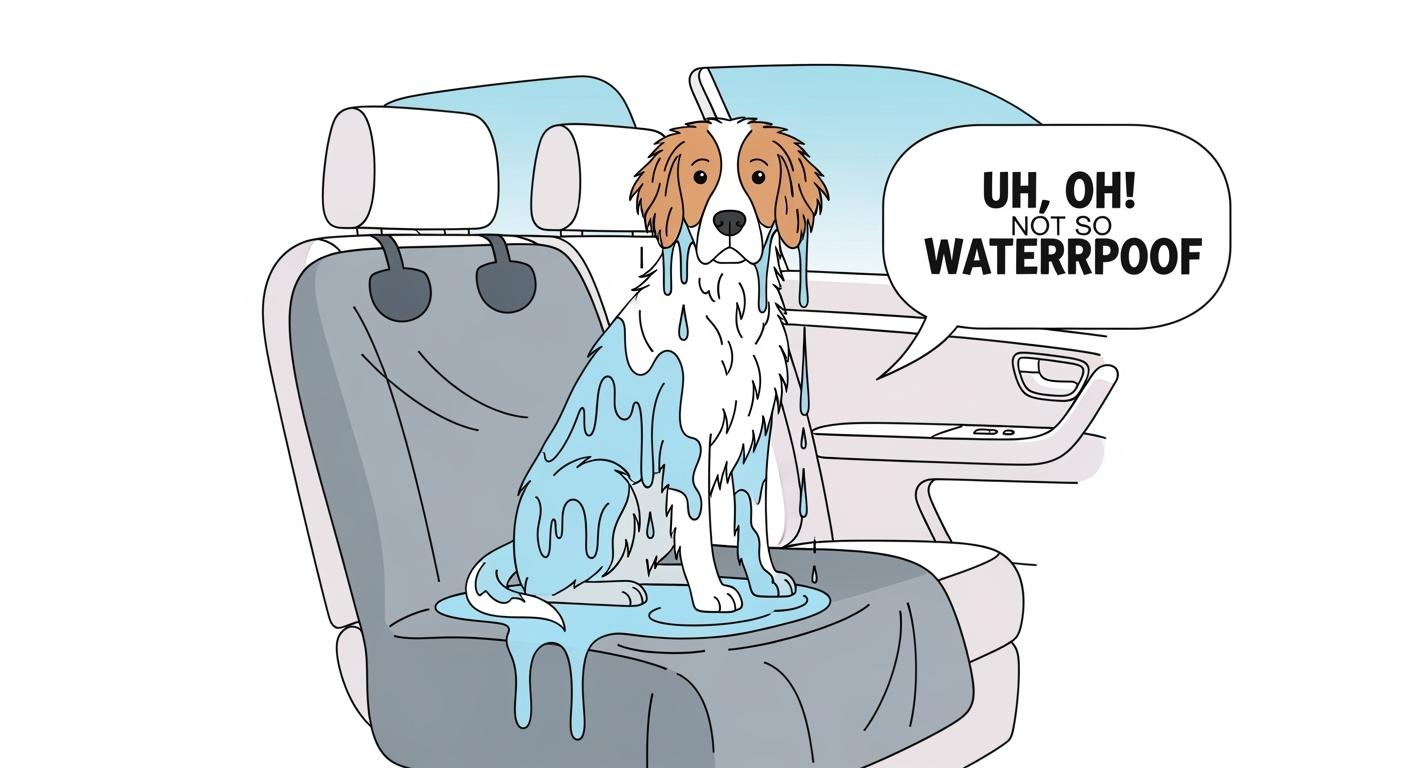
A wet dog jumps onto the back seat. The cover says “waterproof.” Ten minutes later, the seat underneath is damp. Not soaked through the middle — wet at the seams, wet near the edges, wet where the dog was actually sitting. The word on the label promised something the construction could not deliver.
Most failures trace back to the same root cause: surface repellency is not seat protection. Water beads on top, but the dog’s body weight — concentrated under hips and shoulders — generates enough pressure to drive moisture through a single layer of coated fabric. A cover that repels a splash can still fail under sustained load from a 60-pound dog lying in one spot. The difference between a cover that works and one that does not comes down to how it handles pressure, not how it handles a light spray.
This article explains which design features separate surface water resistance from real seat protection — and under what conditions even a well-built car seat cover reaches its limit.
Why Body Weight Defeats Surface-Only Waterproofing
The failure mechanism is mechanical, not chemical. When a wet dog lies down, water is trapped between fur and fabric. Body weight creates downward pressure — roughly 2 to 4 psi under the hips of a medium-sized dog depending on posture and contact area. That pressure drives moisture into the cover’s surface with more force than most spray-rated coatings are designed to resist.
Here is the causal chain: pressure compresses wet fur against the top layer → water penetrates the surface weave or coating micro-fractures → without an impermeable mid-layer barrier, moisture travels through the thickness of the fabric → the seat upholstery underneath absorbs it. A single-layer cover — even one with a DWR (durable water repellent) finish — offers nothing to stop this progression once the surface gives way. The coating delays entry. It does not block it.
You can verify this yourself. After the next wet walk, before wiping the cover down, press a dry paper towel firmly against the area where your dog was sitting for 10 seconds. If the towel comes away damp, water has already moved past the surface layer. That cover is water-resistant. It is not waterproof in any meaningful sense of the word. A cover with true seat protection leaves the paper towel dry after the same test — the barrier layer stopped the moisture before it could reach the wiping surface.
The same pressure dynamic explains why water pools in dips, folds, and low spots where the cover sags. These areas collect runoff from the dog’s fur and hold it in sustained contact with one patch of fabric. Without a waterproof backing layer underneath, that pooled water has minutes — not seconds — to seep through.
Waterproof vs. Water-Resistant: A Construction Difference, Not a Marketing One
Surface resistance relies on a coating or tight weave that makes water bead. Under zero pressure, it works. Under body weight, the same coating can fail in under a minute. Real waterproofing requires a separate impermeable membrane or laminated backing bonded beneath the top layer — a physical barrier that water cannot pass through regardless of how much pressure is applied from above.
The distinction matters at every weak point on the cover:
- Seams: Stitched seams puncture the waterproof membrane unless sealed with tape or thermal bonding. An unsealed seam under a dog’s hip is a direct channel to the seat.
- Edge gaps: Water that runs off the dog’s sides follows gravity to the seat bolsters. If the cover stops at the flat seating surface, the bolsters are unprotected.
- Seatbelt and anchor openings: Every cutout in the cover is a potential entry point. Tight grommets or elastic surrounds around these openings prevent water from following the belt path down to the upholstery.
Note: A cover with sealed seams and a waterproof mid-layer membrane can still leak at the edges if the fit is loose. Waterproofing is a system — fabric, seams, and fit all have to work together. One weak link breaks the whole chain.
Construction Features That Determine Whether a Cover Holds or Leaks
A cover built in three distinct layers — liquid-shedding top, waterproof mid-membrane, grip-stable bottom — solves the pressure problem at the material level. The top layer handles abrasion and surface water. The middle membrane is the true barrier: water cannot pass through it regardless of pressure, which means even when the top layer is saturated and compressed, the seat underneath stays dry. The bottom layer provides structural stability and grip so the cover does not shift under load.
This matters in production too. Laminated three-layer fabrics allow the waterproof membrane to be bonded continuously across the entire cover surface — no gaps, no separate pieces that need post-seaming. The result is fewer failure points compared to covers where a waterproof coating is sprayed onto a single fabric sheet after cutting. That post-applied coating can thin at fold lines and wear unevenly across high-friction zones like the area under a dog’s front paws.
Sealed Seams vs. Stitched-Only Construction
Every needle puncture through a waterproof membrane is a leak waiting to happen. Stitched-only seams leave thousands of microscopic holes along every sewn line. Under a wet dog’s weight, water finds these holes within seconds. Seam sealing — either through heat-welded tape applied over the stitch line or through the use of a waterproof adhesive strip bonded from the underside — closes each puncture point.
Controlled seam placement matters just as much. Seams that run directly under the highest-pressure zones — where hips and shoulders rest — experience more sustained moisture exposure than seams placed at the cover’s perimeter. A design that routes major seam lines away from the center seating area reduces the total number of leak points in the zones that matter most.
| Construction Feature | Why It Matters | Where It Falls Short |
|---|---|---|
| Multi-layer with bonded membrane | Stops water under sustained body-weight pressure | Heavier and takes longer to air-dry than a single-layer cover |
| Sealed or taped seams | Closes every needle puncture along stitch lines | Tape can delaminate after repeated machine washing if not heat-bonded properly |
| Full side and edge panels | Protects seat bolsters and door-side edges from runoff | Adds installation time; requires more anchor points to stay in place |
| Non-slip rubberized backing | Prevents cover shift that exposes seat gaps under a moving dog | Rubber backing degrades faster in direct summer heat if the car is parked outdoors daily |
| Wipe-clean top surface | Sheds water fast; dries between trips without trapping moisture | Smooth tops provide less paw grip for dogs that are anxious during car rides |
Full Edge Coverage and Tall Side Panels
Water does not stay on the flat part of the seat. It runs off the dog’s sides, follows gravity to the bolsters, and collects in the gap between the seat cushion and the door sill. A cover that only protects the seating surface leaves these paths wide open. Tall side panels that extend up the seat back and wrap over the front edge create a continuous barrier — water would have to travel upward to escape, which gravity does not allow.
Check this after a rainy drive: unbuckle the cover at one corner and run your hand along the seat bolster underneath. If you feel dampness, the side coverage is insufficient — water is routing around the edge and wicking inward. The fix is not a thicker cover; it is a wider cover with deeper side flaps that tuck into the seat crevice.
Non-Slip Backing That Holds Under a Moving Dog
A cover that slides forward three inches during a drive has just created three inches of exposed seat. Non-slip backing — typically a grid of silicone or rubberized dots bonded to the underside — keeps the cover planted. The mechanism is friction: the dot pattern creates hundreds of small high-friction contact points against the seat fabric or leather, resisting the shear force from a dog shifting position.
Seat anchors add a mechanical hold beyond friction. Cylindrical anchors pushed deep between the seat back and cushion act as chocks — they resist forward pull because the anchor is wider than the gap it sits in. Combined with non-slip backing, this two-mode retention (friction + mechanical interference) keeps the cover stationary even when a dog scrambles in from the door side.
Tip: A cover with a dense polyester microweave or coated ripstop top surface dries faster than plush or quilted tops. After a wet walk, a wipe-clean surface can be dry in 15 minutes with a towel; an absorbent top stays damp for hours and keeps pressing moisture downward.
When a Waterproof Seat Cover Is the Wrong Solution
No car seat cover blocks every drop in every condition. Recognizing the limits of the design prevents misuse — and prevents blaming the cover for a mismatch between the tool and the job.
Extended submersion is outside the design scope. If a dog is soaking wet from a full swim — not just damp from a rainy walk — the volume of water released over a 30-minute drive exceeds what any seat cover can contain through evaporation and barrier action alone. In that scenario, a contained booster-style seat with a raised rim may channel water more effectively than a flat bench cover, since it pools liquid in a smaller, deeper basin rather than spreading it across the full bench.
Double-coated breeds present a different challenge. A husky or golden retriever holds significantly more water in its undercoat than a short-coated breed of the same weight. The water release is slower and more sustained — it drips out over 20 to 30 minutes rather than shedding in the first five. This extended release period means the cover’s top surface stays wet longer, which increases the odds of seep-through at any weak point. The same cover that keeps a Labrador’s seat dry may show dampness under a husky on an identical route.
Frequent deep-cleaning cycles also degrade waterproofing over time. Machine washing with detergent gradually strips DWR coatings and can delaminate seam tape. A cover that gets washed weekly may lose meaningful water protection within six months, not because the design was flawed but because the maintenance cycle exceeds what the construction was spec’d for.
Disclaimer: This assessment assumes a smooth-coated or moderately-coated dog in typical post-walk wet conditions — damp fur, muddy paws, light to moderate dripping. Double-coated breeds in full saturation or dogs returning from a swim may exceed any seat cover’s barrier capacity. If the dog’s coat retains water longer than 10 minutes after leaving the rain, pair the cover with an absorbent top-layer mat that can be swapped out mid-trip to keep the pressure-driven moisture load within the cover’s design limits.
FAQ
How can I tell if my current car seat cover is actually waterproof or just water-resistant?
Run the paper towel test described earlier: after a wet walk, press a dry paper towel firmly against the area where the dog sat for 10 seconds. If the towel is damp, water has moved past the surface. That cover is water-resistant, not waterproof. A second check: pour two tablespoons of water onto an empty spot on the cover and let it sit for five minutes without the dog’s weight on it. If the seat underneath is dry, the cover has a working barrier — but this only confirms static waterproofing. The paper towel test under real body weight is the harder, more useful check.
Can machine washing damage a waterproof car seat cover?
Yes, over time. Detergent breaks down DWR surface coatings, and the agitation cycle stresses seam tape bonds. Most manufacturers recommend cold water, mild detergent, and air drying for a reason — heat and harsh detergents accelerate barrier degradation. If a cover needs weekly washing, expect to reapply a DWR spray treatment every three to four months to maintain surface repellency. The waterproof mid-layer membrane is less affected by washing than the surface coating, but seam tape delamination remains the weak point after repeated cycles.
Why does water still get through at the sides even if the middle of the cover stays dry?
Side leakage almost always means insufficient edge coverage or a loose fit that leaves the seat bolsters exposed. Water runs off the dog laterally, hits the cover surface, and follows gravity to the lowest point — which is the gap between the seat cushion and door sill. If the cover does not wrap upward over the bolsters with enough height to contain that runoff, water spills over the side edge and onto the seat. A full-coverage seat protector addresses this with tall side panels that extend a few inches above the bolster line.
Does a non-slip backing really make a difference for waterproofing, or is it just about keeping the cover in place?
It directly affects waterproofing. A cover that slides forward even two inches during a drive exposes a strip of unprotected seat at the rear edge. Water that pools at the back of the cover now has a clear path to run over the exposed edge and into the seat crease. Non-slip backing keeps the cover positioned so the waterproof barrier stays between the dog and every inch of the seat it was designed to protect. Movement defeats the barrier regardless of how good the materials are.
Do I need a different type of cover for a dog with a double coat?
A double-coated dog releases water more slowly — the undercoat acts like a sponge and drips for 20 to 30 minutes rather than shedding moisture all at once. A standard waterproof cover still protects the seat, but the sustained wetness means you will need to check the surface more frequently during long drives and may benefit from pairing the cover with a quick-drying top-layer mat that can be removed and wrung out at rest stops. The cover itself does not need to be different — but the maintenance rhythm does.






