
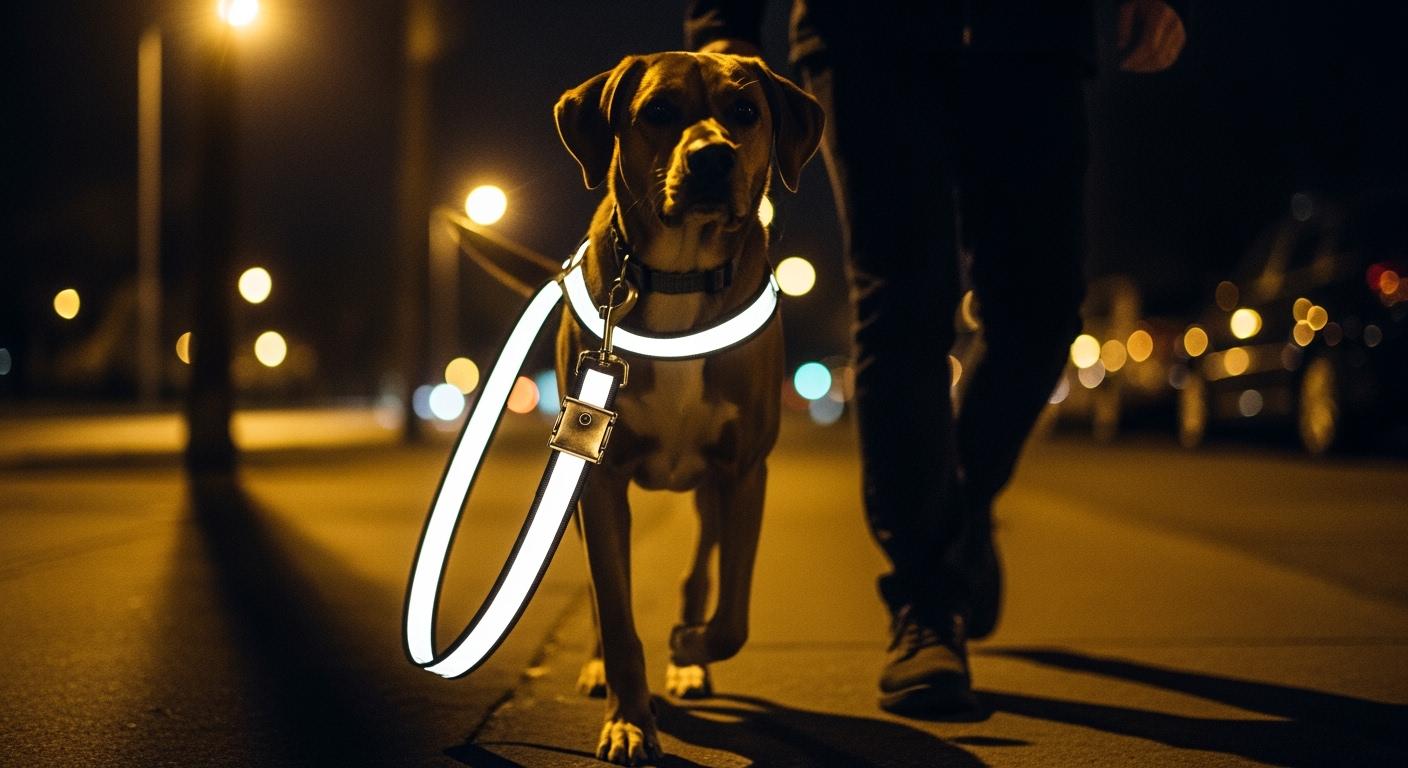
A reflective dog leash for night walks earns its value at 45 degrees. Head-on — any reflective strip works. A driver approaching from a side street, headlights raking across the leash at an oblique angle — that is where the design either holds or fails. The difference between a visible line and a dark strap comes down to two things: how wide the reflective surface is, and whether the hardware blocks it.
Thin reflective thread photographs well under a direct flash. On a dark street, with the dog pulling left and the leash hanging diagonal, it can vanish from a driver’s view. Wider panels change the geometry. More surface area means more angles catch headlight beams and return usable light. That extra fraction of a second of recognition is what separates a close call from a routine nighttime crossing.
In practice: Width is not just about brightness. It is about redundancy. If one segment of a narrow strip gets shadowed by your hand, the leash fold, or the dog’s body, a wider panel still has exposed surface somewhere along the line — and that surviving reflection may be the one a driver catches.
| Design difference | Why it matters | Main limitation | Where it works |
|---|---|---|---|
| Wide reflective stitching | Visible from front, side, and rear; redundancy if one segment blocked | Can be shadowed by heavy hardware placed over it | Night walks, running, street crossings |
| Thin reflective thread | Low-profile look; adds almost no weight | Disappears at side angles; single failure point for visibility | Daytime or well-lit paths |
| LED light section | Active light source visible in total darkness | Adds bulk; depends on battery charge; brightness uneven along tube | Rural unlit roads, trail walking |
| Heavy buckle near clip | Strong attachment point | Pulls leash downward; physically blocks reflective surface; adds swing | Short stationary holds with large dogs |
Why Wider Reflective Stitching Catches Light That Thin Thread Misses
The angle problem narrow strips cannot solve
Reflective materials work by retroreflection — they bounce incoming light back toward its source. But retroreflective efficiency drops sharply as the angle between the light source and the surface moves away from perpendicular. A 0.5 mm reflective thread presents a near-zero-profile target when viewed from the side. Headlights approaching from 30 or 45 degrees off-axis may hit the thread at a glancing angle that scatters most of the reflected light away from the driver.
A wider reflective band — typically 25 mm or more — maintains a larger effective cross-section at oblique angles. Even when the leash hangs diagonal across the handler’s body, or the dog pulls ahead and the leash line tilts, part of that wider surface remains oriented close enough to perpendicular to return a visible flash. This is not about thread quality. It is surface geometry. The same retroreflective coating on a wider substrate produces a larger angular sweet spot. That is the causal chain: wider substrate → larger effective retroreflective cross-section at off-axis angles → shorter driver recognition distance → more reaction time.
The same geometry applies to reflective coverage on walking equipment more broadly — harness panels that wrap around the chest stay visible from the side in ways that a single narrow strip on the back cannot match.
Sidewalk-to-street transitions
Urban night walks involve frequent angle changes. You step off a curb, the dog moves ahead toward a scent, the leash line shifts from vertical to diagonal. A narrow strip that was catching streetlamp light a moment ago now faces the pavement. A wider panel — because it wraps more circumference around the leash body — still presents reflective area to the driver approaching from the side street.
After a 10-minute walk, stop under a streetlamp and check the leash from your dog’s side view at 20 feet. If the reflective line is clearly visible at a 45-degree angle, the panel width is adequate. If it disappears at that angle, the reflective surface is too narrow for off-axis visibility regardless of how bright it looked head-on.
How Buckle Weight and Position Undo Reflective Coverage
When the buckle casts a shadow over the reflective strip
A heavy metal buckle placed directly over or adjacent to the reflective band does two things. First, it physically occludes the reflective surface — the buckle body itself blocks light from reaching that segment. Second, its mass pulls the leash line downward, rotating the reflective surface toward the ground instead of toward oncoming headlights.
The leash line is a tension member. Add a concentrated mass near the clip end and it becomes a pendulum under motion. Each stride introduces a small lateral swing. That swing cycles the reflective panel in and out of sight — visible for part of the arc, dark for the rest. A driver scanning the road may catch the gap, not the flash.
Walk your dog past a reflective storefront window at night and watch the leash line. If the hardware causes the leash to bounce or twist with each step, that instability is cutting your visible window in half. This is one reason steady leash geometry during walks matters for both control and visibility — the two are not separate problems.
Hand feel and control during motion
Hardware weight affects more than reflection. It changes how the leash transmits force. A heavy clip at the dog end creates lag in tension feedback — the handler feels the pull a split second later because the mass must accelerate before the webbing tightens. That delay, though small, matters when a dog lunges. Lighter hardware shortens the feedback loop.
Note: A leash with wide reflective panels and minimal hardware weight improves control and visibility in the same design choice. The two are not independent — balanced hardware serves both goals at once.
Runners feel this more acutely. A leash that swings and bounces with each stride forces the hand to micro-adjust grip continuously. After a mile, that accumulates into hand fatigue. The design fix is not a thicker handle — it is less mass at the far end of the leash where leverage amplifies every swing. A leash built for running typically uses lighter hardware for exactly this reason, and that same lightness happens to preserve reflective line consistency under motion.
Where Wider Panels Cannot Save the Situation

Dirt, wear, and fading
Reflective panels depend on a clean, intact retroreflective surface. Mud, road grime, or salt residue from winter sidewalks can coat the glass beads or prismatic film and scatter light instead of returning it. A leash dragged through wet grass on one walk may lose half its reflective efficiency until cleaned. Wider panels resist this better — more surface means partial occlusion still leaves some reflective area functional. But the cleaning discipline still matters.
After a wet or muddy walk, wipe the reflective band with a damp cloth and check it under a flashlight from 30 feet away. If the returned brightness is visibly dimmer than a clean section, the panel needs attention before the next night walk.
Extreme angles and complete darkness
No reflective surface works without a light source to bounce back. On an unlit rural road with no streetlamps and no approaching vehicle, the leash is invisible regardless of panel width. This is the condition where LED strips have a genuine advantage. The trade-off is bulk and charging dependency.
| Design difference | Why it matters | Main limitation | Where it works |
|---|---|---|---|
| Wide reflective panels + light hardware | Passive visibility across wide angle range; no charging; low bulk | Zero visibility in total darkness with no light source | Urban and suburban night walks, dawn, dusk |
| LED strip + reflective combo | Active light in pitch darkness; reflective backup if battery dies | Added weight; stiff feel; charging port can fail; brightness often uneven | Rural unlit roads, trail walking after dark |
| Heavy-duty buckle + narrow thread | Strong hardware for large dogs | Hardware shadows the thread; narrow strip not visible off-axis; heavy feel | Short daytime hold-and-release use |
Disclaimer: These visibility checks assume a smooth-coated dog and a handler of average height holding the leash at waist level. Dogs with very thick or dark coats may obscure the reflective panel along sections that press against fur — the panel is still reflective, but the fur acts as a partial mask. In those cases, check visibility from the handler side and the dog side separately. If the dog’s breed falls far outside typical chest and neck proportions — particularly barrel-chested breeds or dogs with very deep keels — the leash line may hang at an angle that was not anticipated in standard design testing, and visibility patterns described here may not hold.
Low-Bulk Design for Running and Repeated Night Use
Why less hardware means more consistent visibility
A low-bulk reflective leash integrates the reflective material into the webbing itself rather than attaching it as a separate strip that can peel or shift. This integrated construction keeps the reflective surface aligned with the leash body under tension — no twisting, no sliding, no gaps. When paired with lightweight buckles — typically acetal or aluminum instead of cast zinc — the entire leash stays within a few grams of its non-reflective counterpart. The reflective feature adds visibility without adding inertia.
Reflective leashes built with this balance of width and weight tend to use the panel as the primary visibility feature, not an add-on. That matters for runners who cover distance, for handlers who walk multiple dogs, and for anyone who uses the leash more than once a day.
Waist-worn and hands-free visibility checks
A waist belt with a reflective leash line creates a horizontal visual signature at roughly hip level — a distinct line that differs from the vertical profile of a standing person. Drivers recognize that horizontal band as “dog and handler” faster than a single vertical stripe. The same hardware-weight principle applies: a heavy buckle at the belt attachment can cause the leash to sag between waist and dog, dropping the reflective line below the headlight beam plane of lower vehicles. Light hardware keeps the leash line tauter, keeping the reflective surface at a more consistent height and angle.
Getting the equipment fit right on the handler side — whether the leash runs from hand, waist, or shoulder — changes which angles the reflective line presents to traffic. A line that works well handheld may point at the ground when worn at the waist. Test both positions.
After setting up a waist-worn leash, walk past someone standing 50 feet away holding a flashlight at car-headlight height. Ask whether the reflective line stays visible through a full stride cycle. If it dips out during the forward step, the hardware is too heavy or the attachment point too low.
Note: A leash designed for running should feel as close to not-there as possible. Anything that reminds you of the leash during a stride — bounce, twist, drag — is also degrading the reflective line. How a leash performs during a run often mirrors how it handles visibility under motion more broadly.
FAQ
Does wider reflective stitching actually matter, or is any reflective thread enough at night?
Width changes the angular range. A 0.5 mm thread reflects strongly when perpendicular to the light source and fades quickly at side angles. A 25 mm panel maintains a usable reflective cross-section across roughly 120 degrees of approach angle. The difference in driver recognition distance at a 45-degree side angle can be the length of a parked car — enough to change the outcome at a crossing.
Do LED leashes eliminate the need for reflective panels?
LED leashes provide active light in total darkness — a reflective panel cannot do that. But LEDs introduce different failure points: battery life, charging port durability, uneven brightness along the filament, and the stiff feel from a plastic light tube bonded to webbing. A reflective panel with no electronics works whenever headlights hit it and requires no preparation. The two designs cover different conditions, not the same condition better.
How does buckle weight affect visibility if the reflective strip is elsewhere on the leash?
Weight at the clip end changes the leash line geometry regardless of where the reflective strip sits. A heavy buckle pulls the leash into a deeper sag, rotating the reflective surface downward. It also introduces swing momentum — each stride produces lateral oscillation that cycles the reflective panel in and out of the driver’s line of sight. Even if the buckle does not directly cover the panel, its mass changes where the panel points under motion.






