
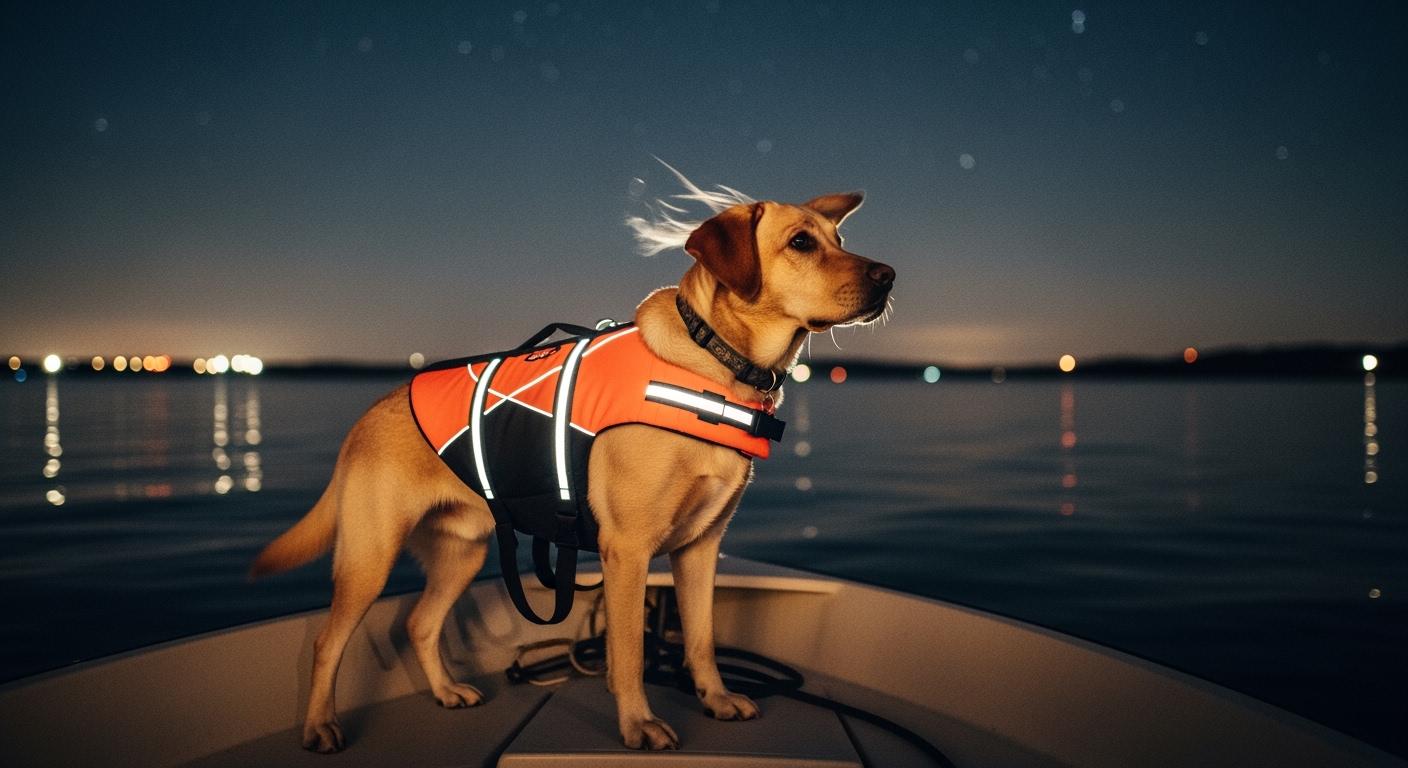
Reflective trim on a dog life jacket sounds straightforward. Stitch on some shiny strips. Done.
That fails fast on real water.
The trim only works when light hits it at the right angle, from the right direction, and the vest has not rotated out of position. On a dock at noon, none of this matters. At dusk with glare off the water and a dog turning in a current, it is the only thing that matters. A dog life jacket with reflective trim is only as good as its placement geometry and the fit that keeps that geometry locked in place.
When Back-Only Reflective Trim Leaves a Dog Invisible
Most dog swim vests place reflective trim along the spine. That works when the dog paddles straight away from you on calm water under a dock light directly overhead.
Real conditions rarely cooperate.
A dog turns. A wave rolls between you. The boat shifts and your sightline drops to water level. In each case, a back-only reflective strip rotates out of the light path and disappears. The physics is simple: a reflective surface returns light only when the angle of incidence matches the observer’s line of sight. Retroreflective materials widen that window, but they cannot bend light around the dog’s body. If no reflective surface faces the light source, no reflection reaches your eyes.
The design difference that matters is edge-to-edge trim coverage. When reflective material wraps around the side panels and lower edges, at least one reflective surface stays oriented toward a light source regardless of the dog’s position. A flashlight sweep from shore level hits side trim even when the back faces away. Boat-mounted lights catch edge trim when the dog swims perpendicular to the hull. The material and sizing choices behind a life jacket shape whether that coverage exists at all.
You can verify this before ever getting on the water. In a dark room, aim a flashlight at the vest from floor level while someone rotates it slowly. Count how many positions produce a visible reflection. A vest with only back trim goes dark at roughly 180 degrees of rotation. Multi-surface coverage stays reflective through at least 270 degrees.
Why Fit Stability Determines Whether Reflective Trim Works
Even multi-surface trim fails if the vest does not stay put.
Water exerts force on every surface of a floating dog. When a dog turns, the water resists. That resistance creates torque on the vest. A loose vest rotates around the dog’s torso before the dog’s body completes the turn. The trim that was facing the boat is now facing the opposite shoreline.
The mechanism is straightforward but often overlooked. A chest strap that allows more than two fingers of lateral movement creates a pivot point. Water pressure against the front panel pushes the vest sideways. The back panel follows. Within seconds of active swimming, every reflective surface has shifted from its intended orientation. The fit checks that keep a life jacket secure during swimming are not about comfort alone — they are about keeping reflective geometry locked to the dog’s body rather than drifting independently.
A stable fit depends on three strap anchor points working together: chest, belly, and neck. When all three are snug — not tight, but resistant to rotation — the vest becomes a fixed exoskeleton. The reflective trim moves as the dog moves, maintaining its orientation relative to the dog’s body. A single loose strap breaks the system. The vest pivots around the tightest point and the trim drifts.
| Design Difference | Why It Matters | Where It Falls Short |
|---|---|---|
| Three-point adjustable straps (chest, belly, neck) | Locks vest orientation to body; trim stays aimed outward during turns | Requires pre-swim adjustment; one loose strap degrades the entire system |
| Single or dual strap only | Faster to put on, less hardware | Creates a pivot point; vest rotates independently under water pressure, hiding trim |
| Wide reflective panels (at least 1 inch) on edges and sides | Increases reflective surface area; catches light at shallow angles from boats and shore | Adds material cost; can stiffen side panels if not segmented |
| Narrow back-only reflective strip | Lighter, less material | Goes dark past roughly 180 degrees of rotation; useless when dog swims perpendicular to light source |
After 10 minutes of active swimming, run your hand along the vest’s side panels. If the reflective trim has shifted more than an inch from its original position over the dog’s ribcage, the fit is not stable enough for low-light conditions. This check works best on smooth-coated breeds; double-coated dogs may show subtler trim drift that requires direct hand-checking rather than visual inspection.
Conditions Where Reflective Trim and Bright Panels Must Work Together
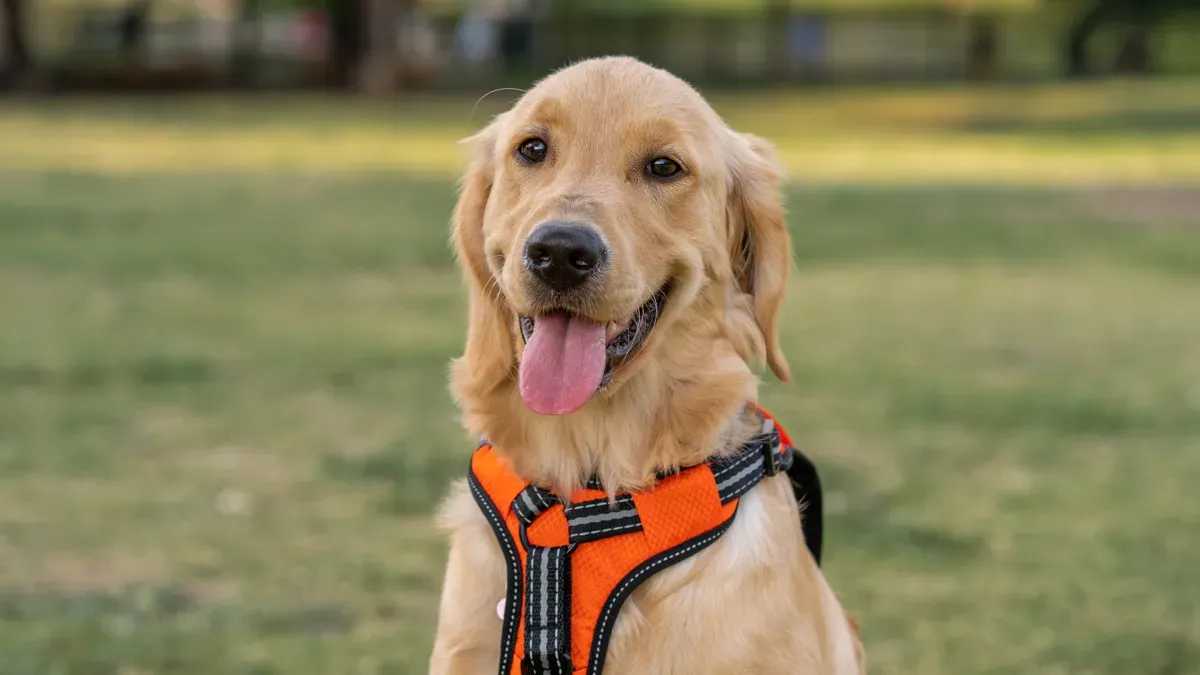
Reflective trim has a hard limit: it needs an external light source. No light, no reflection.
Bright, high-contrast body panels fill a different role. They create a silhouette difference against dark water even in ambient twilight, before a flashlight or dock lamp enters the scene. Orange against black water. Yellow against gray chop. The eye detects contrast before it detects detail, and a high-contrast panel gives you that first visual lock.
The two features are not redundant. They are sequential. Contrast panels give you acquisition — the moment you spot something in the water. Reflective trim gives you confirmation and tracking — the moment you identify it as your dog and follow its position. In conditions where both glare and darkness alternate, a life jacket built for easy lift and visibility during boating uses both layers. One without the other leaves a gap.
A grab handle and stable buoyancy structure serve the same sequential logic. Spotting the dog is step one. Retrieving the dog is step two. If the handle is flimsy or positioned where the vest rotates under load, the retrieval phase introduces new risk. A heavy-duty handle anchored to the vest’s structural webbing — not just stitched to the outer shell — transfers lifting force across the dog’s chest rather than concentrating it at a single seam. How a life jacket is built determines swimming confidence during kayaking and other activities where retrieval distance is measured in yards, not feet.
In practice: The most common failure pattern on the water is not a missing feature. It is a feature that exists but has rotated out of position. Check trim orientation, not just trim presence.
When a Reflective Life Jacket Is Not the Right Tool
Reflective trim solves one specific problem: making a dog visible when artificial light is available and the dog is on or near the surface. It does not solve other water safety problems, and in some conditions its value drops to near zero.
Fog defeats reflective trim. Water droplets scatter light before it reaches the vest and scatter the reflection before it returns. No trim placement fixes this. In fog, proximity and audible cues — a bell on the collar, a whistle — matter more than any visual signal.
Heavy chop creates intermittent visibility even with perfect trim coverage. When the dog drops into a trough between waves, no surface on the vest faces the light source. The reflection window opens and closes with the wave cycle. A life jacket’s sizing and feature set affects how high the dog floats, which determines how long the reflection window stays open between waves.
Dogs with very deep chests or barrel-shaped ribcages present a fit challenge. The standard three-strap geometry may not lock onto the torso the same way it does on a rectangular-bodied breed. The vest can roll slightly even when properly tightened, shifting reflective surfaces toward the waterline.
Disclaimer: If the dog’s chest shape falls well outside the breed norms this vest pattern was designed for — particularly dogs with a barrel chest or very deep keel — the fit stability checks described above may not catch every pressure point. Hand-check trim position every 10 to 15 minutes of active swimming rather than relying on the initial fit alone.
A reflective life jacket also cannot help a dog that panics. Panicked dogs thrash, submerge, and rotate unpredictably. Reflective trim becomes intermittently visible at best. The structural design of the vest — buoyancy distribution, handle placement, strap security — does more for a panicked dog than any amount of reflective material.
FAQ
Does reflective trim work without a direct light source?
No. Reflective trim is passive — it returns light from an external source such as a flashlight, dock lamp, boat light, or headlights. In complete darkness with no artificial light, reflective trim provides zero visibility benefit. Bright contrast panels help in ambient twilight, but neither feature works in total darkness.
How wide should reflective trim be on a dog life jacket?
Wider reflective panels — roughly an inch or more — increase the surface area that can catch and return light. This matters most at shallow angles, such as when a flashlight sweeps from shore level toward a dog swimming low in the water. Narrow piping may look reflective up close but returns far less light at distance.
Can a loose-fitting life jacket still keep a dog safe if it has reflective trim?
A loose vest creates two problems at once. First, buoyancy shifts unpredictably, which can tilt the dog’s head position. Second, the reflective trim rotates with the vest rather than staying oriented outward. A vest that has drifted sideways during swimming may show no reflection at all, even under direct light. Fit stability is a prerequisite, not a nice-to-have.






