
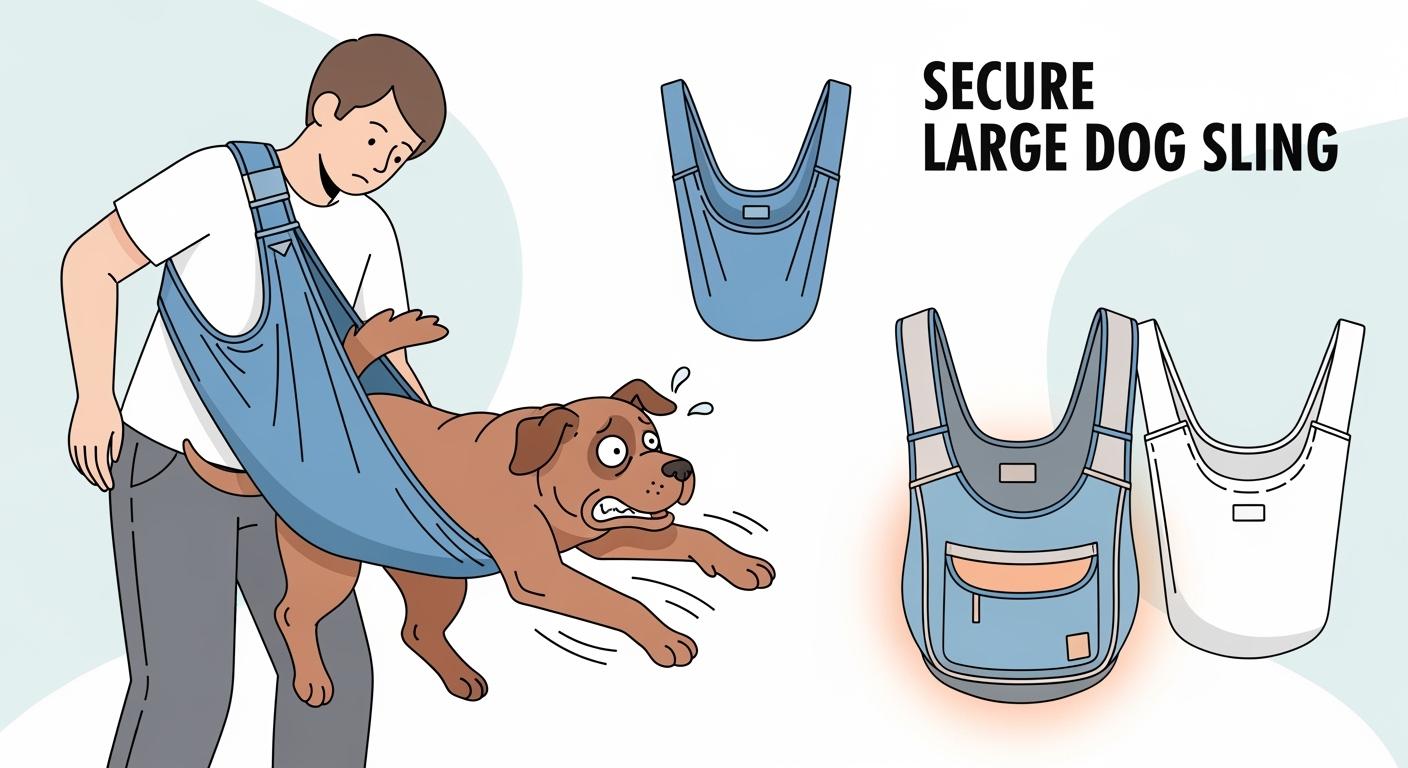
A pet sling fails a large dog for one structural reason: the pouch is not deep enough to contain the dog’s center of mass when it shifts. The side panel sits too low. The bottom fabric folds under weight. The dog slides toward the opening, and the handler spends the carry adjusting instead of walking. That is not a weight-limit problem. It is a containment-geometry problem.
Weight ratings on a tag tell you what the fabric and stitching can hold in a static test. They do not tell you whether the pouch shape keeps a dog inside when the dog leans, shifts, or braces against the edge during movement. A 16-pound dog with a long body can defeat a sling rated for 25 pounds if the side panel only reaches halfway up the dog’s torso. The dimension that matters most is vertical — how much of the dog’s body sits below the top edge of the pouch.
Why Most Pet Slings Fail With Larger Dogs
Shallow Pouches Cannot Contain a Shifting Center of Mass
When a dog sits or lies in a sling, its weight presses downward into the bottom panel. That static load is what weight ratings measure. The problem starts when you walk. Each step tilts the carrier a few degrees. The dog’s center of mass shifts laterally. If the side panel is low, there is no vertical surface to catch that shift.
Here is the causal chain: lateral tilt → weight vector angles toward the opening → the dog’s shoulder contacts the side panel. If that panel rises only to the dog’s elbow, the shoulder rides over it. The dog’s upper body is now unsupported. Gravity and momentum do the rest. A deeper pouch interrupts this chain at the contact point — the side panel meets the dog higher on the torso, so the leaning force meets fabric instead of empty space. That is the difference between containment and a slide-out.
Most slings designed for small dogs use the same pattern scaled up for larger weight ratings. The pouch depth does not scale proportionally with the dog’s torso height. A dog whose shoulder sits 8 inches above the bottom panel needs at least that much side coverage to stay contained during movement. Many slings marketed for medium-to-large dogs provide only 5 to 6 inches.
| Design Difference | Why It Matters | Where It Falls Short |
|---|---|---|
| Low side panel (elbow height or lower) | Lighter materials, easier to slide dog in | Shoulder clears the edge on any lateral shift; zero containment above the dog’s mid-torso |
| High side panel (reaches mid-torso or higher) | Catches the dog’s shoulder and upper body during shifts; keeps center of mass inside the pouch | Adds fabric weight; can feel restrictive if the panel is too stiff rather than padded |
The Bottom Panel Folds Before the Seams Fail
A soft, unstructured bottom is the second failure point. Under a static load, the fabric holds. Under a dynamic load — the dog adjusting position, bracing a paw against the edge — the bottom panel folds along a crease line. Once folded, the effective support area shrinks. The dog sinks into the fold. Legs slip toward the low point.
This is not a seam-strength problem. The seams can hold while the panel geometry collapses. A rigid or semi-rigid base insert prevents folding by distributing the dog’s weight across a flat plane. The wider that plane, the less pressure per square inch on any single point of the bottom fabric.
You can verify this yourself. After a 10-minute carry, lift the dog out and check the bottom panel. A crease line or a U-shaped sag means the base folded during use. A flat, unchanged surface means the panel stayed rigid under load. This check works regardless of what the weight tag says.
Note: If the bottom panel shows a fold line after one short carry, it will fold faster on the next use — fabric memory works against you here. The crease becomes a hinge.
Straps That Let the Bag Tilt Away Multiply the Problem
Even a deep pouch and a rigid bottom lose effectiveness if the strap system lets the bag tilt away from your body. When the carrier tilts outward, the dog’s weight shifts toward the outer edge — exactly where containment is weakest. A single shoulder strap with no cross-body stabilization allows this tilt with every step.
The strapping on a sling matters for the same reason the side panel height matters: both determine where the dog’s weight vector points relative to the opening. A strap that holds the carrier snug against your hip keeps the weight vector pointing down into the bottom panel. A strap that allows outward tilt redirects that vector toward the side opening. The sizing and material choices in sling carriers determine whether the bag stays flush against your body or drifts away with movement. Wide, padded cross-body straps with adjustable length reduce tilt more effectively than narrow single-shoulder designs. The adjustment point matters too — straps that tighten from the bag side rather than the shoulder side stay set longer during movement.
Structural Features That Change How Weight Is Held
The side panel height is the primary containment variable. A panel that reaches the dog’s mid-torso creates a barrier the dog cannot clear with a casual lean or stretch. The fabric does not need to be rigid — it needs to be tall enough that the dog’s shoulder contacts it before the dog’s weight passes the edge.
Fabrics play a supporting role here. Breathable mesh panels prevent heat buildup during longer carries, which matters because an overheating dog fidgets more. But breathability does not replace depth. A shallow mesh pouch ventilates well and contains poorly. The priority order is depth first, then material. Selecting a sling by material alone skips the dimension that actually prevents slide-outs.
Rigid Bottom Panel and Full-Body Support Length
A bottom panel that extends from the dog’s chest to its hindquarters keeps the spine level. When the panel is shorter than the dog’s body, the unsupported portion hangs over the edge. That overhang creates a lever — the dog’s own weight pulls it toward the overhanging side.
A rigid or semi-rigid insert inside the bottom panel changes the load path. Instead of the dog’s weight concentrating at the lowest point of a sagging fabric hammock, it spreads across a flat surface. The dog’s spine stays aligned. Pressure stays distributed. You can check this after a carry: run your hand along the bottom panel from the outside. If you feel a heat concentration in one spot, the panel flexed and weight pooled there. A cool, uniform surface means the insert held its shape.
| Design Difference | Why It Matters | Main Limitation |
|---|---|---|
| Soft fabric-only bottom | Lighter, packs flat, cheaper to produce | Folds under dynamic load; creates a hinge point that funnels the dog toward the opening |
| Semi-rigid insert bottom | Distributes weight across a flat plane; resists folding during movement | Adds weight; insert must be removable for washing or it traps moisture |
| Full-length bottom panel | Supports the entire torso; no overhang leverage pulling the dog outward | Limits the sling to dogs within a specific body-length range |
| Reinforced edge binding | Prevents the edge from rolling under lateral pressure; keeps the opening shape stable | Adds manufacturing complexity; stiff binding can chafe if not padded |
Adjustable Closures and Non-Slip Interior Surface
The opening of the sling is the last line of containment. An adjustable closure — whether buckle, drawstring, or hook-and-loop — lets you reduce the opening to match the dog’s girth. A fixed opening leaves a gap. That gap is where the dog’s shoulder finds escape during a shift.
Inside the pouch, a non-slip lining does something the side panel cannot: it prevents micro-sliding. Each time the dog adjusts, a slick interior surface lets the dog’s weight drift a fraction of an inch. Over minutes of walking, those fractions add up to a dog whose position has migrated toward the opening. A textured or mesh lining creates friction that resists each small shift. Using a sling correctly starts with positioning, but the lining determines whether that position holds.
Tip: After securing the closure, slide two fingers between the fabric and the dog’s chest. If the gap is wider than that, the opening is too loose to contain a hard lean.
The combination of a deep pouch, a rigid bottom, and adjustable closures works together as a system. Each feature covers a gap the others leave. Deep panels handle lateral shifts. The rigid bottom handles vertical compression. The closure handles the opening. Urban carrying scenarios — sidewalks, public transit, crowded spaces — amplify every one of these demands because sudden stops and direction changes test containment repeatedly. A well-constructed sling carrier integrates all three rather than treating them as independent features.
When a Sling Is Not the Right Tool
A sling is a short-carry tool. It works for errands, vet visits, navigating a crowd, or giving an older dog a break on a walk. It is not a replacement for a structured carrier on longer trips, and it is not the right choice for every dog.
Dogs with barrel chests or very deep keels often do not fit the sling geometry well. The pouch is built around an assumed torso shape — typically a moderately deep but not dramatically keeled chest. If the dog’s ribcage shape falls outside that pattern, the side panel may sit too low even on a well-designed sling because the dog’s torso height exceeds what the panel was patterned for. Heavier dogs near a sling’s practical limit also run into a comfort ceiling: the handler’s shoulder and back fatigue becomes the real constraint before the fabric fails. For distances beyond a few blocks or dogs whose body shape does not match the sling’s patterning, a two-hand structured carrier or a lift harness distributes the load across both of the handler’s shoulders and keeps the dog in a more natural position.
Disclaimer: These containment checks assume a dog that tolerates being carried without thrashing. A dog that panic-struggles or twists hard can defeat even a deep, rigid-bottom sling — the carrier design matters less than the dog’s temperament in that scenario. If the dog fights the carrier, a structured two-hand carrier or lift harness is the safer path regardless of sling construction quality.
FAQ
Why does the advertised weight limit not guarantee my dog will stay inside?
Weight ratings measure static load capacity — what the fabric and stitching hold when the dog is still. Containment depends on pouch depth, side panel height, and bottom rigidity. A sling rated for 25 pounds can still let a 14-pound dog slide out if the side panel reaches only to the dog’s elbow.
What is the single most important design feature for keeping a large dog contained?
Side panel height relative to the dog’s torso. If the panel does not reach at least to the dog’s mid-torso, no amount of strap adjustment or closure tightening will prevent a slide-out during movement. Depth beats all other variables.
How can I test whether my current sling’s bottom panel is rigid enough?
Carry your dog for 10 minutes, then remove the dog and check the bottom panel from the outside. A crease line or U-shaped sag means the panel folded under load. A flat, uniform surface means it held. Check again after a longer carry — panel fatigue can appear gradually.
Can I use a sling for a dog that weighs more than the stated limit if the pouch is deep enough?
Weight limits exist for the handler as much as the carrier. A sling concentrates the dog’s full weight on one shoulder. Even if the fabric holds, carrying a dog above the practical comfort threshold for more than a few minutes strains the handler’s shoulder and back. For distances longer than a short errand, a structured carrier distributes the load better.






