
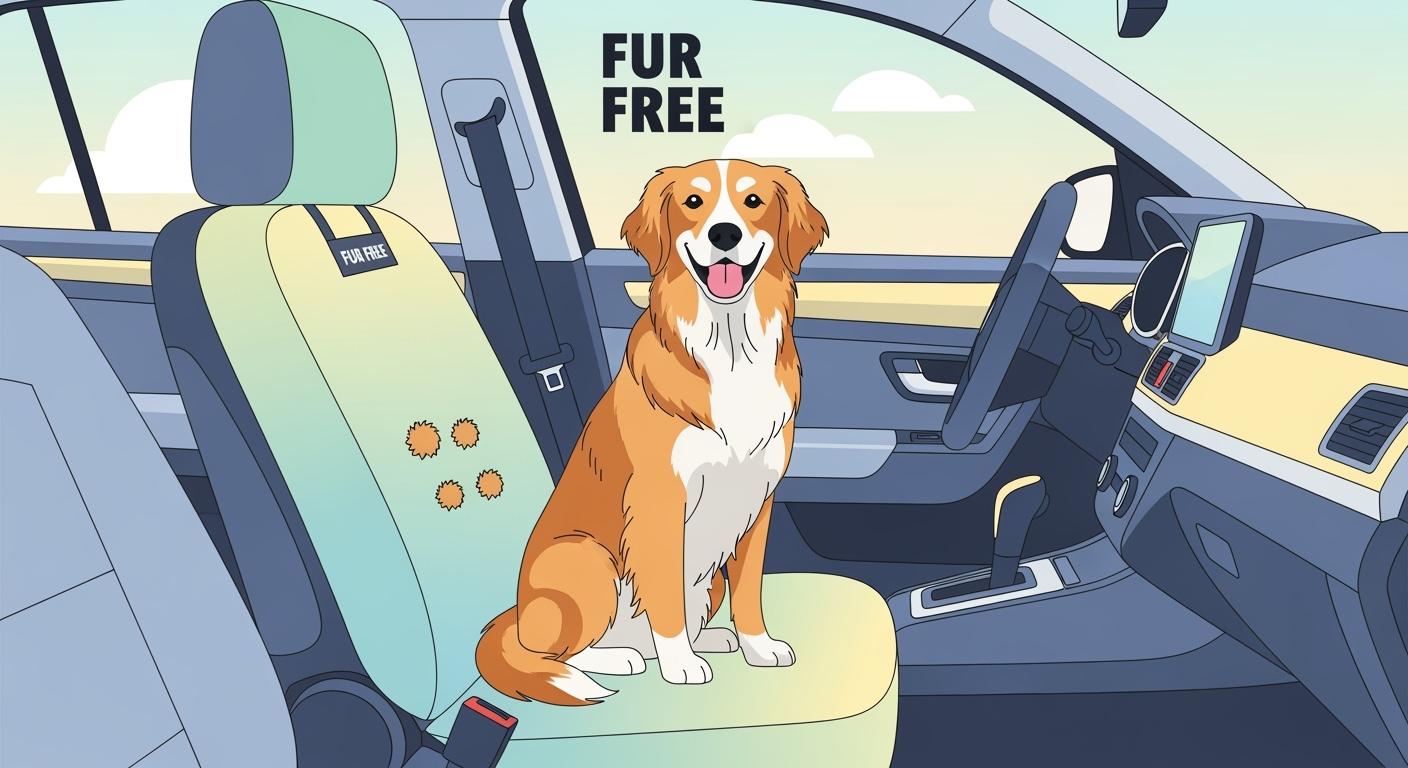
A car seat protector keeps dog hair off the upholstery, but only if the design accounts for how hair moves inside a vehicle. Hair does not fall straight down. Lateral force from a dog shifting weight during a turn pushes individual strands sideways across the cover surface. When those strands reach an edge gap, a loose buckle opening, or a lifted seam, they slip through. The protector’s job is not to catch hair. It is to give hair nowhere to go but the top surface.
In practice: Hair infiltration follows a predictable pattern. If the cover shifts even a quarter-inch at the anchor point, hair accumulates in that gap within a single drive. The failure is not random — it is a direct result of how the cover’s attachment geometry interacts with the dog’s movement during braking and cornering.
A car seat protector that only shields the center cushion leaves the perimeter exposed. Edge gaps, buckle slots, and the seam where the backrest meets the seat base become entry points. The question is not whether a cover blocks hair in a static photo. It is whether the design holds position under dynamic load — a dog’s body weight shifting through turns, stops, and starts.
Why Dog Hair Still Gets Past a Seat Protector
The Lever Effect of Mid-Span Anchoring
When a dog shifts weight during a turn or brake, lateral force travels through the cover fabric to the anchor points. A cover that anchors only at the headrest and seat-base channels creates two fixed pivot points with unsupported fabric between them. The dog’s weight applies force perpendicular to the anchor line, and the fabric lifts at the midpoint — exactly where the seat backrest meets the seat base. That gap opens just enough for loose hair to slip under. When the dog settles, the cover drops back down, compressing the hair into the seat crease. Over repeated drives, this cycle packs hair deeper into the seam, past the reach of vacuum attachments.
The fix is not necessarily more anchors. It is anchor placement that eliminates the mid-span lever arm. A cover with a full-length non-slip backing distributes force across the entire contact patch instead of concentrating it at two endpoints. Hair stays on top because the fabric never lifts far enough to create an entry gap.
Buckle Slots That Do Not Match the Vehicle
Seatbelt buckle openings cut larger than the anchor base create a ring of exposed seat fabric around each buckle. Hair slides across the cover, hits that exposed ring, and drops through. The problem compounds when slot placement does not match the vehicle’s actual buckle spacing. A cover cut for a generic bench seat may position the openings two inches forward or aft of where the buckles sit in a specific car model. That mismatch leaves a runway of exposed fabric for hair to reach.
Better designs size the openings to the anchor footprint and edge them with elastic or a raised lip. The opening becomes a gasket around the buckle base rather than a hole next to it. It is a small difference that determines whether the three square inches around each buckle become the hair-collection zone.
| Failure point | Design cause | What a better design does differently |
|---|---|---|
| Hair packed into seat-backrest crease | Cover anchored only at ends, fabric lifts mid-span | Full-length grip backing or a mid-span anchor channel holds the center flat under load |
| Hair collecting around buckle bases | Buckle slots cut larger than the seatbelt anchor footprint | Contoured openings sized to anchor dimensions, edged to seal the perimeter |
| Hair accumulated under the cover surface | Non-slip backing absent or only partial-coverage | Full-coverage rubberized backing resists lateral fabric creep across the entire contact area |
Seams That Grip Instead of Release
Deep stitching lines and raised seams on the cover surface act like microscopic combs. Hair strands catch on the thread texture, especially in dry conditions where static charge builds between the dog’s coat and the cover fabric. Smooth, flat-seam construction eliminates those catch points. The production tradeoff is real: flat seams require single-needle post-bed stitching, which is slower per unit than standard double-needle lockstitch. But the result is a surface where hair slides across the seam line instead of lodging in it.
What Protector Design Keeps Hair on the Surface
Full-Coverage Fit Determines Where Hair Can Go
Edge-to-edge fit is not about looking tidy. It is a geometric constraint on hair movement. When the cover spans the full seat width and extends down the front edge and side bolsters, a hair strand moving laterally under the dog’s weight hits a vertical barrier — the side flap — before reaching an exposed seam. The hair stops on the cover surface. A narrow cover that leaves two inches of upholstery exposed on each side gives hair a landing zone. The difference is binary: either the cover wraps past every fabric edge, or it does not.
Here is a test that takes ten seconds after a drive. Pull the cover back along the seat crease. Run your palm flat along that seam. If your hand picks up hair that was trapped between the cover and the seat, the fit does not extend far enough into that junction. Hair found the edge.
Surface Material — Why Some Fabrics Trap Hair and Others Release It
A woven cotton-blend cover grips hair. The fiber structure creates microscopic texture that individual hair strands wrap around, especially when static builds during a drive. A smooth polyester or coated surface gives hair nothing to hold onto. The strand sits on top. A damp cloth lifts it off in a single pass.
This is not about waterproofing. It is about surface friction at the fiber level. Materials with a tighter weave and a smoother finish reduce the contact area between each hair strand and the cover surface. Less contact area means less adhesion. Hair lifts off with minimal force — which is why a quick wipe clears fur from a smooth cover while a textured fabric needs a lint roller.
Test this before buying. Rub a dryer sheet across the cover to simulate light static, then drag a handful of loose dog hair across the surface. If the hair slides and stays loosely on top, the surface releases fur. If individual strands catch and embed in the weave, the material will trap hair the same way during actual drives.
Stable Anchoring and Non-Slip Backing
An anchoring system that holds position during cornering matters more for hair control than most material choices. A cover that shifts two inches left during a right turn opens a two-inch gap on the right side. Hair sitting safely on the cover now has a direct path onto exposed seat fabric. When the car straightens out and the cover shifts back, the hair is already underneath.
Non-slip backing is the first line of defense. A rubberized or silicone-dotted underside increases static friction between the cover and the seat upholstery. Seat anchors — the straps that secure the cover to the headrest and seat-base channels — provide the second layer. Together, keeping the car interior clean during drives depends on whether the cover moves less than the dog does. If the cover stays put while the dog shifts, no entry gap forms.
Side Flaps and Buckle Openings That Seal the Perimeter
Tight side flaps do more than protect against scratches during entry. Side flaps that seal against the door-side edge close the last major hair escape route. When a dog jumps out, fur that drifted toward the seat edge during the ride stays on the flap surface. A flimsy or short flap lets that fur fall between the seat and the door sill.
Controlled buckle openings work the same way. Elastic-edged slots that grip the buckle base leave no exposed ring of seat fabric around the anchor. The cover surface runs right up to the plastic buckle housing, eliminating the gap that catches drifting hair. These are small design decisions — an extra inch of flap length, a strip of elastic edging — but they decide whether the driver spends thirty seconds or ten minutes cleaning hair after each trip.
| Design detail | What it changes | Main limitation |
|---|---|---|
| Edge-to-edge width | Eliminates exposed seat fabric on the sides | Requires correct sizing for the specific vehicle’s bench width |
| Smooth, tight-weave surface | Reduces fiber-level grip so hair lifts off with a wipe | Smooth surfaces can feel slick; dogs with mobility issues may need more traction |
| Full-coverage non-slip backing | Resists the initial shift that opens hair-entry gaps | Backing effectiveness drops on heavily contoured or deeply bolstered seats |
| Elastic-edged buckle openings | Seals the ring around each buckle anchor | Opening size is fixed; may not fit oversized aftermarket buckle receivers |
When a Good Design Is Not Enough
A cover with full edge-to-edge fit, a fur-releasing surface, and stable anchors will stop most hair from reaching the seat. But three conditions push any protector past its limits.
First, heavy double-coated shedders produce an undercoat layer of ultra-fine fibers that behave differently than guard hairs. These fibers are light enough to become airborne during a drive. They settle on surfaces the cover cannot reach: the dashboard, the front footwells. The protector does its job on the seat surface. The airborne fraction is a separate problem.
Second, how a cover interfaces with the seat geometry matters most on bench seats with deep contouring. Sculpted seats create uneven contact between the non-slip backing and the upholstery. Bolster ridges leave air gaps where the backing does not make full contact, reducing friction at those points. Hair works through those low-contact zones.
Third, a dog that paces or circles continuously during drives generates more lateral force cycles than the cover can absorb. Each cycle is a new opportunity for a small shift. A restless dog on a two-hour drive may trigger dozens of micro-shifts. Most covers are designed for intermittent movement — a repositioning every few minutes — not constant motion.
Disclaimer: The fit and surface checks described here assume a smooth-coated or single-coated dog whose shed hair contacts the cover surface directly. Double-coated breeds shed undercoat fibers that can aerosolize during a drive and settle beyond the cover’s protected zone. If most of the hair you find after a trip is on the dashboard or front seats rather than on the cover itself, the problem is airborne undercoat — not a protector design failure. A grooming routine before the drive addresses airborne shedding more effectively than any seat cover can.
FAQ
Why does hair still get under the cover even though it fits tightly at installation?
A cover that looks tight when parked may lift under dynamic load. The dog’s weight shifting during turns and braking creates lateral force that a static check cannot simulate. After the first drive with the dog, pull the cover back at the seat crease. Hair underneath confirms the cover lifted during motion even though it appeared secure at rest.
Does a waterproof cover help with hair control?
Indirectly. The waterproof layer itself does not affect hair adhesion. But waterproof covers typically use a coated fabric with a smoother surface finish than uncoated textiles. That smoother finish is what reduces the fiber-level grip that traps hair. The waterproofing is a side benefit for spills; the surface smoothness is what matters for fur removal.
Are bench-style covers better than hammock-style for blocking hair?
Bench covers leave the front edge of the seat exposed unless they include a front flap that drapes over the seat base. Hammock designs connect front and rear headrests, enclosing the footwell. For hair control, the hammock style eliminates the gap between the front edge of the rear seat and the front seatback — a common hair collection zone. The tradeoff: the hammock blocks passenger use of the rear footwell.
How often should a car seat protector be cleaned to prevent hair buildup?
Frequency depends on the surface material more than the dog’s shedding rate. A smooth, fur-releasing surface can go several drives between cleanings because hair sits loosely on top. A textured fabric traps hair on contact and benefits from cleaning after every drive. The design of the surface — not the cleaning schedule — determines how much effort each session takes.
| Surface type | Hair adhesion behavior | Typical cleaning method |
|---|---|---|
| Smooth polyester / coated fabric | Hair sits on top, does not embed in weave | Wipe with damp cloth; vacuum optional |
| Textured woven fabric | Hair strands catch in fiber texture; static increases grip | Lint roller or vacuum with brush attachment |
| Quilted multi-layer with flat top stitch | Moderate release; hair may catch in stitch lines if deep | Wipe surface + periodic vacuum along seam lines |






