
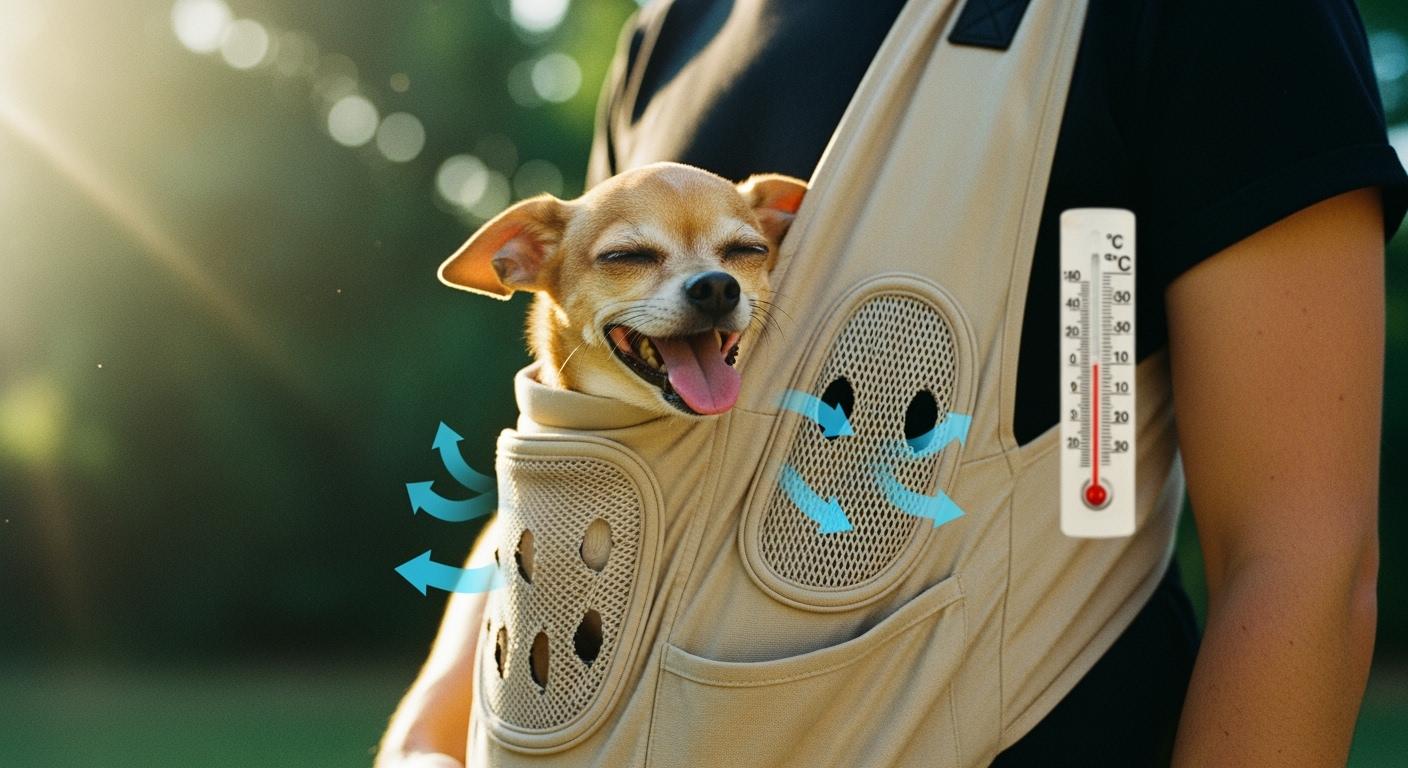
A sling carrier wraps a pet against your ribcage or hip. That contact is the design’s core convenience — and its core thermal problem. Your body runs at roughly 98.6°F. On a warm sidewalk, surface heat adds another layer. When the fabric between you and the pet is thick, closed, or unstructured, that heat has nowhere to go. The carrier becomes a pouch with a built-in heater.
But the difference between a sling that cooks and one that stays tolerable is not a marketing label. It is mesh placement, fabric weight, and whether the carrier holds its shape under load. This article walks through those three design dimensions — and when a sling is simply the wrong tool for the heat.
How a Sling Carrier Becomes a Heat Trap
Body Heat Transfer Is the Design Constant You Cannot Remove
A sling carrier presses the pet directly against the wearer. Unlike a backpack carrier with a rigid back panel or a tote held at arm’s length, the sling eliminates any air gap between human and animal. Heat moves by conduction through the contact fabric, then by radiation from the wearer’s body into the enclosed space. Even standing still in shade, your torso emits roughly 80–100 watts of thermal energy. The carrier interior absorbs a share of that.
This is not a defect. It is a physical consequence of the sling form factor — and it means the carrier’s materials and venting carry the entire cooling burden. There is no passive air gap to rely on. If the fabric resists convective heat transfer, the interior temperature climbs with every minute the carrier is worn.
A quick observable check: after a 10-minute walk, slide your hand between the carrier’s back panel and your body. If that panel feels warmer than your own skin, the carrier is storing, not releasing, the heat you are producing.
| Summer Use Problem | Likely Carrier Design Cause | Better Design Direction |
|---|---|---|
| Heat buildup on short trips | Thick, closed fabric without venting | Mesh panels spanning multiple sides |
| Pet shifts or presses against fabric | Sagging, unstructured material collapsing inward | Semi-rigid edge support that holds shape under load |
| Stuffy interior after minutes of wear | Single vent or no opposing airflow path | Dual-side ventilation creating a through-channel |
The table above distills what fails and what fixes it. But the why behind each row is where the design story actually lives.
Mesh Placement Decides Whether Air Actually Moves
High Mesh, Not Just Any Mesh
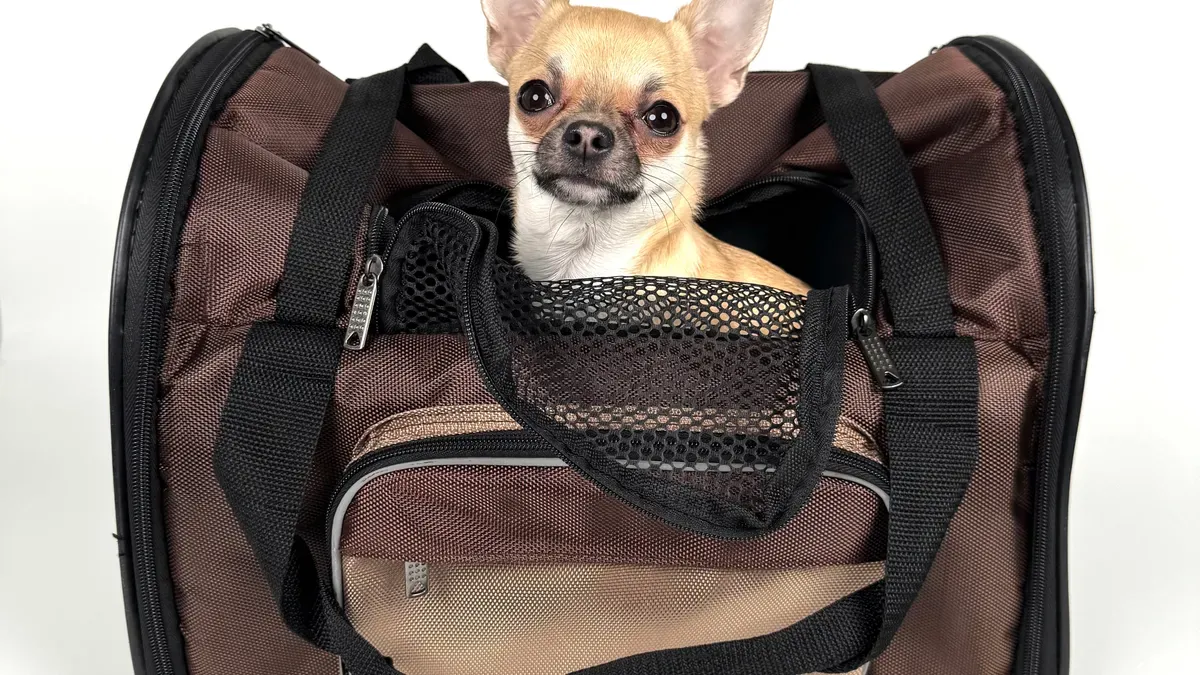
A mesh panel positioned low on the carrier body looks ventilated on a product page. In use, it fails. The pet’s weight presses the mesh against the wearer’s hip or torso, closing the very pores meant to vent heat. Air, blocked at the entry side, cannot form a pressure differential across the carrier. Without that differential, there is no driving force for flow. The carrier becomes a sealed pouch — body heat on one side, ambient air that never reaches the interior.
Mesh that sits above the pet’s shoulder line stays clear. The pet’s body cannot block it, and the wearer’s arm movement creates small pressure pulses that push stale air out and pull fresh air in. This is not about “more mesh.” It is about mesh the pet cannot collapse.
Opposing panels complete the circuit. When mesh openings face each other across the carrier — one near the chest, one near the back — moving air has both an entry and an exit. A single mesh panel vents to nowhere. Two panels on adjacent sides create a weak cross-draft. Two panels on opposite sides create a through-channel. The difference is the difference between a window and a hallway.
| Poor Airflow Signal | Likely Carrier Design Cause | Better Design Direction |
|---|---|---|
| Dog pants or shifts position repeatedly | Low mesh placement blocked by the pet’s body | High mesh above the shoulder line, unblocked by seated posture |
| Carrier exterior feels warm against wearer | No back panel air gap; direct body heat conduction | Structured back panel with built-in standoff spacing |
| Mesh panels fold or collapse inward under load | Soft unstructured walls that deform when the pet settles in | Semi-rigid edge construction that holds the airway open |
Structured Support Is What Keeps the Vents Open
A carrier that holds its shape when empty but collapses when a pet sits inside has a structural problem, not a material problem. The difference shows up in the edge construction. Semi-rigid piping, reinforced seams along the opening rim, and back panels with enough stiffness to resist bowing — these details determine whether the mesh stays an airway or becomes a decoration.
After a walk, flip the carrier open and check the bottom corners. Warm, still air that pools in the lower corners means dead zones — the mesh placement or the structure failed to create through-flow. A well-ventilated carrier should feel neutral to the touch throughout, with no localized warm pockets. If the fabric in the bottom third feels noticeably warmer than the fabric near the shoulder opening, the carrier’s ventilation design is not reaching the full interior volume. That gap is what makes a pet restless after 10 minutes even when the label promised breathability.
Material choice for sling carriers intersects with structure in ways that are not obvious from a product photo. A carrier built with semi-rigid edge reinforcement resists the inward collapse that blocks mesh panels. When the structure holds, the ventilation design actually gets a chance to work. When it sags, even well-placed mesh becomes irrelevant.
| Design Detail | How It Affects Internal Temperature |
|---|---|
| Mesh coverage across opposing sides | Creates a pressure-driven airflow channel — hot air exits one side as cooler air enters the other |
| Perforated panels paired with open mesh | Increases total venting surface area; reduces humidity buildup inside the carrier |
| Internal standoff channels or spacers | Prevents fabric from lying flat against the wearer, maintaining an air gap even under body contact |
| Removable or roll-up privacy flaps | Lets the user increase venting on hot days and reduce it when the pet needs a darker, quieter space |
Fabric Weight and the Sagging Problem
Dense Fabric Versus Open Weave
Fabric weight matters for a sling carrier in summer for two reasons that compound each other. First, denser materials — neoprene-like padding, thick polyester canvas, quilted linings — resist convective heat transfer at the fiber level. Air cannot pass through the weave fast enough to carry heat away. Second, heavier fabric sags more under the pet’s weight because the material itself has more mass to pull downward. The sag presses the fabric against the pet, eliminating the small air pockets that would otherwise provide some buffering.
Cotton and cotton-blend fabrics breathe better at the fiber level than tightly woven polyester. The looser fiber structure allows more air permeability per square inch. This does not make cotton “better” in every dimension — polyester holds its shape more reliably when wet and dries faster — but for thermal management on a hot day, the air-permeability advantage is real.
Some designs use a hybrid approach: dense structural panels along the bottom and back for load-bearing, combined with large mesh or cotton-blend panels on the sides and top for ventilation. This balances the competing demands of support and airflow without overbuilding either one.
When the Carrier Collapses, the Cooling Design Disappears
A sling that sags inward does two things at once: it reduces the interior volume the pet can occupy, and it closes the ventilation paths that the design intended to use. The pet ends up wrapped in collapsed fabric — more contact surface, less air circulation. A carrier that uses structured seams and a non-sag back panel maintains the internal shape the pet needs to shift position and find a cooler spot. Without that structure, the pet has no way to self-regulate — every position is pressed against warm fabric.
Lightweight construction does not have to mean flimsy. The difference between a sling that collapses and one that stays open is rarely the weight of the fabric alone. It is whether the design includes edge reinforcement, a structured rim around the opening, or a back panel stiff enough to resist bowing when the pet leans into it.
When a Sling Works for Summer — and When It Does Not
Short Trips, Smart Positioning
A sling carrier is mechanically suited to short-duration carries — quick errands, car-to-store transitions, brief waits outdoors. The form factor rewards fast on/off and keeps the pet accessible. Those same design traits — close body contact, soft enclosure — become liabilities as trip length extends. After roughly 15–20 minutes of continuous wear on a warm day, even a well-ventilated sling will accumulate heat faster than it can shed it. The thermal mass of the wearer simply dominates.
Positioning the pet with head and shoulders near the carrier opening helps. So does keeping the opening unclipped or rolled back so that the largest possible vent stays unobstructed. But these are mitigation tactics, not solutions. They extend the comfortable window; they do not eliminate the thermal ceiling.
For walks longer than a quick errand, or for any outing where the temperature exceeds 85°F on pavement, a structured tote or backpack carrier with a rigid frame and standoff back panel tends to perform better. Those designs create an air gap between the wearer and the pet by default — something a sling cannot do without sacrificing the close-carry form that defines it.
Disclaimer: The airflow and temperature checks described here assume a short-coated, small-to-medium dog carried in typical urban summer conditions — pavement walking, short errands, partial shade. Brachycephalic breeds, dogs with dense double coats, or any pet with a known respiratory condition overheat more rapidly regardless of carrier design. If the dog’s panting escalates from mouth-open breathing to deep, rapid flank movement within five minutes of being carried, end the outing immediately — the carrier is not the limiting factor, the dog’s thermoregulation is.
Quick Design Checklist
When evaluating whether a sling carrier can handle summer use, three factors matter more than any others:
- Mesh that sits above the pet’s shoulder line — unblockable by body position
- Venting on opposing sides — a through-channel, not a single vented panel
- Edge structure that resists collapse — semi-rigid rim or reinforced seams at the opening
Secondary factors — fabric type, privacy flap design, strap padding — influence comfort. But without the three core factors above, they are rearranging deck chairs. The carrier’s thermal ceiling is set by its ventilation architecture, not by a breathable-fabric claim on the tag.
FAQ
How quickly can a sling carrier overheat a pet on a warm day?
In direct sunlight on an 80°F day, the interior of a poorly vented sling can become uncomfortable within 5–10 minutes. The wearer’s body heat is the primary driver, not ambient temperature alone. A carrier with opposing mesh panels and structured standoff spacing roughly doubles the tolerable window — but it is still a short-trip tool, not an all-afternoon solution.
Does mesh coverage percentage actually predict cooling performance?
Only partly. Mesh coverage matters, but placement matters more. A carrier with 40% mesh concentrated high and on opposing sides will typically outperform one with 60% mesh placed low where the pet’s body blocks it. The metric to care about is unblocked open vent area when the pet is seated inside — a number no product page reports and you can only assess by loading the carrier and checking.
What is the single fastest way to tell if a carrier vents well enough for summer?
Load the carrier with a comparable weight (a bag of rice or flour works), wear it for 10 minutes, then check the interior back panel and bottom corners with your hand. Warm spots — especially localized ones — mean poor airflow. A carrier that vents properly should feel close to ambient temperature throughout, with no hot zones.
Can you add ventilation to a sling carrier that was not designed for it?
Not reliably. Cutting or sewing additional mesh panels into a carrier changes its structural integrity and load path — seams that were not designed to terminate at the new opening may tear under the pet’s weight. A carrier’s ventilation is a design-phase decision, not a retrofit. If the existing carrier traps heat, the safest path is to use it only for air-conditioned indoor transitions and switch to a properly vented design for outdoor summer use.






